
Bro diabetes type 2 k treatment protocol patient age 50 year
I'll check the medical library skill first, then pull up the treatment protocol.
Reading File
Now let me search the medical library and PubMed in parallel for a 50-year-old T2DM treatment protocol.
Finding Sources
Searching PubMed
"type 2 diabetes"[MeSH Terms] AND "management"[MeSH Terms]
Finding Sources
Searching PubMed
"type 2 diabetes" AND "treatment guidelines"
Good - found the Family Medicine textbook section on Diabetes. Let me read it in parallel with a targeted search.
Reading File
Finding Sources
Good finds. Let me now read the core treatment sections from Goodman & Gilman and Swanson's in parallel.
Reading File
Reading File
Excellent - great content. Let me also fetch the treatment algorithm image and read the Goodman & Gilman biguanides section for more detail.
Loading Image
Reading File
I now have everything needed for a comprehensive answer. Here is the full Type 2 Diabetes treatment protocol for a 50-year-old patient:
Type 2 Diabetes Mellitus - Treatment Protocol (Patient Age: 50 Years)
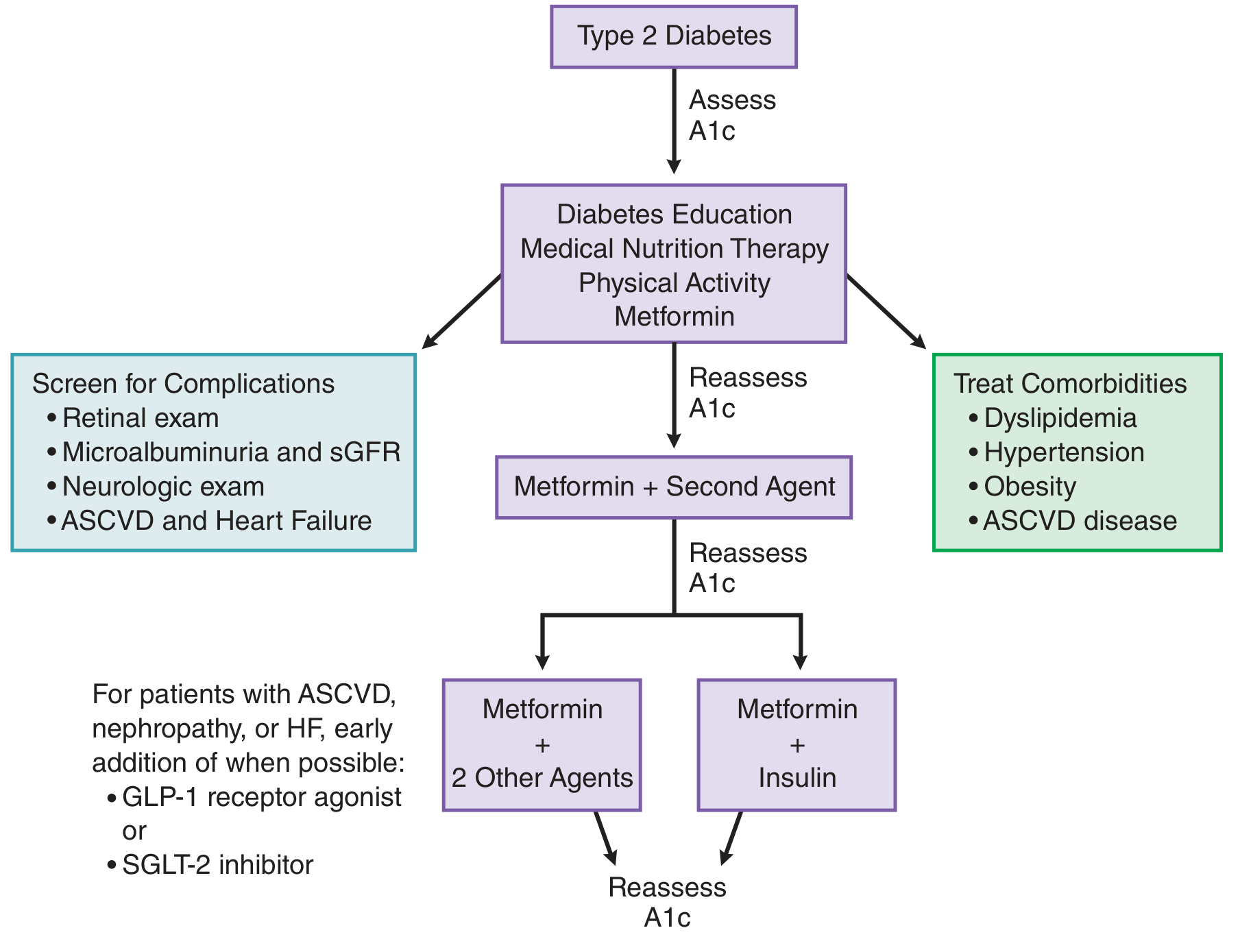
Step 0 - Initial Assessment
Before starting any medication, assess the following:
| Parameter | Target / Action |
|---|---|
| HbA1c | Measure baseline; target <7% for most patients |
| FPG / OGTT | Confirm diagnosis |
| eGFR / Creatinine | Required before Metformin (hold if eGFR <30) |
| Lipid profile | Screen for dyslipidemia |
| BP | Target <130/80 mmHg |
| BMI / Weight | Assess for obesity |
| Retinal exam | Baseline diabetic retinopathy screen |
| Microalbuminuria | Baseline nephropathy screen |
| CVD risk | ASCVD, heart failure, CKD present? |
Step 1 - Lifestyle + Metformin (Start at Diagnosis)
Lifestyle modifications (mandatory, reinforce at every visit):
- Prudent diet, caloric restriction, carbohydrate control
- Weight loss if BMI >25 (even 5-10% weight loss significantly improves glycemia)
- Aerobic exercise: 150 min/week minimum
- Diabetes education and self-monitoring of blood glucose
Pharmacotherapy - First Line:
Metformin (Drug of Choice)
| Detail | Information |
|---|---|
| Mechanism | Reduces hepatic gluconeogenesis, improves peripheral glucose uptake, decreases intestinal glucose absorption |
| Dose | Start 500 mg once or twice daily with meals; titrate slowly over 4-8 weeks |
| Max dose | 2000-2550 mg/day (benefit plateaus at 2000 mg) |
| XR formulation | 500-2000 mg once daily (fewer GI side effects) |
| Key advantages | No hypoglycemia, mild weight loss, low cost, reduces microvascular complications |
| Side effects | GI: nausea, diarrhea, bloating (minimize by slow titration + take with meals); Vitamin B12 deficiency - monitor periodically |
| Contraindications | eGFR <30 mL/min, active liver disease, alcohol excess, iodinated contrast (hold 48h) |
Reassess HbA1c at 3 months. If target not achieved, add a second agent.
Step 2 - Add Second Agent (if HbA1c still >7% after 2-3 months)
Drug choice depends on comorbidities:
A) Patient has ASCVD / High CV Risk
- Add GLP-1 Receptor Agonist (preferred): Liraglutide, Dulaglutide, Semaglutide
- Reduce CV events, promote weight loss, once weekly injection
- OR SGLT-2 Inhibitor: Empagliflozin, Canagliflozin, Dapagliflozin
- Reduce CV mortality, HF hospitalization
B) Patient has Heart Failure or Diabetic Nephropathy
- SGLT-2 Inhibitor preferred (Empagliflozin/Dapagliflozin)
- Reduces renal progression and HF hospitalization
- Caution: hold if eGFR <45 (canagliflozin) or <30 (empagliflozin)
C) Patient needs to avoid weight gain and hypoglycemia
- DPP-4 Inhibitor: Sitagliptin, Saxagliptin, Linagliptin
- Weight neutral, no hypoglycemia, safe in renal insufficiency
- Can be used with Metformin or TZD
D) Cost is a major concern
- Sulfonylurea (SU): Glipizide, Glimepiride
- Cheap and effective; risk of hypoglycemia + weight gain
- Avoid or use cautiously in elderly / those with erratic meals
Second Agent Quick Reference Table
| Drug Class | Example | HbA1c Reduction | Weight | Hypoglycemia | Special Use |
|---|---|---|---|---|---|
| GLP-1 agonist | Liraglutide, Semaglutide | 1-1.5% | Loss | No | CV protection |
| SGLT-2 inhibitor | Empagliflozin | 0.5-1% | Loss | No | HF/CKD protection |
| DPP-4 inhibitor | Sitagliptin | 0.5-0.8% | Neutral | No | Safe in CKD |
| Sulfonylurea | Glipizide | 1-1.5% | Gain | Yes | Low cost |
| TZD | Pioglitazone | 0.5-1.4% | Gain | No | NAFLD benefit |
| Meglitinide | Repaglinide | 0.5-1% | Neutral | Less | Postprandial spikes |
Reassess HbA1c at 3 months again. If still not at goal - escalate.
Step 3 - Triple Therapy / Insulin
If HbA1c remains above goal on dual therapy:
- Metformin + 2 Oral Agents (e.g., Metformin + SGLT-2 + DPP-4), OR
- Metformin + Basal Insulin (Glargine or Detemir, once nightly)
- 15-20% of T2DM patients will eventually need insulin
- Start basal insulin at 10 units at bedtime, titrate by 2 units every 3 days until fasting glucose 80-130 mg/dL
Monitoring Schedule
| Test | Frequency |
|---|---|
| HbA1c | Every 3 months until stable, then every 6 months |
| Fasting glucose / SMBG | Daily (patient self-monitors) |
| eGFR + Creatinine | Annually |
| Urine microalbumin | Annually |
| Lipid panel | Annually |
| Blood pressure | Every visit |
| Retinal exam | Annually |
| Foot examination | Annually (monofilament test, pulses) |
| Vitamin B12 | Annually (if on Metformin long-term) |
HbA1c Target for a 50-Year-Old
| Patient Profile | HbA1c Target |
|---|---|
| Otherwise healthy, long life expectancy | <7% (ADA standard) |
| Extensive comorbidities, risk of hypoglycemia | 7.5-8% |
| Short life expectancy / frail | 8-8.5% |
A 50-year-old with no major comorbidities should aim for HbA1c <7% to prevent micro- and macrovascular complications.
Comorbidity Management (Often Overlooked But Critical)
| Comorbidity | First-Line Drug |
|---|---|
| Hypertension | ACE inhibitor or ARB (also protects kidneys) |
| Dyslipidemia | Statin therapy (high-intensity if CV risk high) |
| Obesity | GLP-1 agonist or SGLT-2 inhibitor preferred |
| Microalbuminuria | ACE inhibitor/ARB + SGLT-2 inhibitor |
| ASCVD | GLP-1 agonist + Statin + Aspirin (if appropriate) |
Sources:
- Goodman & Gilman's Pharmacological Basis of Therapeutics, Table 51-6 & Figure 51-11
- Swanson's Family Medicine Review, Table 4.11
- Textbook of Family Medicine 9e, Diabetes Mellitus chapter
This is a shared conversation. Sign in to Orris to start your own chat.