
Socio-cultural determinant of health psm mbbs
Reading File
Now let me search the medical library for this PSM topic.
Finding Sources
Finding Sources
Finding Sources
Finding Sources
Park's Textbook of Preventive and Social Medicine is the key PSM reference. Let me search it directly.
Finding Sources
Finding Sources
I found the "Cultural and Social Factors" section in Park's. Let me read it along with the broader determinants of health section.
Reading File
Finding Sources
Excellent! Found the key section in Park's. Let me now read the main determinants of health section from block1.
Reading File
Reading File
Let me find the main "Determinants of Health" section in Park's textbook which will cover all dimensions including socio-cultural ones:
Finding Sources
Reading File
I have excellent content from Park's. Let me read more of this section to get the socio-cultural determinants specifically:
Reading File
Let me read the specific socio-cultural determinants section more carefully (earlier the section ran from ~1600 onwards). Let me re-read the section between biological determinants and the right to health:
Reading File
I now have comprehensive content from Park's Textbook. Let me also fetch the determinants diagram image that was referenced:
Loading Image
I now have everything needed to write a thorough, exam-oriented PSM answer. Let me compile it.
Socio-Cultural Determinants of Health - PSM (Park's Textbook)
Determinants of Health - Overview
Health is multifactorial. The factors that influence health lie both within the individual and externally in the society in which he or she lives. As defined in epidemiology, determinants are "the geophysical, biological, behavioural, social, cultural, economic, and political factors that influence health."
The diagram below from Park's Textbook illustrates all determinants of health (Fig. 3):
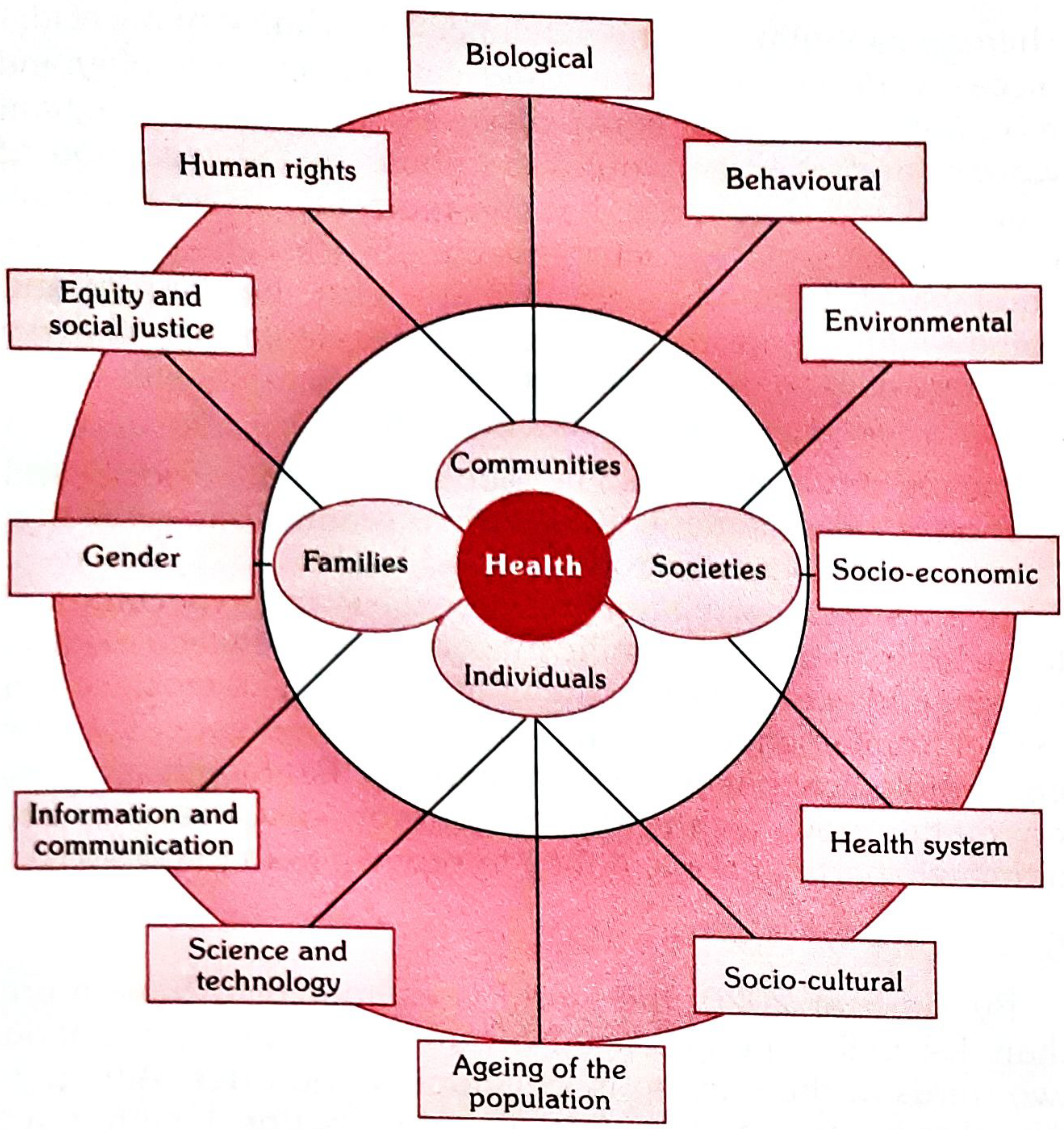
The major determinants are: Biological, Behavioural/Socio-cultural, Environmental, Socio-economic, Health system, Gender, Human rights, Equity and social justice, Information and communication, Science and technology, and Ageing of the population.
Behavioural and Socio-Cultural Determinants (Detailed)
This is classified as Determinant No. 2 in Park's.
What is "Lifestyle"?
- A diffuse concept denoting "the way people live" - reflecting a whole range of social values, attitudes, and activities.
- It is composed of cultural and behavioural patterns and lifelong personal habits (e.g., smoking, alcoholism) that develop through socialization.
- Lifestyles are learnt through:
- Parents, peer groups, friends, siblings
- School and mass media
Health and Lifestyle
- A considerable body of evidence shows an association between health and lifestyle.
- In developed countries: coronary heart disease, obesity, lung cancer, drug addiction are linked to lifestyle changes.
- In developing countries like India: risks are connected with lack of sanitation, poor nutrition, personal hygiene, elementary human habits, customs, and cultural patterns.
- Not all lifestyle factors are harmful - healthy ones include adequate nutrition, sufficient sleep, and physical activity.
- "Health is both a consequence of an individual's lifestyle and a factor in determining it."
Specific Socio-Cultural Factors (as Applied to Infant Mortality - Park's)
Park's identifies specific cultural and social factors affecting health outcomes (especially infant mortality):
(a) Breast-feeding
- Infant health is closely related to breastfeeding due to its nutritional content and natural immunizing agents.
- Early weaning and bottle-fed infants under poor hygienic conditions are more prone to die than breastfed infants under similar conditions.
(b) Religion and Caste
- Differences in health outcomes are attributed to socio-cultural patterns of living involving:
- Age-old habits, customs, traditions
- Practices affecting cleanliness, eating, clothing, child care, and almost every detail of daily living.
(c) Early Marriages
- The baby of a teen-age mother has the highest risk for neonatal and post-neonatal mortality.
(d) Sex of the Child
- In many parts of India, female infants receive far less attention than males.
- Birth of a female child may be unwelcome in many families.
- Female infant mortality is statistically higher than male infant mortality (post-neonatal component).
- (Note: neonatal death rate is actually higher for males, but post-neonatal death rate is higher for females - reflecting social discrimination.)
(e) Quality of Mothering
- Deprivation of maternal care is found in large families; fewer children = better maternal care = less morbidity and decreased infant mortality.
Socio-Cultural Determinants - Comprehensive Classification
The following socio-cultural factors influence health at the population level:
| Category | Examples |
|---|---|
| Customs and traditions | Food taboos, dietary restrictions during illness or pregnancy, rituals during childbirth |
| Religion | Dietary laws, attitudes to blood transfusion, family planning, contraception |
| Social class/caste | Access to resources, health-seeking behaviour, discrimination |
| Education | Health literacy, ability to act on health information, use of health services |
| Occupation | Occupational hazards, social prestige, income levels |
| Family structure | Nuclear vs. joint family, size of family, gender roles |
| Gender roles | Female autonomy, access to health care, decision-making power |
| Marriage practices | Child marriage, consanguineous marriage (increases genetic diseases) |
| Migration and urbanization | Disruption of social networks, exposure to new disease patterns |
| Communication and information | Health awareness, media influence on health behaviour |
Psychosocial Concept of Health (Park's)
The psychosocial concept recognizes that health is not only a biomedical phenomenon but one influenced by social, psychological, cultural, economic, and political factors. This was a critique of the earlier biomedical concept, which had minimized the role of environmental, social, psychological, and cultural determinants.
Lalonde's "Health Field Concept" (1974)
Marc Lalonde (Canadian Health Minister) proposed a framework with 4 determinants:
- Human biology - genetics, maturation, aging
- Environment - physical, biological, social
- Lifestyle (socio-cultural) - personal decisions, behaviors
- Health care organization - availability, quality, quantity of services
This framework highlighted that lifestyle/socio-cultural factors contribute more to premature mortality than health care organization alone.
WHO Commission on Social Determinants of Health (CSDH)
The CSDH (2008) identified the structural determinants (causes of the causes):
- Income and social protection
- Education
- Unemployment and job insecurity
- Living conditions (housing, basic amenities)
- Social norms, discrimination, and societal values (directly socio-cultural)
- Access to health services
Key message: "The conditions in which people are born, grow, live, work, and age" shape health - and these are largely socio-cultural in nature.
Exam Points to Remember
- Socio-cultural determinants are included under Determinant No. 2 ("Behavioural and socio-cultural conditions") in Park's classification.
- The biomedical concept failed because it minimized social, cultural, and psychological determinants.
- Lifestyle is the key concept linking socio-cultural factors to health - it is learnt through socialization.
- Important socio-cultural factors for MBBS exams: breast-feeding practices, religion and caste, early marriage, gender discrimination, food habits, and education.
- The psychosocial concept of health (Engel, Cassel, Syme) integrates socio-cultural factors into the health model.
- In India specifically, traditional socio-cultural practices (purdah system, female foeticide, child marriages, dietary taboos in pregnancy) remain important determinants.
Source: Park's Textbook of Preventive and Social Medicine, Chapter 1 - Concept of Health and Disease (Determinants of Health, pp. 23-26)
This is a shared conversation. Sign in to Orris to start your own chat.