Here are both fully structured 15-mark answers, written in clear language with textbook-quality diagrams.
QUESTION 1 (15 Marks)
Properties of Enzymes AND Factors Affecting Enzyme Activity
PART A — Properties of Enzymes
Enzymes are biological catalysts that speed up chemical reactions in living organisms. The following are their key properties:
1. Enzymes are Proteins
All enzymes are proteins in nature. They are made of amino acids folded into a specific three-dimensional shape. This shape determines their function. A few RNA molecules (called ribozymes) also have catalytic activity, but most enzymes are proteins.
2. Enzymes are Catalysts — They are NOT Consumed
Enzymes accelerate the rate of chemical reactions but they do not become chemically altered themselves. This means a single enzyme molecule can catalyze the same reaction thousands of times. They do not change the equilibrium of a reaction — only the speed at which equilibrium is reached.
3. Specificity — "Lock and Key"
Each enzyme acts on only one or a few specific molecules called the substrate. This is called specificity. There are three types:
- Binding specificity — The enzyme binds only specific substrates (like a lock accepting only one key).
- Reaction specificity — The enzyme catalyzes only one type of chemical bond breaking or formation.
- Stereospecificity — Enzymes recognize only one form (e.g., L-amino acids, not D-amino acids).
SUBSTRATE → binds to → ACTIVE SITE of ENZYME → forms ENZYME-SUBSTRATE COMPLEX → PRODUCT released
4. Active Site
Enzymes have a specific region called the active site where the substrate binds. The active site has a shape complementary to the substrate. According to the Induced Fit Model, the active site slightly changes shape when the substrate binds, like a hand fitting into a glove.
5. Enzymes Lower Activation Energy
Enzymes work by lowering the activation energy (energy needed to start a reaction). They do this without being consumed. This makes reactions occur much faster at body temperature.
                    Without Enzyme
                         /\
Energy                  /  \
Level        ___________/    \__________
            Reactants         Products

                    With Enzyme
                        /\
Energy                 /  \
Level       __________/    \_________
            Reactants  (lower peak)  Products
6. Cofactors and Coenzymes
Many enzymes need helper molecules to function:
- Cofactors — Inorganic ions (e.g., Mg²⁺, Zn²⁺, Fe²⁺)
- Coenzymes — Organic molecules, often vitamins (e.g., NAD⁺, FAD, Coenzyme A)
- The complete active enzyme = Apoenzyme (protein part) + Cofactor = Holoenzyme
7. Isozymes (Isoenzymes)
Multiple forms of the same enzyme found in different tissues are called isozymes. They catalyze the same reaction but have different structural forms. Example: Lactate Dehydrogenase (LDH) has 5 isozymes — LDH-1 (heart) and LDH-5 (liver). This is clinically important in diagnosing heart attacks and liver disease.
8. Regulation
Enzyme activity can be regulated by:
- Substrate concentration
- Allosteric regulators (molecules that bind away from the active site)
- Covalent modification (e.g., phosphorylation)
- Inhibitors
PART B — Factors Affecting Enzyme Activity
1. Temperature
Every 10°C rise in temperature approximately doubles enzyme activity. However, above the optimal temperature, enzymes begin to denature (lose their shape) and activity drops sharply.
- Most human enzymes work best at 37°C (body temperature)
- CK (creatine kinase) starts to denature at 37°C
- Taq polymerase (used in PCR) is stable at 95°C
        Enzyme Activity
              |         *
              |       *   *
              |     *       *  ← Denaturation
              |   *
              | *
              +--------------------→ Temperature (°C)
             Low   Optimal   High
                   (~37°C)
(Bell-shaped curve — activity rises then falls sharply)
2. pH
Each enzyme has an optimal pH at which activity is maximum. Above or below this pH, the enzyme's ionic state changes, affecting substrate binding and catalysis.
- Pepsin (stomach enzyme): optimal pH = 1.5–2 (acidic)
- Trypsin (intestine): optimal pH = 7.5–8 (slightly alkaline)
- Salivary amylase: optimal pH = 6.8–7
        Enzyme Activity
              |        *
              |      *   *
              |    *       *
              |  *           *
              +--------------------→ pH
             Low   Optimal   High
3. Substrate Concentration [S]
As substrate concentration increases, enzyme activity increases until all enzyme active sites are occupied (saturation). After this point, adding more substrate does NOT increase the rate — this is called Vmax (maximum velocity).
The Michaelis-Menten equation describes this:
v₀ = (Vmax × [S]) / (Km + [S])
- Km (Michaelis constant) = substrate concentration at half Vmax
- Low Km = high affinity for substrate
- High Km = low affinity for substrate
The Lineweaver-Burk plot (double reciprocal plot) is used to calculate Vmax and Km graphically:
Fig: Lineweaver–Burk (double reciprocal) plot — Lippincott's Biochemistry
4. Enzyme Concentration
If substrate is present in excess, increasing enzyme concentration increases the reaction rate proportionally. More enzyme molecules = more active sites available.
5. Cofactors and Coenzymes
Many enzymes are inactive without their cofactors. For example:
- Carbonic anhydrase requires Zn²⁺
- Pyruvate dehydrogenase requires Mg²⁺ and coenzyme thiamine pyrophosphate
6. Inhibitors
Inhibitors are substances that reduce enzyme activity. They are discussed in detail in Question 2.
7. Allosteric Regulation
Some enzymes have allosteric sites — sites other than the active site where regulators bind. Binding of an allosteric activator increases activity; binding of an allosteric inhibitor decreases activity. This is important for metabolic pathway control (feedback inhibition).
Summary Table — Factors Affecting Enzyme Activity
| Factor | Effect on Activity |
|---|
| Increase in temperature (up to optimal) | Increases activity |
| Temperature above optimal | Decreases (denaturation) |
| Optimal pH | Maximum activity |
| pH above/below optimal | Decreases activity |
| Increase in [S] up to Vmax | Increases activity |
| [S] beyond Vmax | No change |
| Increase in enzyme concentration | Increases activity |
| Inhibitors | Decreases activity |
| Cofactors absent | Decreases/no activity |
QUESTION 2 (15 Marks)
Enzyme Inhibition — Definition and Types
Definition
Enzyme inhibition is the process by which a substance (called an inhibitor) decreases or completely stops the catalytic activity of an enzyme.
Any substance that can decrease the velocity of an enzyme-catalyzed reaction is considered to be an inhibitor. — Lippincott's Illustrated Reviews: Biochemistry, 8th ed.
Inhibitors are classified into two major categories:
- Irreversible Inhibitors
- Reversible Inhibitors (further divided into Competitive and Noncompetitive)
TYPE 1 — Irreversible Inhibition
Definition
Irreversible inhibitors bind to the enzyme through covalent (permanent) bonds. Once bound, the enzyme cannot be recovered — its activity is permanently lost.
Mechanism
The inhibitor permanently destroys the active site or binds so tightly that the enzyme cannot function.
Examples
- Lead (Pb²⁺) — binds covalently to the sulfhydryl (–SH) group of cysteine in enzymes. It irreversibly inhibits ferrochelatase, an enzyme involved in heme synthesis → causes lead poisoning.
- Aspirin — irreversibly inhibits cyclooxygenase (COX) enzyme, blocking prostaglandin synthesis.
- Organophosphates (nerve agents/pesticides) — irreversibly inhibit acetylcholinesterase.
- Penicillin — irreversibly inhibits bacterial cell wall synthesis enzyme (transpeptidase).
Key Feature
- Cannot be reversed by dilution
- Enzyme must be newly synthesized to restore activity
Inhibitor──►[Enzyme Active Site]──Permanent Covalent Bond──► NO Activity
TYPE 2 — Reversible Inhibition
Reversible inhibitors bind to enzymes through non-covalent bonds (hydrogen bonds, ionic interactions). Dilution of the enzyme-inhibitor complex results in dissociation and recovery of enzyme activity.
There are two main subtypes:
A. Competitive Inhibition
Definition
Competitive inhibition occurs when the inhibitor is structurally similar to the substrate and competes with the substrate for binding to the same active site of the enzyme.
Mechanism
- The inhibitor occupies the active site → substrate cannot bind
- With more substrate, the substrate can outcompete the inhibitor → effect is reversible
Effects on Kinetics
| Parameter | Effect |
|---|
| Vmax | Unchanged (can be overcome by excess substrate) |
| Km | Increased (apparent Km rises — more substrate needed) |
Lineweaver-Burk Plot (Competitive Inhibition)
- Lines intersect on the Y-axis (same Vmax)
- X-intercepts differ (Km is increased)
Fig 5.12: Effect of competitive inhibitor. A: v₀ vs [S] — Vmax is unchanged but apparent Km increases. B: Lineweaver-Burk plot — lines cross on Y-axis. (Lippincott's Biochemistry)
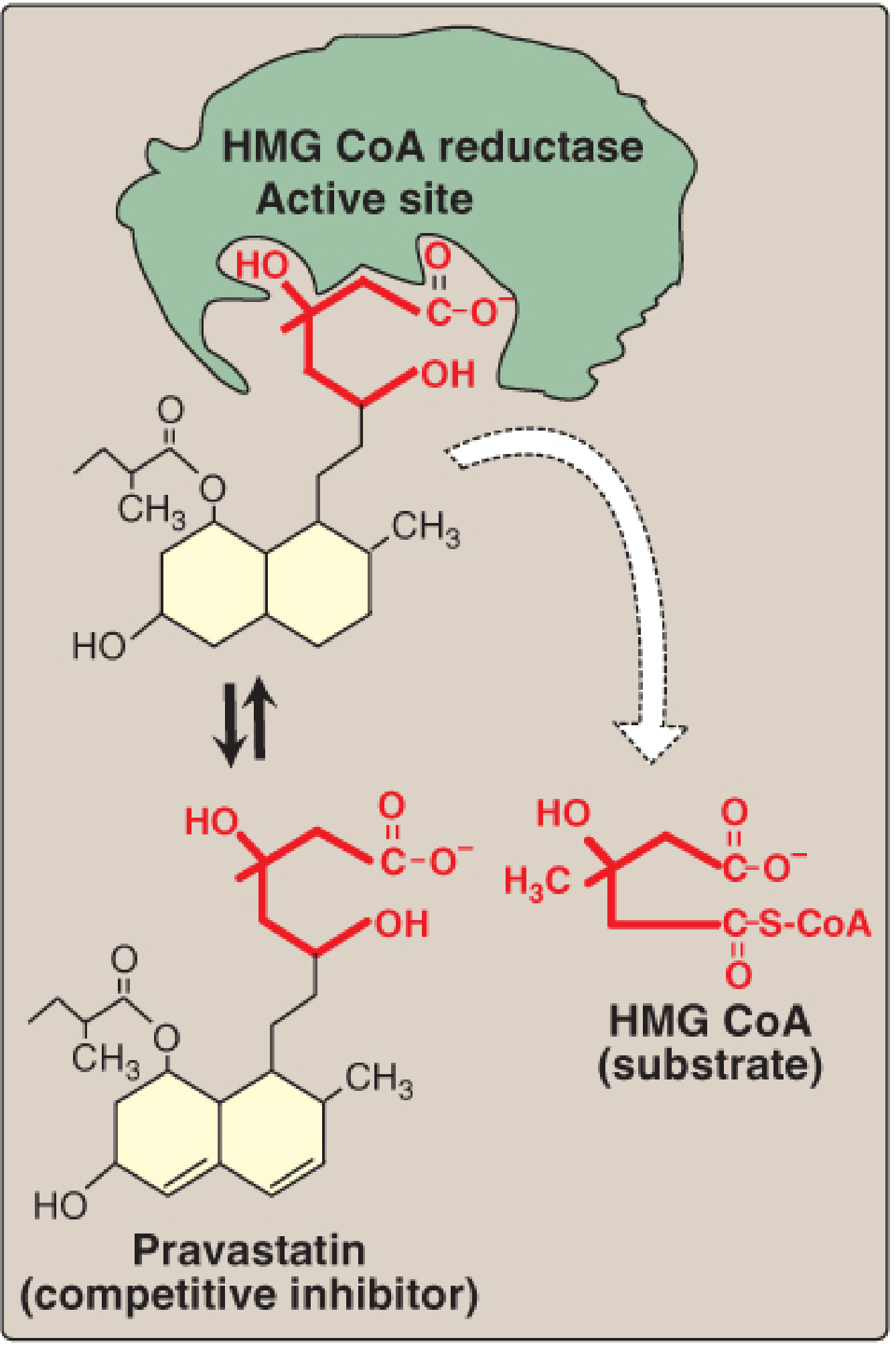
Clinical Example — Statin Drugs
Statins (atorvastatin, pravastatin) are competitive inhibitors of HMG CoA reductase (the rate-limiting enzyme in cholesterol biosynthesis). Statins are structural analogs of HMG CoA and compete for the active site.
Fig 5.13: Pravastatin competing with HMG CoA substrate at the active site of HMG CoA reductase. (Lippincott's Biochemistry)
Other clinical examples:
- Methotrexate competitively inhibits dihydrofolate reductase (used in cancer/rheumatoid arthritis)
- Sulfonamides competitively inhibit bacterial folate synthesis enzyme
B. Noncompetitive Inhibition
Definition
Noncompetitive inhibition occurs when the inhibitor binds to a different site on the enzyme (not the active site), called an allosteric site. The inhibitor can bind whether or not the substrate is present.
Mechanism
- Inhibitor + Free Enzyme → Inactive complex
- Inhibitor + Enzyme-Substrate complex → Also inactive
- Since the inhibitor does NOT compete with substrate, adding more substrate cannot overcome this inhibition
Effects on Kinetics
| Parameter | Effect |
|---|
| Vmax | Decreased (cannot be overcome by more substrate) |
| Km | Unchanged (substrate still binds normally) |
Lineweaver-Burk Plot (Noncompetitive Inhibition)
- Lines intersect on the X-axis (same Km)
- Y-intercepts differ (Vmax is decreased)
Fig 5.14: Effect of noncompetitive inhibitor. A: Vmax is reduced. B: Lineweaver-Burk plot — Km unchanged, Vmax decreased. (Lippincott's Biochemistry)
Examples
- Heavy metals (Hg²⁺, Ag⁺) bind to –SH groups away from the active site
- Cyanide inhibits cytochrome oxidase noncompetitively
C. Uncompetitive Inhibition (Additional Point for High Marks)
The inhibitor binds only to the enzyme-substrate (ES) complex — NOT to free enzyme.
| Parameter | Effect |
|---|
| Vmax | Decreased |
| Km | Decreased |
On a Lineweaver-Burk plot, lines are parallel (same slope).
Comparison Table — All Types of Inhibition
| Feature | Irreversible | Competitive | Noncompetitive | Uncompetitive |
|---|
| Binding | Covalent | Non-covalent | Non-covalent | Non-covalent |
| Site of binding | Active site | Active site | Allosteric site | ES complex |
| Effect on Vmax | Reduced | No change | Reduced | Reduced |
| Effect on Km | Reduced | Increased | No change | Decreased |
| Reversed by excess substrate? | No | Yes | No | No |
| Lineweaver-Burk | — | Same Y-intercept | Same X-intercept | Parallel lines |
| Example | Lead, Organophosphates, Aspirin | Statins, Methotrexate | Heavy metals, Cyanide | — |
Simple Diagram — Types of Inhibition
                          ENZYME
                        ___________
                       |           |
   SUBSTRATE ──────►  | ACTIVE    | ← COMPETITIVE INHIBITOR also binds here
                       | SITE      |
                       |           |
                       | ALLOSTERIC| ← NONCOMPETITIVE INHIBITOR binds here
                       | SITE      |
                       |___________|
Clinical Significance of Enzyme Inhibition
At least half of the 10 most commonly prescribed drugs in medicine act as enzyme inhibitors:
- β-lactam antibiotics (penicillin, amoxicillin) — inhibit bacterial cell wall synthesis enzymes
- ACE inhibitors (enalapril, ramipril) — inhibit angiotensin-converting enzyme → lower blood pressure
- Statins — competitive inhibitors of HMG CoA reductase → lower cholesterol
- Methotrexate — competitive inhibitor of dihydrofolate reductase → used in cancer and RA
- Aspirin — irreversible inhibitor of COX → anti-inflammatory/anti-platelet
Sources: Lippincott's Illustrated Reviews: Biochemistry, 8th ed. | Henry's Clinical Diagnosis and Management by Laboratory Methods | Katzung's Basic and Clinical Pharmacology, 16th ed.
---Both answers are now complete. Here's a quick guide to help you score maximum marks:
Tips to Maximize Your Marks
Question 1 (Properties + Factors):
- Start with a one-line definition of enzymes
- Cover at least 6 properties with subheadings
- Draw the bell-shaped curves for temperature and pH — examiners love these
- Mention Km and Vmax with the Michaelis-Menten equation for substrate concentration
- End with the summary table — it shows organization
Question 2 (Enzyme Inhibition):
- Define inhibition clearly in the opening
- Split into Irreversible → Competitive → Noncompetitive (and mention Uncompetitive for extra marks)
- For each type: definition → mechanism → effect on Vmax → effect on Km → Lineweaver-Burk plot → example
- The comparison table at the end is a high-yield scoring point
- Mention clinical drugs (statins, penicillin, ACE inhibitors) — this shows applied knowledge
The diagrams included (Lineweaver-Burk plots, competitive vs noncompetitive inhibition graphs, and the statin mechanism) are from Lippincott's Illustrated Reviews: Biochemistry — a standard university textbook — so drawing these in your answer will make a strong impression on the checker.

![Lineweaver-Burk Plot showing 1/v₀ vs 1/[S] with y-intercept = 1/Vmax and x-intercept = -1/Km](https://cdn.orris.care/cdss_images/97e1ac12ff3f834e86b6e1c88679dcf3fc798ffb2c801f21d1429bad97a5775e.png)
![Competitive Inhibition: Velocity vs [S] and Lineweaver-Burk plot showing same Vmax but increased Km in the presence of competitive inhibitor](https://cdn.orris.care/cdss_images/fa729df9d61b10d4202bd70dc610b8044dd78c91b3e4ec4dd5b9ec3e0dc8a15a.png)
![Noncompetitive Inhibition: Velocity vs [S] and Lineweaver-Burk plot showing decreased Vmax but same Km](https://cdn.orris.care/cdss_images/d42e27adf642fcd5678e70f2715c74d6be1141e941ff9360c9ff0fb2972786d8.png)