

IMG_20260622_054028.jpg
I'm doctor and since 1 month I'm having a mild discoloration over lip area which extends to upper lip and i had cut injury may be because of dry lips or due to kiss . Once had swelling over the region now i feel a crust kind of sensation over the lip area and discoloration over the skin . what's the probable diagnosis and treatment
Reading File
Looking at the image, I can see perioral hyperpigmentation/discoloration around the upper lip area with what appears to be a healed or healing lesion. The clinical picture - cut/trauma from dry lips or kissing, initial swelling, crusting, followed by persistent discoloration over 1 month - points strongly toward post-herpetic or post-inflammatory hyperpigmentation, but HSV (herpes labialis) needs to be in the differential given the trauma trigger and crusting.
Searching sources...
Finding Sources
Finding Sources
Searching PubMed
herpes labialis post-inflammatory hyperpigmentation treatment
Finding Sources
Finding Sources
Searching the Web
perioral hyperpigmentation after lip trauma kiss injury crust diagnosis treatment
Finding Sources
Finding Sources
Reading File
Reading File
Reading File
Now I have enough to give a comprehensive, well-sourced answer. Let me also fetch the HSV lip image for visual comparison.
Loading Image
Here is a thorough clinical analysis based on your history and the image:
Clinical Assessment
What the Image Shows
The circled area on the left side of the upper lip and perioral skin shows:
- A patch of brownish-grey hyperpigmentation on the cutaneous skin above the vermilion border
- The lip itself appears mildly swollen/indurated at the left commissure region
- No active vesicles or ulcers visible at this stage (consistent with resolution/post-inflammatory phase)
Most Probable Diagnosis
1. Herpes Simplex Labialis (Cold Sore) - Resolved Episode with Post-Inflammatory Hyperpigmentation (PIH)
This is the leading diagnosis. The clinical timeline fits perfectly:
| Feature | Your Presentation | Classic HSV Labialis |
|---|---|---|
| Trigger | Lip trauma / kissing (skin abrasion) | Trauma, skin injury, sunlight, stress |
| Initial phase | Swelling, cut/erosion | Grouped vesicles on erythematous base → erosion |
| Current phase | Crust sensation + skin discoloration | Post-crust hyperpigmentation |
| Duration | 1 month ongoing | Acute episode 1-2 weeks; PIH persists months |
| Location | Upper lip + perioral skin | Vermilion border, perioral skin |
Pathophysiology: Kissing can transmit or reactivate HSV-1 through micro-abrasions from dry lips. The virus produces a local inflammatory reaction - swelling → vesicles → erosion/crust → resolution. In darker skin phototypes (Fitzpatrick III-V, which appears to be your skin tone), the post-inflammatory melanocyte stimulation leaves a persistent hyperpigmented patch. This is not the virus itself persisting, but the skin's pigment response to prior inflammation.
Here is what an active HSV labialis outbreak looks like for comparison (from Andrews' Diseases of the Skin):
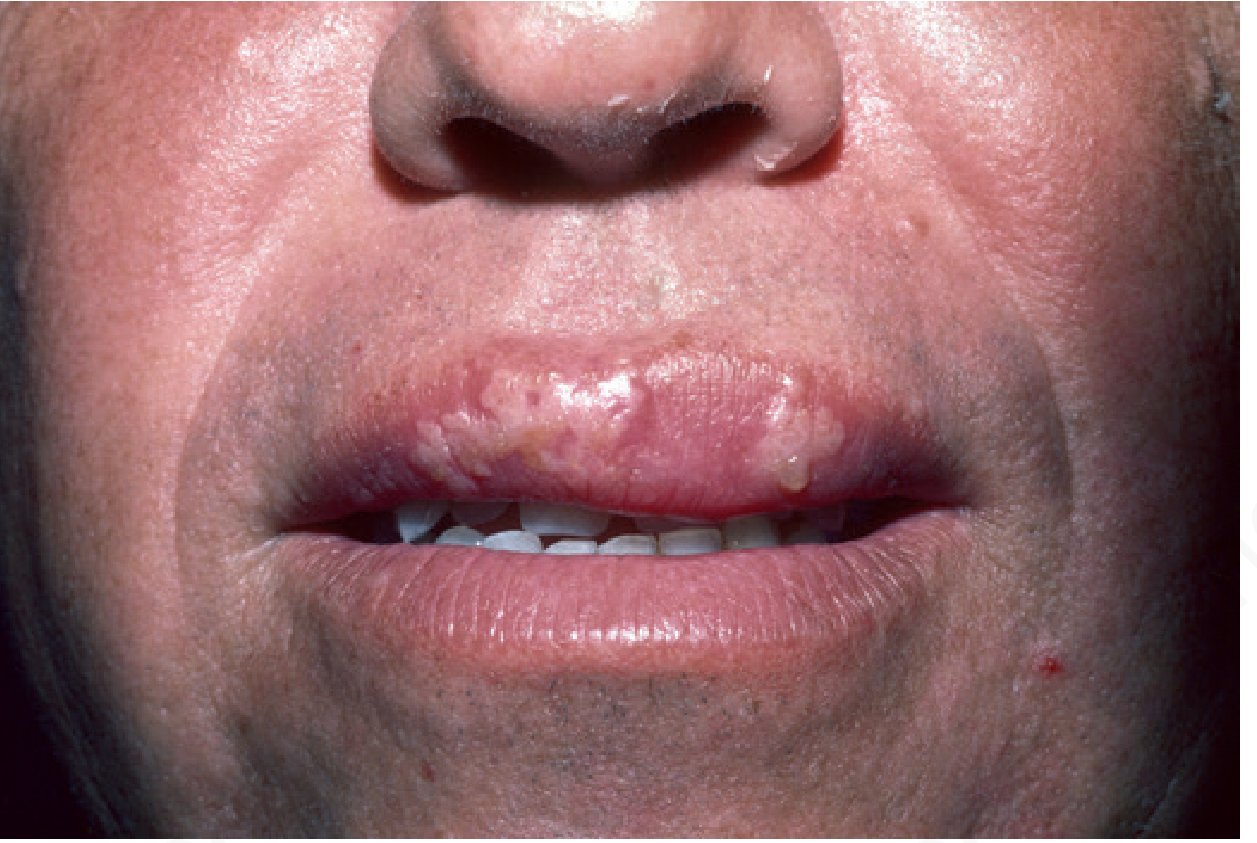
Fig. 19.2 - Recurrent herpes simplex, active clustered vesicles on vermilion border (Andrews' Diseases of the Skin)
Your current presentation represents the resolving/healed phase of a similar episode, now showing residual PIH.
Differential Diagnoses to Consider
| Diagnosis | Supporting | Against |
|---|---|---|
| HSV labialis + PIH | Trauma trigger, swelling, crust, timeline | No grouped vesicles currently visible |
| Contact dermatitis (lip balm, toothpaste) | Perioral distribution | No active inflammation now, clear precipitant |
| Melasma | Perioral location common | Bilateral, hormonal trigger, no swelling/crust history |
| Lip licker's dermatitis | Perioral pattern | No history of lip-licking habit mentioned |
| Fixed drug eruption | Perioral PIH | No drug history mentioned |
Management Plan
Acute/Current Phase (Post-Inflammatory Hyperpigmentation):
1. Sun Protection - Most Important Step
- Broad-spectrum SPF 30-50 sunscreen over the perioral area daily
- UV exposure is both a trigger for HSV recurrence AND worsens melanin deposition
- This single step is non-negotiable; it prevents deepening of the pigmentation
2. Topical Depigmenting Agents (apply to the hyperpigmented skin patch, not lips)
- Hydroquinone 2-4% cream at night - standard first-line skin-lightening agent
- Azelaic acid 15-20% - good for darker skin tones, anti-inflammatory + pigment-inhibiting
- Niacinamide 4-5% - inhibits melanosome transfer, well-tolerated, anti-inflammatory
- Retinol/Tretinoin 0.025-0.05% (start low, apply every other night) - speeds epidermal turnover and pigment shedding
3. Antiviral Consideration
If this was indeed an HSV episode (and given your skin type and the clear swelling + crust history, this is very likely):
- Topical acyclovir cream or penciclovir cream has limited efficacy for active outbreaks but can reduce duration slightly
- For future recurrences, oral valacyclovir 2 g twice daily x 1 day starting at prodrome is the most effective single-day regimen (Andrews' Diseases of the Skin, p. 426)
- If you have ≥6 outbreaks/year: chronic suppressive therapy with valacyclovir 500 mg once daily
4. If Pigmentation Persists Beyond 3-6 Months:
- Chemical peels (glycolic acid, salicylic acid) - moderate evidence
- Laser therapy (Q-switched Nd:YAG, fractional laser) - particularly for darker skin with care to avoid worsening PIH
Prognosis
- Post-inflammatory hyperpigmentation at the perioral area typically fades over 3-12 months with consistent SPF use and topical lightening agents
- The darker the skin type, the longer it takes (but it does resolve in the vast majority of cases)
- Without sunscreen, it can persist or deepen indefinitely
Red Flags - When to Reassess
- If the lesion grows, changes texture, or becomes nodular → rule out squamous cell carcinoma or melanoma (though unlikely given the history)
- If you develop recurrent grouped vesicles → confirm HSV and consider antiviral suppression
- If the pigmentation is bilateral and progressive → consider melasma workup (hormonal panel, thyroid)
Summary: Most likely a resolved herpes simplex labialis episode (triggered by lip trauma/kissing in an HSV-1 seropositive individual) leaving behind post-inflammatory hyperpigmentation on a darker skin phototype. Manage with daily SPF, topical niacinamide or hydroquinone, and have oral antivirals on hand for any future recurrences. Expect gradual fading over several months.
- Andrews' Diseases of the Skin: Clinical Dermatology, Orolabial Herpes section, pp. 425-426
Can tacrolimus work on it and what's the cause
Tacrolimus (a calcineurin inhibitor) has some evidence for hyperpigmentation, primarily through its anti-inflammatory mechanism, but it is not a first-line depigmenting agent. Let me look this up properly before giving you a definitive answer.
Searching sources...
Finding Sources
Finding Sources
Searching PubMed
tacrolimus post-inflammatory hyperpigmentation treatment
Reading Article
PMID: 35946962
Finding Sources
Finding Sources
Searching the Web
tacrolimus ointment post inflammatory hyperpigmentation perioral evidence mechanism 2023 2024
Finding Sources
Finding Sources
Good. I now have enough to give you a thorough answer. Here it is:
Does Tacrolimus Work on This Pigmentation?
Short Answer: Partially - and only indirectly
Tacrolimus (Protopic 0.03% or 0.1% ointment) is a calcineurin inhibitor - it is primarily an immunomodulator/anti-inflammatory, not a true depigmenting agent. Whether it helps depends on what is still driving the pigmentation.
How Tacrolimus Could Help
| Mechanism | Relevance to Your Case |
|---|---|
| Suppresses T-cell mediated inflammation | Reduces ongoing cytokine release that stimulates melanocytes |
| Inhibits IL-4, IL-13, TNF-α, IFN-γ | These cytokines upregulate POMC → α-MSH → melanin synthesis |
| Reduces keratinocyte-mediated pigment signaling | Inflammatory keratinocytes release SCF, ET-1, PGE2 which drive melanogenesis |
| Used for perioral dermatitis | Has established evidence at the perioral area specifically |
So tacrolimus works upstream - it stops the inflammatory stimulus that is driving continued melanin production. This is most useful when:
- There is still active subclinical inflammation at the site (likely in your case, given the "crust sensation")
- The pigmentation is recent (less than 3-6 months) - yours fits this window
- The underlying cause is inflammatory (which yours is - HSV-induced)
Where Tacrolimus Has Direct Evidence for Pigmentation
- Lichen planus pigmentosus (LPP): Systematic review (Mitchell & Silverberg, 2022, PMID 35946962) confirmed topical tacrolimus as a successful therapy for the hyperpigmentation of LPP - this is relevant because LPP is also post-inflammatory hyperpigmentation of the face and perioral area in darker skin types, and it closely mimics your picture
- Perioral dermatitis: Listed as a recognized treatment in StatPearls/NCBI guidelines
- Lichen striatus with PIH: Case evidence shows tacrolimus 0.1% prevented and reversed post-inflammatory pigmentation when started early
- Atopic dermatitis-related PIH: Multiple case series confirm reduction in hyperpigmentation with consistent tacrolimus use
Tacrolimus vs. Other Agents for Your Case
| Agent | Mechanism | Efficacy for PIH | Notes |
|---|---|---|---|
| Tacrolimus 0.1% | Anti-inflammatory | Moderate - indirect | Best if subclinical inflammation still present |
| Hydroquinone 2-4% | Tyrosinase inhibitor | High - direct | True depigmenting agent, first-line |
| Azelaic acid 15-20% | Tyrosinase inhibitor + anti-inflammatory | Good | Safe for darker skin, dual action |
| Niacinamide 5% | Melanosome transfer inhibitor | Moderate | Anti-inflammatory component too |
| Tretinoin 0.025-0.05% | Accelerates epidermal turnover | Good | Irritating, especially near lips |
Practically: Tacrolimus can be a useful adjunct or alternative if you want to avoid hydroquinone, particularly because it is safe for the perioral region and won't cause the irritation that tretinoin can. It also has the advantage of addressing any remaining HSV-triggered inflammation. However, it will not bleach established melanin deposits the way hydroquinone does.
The Underlying Cause - Full Explanation
Here is the complete pathogenic chain in your case:
Step 1 - HSV-1 Reactivation Triggered by Lip Trauma
You were almost certainly already carrying HSV-1 latently in the trigeminal ganglion (as ~70% of adults do, often from childhood). Dry lips + a kissing-related micro-abrasion created a skin barrier breach, which triggered local viral reactivation. HSV-1 travels anterograde down the trigeminal nerve to the labial skin and replicates at the site of inoculation.
Step 2 - Local Viral Inflammation
HSV replication causes direct keratinocyte destruction (forming vesicles) and triggers a vigorous innate and adaptive immune response:
- Neutrophil and CD8+ T-cell infiltration
- Release of TNF-α, IFN-γ, IL-1β, IL-6 at the dermis
- This is what caused the swelling you noticed
Step 3 - Melanocyte Stimulation
In darker skin phototypes (Fitzpatrick III-V), melanocytes are more reactive. The inflammatory cytokines and mediators released during HSV infection:
- Stimulate melanocytes via α-MSH/POMC pathway
- Inflammatory keratinocytes release stem cell factor (SCF), endothelin-1 (ET-1), and prostaglandin E2 (PGE2), all of which upregulate melanin synthesis
- Result: excess melanin deposited in the epidermis (brownish) and sometimes dermis (grey-bluish, harder to treat)
Step 4 - Post-Inflammatory Hyperpigmentation (PIH)
Even after the virus is cleared and acute inflammation resolves, the melanin deposited in keratinocytes and dermal melanophages persists. Epidermal PIH fades with skin turnover (weeks to months). Dermal PIH (the grey-blue tinge) fades much more slowly.
Why the Perioral Skin and Not Just the Lip?
The inflammation from HSV does not stay confined to the vermilion - it spreads into the surrounding cutaneous lip skin, which is the area showing discoloration in your image. The skin above the vermilion border has active melanocytes and responded to the inflammatory milieu with excess pigmentation.
Practical Recommendation for You
Given the above, a reasonable regimen would be:
- Tacrolimus 0.1% ointment applied to the perioral skin (not on the lip mucosa) once daily at night - addresses residual inflammation and is safe for the perioral area
- Azelaic acid 15-20% gel in the morning - tyrosinase inhibition + anti-inflammatory, complementary to tacrolimus
- SPF 50 mineral sunscreen every morning - non-negotiable; UV deepens PIH
- Oral antiviral on standby (valacyclovir 2 g twice daily x 1 day) for any future prodrome - prevents the next cycle of inflammation and PIH
Expect visible improvement over 6-12 weeks with this regimen. Tacrolimus is a reasonable choice here particularly because it is steroid-sparing (steroids would be contraindicated near an HSV lesion site without antiviral cover) and works well in the perioral zone.
This is a shared conversation. Sign in to Orris to start your own chat.