

1000149267.jpg
Give diagnosis and treatment in details
analyse_media
Reading File
The image shows a classic chronic lichenified plaque on the posterior neck - consistent with Lichen Simplex Chronicus (LSC), also known as neurodermatitis circumscripta. Let me search the medical library for detailed diagnosis and treatment.
Searching sources...
Finding Sources
Finding Sources
Searching PubMed
"lichen simplex chronicus" AND treatment
Good. Now let me read the detailed content from Andrews' Diseases of the Skin and Dermatology 5e, the most authoritative dermatology textbooks:
Reading File
Reading File
Reading File
I now have excellent, detailed information from multiple authoritative dermatology textbooks. Let me also fetch the LSC image from Andrews' to show alongside the answer.
Reading File
Loading Image
I now have all the information needed for a complete, well-sourced answer.
Diagnosis: Lichen Simplex Chronicus (LSC)
Also known as: Circumscribed Neurodermatitis
Clinical Features in This Image
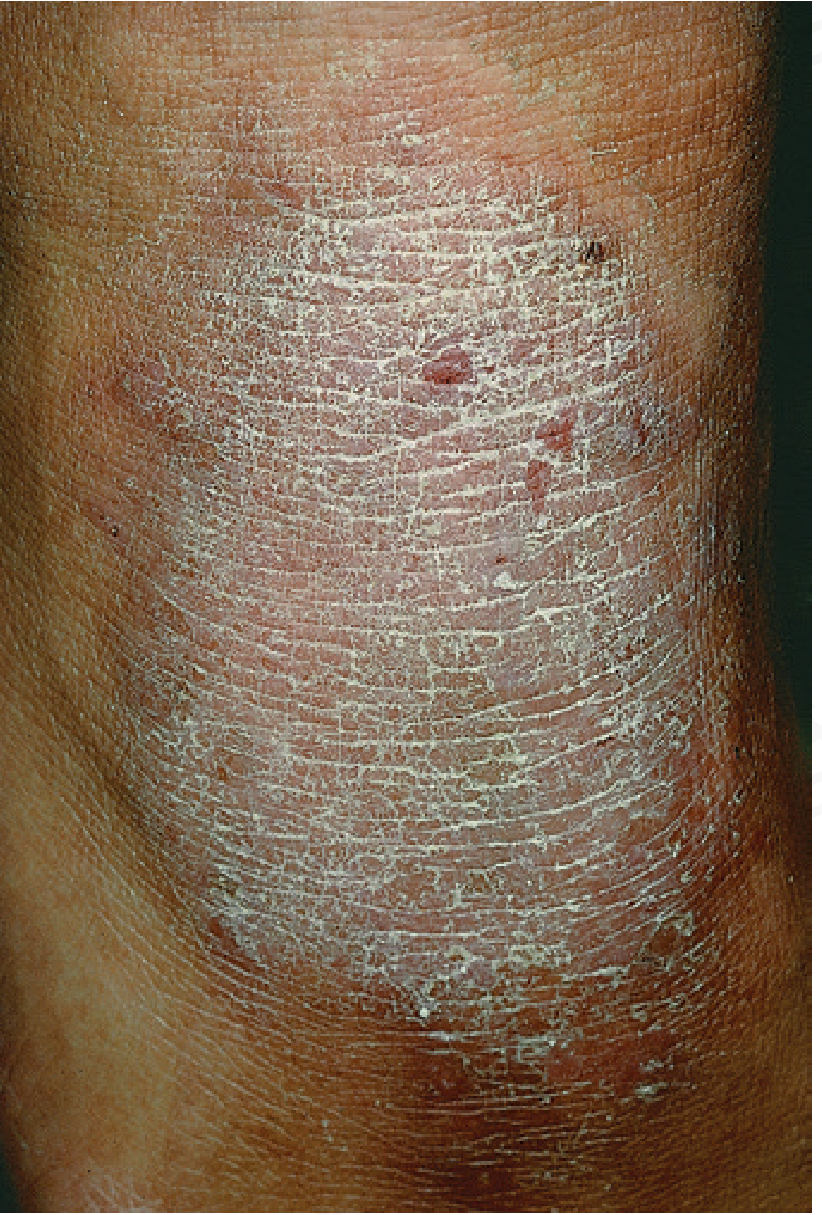
The lesion on the posterior neck (nape) shows every hallmark of LSC:
| Feature | Observed |
|---|---|
| Location | Posterior/lateral neck - classic predilection site |
| Morphology | Solitary, well-demarcated, oval lichenified plaque |
| Color | Dusky brown-grey hyperpigmentation |
| Lichenification | Prominent exaggerated skin markings in a crisscross mosaic pattern - the defining feature |
| Excoriation | Focal bright red erosion from active scratching |
| Scaling | Fine whitish-grey scale at margins |
| Satellite lesions | Small hyperpigmented papules adjacent to the main plaque |
This is a textbook presentation. Dermatology 5e specifically notes: "B - Note the increased skin markings in this hyperpigmented plaque on the posterior neck" as a classic LSC example. - Dermatology 2-Volume Set 5e
Pathophysiology
LSC results from long-term chronic rubbing and scratching, more vigorously than a normal pain threshold permits. The skin becomes thickened and leathery - a process called lichenification - where striae form a crisscross pattern producing a mosaic of flat-topped, shiny, quadrilateral facets. This creates a vicious itch-scratch-itch cycle that becomes self-perpetuating. - Andrews' Diseases of the Skin
Histologically: compact hyperkeratosis, acanthosis with irregular elongation of rete ridges, hypergranulosis, and vertically oriented collagen bundles in the papillary dermis. - Dermatology 5e
Predisposing Factors
- Atopy / atopic dermatitis
- Anxiety disorders and obsessive-compulsive disorder (OCD)
- Xerosis (dry skin)
- Psoriasis or contact dermatitis (underlying disease that initiated itching)
- Localized neuropathic itch
- Systemic pruritic disease
- Depression (associated with erectile dysfunction in males)
Differential Diagnosis
| Condition | Key differentiating feature |
|---|---|
| Hypertrophic lichen planus | Violaceous papules, favors shins, Wickham striae |
| Lichen amyloidosis | Usually bilateral, rippled surface, shins |
| Psoriasis | Silvery scale, well-defined, nail/joint involvement |
| Allergic/contact dermatitis | History of allergen exposure, acute onset |
| Tinea (ringworm) | Active scaly border, KOH positive |
| Prurigo nodularis | Discrete firm nodules rather than plaques |
A KOH preparation should be done to exclude tinea. Biopsy if diagnosis is uncertain.
Treatment - Detailed
The goal is cessation of pruritus and breaking the itch-scratch cycle. The patient must be counseled to avoid scratching even when itching is relieved. - Andrews' Diseases of the Skin
Step 1 - Identify and Treat Underlying Cause
Look for and treat any underlying dermatitis (atopic, contact, psoriasis, tinea) that originally triggered the itch.
Step 2 - Topical Therapies (First Line)
A. Topical Corticosteroids - Mainstay
- Initial: High-potency corticosteroid cream or ointment (e.g., clobetasol 0.05%, betamethasone dipropionate 0.05%) - but NOT indefinitely due to risk of steroid-induced atrophy
- Maintenance/Taper: Switch to medium- to lower-potency topical steroids as lesions resolve
- Occlusion: Occlusion of a medium-potency steroid significantly enhances penetration and benefit
- Steroid-impregnated tape (e.g., fludroxycortide tape) provides both occlusion and anti-inflammatory effects simultaneously
B. Topical Calcineurin Inhibitors (steroid-sparing, safe for long term)
- Tacrolimus ointment 0.1% or pimecrolimus cream 1% - significant antipruritic effects, good adjunct
- Particularly useful on the neck to avoid steroid atrophy
C. Topical Antipruritic Agents
- Topical doxepin cream (H1/H2 antihistamine)
- Capsaicin cream (depletes substance P - good for neuropathic itch component)
- Topical lidocaine 5% or capsaicin 8% patches (licensed for post-herpetic neuralgia) - helpful in recalcitrant cases
D. Hydrocolloid Dressings
- Repeated application can lead to improvement by acting as a physical barrier preventing scratching
Step 3 - Intralesional Therapy
Intralesional triamcinolone acetonide
- Concentration: 2.5-5 mg/mL (use lower concentration to avoid atrophy/depigmentation)
- Inject into the dermis - not too superficially (risk of epidermal/dermal atrophy and depigmentation lasting months)
- Do NOT inject into infected or excoriated lesions (risk of abscess)
- Highly effective for thick, resistant plaques like the one shown
Step 4 - Systemic/Adjunctive Therapies
| Agent | Role |
|---|---|
| Antihistamines | Reduce itch, sedating types (hydroxyzine, cetirizine) useful at night |
| Gabapentinoids (gabapentin, pregabalin) | For neuropathic itch component |
| Antidepressants (SSRIs, mirtazapine) | For associated anxiety/OCD/depression driving scratching behavior |
| Topical/oral antibiotics | Only if secondary bacterial infection (as seen here - small erosion/crust) |
| Phototherapy (NB-UVB) | For widespread or recalcitrant disease |
| Transcutaneous electrical stimulation | Emerging adjunct |
| Focused ultrasound | Emerging adjunct |
| Botulinum toxin A injection | May be curative in refractory cases |
Step 5 - Severe/Refractory Cases
Complete occlusion with an Unna boot (zinc oxide impregnated bandage) can break the itch-scratch cycle in the most severe cases. - Andrews' Diseases of the Skin
Behavioral/Psychological Management
- Insight-oriented psychotherapy
- Habit-reversal training (substituting a non-damaging behavior for scratching)
- Topical antipruritic applications as a "substitute" for the scratching behavior
- Treating underlying anxiety or OCD formally if present
Practical Management Summary for This Patient
Given the posterior neck location with moderate-to-severe lichenification and active excoriation:
- Betamethasone dipropionate ointment 0.05% under occlusion (e.g., plastic wrap overnight) for 2-4 weeks
- Intralesional triamcinolone 2.5 mg/mL into the thickest central area of the plaque
- Tacrolimus ointment 0.1% twice daily as maintenance after steroid taper
- Hydroxyzine 25 mg at night for antipruritic/sedating effect to prevent nocturnal scratching
- Short course of topical antibiotic (mupirocin) to the central erosion/crust (secondary impetiginization)
- Counsel strongly on breaking the scratch cycle - "the more you scratch, the more it itches"
- Screen and treat anxiety/OCD if present
Prognosis note: Recurrences are frequent even after thorough treatment. Clearing one lesion may see the onset of another elsewhere. Long-term follow-up and habit modification are as important as pharmacological treatment. - Andrews' Diseases of the Skin, Dermatology 5e
This is a shared conversation. Sign in to Orris to start your own chat.