
Types of tuning fork uses of tuning fork and their parts
A tuning fork is a medical/acoustic instrument, so let me check the medical library first.
Searching sources...
Reading File
Searching the Web
tuning fork types uses parts medical ENT
Now let me search the medical library for tuning fork content and fetch the key images in parallel.
Finding Sources
Loading Image
Loading Image
Excellent - found rich textbook content. Let me read the most comprehensive sections in parallel.
Reading File
Reading File
Reading File
Let me read more from Scott-Brown's and search for vibration sense / neurological uses.
Reading File
Finding Sources
Now I have comprehensive data. Let me also get the remaining tests from Scott-Brown's and the Stenger/Schwabach data.
Reading File
I now have everything needed to write a thorough, well-sourced answer. Let me compose it.
Tuning Fork - Parts, Types, and Uses
Parts of a Tuning Fork
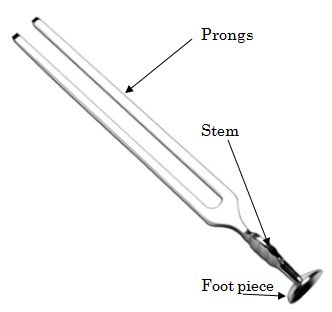
A tuning fork has three main parts:
| Part | Description |
|---|---|
| Prongs (Tines) | The two parallel arms that vibrate when struck. Their length and mass determine the pitch (frequency) produced. |
| Stem | The handle/shaft connecting the prongs to the foot piece. It conducts vibration when placed on a bony surface (bone conduction testing). |
| Foot Piece (Base) | The flat, weighted disk at the bottom of the stem. Placed firmly on bony prominences (mastoid, forehead, skull, sternum, toes) for bone conduction testing. |
Types of Tuning Forks
Tuning forks are classified by their frequency (Hz). Medical tuning forks range from 64 Hz to 4096 Hz:
| Frequency | Primary Use |
|---|---|
| 128 Hz | Testing vibration sense (neurological exam) - placed on bony prominences |
| 256 Hz | Hearing tests (Rinne, Weber); also vibration sense; lower reliability due to tactile sensation felt by patient |
| 512 Hz | Most widely used in ENT - Rinne and Weber hearing tests. Most accurate for distinguishing conductive vs. sensorineural hearing loss |
| 1024 Hz | Hearing tests; less commonly used |
| 2048 Hz | Higher-frequency hearing screening |
"The most useful fork is the 512-Hz fork, but 1024 Hz and 2048 Hz may also be used. Typically, tuning forks for frequencies below 512 Hz, such as 128 or 256-Hz, are not used [for hearing tests] because the low-frequency vibrations may be felt rather than heard. This somatosensory stimulation may confuse the patient and compromise findings."
- K.J. Lee's Essential Otolaryngology, p. 2834
"The most commonly used forks are the 256 Hz and 512 Hz forks, as these give more reliable responses than the 1024 Hz fork."
- Scott-Brown's Otorhinolaryngology Head & Neck Surgery Vol 2
Uses of Tuning Forks
1. ENT / Audiology - Hearing Assessment
Rinne Test (512 Hz)
Tests whether air conduction (AC) is better than bone conduction (BC) in each ear individually.
- Method: Vibrating fork placed against the mastoid process (BC), then held 2 cm from the ear canal (AC). Patient says which is louder.
- AC > BC (Positive Rinne): Normal hearing OR sensorineural hearing loss
- BC > AC (Negative Rinne): Conductive hearing loss (air-bone gap of ≥20 dB with 512 Hz fork)
- The threshold comparison method can also be used: hold fork near ear until inaudible, then place on mastoid - if heard again, BC > AC.
- Shambaugh Surgery of the Ear, p. 205
Weber Test (512 Hz)
Tests lateralization of sound - where the patient hears the tone louder.
- Method: Vibrating fork placed on the forehead, nasal dorsum, or mandibular symphysis (midline). Patient reports which ear hears it louder.
- Lateralizes to the affected ear: Conductive hearing loss on that side (typically ≥3-5 dB gap)
- Lateralizes to the opposite ear: Sensorineural loss on that side
- No lateralization (midline): Normal, or symmetric loss
- Shambaugh Surgery of the Ear, p. 205; Scott-Brown's Vol 2
Bing Test
- Method: Activated fork placed on mastoid, then the ear canal is occluded with a finger.
- If occlusion makes the sound louder → normal hearing or sensorineural loss (Bing positive)
- If occlusion produces no change → conductive hearing loss (Bing negative)
- Based on the occlusion effect: blocking the external canal increases bone conduction only when the ossicular chain is intact.
- Scott-Brown's Otorhinolaryngology Head & Neck Surgery Vol 2
Schwabach Test
- Compares patient's bone conduction to the examiner's (assumed normal).
- Vibrating fork placed on patient's mastoid; when patient can no longer hear it, placed on examiner's mastoid.
- Diminished Schwabach: Patient stops hearing before examiner → sensorineural loss
- Prolonged Schwabach: Patient hears longer than examiner → conductive loss
2. Neurology - Vibration Sense Testing (128 Hz)
A 128 Hz fork is specifically used for pallesthesia (vibration sense) testing, which assesses the dorsal column (posterior column) pathway.
- Method: Strike fork, place the flat base on bony prominences - great toe, medial malleolus, patella, anterior tibia, sternum, finger joints.
- Patient reports when vibration starts and stops.
- Timed vibration test: Apply 128 Hz fork, count seconds patient perceives vibration. Compare against normal or opposite limb.
- Diminished vibration sense suggests peripheral neuropathy (e.g., diabetes, B12 deficiency) or dorsal column disease.
"Vibration sense is tested by placing a tuning fork with a..." - Adams and Victor's Principles of Neurology, 12th Ed.
"Vibration is tested by placing a 128-cycles/sec tuning fork on the bony prominences of the extremities and asking the patient to identify when it stops vibrating." - Textbook of Family Medicine, 9th Ed.
3. Neurology - Temperature Sensation Testing
A metal tuning fork (even un-struck) acts as a cool metal object to test temperature sensation (spinothalamic tract). A cool fork is applied to the skin to test cold sensation.
"Temperature sensation can be tested with a cool piece of metal such as a tuning fork." - Neuroanatomy through Clinical Cases, 3rd Ed.
4. Diagnosing Stress Fractures
A vibrating tuning fork placed over a suspected stress fracture site causes pain at the fracture site due to the vibration transmitted through bone - a useful bedside screen when X-ray is unavailable.
How to Properly Activate a Tuning Fork
- Strike it lightly against a soft surface (elbow, thenar eminence, rubber pad) - never a hard surface.
- Striking on a hard surface produces harmonics/overtones that distort the pure tone and give unreliable results.
- The fork should generate sound only when brought close to the ear (approximately 70 dBA at the ear).
Summary Table
| Test | Fork Used | What It Tests | Key Finding |
|---|---|---|---|
| Rinne | 512 Hz | AC vs BC per ear | BC > AC = Conductive loss |
| Weber | 512 Hz | Lateralization | Lateralizes to conductive loss side |
| Bing | 512 Hz | Occlusion effect | No change = Conductive loss |
| Schwabach | 512 Hz | BC vs examiner | Diminished = Sensorineural loss |
| Vibration sense | 128 Hz | Dorsal column integrity | Decreased = Neuropathy |
| Temperature | Any | Spinothalamic tract | Decreased = Spinothalamic lesion |
| Stress fracture | 128 Hz | Bone integrity | Pain at site = Fracture |
Sources: Scott-Brown's Otorhinolaryngology Head & Neck Surgery Vol 2; Shambaugh Surgery of the Ear; K.J. Lee's Essential Otolaryngology; Adams and Victor's Principles of Neurology 12th Ed.; Harrison's Principles of Internal Medicine 22nd Ed.
This is a shared conversation. Sign in to Orris to start your own chat.