
from Guyton and Hall textbook of medical physiology, 4th South Asia edition write a 10 mark long answer on .Blood Pressure-define,long-term regulation
Reading File
Finding Sources
Finding Sources
Finding Sources
Finding Sources
Finding Sources
Reading File
Reading File
Finding Sources
Reading File
Finding Sources
Reading File
Finding Sources
Reading File
Reading File
Reading File
Finding Sources
Reading File
Loading Image
Loading Image
I now have all the content needed from Guyton and Hall. Let me compile the comprehensive 10-mark long answer.
Blood Pressure - Definition and Long-Term Regulation
(10 Marks | Based on Guyton and Hall Textbook of Medical Physiology, 4th South Asia Edition)
I. DEFINITION OF BLOOD PRESSURE
Arterial blood pressure is defined as the lateral pressure exerted by a column of blood on the walls of the arteries in which it is contained. It is expressed in millimeters of mercury (mm Hg).
Normal values:
- Systolic blood pressure (SBP): < 120 mm Hg (pressure during ventricular systole)
- Diastolic blood pressure (DBP): < 80 mm Hg (pressure during ventricular diastole)
- Mean arterial pressure (MAP): approximately 90 mm Hg
- MAP = DBP + 1/3 (SBP - DBP)
The fundamental equation governing arterial pressure is:
Arterial Pressure = Cardiac Output × Total Peripheral Resistance
Stage 1 hypertension is defined when SBP is 130-139 mm Hg or DBP is 80-89 mm Hg. In severe hypertension, MAP can rise to 150-170 mm Hg, with DBP as high as 130 mm Hg and SBP occasionally up to 250 mm Hg.
II. LONG-TERM REGULATION OF BLOOD PRESSURE
Overview
In addition to the rapidly acting mechanisms (baroreceptors, chemoreceptors, CNS ischemic response), the body has powerful mechanisms for regulating arterial pressure week after week and month after month. Long-term control of arterial pressure is closely intertwined with body fluid volume homeostasis, which is determined by the balance between fluid intake and output. Multiple nervous and hormonal controls and local kidney control systems regulate this balance.
A. The Renal-Body Fluid System for Arterial Pressure Control
This is the cornerstone of long-term blood pressure regulation. It acts slowly but with enormous power.
Basic principle: If blood volume increases (without a change in vascular capacitance), arterial pressure rises. The rising pressure causes the kidneys to excrete the excess volume, returning pressure toward normal.
This is a phylogenetically primitive but highly conserved mechanism, first seen in the hagfish, which regulates its 8-14 mm Hg pressure through a similar volume-pressure-excretion feedback.
1. Pressure Diuresis and Pressure Natriuresis
A rise of just a few mm Hg in arterial pressure in humans can:
- Double the renal output of water - called pressure diuresis
- Double the output of salt - called pressure natriuresis
At 50 mm Hg arterial pressure, urine output is nearly zero. At 100 mm Hg it is normal. At 200 mm Hg it is 4-6 times normal.
2. The Equilibrium Point and Infinite Feedback Gain
The intersection of:
- The renal urinary output curve (output of water and salt vs. arterial pressure), and
- The water and salt intake line
...defines the equilibrium point - the only pressure level where output exactly equals intake. This is shown in Fig. 19.1 below:
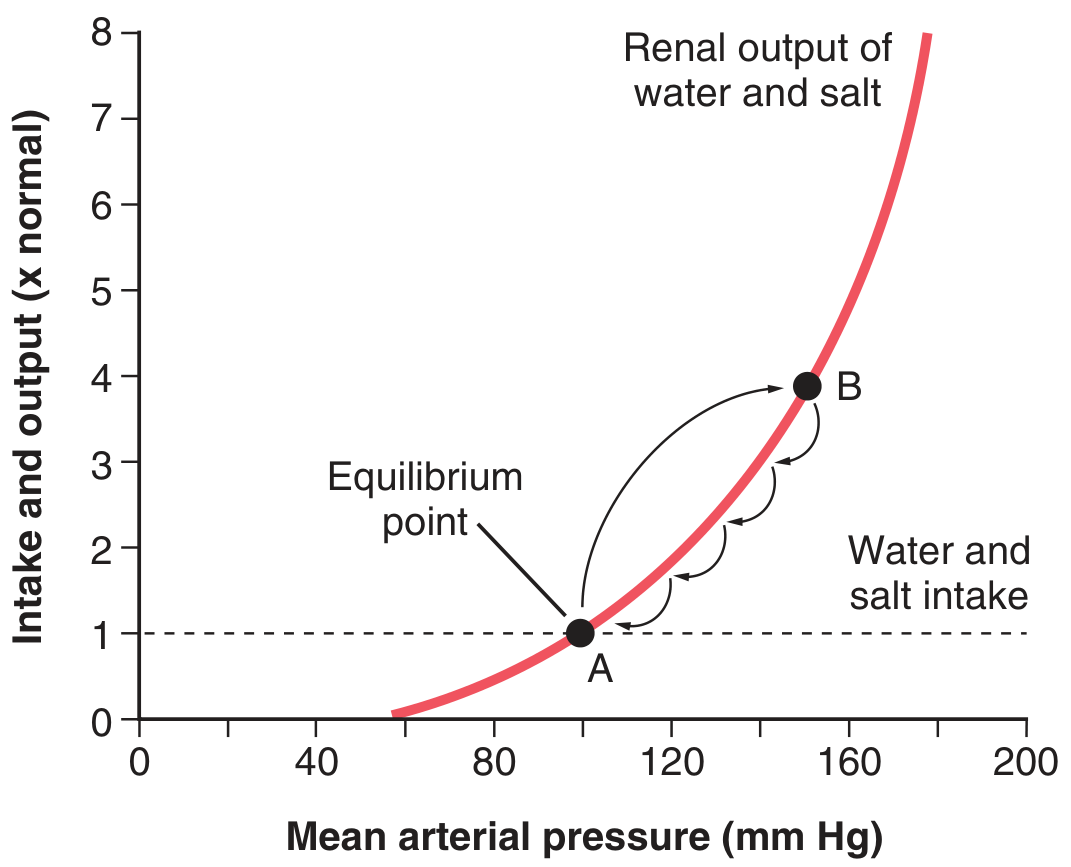
Figure 19.1: The equilibrium point (A) is where intake equals output (~100 mm Hg). If pressure rises to point B (~150 mm Hg), renal output triples, the body loses fluid, and pressure falls back to A. (Guyton & Hall, Ch. 19)
This mechanism provides nearly infinite feedback gain for long-term pressure control - any deviation from the equilibrium point triggers a corrective change in fluid volume until pressure returns exactly to the set point.
B. Two Key Determinants of Long-Term Arterial Pressure
There are only two ways to change the long-term equilibrium arterial pressure:
- Shifting the renal output curve along the pressure axis (e.g., renal disease, hormonal changes, reduced nephron mass)
- Changing the level of water and salt intake
If the renal output curve shifts 50 mm Hg to the right (e.g., due to kidney disease), the equilibrium pressure rises by 50 mm Hg, causing hypertension. Conversely, a 4-fold increase in salt and water intake without a change in the renal curve can shift equilibrium to 160 mm Hg.
C. Increased Fluid Volume Elevates Arterial Pressure via Two Pathways
The sequential mechanism by which increased extracellular fluid volume raises arterial pressure is:
↑ Extracellular fluid volume → ↑ Blood volume → ↑ Mean circulatory filling pressure → ↑ Venous return → ↑ Cardiac output → ↑ Arterial pressure
Crucially, increased cardiac output raises arterial pressure by two mechanisms:
- Direct effect: Increased cardiac output directly increases pressure
- Indirect effect via whole-body autoregulation: When excess blood flows through tissues, local vasoconstriction occurs (autoregulation), increasing total peripheral resistance and further raising pressure. This is amplified by myogenic vasoconstriction.
Both effects culminate in elevated urine output, closing the negative feedback loop as shown in the diagram below:
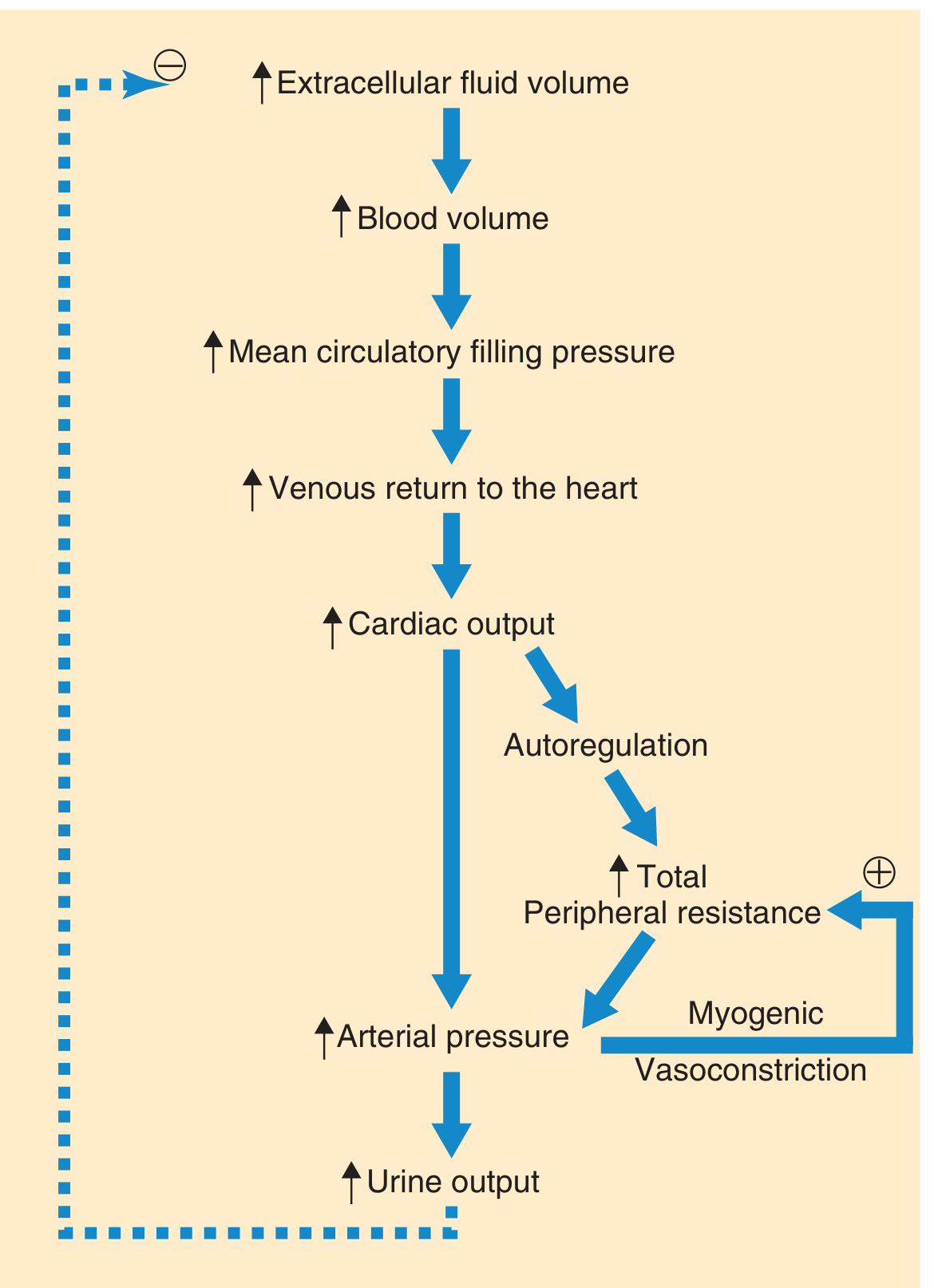
Figure 19.6: Increased extracellular fluid volume raises blood volume, cardiac output, and arterial pressure. Autoregulation and myogenic vasoconstriction amplify this via increased total peripheral resistance. (Guyton & Hall, Ch. 19)
D. Role of Total Peripheral Resistance in Long-Term Pressure
A critical concept is that an acute increase in total peripheral resistance does NOT chronically raise arterial pressure if renal function is unchanged. When TPR is acutely increased:
- Pressure initially rises
- Kidneys respond with pressure diuresis and natriuresis
- Salt and water are lost, blood volume falls
- Arterial pressure returns to the equilibrium point
However, if vascular resistance is increased specifically in the kidneys (raising renal vascular resistance and shifting the renal function curve to the right), chronic hypertension results. It is the renal resistance, not peripheral resistance per se, that is the culprit in chronically raising arterial pressure.
E. Importance of Salt (NaCl) in Long-Term Regulation
Sodium chloride is more potent than water alone in elevating arterial pressure because:
- Osmotic thirst mechanism: Excess NaCl raises extracellular osmolality → stimulates the thirst center → person drinks extra water → extracellular fluid volume increases
- ADH mechanism: Increased osmolality stimulates hypothalamic-posterior pituitary secretion of ADH → kidneys reabsorb more water from tubular fluid → diminished urine output → increased extracellular fluid volume
Thus, accumulated salt is an important determinant of extracellular fluid volume, and even small increases in blood volume can substantially raise arterial pressure.
Salt sensitivity: Most healthy people can accommodate wide ranges of sodium intake with minimal BP change because the kidneys rapidly eliminate excess salt. However, some individuals are salt-sensitive due to:
- Loss of functional nephrons (aging, kidney injury, diabetes, obesity, chronic hypertension)
- Excessive formation of antinatriuretic hormones (angiotensin II, aldosterone)
- Genetic causes (Liddle syndrome, Gordon syndrome, primary aldosteronism, congenital adrenal hyperplasia)
F. Renin-Angiotensin-Aldosterone System (RAAS) and Long-Term Pressure Regulation
The RAAS is an especially important refinement added through evolution to make the renal-body fluid system more precise. It exerts powerful effects on salt and water excretion:
- Angiotensin II promotes renal tubular sodium reabsorption and stimulates aldosterone release, both raising blood volume and pressure
- Aldosterone acts on the distal tubule and collecting duct to increase sodium (and water) reabsorption
When blood pressure rises chronically, the sympathetic nervous system is suppressed (via baroreceptor reset) and angiotensin II and aldosterone formation is reduced - this amplifies pressure natriuresis and diuresis, powerfully opposing the pressure rise. When pressure falls, these antinatriuretic systems are activated to retain salt and water.
Abnormalities that prevent adequate RAAS suppression during high sodium intake greatly increase salt sensitivity of arterial pressure. Drugs that block RAAS (ACE inhibitors, ARBs, mineralocorticoid receptor antagonists) reduce salt sensitivity by restoring effective pressure natriuresis.
G. Chronic Hypertension from Impaired Renal Function
Chronic hypertension occurs when the renal output curve is shifted permanently to a higher pressure level, caused by:
- Reduced functional nephron mass (surgical nephrectomy, kidney diseases, diabetic nephropathy)
- Increased renal vascular resistance
- Excessive antinatriuretic hormones
Guyton's experiment in dogs with 70% kidney mass removed and given salt water demonstrated this directly: arterial pressure rose ~40 mm Hg above normal within days of high NaCl intake, returning to normal when salt water was withdrawn. This demonstrates the fundamental role of the renal-body fluid equilibrium point in setting chronic arterial pressure.
III. SUMMARY TABLE: Long-Term Mechanisms
| Mechanism | Effect on Long-Term BP | Time Course |
|---|---|---|
| Renal-body fluid feedback (pressure diuresis/natriuresis) | Primary regulator; infinite gain; sets equilibrium point | Days to weeks |
| Increased salt/water intake | Shifts equilibrium point upward | Days |
| Renal output curve shift (renal disease, RAAS activation) | Raises equilibrium pressure | Days to months |
| RAAS (Ang II, Aldosterone) | Amplifies renal retention; raises BP if chronically activated | Weeks to months |
| Whole-body autoregulation (blood flow-vascular resistance) | Converts volume excess into TPR increase; sustains BP elevation | Days |
| ADH (vasopressin) | Retains water when osmolality rises; supports volume expansion | Hours to days |
IV. CONCLUSION
Long-term blood pressure regulation is dominated by the renal-body fluid system, which has virtually infinite feedback gain because it continuously operates until fluid output exactly matches intake at the equilibrium point. The kidneys are therefore the ultimate long-term arbiters of arterial pressure. Any factor that shifts the renal pressure-natriuresis/diuresis curve - whether impaired nephron mass, excessive angiotensin II, aldosterone, or increased ADH - will chronically elevate mean arterial pressure to the new equilibrium level. This principle, articulated by Guyton, explains why virtually all forms of chronic hypertension ultimately involve an impairment of the kidneys' ability to excrete sodium at normal arterial pressures.
Source: Guyton and Hall Textbook of Medical Physiology, 4th South Asia Edition - Chapter 18 (Nervous Regulation and Rapid Control) and Chapter 19 (Role of the Kidneys in Long-Term Control of Arterial Pressure and Hypertension)
This is a shared conversation. Sign in to Orris to start your own chat.