
Describe the components of Innate and adaptive immune response?8 mark
Reading File
Now let me search the medical library for comprehensive content on innate and adaptive immunity.
Finding Sources
Finding Sources
Excellent results. Let me read from the most authoritative immunology sources - Cellular and Molecular Immunology and Robbins Pathology.
Reading File
Reading File
Let me fetch the diagram image and read more content on adaptive immunity from Robbins.
Reading File
Loading Image
I now have excellent content. Let me read the adaptive immunity section more fully from Robbins.
Reading File
I have enough comprehensive content from the textbooks. Let me now compose a thorough 8-mark answer.
Components of Innate and Adaptive Immune Response
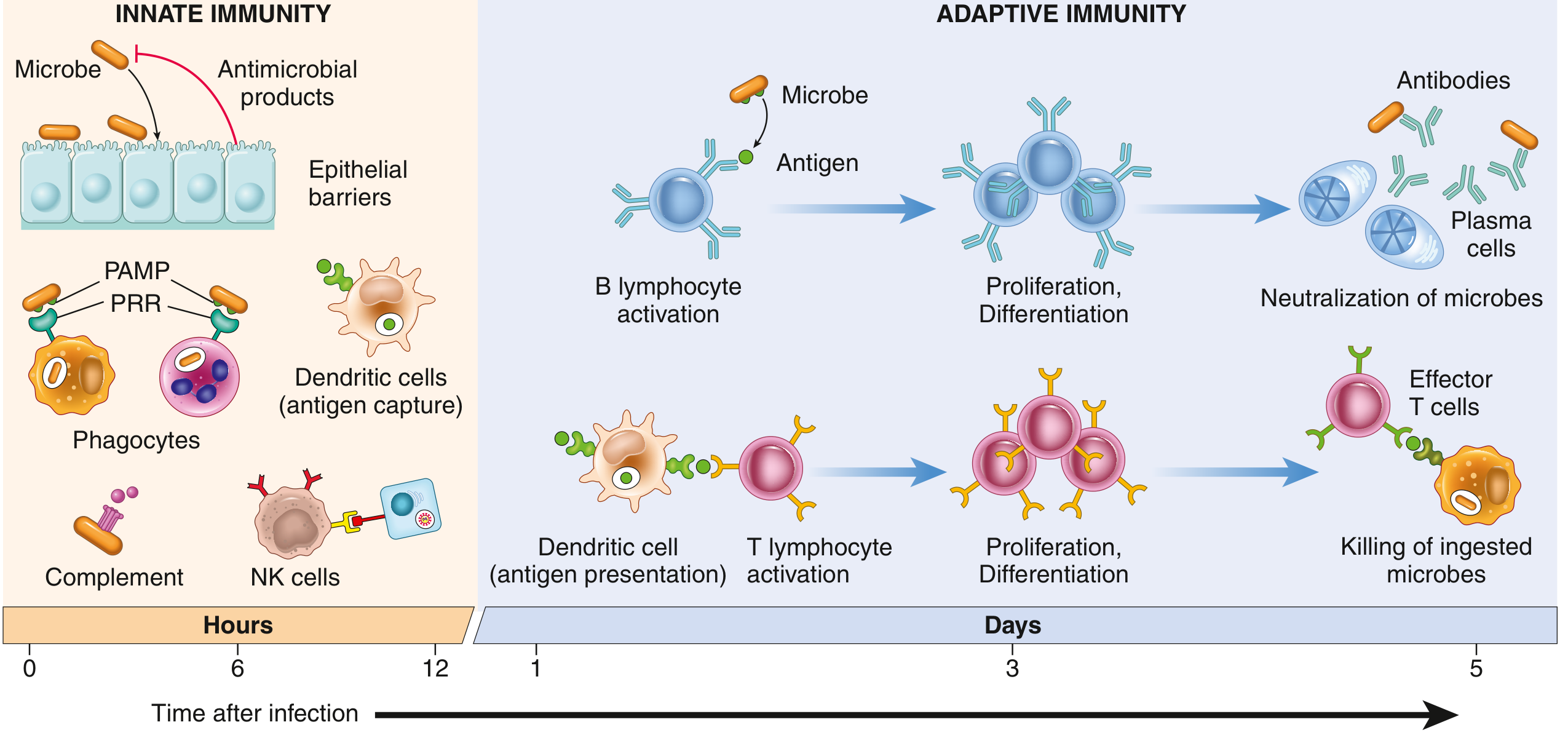
FIG. 5.1 - Robbins & Kumar Basic Pathology: Principal components and kinetics of innate vs. adaptive immune responses
I. INNATE IMMUNITY
Innate immunity is the first line of defense - it acts within minutes to hours of infection. It uses a fixed set of receptors that recognize conserved molecular patterns shared by microbes rather than fine structural differences. It does not improve with repeated exposure.
A. Physical and Chemical Barriers
The epithelial surfaces (skin, mucosae) form a mechanical barrier that prevents microbial entry. Chemical products at these surfaces include:
- Antimicrobial peptides (defensins)
- Lysozyme in secretions
- Mucus trapping in respiratory and GI tracts
These are the "first-contact" barriers that prevent most pathogens from ever entering the body.
B. Cellular Components
| Cell Type | Origin | Key Function |
|---|---|---|
| Neutrophils | Bone marrow | First recruited phagocytes; kill bacteria via ROS, enzymes, NETs |
| Macrophages | Monocytes | Tissue-resident phagocytes; secrete cytokines (TNF, IL-1, IL-6); activate adaptive immunity |
| Dendritic cells (DCs) | Bone marrow | Sentinels in tissue; capture antigens; bridge innate to adaptive by presenting antigen to T cells |
| NK cells | Bone marrow | Kill virus-infected cells and tumor cells without prior sensitization; release IFN-γ |
| Mast cells | Bone marrow | Tissue-resident; release histamine, cytokines on activation; important in allergy and parasitic defense |
| Innate lymphoid cells (ILCs) | Bone marrow | Non-antigen-specific lymphoid cells; support mucosal defense and tissue repair |
C. Pattern Recognition Receptors (PRRs)
Innate immune cells detect microbes through PRRs that recognize:
- PAMPs (Pathogen-Associated Molecular Patterns) - e.g., bacterial LPS, flagellin, viral dsRNA
- DAMPs (Damage-Associated Molecular Patterns) - signals from necrotic cells (uric acid, ATP, HMGB1)
Major PRR classes:
-
Toll-Like Receptors (TLRs): Best-characterized PRRs. Plasma membrane TLRs detect bacterial products (LPS). Endosomal TLRs detect viral/bacterial nucleic acids. Activation stimulates NF-kB -> cytokine production and costimulator upregulation.
-
NOD-Like Receptors (NLRs): Cytosolic receptors; NOD-1/NOD-2 detect bacterial peptidoglycans. Several NLRs signal via the inflammasome, activating caspase-1 -> cleaves pro-IL-1β to active IL-1β -> fever and inflammation. Relevant to gout (urate crystal detection) and autoinflammatory syndromes.
-
C-type Lectin Receptors: On macrophages and DCs; detect fungal/bacterial polysaccharides -> phagocytosis.
-
RIG-like Receptors (RLRs): Cytosolic sensors for viral RNA -> trigger type I interferon production.
-
Cytosolic DNA Sensors: Detect viral/bacterial DNA in the cytoplasm -> interferons. Dysregulation causes interferonopathies.
-
G protein-coupled receptors: On neutrophils/macrophages; detect N-formylmethionyl peptides (bacterial) -> chemotaxis.
D. Plasma Proteins
- Complement system (C1-C9): Three pathways (classical, alternative, lectin) converge to produce opsonins (C3b), chemotactic factors (C5a), and the membrane attack complex (MAC). ~100 different innate receptors recognize a few thousand molecular patterns.
- Acute phase proteins: CRP, mannose-binding lectin (MBL), fibrinogen - opsonize microbes and activate complement.
- Interferons (type I, IFN-α/β): Secreted by virus-infected cells; induce antiviral state in neighboring cells; degrade viral nucleic acids.
E. Reactions of Innate Immunity
- Inflammation - cytokines + complement fragments recruit leukocytes that destroy pathogens and clear dead cells
- Antiviral defense - type I interferons block viral replication
- Bridging to adaptive immunity - DCs upregulate MHC molecules and costimulators; innate cytokines (IL-12) direct the type of adaptive response
II. ADAPTIVE IMMUNITY
Adaptive immunity develops over days to weeks, is mediated by lymphocytes, and improves dramatically with each encounter (immunological memory). It recognizes an enormous variety of distinct antigens.
Cardinal Features
- Specificity: Each lymphocyte clone recognizes a single epitope (clonal selection theory, Burnet 1957)
- Diversity: ~10^7 - 10^9 distinct antigenic specificities in the lymphocyte repertoire
- Memory: Secondary responses are faster, greater in magnitude, and qualitatively superior
- Self-tolerance: Lymphocytes reactive to self-antigens are normally eliminated or suppressed
A. Humoral Immunity (B Lymphocytes)
B cells originate and mature in bone marrow. They carry surface immunoglobulin as their B-cell receptor (BCR) - a transmembrane antibody with two heavy and two light chains linked by disulfide bonds. BCR can directly recognize native (unprocessed) antigens in the blood, lymph, and mucosal secretions.
On activation (usually with T-cell help):
- B cells proliferate and differentiate into plasma cells (antibody-secreting factories)
- Some become long-lived memory B cells
Functions of antibodies:
- Neutralization - block microbial attachment to host cells
- Opsonization - coat pathogens for phagocytosis (via Fc receptors)
- Complement activation - via the classical pathway
- ADCC - Antibody-dependent cellular cytotoxicity (NK cells kill Ab-coated targets)
Antibody classes (Isotypes): IgM (first responder), IgG (most abundant, crosses placenta), IgA (mucosal), IgE (allergy/parasites), IgD (B-cell surface receptor)
B. Cell-Mediated Immunity (T Lymphocytes)
T cells mature in the thymus and constitute 60-70% of peripheral blood lymphocytes. Unlike B cells, T cells cannot recognize free antigen - they only see peptide fragments presented by MHC molecules on antigen-presenting cells (APCs).
T-cell receptor (TCR): Heterodimer of α and β chains, each with a variable (antigen-binding) and constant region. Diversity generated by somatic V(D)J recombination.
Two Major T-cell Subsets:
1. CD4+ Helper T cells (Th)
- Recognize antigen presented by MHC class II (on APCs: dendritic cells, macrophages, B cells)
- Secrete cytokines that help B cells produce antibodies and help macrophages destroy phagocytosed microbes
- HIV destroys CD4+ cells -> severe combined immunodeficiency
- Further differentiate into:
- Th1: secrete IFN-γ -> activate macrophages (intracellular pathogen defense)
- Th2: secrete IL-4, IL-5, IL-13 -> eosinophil activation, IgE production (allergy/parasites)
- Th17: secrete IL-17 -> neutrophil recruitment (extracellular bacteria/fungi)
- T follicular helper (Tfh): assist B cells in germinal centers
2. CD8+ Cytotoxic T Lymphocytes (CTLs)
- Recognize antigen on MHC class I (on all nucleated cells)
- Directly kill virus-infected cells, tumor cells, and graft cells
- Kill via perforin/granzyme pathway and Fas-FasL interactions
Regulatory T cells (Tregs)
- CD4+CD25+FoxP3+ cells
- Suppress immune responses; maintain peripheral tolerance
- Prevent autoimmunity
C. Antigen-Presenting Cells (APCs)
| APC | Key Features |
|---|---|
| Dendritic cells | Most potent APCs; tissue sentinels; express high MHC II + costimulators; bridge innate/adaptive |
| Macrophages | Present antigen to T cells AND effector function (phagocytosis) |
| B cells | Present antigen to Th cells to receive help for antibody production |
APCs provide two signals for T-cell activation:
- Signal 1: Antigen-MHC binds TCR
- Signal 2 (Costimulation): B7 (CD80/CD86) on APC binds CD28 on T cell
Without Signal 2, T cells become anergic (tolerant).
D. Cytokines - Soluble Mediators
Cytokines coordinate both arms:
| Cytokine | Source | Function |
|---|---|---|
| IL-1, IL-6, TNF | Macrophages | Inflammation, fever, acute phase response |
| IL-12 | DCs, macrophages | Drive Th1 responses; activate NK cells |
| IFN-γ | Th1, NK cells | Activate macrophages; antiviral |
| IL-4 | Th2 cells | B-cell class switching to IgE; Th2 differentiation |
| IL-17 | Th17 cells | Neutrophil recruitment |
| TGF-β, IL-10 | Tregs | Anti-inflammatory, tolerance |
Summary Comparison Table
| Feature | Innate Immunity | Adaptive Immunity |
|---|---|---|
| Response time | Minutes to hours | Days to weeks |
| Specificity | Broad (PAMPs/DAMPs) | Exquisitely specific (individual epitopes) |
| Memory | None | Long-lived memory cells |
| Receptors | PRRs (TLRs, NLRs, etc.) - germline encoded | TCR, BCR - somatically rearranged |
| Key cells | Neutrophils, macrophages, NK cells, DCs | T cells, B cells |
| Mediators | Complement, interferons, cytokines | Antibodies, cytokines |
| Diversity | ~100 receptors, few thousand patterns | 10^7 - 10^9 specificities |
Sources: Robbins & Kumar Basic Pathology, p. 155-160; Cellular and Molecular Immunology, p. 32-35
This is a shared conversation. Sign in to Orris to start your own chat.