
Explain ecg and most common way to understand ECG and most commonly asked pyq in neet pg
Reading File
Now let me search the medical library and web simultaneously for ECG content and NEET PG previous year questions.
Finding Sources
Searching the Web
NEET PG most commonly asked ECG questions previous year 2022 2023 2024
Finding Sources
Searching the Web
NEET PG ECG important topics cardiology physiology asked repeatedly INI CET
Reading File
Finding Sources
Reading Web Page
https://getoncourse.ai/blog/high-yield-neet-pg-cardiology-to…
Reading File
Finding Sources
Finding Sources
Finding Sources
Reading File
Reading File
Now I have comprehensive data. Let me compile the full answer.
Loading Image
Here is a thorough, exam-focused guide to ECG for NEET PG.
ECG (Electrocardiogram) - Complete NEET PG Guide
1. What is an ECG?
An ECG records the heart's electrical activity over time using electrodes placed on the body surface. It captures sequential depolarization and repolarization events across the cardiac cycle, giving direct information about rate, rhythm, conduction, and structural changes.
- Standard paper speed: 25 mm/sec
- Standard calibration: 10 mm = 1 mV
- Grid: Small box = 1 mm = 0.04 sec; Large box = 5 mm = 0.2 sec
- 5 large boxes = 1 second
(Medical Physiology, BOX 21-2)
2. ECG Waves and Their Meaning
| Wave/Segment | What it Represents | Normal Duration |
|---|---|---|
| P wave | Atrial depolarization | < 120 ms, amplitude < 2.5 mm |
| PR interval | AV nodal conduction (SA → ventricles) | 120-200 ms |
| QRS complex | Ventricular depolarization | < 120 ms |
| ST segment | Plateau phase of ventricular action potential | Isoelectric |
| T wave | Ventricular repolarization | Upright in most leads |
| QT interval | Total ventricular electrical activity | Corrected QTc < 440 ms (men), < 460 ms (women) |
| U wave | Slow repolarization of His-Purkinje system | Best seen in V2-V3 |
3. The Systematic 7-Step Approach to ECG
This is the most reliable method for NEET PG and clinical practice. Memorize it in this exact order:
Step 1 - RATE
- Regular rhythm: Rate = 300 / (number of large boxes between R-R)
- Memory trick for large-box count: 300 - 150 - 100 - 75 - 60 - 50 (for 1, 2, 3, 4, 5, 6 large boxes)
- Irregular rhythm: Count QRS complexes in a 10-second strip and multiply by 6
- Normal: 60-100 bpm | Tachycardia: >100 | Bradycardia: <60
Step 2 - RHYTHM
- Is it regular or irregular?
- Is there a P wave before every QRS? Is there a QRS after every P?
- Normal sinus rhythm: P wave upright in II, inverted in aVR, followed by QRS
Step 3 - AXIS
- Normal axis: -30° to +90°
- Quick method: If QRS is positive in lead I and positive in aVF → Normal axis
- Left axis deviation (LAD): Positive I, negative aVF (left anterior hemiblock, LVH, inferior MI)
- Right axis deviation (RAD): Negative I, positive aVF (RVH, PE, lateral MI)
- Extreme axis: Negative in both I and aVF
Step 4 - P WAVE
- Morphology, duration, axis
- P pulmonale: Peaked P >2.5 mm in II (RA enlargement)
- P mitrale: Broad notched P >120 ms (LA enlargement)
Step 5 - PR INTERVAL
- Short PR (<120 ms): WPW syndrome, LGL syndrome, junctional rhythm
- Long PR (>200 ms): First-degree AV block
Step 6 - QRS COMPLEX
- Duration >120 ms = bundle branch block or ventricular rhythm
- Pathological Q wave: >40 ms wide OR >25% of R wave height = old MI
- LBBB: Broad QRS, no septal q waves, RSR' (M shape) in V5/V6, deep S in V1
- RBBB: RSR' (rabbit ears) in V1, deep S in I, V5, V6
Step 7 - ST SEGMENT AND T WAVE
- ST elevation: STEMI, pericarditis, Brugada, early repolarization
- ST depression: NSTEMI, ischemia, digoxin effect, LVH strain
- T wave inversion: Ischemia, RBBB, PE (V1-V4), Wellens syndrome
- Peaked T waves: Hyperkalemia
4. AV Block Classification (High-Yield Table)
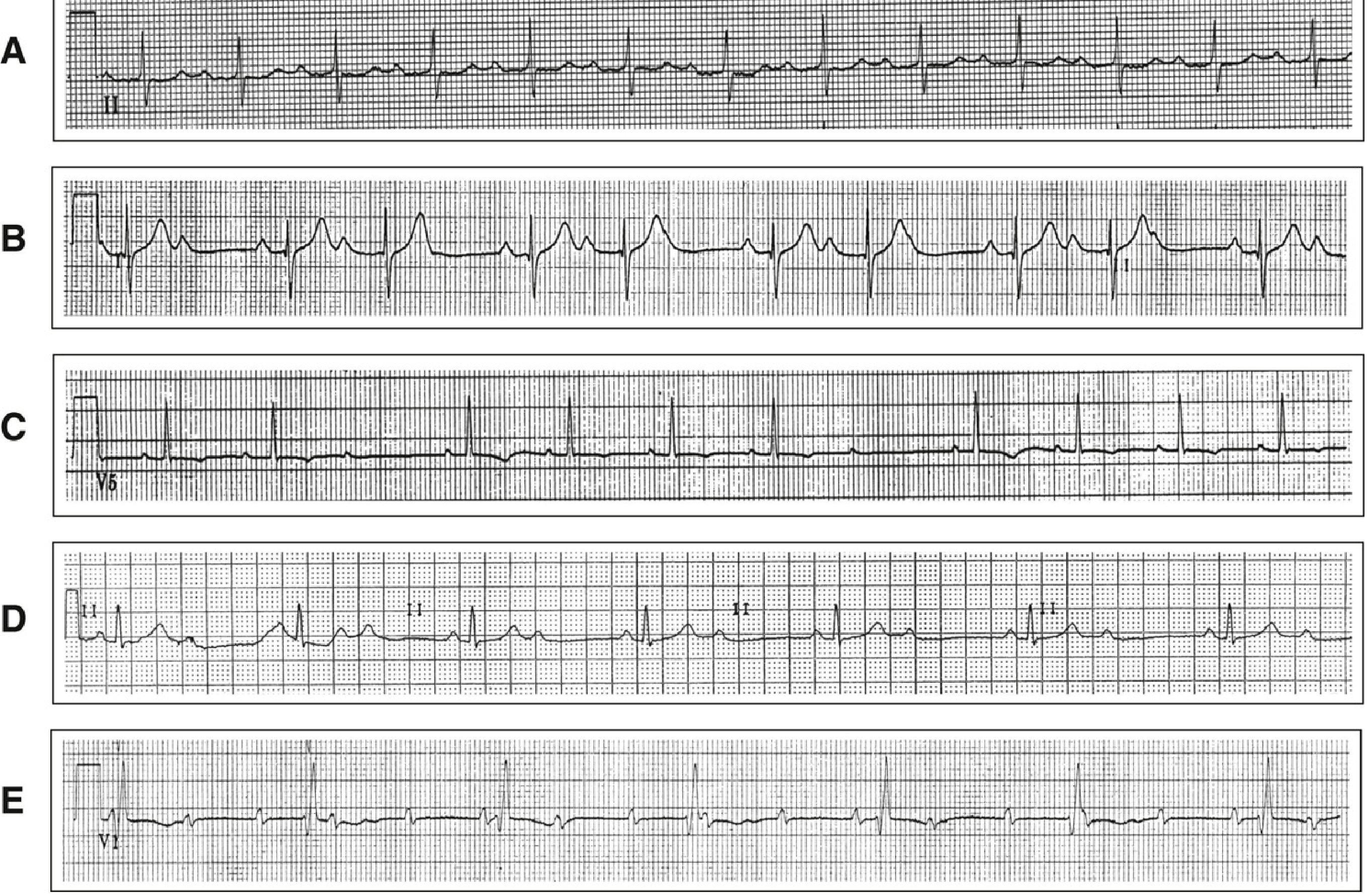
| Block | ECG Finding | Site | Treatment |
|---|---|---|---|
| 1st degree | PR >200 ms, all P waves conduct | AV node | None |
| 2nd degree Mobitz I (Wenckebach) | Progressive PR lengthening → dropped QRS; group beating | AV node | Usually none; observe |
| 2nd degree Mobitz II | Fixed PR interval, sudden dropped QRS; often wide QRS | Infranodal (His-Purkinje) | Permanent pacemaker |
| 2:1 Block | 2 P waves for every 1 QRS - can't distinguish Mobitz I vs II | - | Treat as Mobitz II if QRS wide |
| 3rd degree (Complete) | AV dissociation; P rate > QRS rate; no relationship | Complete block | Permanent pacemaker |
(Harrison's Principles of Internal Medicine 22E, Table 252-1; Washington Manual)
Key NEET PG point: Mobitz II always needs pacing even if asymptomatic. Wenckebach (Mobitz I) is benign and usually does NOT need pacing.
5. Most Commonly Asked NEET PG ECG Topics
Cardiology accounts for 12-15% of NEET PG questions, with ECG being the single highest-yield subtopic (25-30 questions per exam cycle).
A. Myocardial Infarction ECG Changes
| Stage | ECG Finding |
|---|---|
| Hyperacute (minutes) | Peaked (tall, broad) T waves ("hyperacute T waves") |
| Acute (<12 hours) | ST elevation (convex/domed upward) in territory leads |
| Evolving (hours-days) | ST elevation + Q wave formation + T wave inversion |
| Old/Established | Pathological Q waves + T wave inversion |
Territory localization (NEET favorite):
- Anterior MI (LAD): ST elevation V1-V4
- Inferior MI (RCA): ST elevation II, III, aVF; reciprocal ST depression in I, aVL
- Lateral MI (LCx): ST elevation I, aVL, V5-V6
- Posterior MI: ST depression V1-V3 + tall R in V1 (mirror image); confirm with V7-V9
- RV MI (proximal RCA): ST elevation in V4R; associated with inferior MI
B. Atrial Fibrillation (AF)
- Irregularly irregular rhythm - no two R-R intervals equal
- No P waves - replaced by fibrillatory (f) baseline
- Narrow QRS (usually) unless aberrant conduction or WPW
- Classic association: Mitral stenosis, thyrotoxicosis, hypertension
- NEET PG pearl: AF + very fast irregular wide-complex tachycardia = WPW + AF (pre-excited AF) - do NOT give AV nodal blockers (digoxin, verapamil, adenosine)
C. Ventricular Tachycardia (VT) vs. SVT with Aberrancy
| Feature | VT | SVT with aberrancy |
|---|---|---|
| QRS duration | >160 ms (very wide) | 120-160 ms |
| AV dissociation | Present (P rate ≠ QRS rate) | Absent |
| Capture beats | Present | Absent |
| Fusion beats | Present | Absent |
| Concordance in chest leads | Positive or negative concordance | Usually absent |
| Brugada sign | RS nadir >100 ms | Usually <100 ms |
| Clinical rule | Wide complex tachycardia = VT until proven otherwise |
D. Hyperkalemia ECG Progression (Sequential Changes)
- Peaked (tented) T waves - earliest
- PR prolongation + P wave flattening
- Wide QRS complex
- Sine wave pattern - pre-terminal
- VF/Asystole
E. Wolff-Parkinson-White (WPW) Syndrome
- Short PR (<120 ms)
- Delta wave (slurred upstroke of QRS)
- Wide QRS (>120 ms)
- Secondary ST-T changes
- Type A WPW: Positive delta in V1 (left accessory pathway)
- Type B WPW: Negative delta in V1 (right accessory pathway)
F. Bundle Branch Blocks
RBBB (RSR' in V1 - "rabbit ears"):
- QRS >120 ms
- RSR' pattern in V1 (M pattern)
- Broad S waves in I, V5, V6
- Causes: RV strain, PE, ASD, normal variant
LBBB (W in V1, M in V6):
- QRS >120 ms
- Broad R, no septal q, no normal R progression V1-V3
- RSR' (M shape) in I, aVL, V5, V6
- NEET pearl: New LBBB + chest pain = STEMI equivalent; treat as STEMI
G. Pericarditis ECG Changes
- Saddle-shaped (concave upward) ST elevation in multiple leads (diffuse, not regional)
- PR depression in multiple leads (most specific finding)
- No reciprocal ST depression (unlike STEMI)
- No Q waves
- Stage IV: T wave normalization
H. Long QT Syndrome
- QTc >440 ms (men), >460 ms (women)
- Risk of Torsades de Pointes (TdP)
- Causes: Congenital (Romano-Ward, Jervell-Lange-Nielsen), drugs (amiodarone, sotalol, haloperidol, erythromycin, fluoroquinolones), hypokalemia, hypomagnesemia
- TdP ECG: Twisting of QRS axis around isoelectric line
I. Pulmonary Embolism (PE) - S1Q3T3
- Sinus tachycardia (most common ECG finding in PE)
- S1Q3T3: Deep S in lead I, Q wave in III, inverted T in III
- RBBB (incomplete or complete)
- Right axis deviation
- T inversion V1-V4 (right heart strain pattern)
- NEET pearl: S1Q3T3 is classic but rare; sinus tachycardia is actually the most common finding
J. Brugada Syndrome
- Coved-type ST elevation in V1-V3 (≥2 mm downsloping ST elevation + T wave inversion)
- RBBB pattern
- Risk of sudden cardiac death (SCD) from VF
- Autosomal dominant (SCN5A mutation)
- Unmasked by: fever, flecainide test, sodium channel blockers
6. Normal ECG Intervals - Quick Reference Table
| Parameter | Normal Value |
|---|---|
| PR interval | 120-200 ms (3-5 small boxes) |
| QRS duration | 60-100 ms (<3 small boxes) |
| QT interval | <440 ms (men); <460 ms (women) |
| P wave duration | <120 ms |
| P wave amplitude | <2.5 mm (limb leads) |
| R-R interval at 75 bpm | 4 large boxes (800 ms) |
7. Quick Memory Tricks for NEET PG
- Rate rule: 300-150-100-75-60-50 for 1-6 large boxes
- Axis in 4 steps: Lead I (+) and aVF (+) = Normal; I(+) aVF(-) = LAD; I(-) aVF(+) = RAD; both negative = Extreme
- LBBB vs RBBB in V1: LBBB = W (rS), RBBB = M (RSR')
- Wenckebach = Benign, Mobitz II = Dangerous
- WPW triad: Short PR + Delta wave + Wide QRS
- Hyperkalemia: T peaks first, then P disappears, then QRS widens, then sine wave
- AF: Irregularly irregular + no P waves
- PE: Sinus tachycardia is most common; S1Q3T3 is classic but rare
- Pericarditis vs STEMI: Saddle-shaped vs convex ST elevation; PR depression in pericarditis; no reciprocal changes
8. NEET PG Image-Based ECG Questions - What to Expect
Based on exam trends (2022-2025), the NBE increasingly asks image-based ECG strips requiring direct identification. Most common patterns tested:
- STEMI with territory identification - "ECG shows ST elevation in II, III, aVF - which artery?"
- Complete heart block - AV dissociation with slow ventricular rate
- Atrial fibrillation - irregular rate, no P waves
- VT vs SVT - wide complex tachycardia differential
- WPW - delta wave + short PR
- Hyperkalemia - peaked T waves or sine wave
- LBBB/RBBB - RSR' pattern identification
- PE - S1Q3T3 pattern
- Brugada - coved ST elevation V1-V3
- Pericarditis - diffuse saddle-shaped ST elevation + PR depression
Sources: Medical Physiology (Boron & Boulpaep, BOX 21-2); Harrison's Principles of Internal Medicine 22E; Washington Manual of Medical Therapeutics; NEET PG High-Yield Cardiology Topics 2026.
This is a shared conversation. Sign in to Orris to start your own chat.