
Sebaceous cyst post auricular
Reading File
Searching for clinical information on post-auricular sebaceous cysts, covering presentation, diagnosis, and management.
search_medical_text
sebaceous cyst post auricular presentation diagnosis management
Bailey and Love's Short Practice of Surgery 28th Edition
Page 945
GradeResponse
GradeResponse
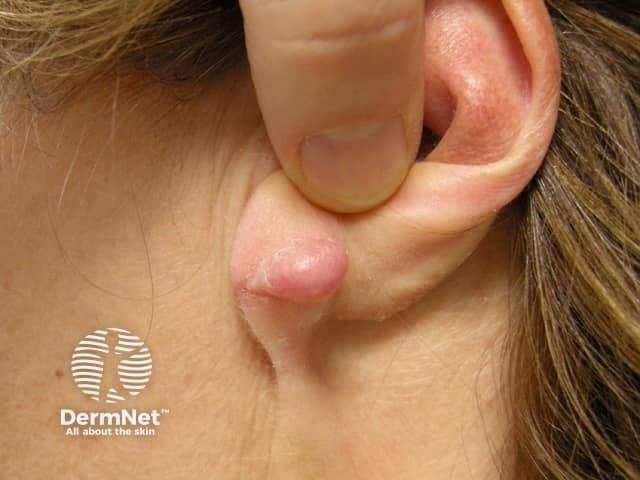
Post-Auricular Sebaceous Cyst
Overview
A sebaceous (epidermal inclusion) cyst in the post-auricular region is one of the most common benign cutaneous lesions behind the ear. Despite the name, true "sebaceous" cysts are usually epidermal inclusion cysts (EICs) histologically — lined by stratified squamous epithelium and filled with keratin/sebaceous material, not a true sebaceous gland neoplasm.
Etiology & Pathogenesis
- Arise from occlusion or disruption of the pilosebaceous unit or implantation of epidermis into the dermis
- Post-auricular location is predisposed due to:
- Dense concentration of pilosebaceous follicles behind the ear
- Friction from spectacle frames, hearing aids, headphones
- Minor trauma (ear piercing, scratching)
- Blocked duct → accumulation of keratin/sebum → cyst wall expansion
Clinical Features
| Feature | Description |
|---|---|
| Location | Post-auricular sulcus (most common), mastoid skin, lobule |
| Appearance | Dome-shaped, smooth, well-circumscribed nodule |
| Size | Few mm to several cm |
| Consistency | Soft to firm, fluctuant if large |
| Color | Skin-colored, white, or yellowish |
| Punctum | Characteristic central dark punctum (not always visible) |
| Mobility | Freely mobile over deeper structures |
| Tenderness | Non-tender unless infected |
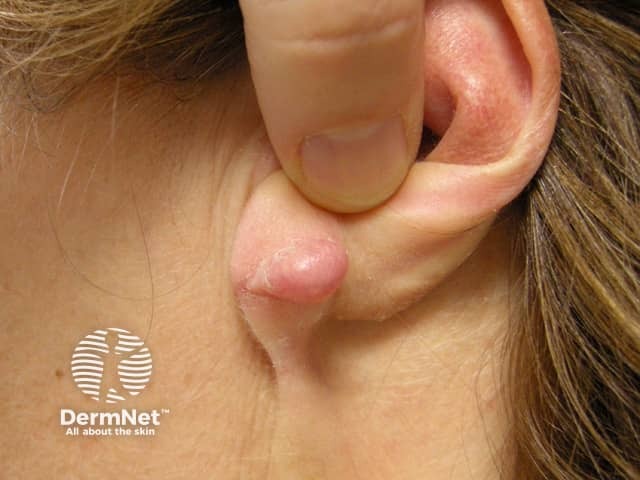
Diagnosis
Diagnosis is primarily clinical:
- Well-defined subcutaneous swelling, doughy or fluctuant
- Presence of a punctum is pathognomonic
- Cheesy/malodorous whitish material may extrude on pressure
Investigations (if uncertain):
- USS (ultrasound): Hypoechoic, well-defined cystic lesion — confirms diagnosis, excludes solid tumor or lymph node
- Fine needle aspiration (FNAC): Reveals amorphous keratin debris
- Histopathology after excision: Definitive — shows stratified squamous epithelium-lined cyst with lamellated keratin
Differential Diagnosis
| Condition | Distinguishing Features |
|---|---|
| Lipoma | Softer, deeper, lobulated, no punctum |
| Post-auricular lymph node | Reactive/tender, associated infection, no cyst feel |
| Dermoid cyst | Present since birth, midline tendency, may have sinus |
| Preauricular sinus/cyst | Anterior to tragus, congenital |
| Pilar cyst (trichilemmal) | More common on scalp, firm, no punctum |
| Pyogenic granuloma | Red, vascular, bleeds easily |
| Keratoacanthoma | Rapid growth, central keratin plug, older patients |
| Mastoiditis | Deep, bony tenderness, ± otorrhea, constitutional symptoms |
Complications
- Infection/Abscess: Most common complication — erythema, tenderness, fluctuance, purulent discharge
- Rupture: Spontaneous or traumatic, foreign body reaction
- Recurrence: If cyst wall is incompletely excised
- Malignant transformation: Extremely rare — squamous cell carcinoma arising in cyst wall
Management
Uncomplicated Cyst
- Observation is acceptable if asymptomatic and small
- Elective surgical excision — definitive treatment
- Elliptical excision including the punctum and intact cyst wall
- Complete removal of the cyst wall is essential to prevent recurrence
- Post-auricular approach gives good cosmetic scar
Infected/Inflamed Cyst
- Acute phase: Incision and drainage (I&D) + antibiotics (e.g., co-amoxiclav or clindamycin)
- Do NOT excise acutely — inflamed tissue planes make complete removal difficult and increase recurrence risk
- Definitive excision planned 4–6 weeks after resolution of infection
Surgical Tips
- Use fine curved scissors to dissect around the cyst wall without rupture
- If cyst wall ruptures intraoperatively: curette the cavity thoroughly and irrigate
- Specimen sent for histopathology routinely
Prognosis
- Benign, with excellent prognosis after complete excision
- Recurrence rate is low (~1–5%) with complete wall removal
- Higher recurrence if cyst ruptures during surgery or if excised during active infection
Key clinical pearl: The post-auricular region is a classic site for sebaceous/epidermal inclusion cysts. Always look for the central punctum to differentiate from lymphadenopathy or lipoma, and always excise the entire cyst wall intact for cure.
This is a shared conversation. Sign in to Orris to start your own chat.