
Nephrotic syndrome cause
Reading File
Finding Sources
Searching PubMed
"nephrotic syndrome" causes etiology
Reading File
Reading File
Finding Sources
Reading File
Reading File
Reading File
Reading File
Loading Image
Reading File
Here is a comprehensive breakdown of the causes of nephrotic syndrome, drawn from multiple nephrology textbooks.
Nephrotic Syndrome - Causes
Definition: Nephrotic syndrome = proteinuria >3.5 g/24 hr + serum albumin <3.5 g/dL + edema + hyperlipidemia/lipiduria.
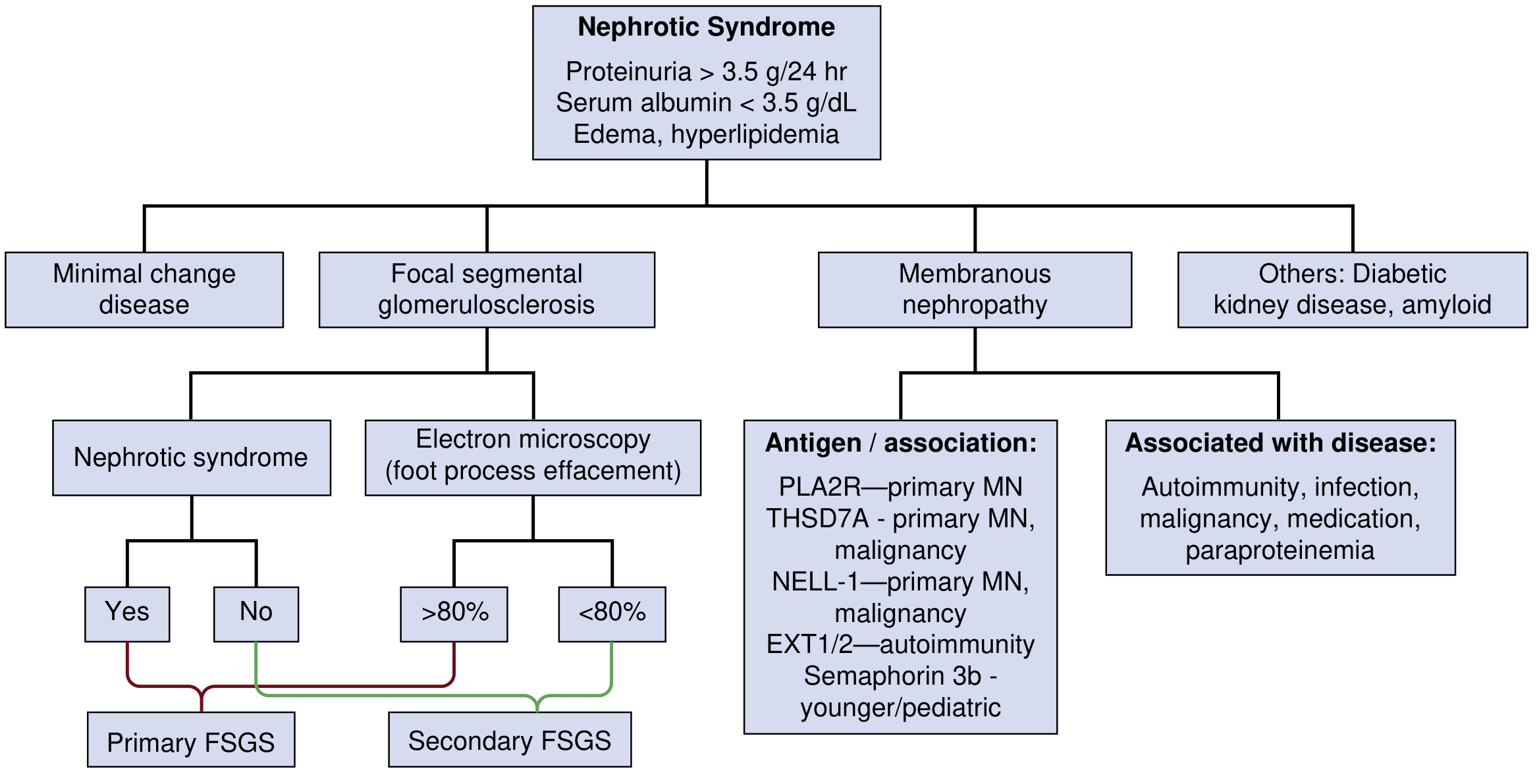
PRIMARY (Idiopathic) Causes
These arise from intrinsic glomerular disease with no identifiable systemic trigger. The underlying mechanism in all primary causes involves podocyte injury disrupting the glomerular filtration barrier.
1. Minimal Change Disease (MCD)
- Most common cause in children (70-90% of pediatric nephrotic syndrome); accounts for ~15% of adult cases.
- Light microscopy is normal; electron microscopy shows diffuse foot process effacement.
- Pathogenesis is unknown but linked to T-cell dysfunction.
- Associations: NSAID use, Hodgkin lymphoma, thymoma.
- Highly steroid-responsive.
2. Focal Segmental Glomerulosclerosis (FSGS)
- Accounts for ~25% of adult nephrotic syndrome; most common cause in people of African descent.
- Classified as:
- Primary FSGS - due to an undiscovered circulating podocyte permeability factor.
- Secondary FSGS - viral (HIV, parvovirus B19, CMV, COVID-19), drug-induced (heroin, pamidronate, interferon, sirolimus, anabolic steroids), adaptive/maladaptive (obesity, reduced nephron mass, low birth weight, unilateral renal agenesis, sickle cell anemia, hypertensive nephrosclerosis, aging).
- Genetic FSGS - mutations in podocyte genes: NPHS1 (nephrin), NPHS2 (podocin), PLCE1, INF2, ACTN4, APOL1.
- Collapsing FSGS is strongly associated with HIV.
3. Membranous Nephropathy (MN)
- Most common cause of nephrotic syndrome in white adults (4th-5th decade, M:F = 2:1).
- Characterized by subepithelial immune deposits in the GBM; silver stain shows "spikes."
- Primary MN - autoantibodies against:
- PLA2R (phospholipase A2 receptor) - ~70% of primary cases
- THSD7A (~1-3%)
- NELL-1, EXT1/2, Semaphorin 3B (recently identified)
- Secondary MN - associated with:
- Autoimmune: SLE (lupus nephritis class V)
- Infections: Hepatitis B, hepatitis C, syphilis
- Malignancy: solid tumors (especially lung, colon, breast)
- Drugs: NSAIDs, gold, penicillamine, captopril
- Paraproteinemias
4. Mesangial Proliferative GN
- Less common; seen particularly in children.
SECONDARY Causes
Systemic diseases that damage the glomerulus and produce a nephrotic picture.
| Disease | Mechanism |
|---|---|
| Diabetic nephropathy | Most common cause of kidney failure in the US; GBM thickening, mesangial expansion, Kimmelstiel-Wilson nodules; appears 10-15 years post-diabetes onset |
| Amyloidosis (AL/AA) | Amyloid fibrils deposit in the glomerulus; Congo red staining positive; commonly associated with plasma cell dyscrasias or chronic inflammation |
| Systemic Lupus Erythematosus (SLE) | Immune complex deposition; class V lupus nephritis presents with nephrotic syndrome |
| Infections | Hepatitis B, hepatitis C, HIV, syphilis, malaria, schistosomiasis |
| Malignancy | Solid tumors (MN-pattern), Hodgkin lymphoma (MCD-pattern), leukemia/lymphoma |
| Drugs | Gold, penicillamine, NSAIDs, captopril, heroin, pamidronate, interferon |
| Preeclampsia | Glomerular endotheliosis in pregnancy |
| Hereditary nephropathies | Alport syndrome, congenital nephrotic syndrome (Finnish type - NPHS1 mutation) |
CONGENITAL / INFANTILE Causes (Pediatric)
- Congenital nephrotic syndrome (Finnish type) - mutations in NPHS1 (nephrin gene); presents within the first 3 months of life.
- Other genetic mutations: NPHS2 (podocin), WT1, LAMB2 (Pierson syndrome).
Key Points by Age Group
| Age Group | Most Common Cause |
|---|---|
| Infants (<1 yr) | Congenital/genetic (NPHS1, NPHS2) |
| Children (1-8 yrs) | Minimal change disease (~80%) |
| Older children/adolescents | MCD, FSGS |
| Adults (white) | Membranous nephropathy |
| Adults (African descent) | FSGS |
| Adults (diabetic) | Diabetic nephropathy |
| Elderly | Membranous nephropathy (consider occult malignancy), amyloidosis |
Sources:
- National Kidney Foundation Primer on Kidney Diseases, 8e (Ch. 16)
- Tietz Textbook of Laboratory Medicine, 7th Ed.
- Campbell-Walsh-Wein Urology
- Brenner and Rector's The Kidney
This is a shared conversation. Sign in to Orris to start your own chat.