
Diabetes mellitus flashcard
A detailed medical flashcard titled "Diabetes Mellitus" with a clean clinical layout. Include the following sections clearly organized: DEFINITION: Metabolic disorder characterized by hyperglycemia due to defects in insulin secretion, insulin action, or both. CLASSIFICATION (4 types listed): - Type 1 DM: Autoimmune beta-cell destruction → absolute insulin deficiency (5-10% of cases) - Type 2 DM: Insulin resistance + progressive beta-cell failure (most common, 90-95%) - Gestational DM: Hyperglycemia first detected in pregnancy - Other: MODY, drug-induced (steroids, thiazides), pancreatic disease PATHOPHYSIOLOGY: T1DM: Autoantibodies (ICA, IAA, anti-GAD, anti-IA-2) → HLA DR/DQ association T2DM: Insulin resistance → compensatory hyperinsulinemia → beta-cell exhaustion CLASSIC SYMPTOMS (3 Ps): Polyuria | Polydipsia | Polyphagia + weight loss, fatigue, blurred vision DIAGNOSTIC CRITERIA (any one of 4): 1. FPG ≥ 126 mg/dL (fasting ≥8 hrs) 2. 2-hr OGTT ≥ 200 mg/dL (75g glucose load) 3. HbA1c ≥ 6.5% 4. Random glucose ≥ 200 mg/dL + symptoms [Prediabetes: FPG 100-125 | OGTT 140-199 | HbA1c 5.7-6.4%] COMPLICATIONS: Microvascular: Retinopathy | Nephropathy | Neuropathy Macrovascular: CAD | Stroke | Peripheral artery disease Acute: DKA (T1DM) | HHS (T2DM) TREATMENT: T1DM: Insulin (basal-bolus regimen) T2DM: Lifestyle changes → Metformin (1st line) → Add SGLT-2 inhibitor / GLP-1 agonist / Sulfonylurea / Insulin HbA1c target: < 7% (general), individualized per patient MONITORING: HbA1c (every 3 months) | Self-monitoring blood glucose | Annual eye exam, urine microalbumin, foot exam Use a professional blue and white medical color scheme with clear section headers, icons or simple illustrations for each section, organized in a grid layout suitable for studying.
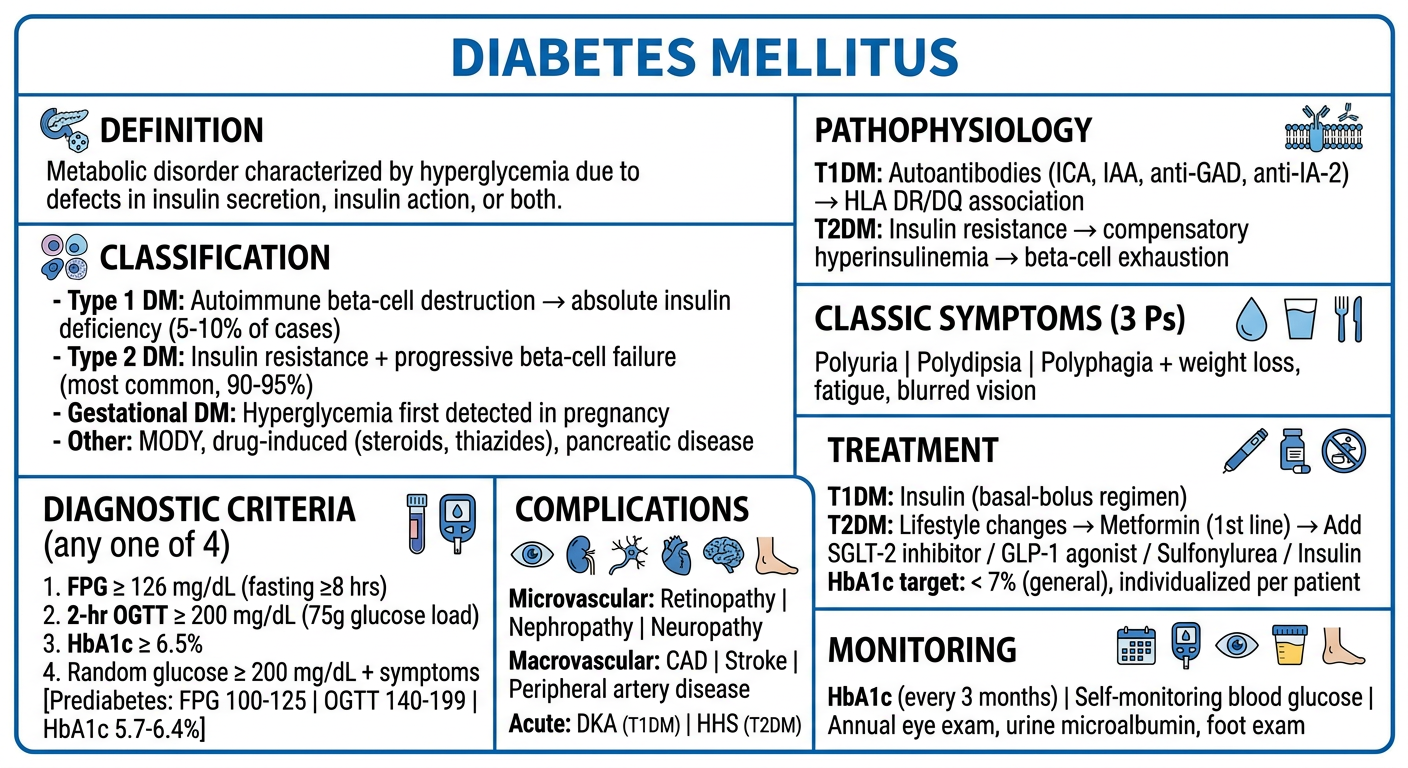
- Classification covers all 4 WHO/ADA categories: T1DM, T2DM, Gestational, and Secondary/Other causes
- Diagnostic criteria reflect current ADA standards - any single criterion (confirmed on a separate day if asymptomatic) is sufficient
- Prediabetes thresholds are included for comparison
- Complications are split into micro- vs. macrovascular, plus the two major acute emergencies (DKA in T1DM, HHS in T2DM)
- Treatment follows the stepwise T2DM algorithm with SGLT-2 inhibitors and GLP-1 agonists as preferred add-ons, especially when cardiovascular or renal disease is present
- HbA1c reflects 3-month average glucose; unreliable in hemolytic anemias or sickle cell disease
Generate a quick-reference chart of antidiabetic drugs & mechanisms
A professional medical quick-reference chart titled "Antidiabetic Drugs: Mechanisms & Key Features" with a clean white background, organized as a detailed comparison table with color-coded drug class rows. The chart should have columns: Drug Class | Examples | Mechanism of Action | Key Benefits | Key Adverse Effects | Notes/Contraindications Rows (each with a distinct color band): 1. BIGUANIDES (blue) | Metformin | Reduces hepatic gluconeogenesis; slows intestinal glucose absorption; improves peripheral insulin sensitivity. Does NOT stimulate insulin secretion | Low hypoglycemia risk; weight neutral/loss; cheap; CV neutral | GI upset (nausea, diarrhea), lactic acidosis (rare), B12 deficiency | 1st-line for T2DM; avoid if eGFR <30; hold before contrast 2. SULFONYLUREAS (orange) | Glipizide, Glyburide, Glimepiride | Block ATP-sensitive K+ channels on beta-cells → depolarization → Ca2+ influx → insulin release (glucose-independent) | Effective HbA1c reduction; inexpensive | Hypoglycemia (major), weight gain | 2nd-generation preferred; avoid in renal/hepatic failure 3. MEGLITINIDES (light orange) | Repaglinide, Nateglinide | Same K+ channel mechanism as sulfonylureas but shorter acting; taken with meals | Flexible dosing; targets postprandial glucose | Hypoglycemia (less than SUs), weight gain | Take with each meal; skip dose if meal skipped 4. THIAZOLIDINEDIONES / TZDs (green) | Pioglitazone, Rosiglitazone | PPAR-γ agonists → increase insulin sensitivity in adipose, muscle, and liver | Durable HbA1c reduction; may reduce CV events (pioglitazone) | Weight gain, fluid retention/edema, heart failure, fracture risk | Avoid in heart failure (NYHA III-IV); bladder cancer risk (pioglitazone) 5. DPP-4 INHIBITORS (teal) | Sitagliptin, Saxagliptin, Linagliptin | Inhibit DPP-4 enzyme → increase active GLP-1 and GIP → glucose-dependent insulin release + suppress glucagon | Weight neutral; low hypoglycemia risk | Nasopharyngitis, pancreatitis (rare), joint pain | Renal dose adjustment (except linagliptin) 6. GLP-1 RECEPTOR AGONISTS (purple) | Semaglutide, Liraglutide, Dulaglutide, Exenatide | Activate GLP-1 receptors → glucose-dependent insulin release, suppress glucagon, delay gastric emptying, reduce appetite | Weight loss; CV and renal protection; low hypoglycemia risk | Nausea, vomiting (common), pancreatitis (rare), injection site reactions | Preferred in T2DM + CVD or obesity; avoid in MTC history 7. SGLT-2 INHIBITORS (indigo) | Empagliflozin, Dapagliflozin, Canagliflozin | Block SGLT2 in renal proximal tubule → reduce glucose reabsorption → glucosuria; osmotic diuresis → ↓BP | CV death reduction; HF hospitalization reduction; renal protection; weight loss | Genital mycotic infections, UTIs, DKA (rare), Fournier's gangrene, bone fractures | Preferred in T2DM + HF or CKD; avoid if eGFR <45 8. ALPHA-GLUCOSIDASE INHIBITORS (yellow) | Acarbose, Miglitol | Inhibit intestinal brush border alpha-glucosidase → delay carbohydrate digestion → ↓ postprandial glucose | No hypoglycemia (monotherapy); modest weight loss | Flatulence, bloating, diarrhea (GI side effects limit use) | Take at start of each meal; modest HbA1c lowering 9. INSULIN (red) | Rapid: Lispro, Aspart; Short: Regular; Intermediate: NPH; Long: Glargine, Detemir, Degludec | Binds insulin receptor → activates glucose transporter GLUT4; promotes glycogen/fat synthesis; inhibits gluconeogenesis | Most potent HbA1c reduction; no dose ceiling; required for T1DM | Hypoglycemia, weight gain, injection site reactions, lipodystrophy | Mandatory for T1DM; used in T2DM when oral agents insufficient Bottom row: HbA1c TARGET: <7% (general adult) | <8% (elderly/frail) | <6.5% (young, no hypoglycemia risk) Source: Lippincott Illustrated Reviews Pharmacology | Goodman & Gilman's Pharmacology Use a clean, professional medical layout with clear bold headers, good font hierarchy, and color-coded rows for easy visual scanning. Make it suitable for printing as a study reference.