
Maddox road test individual for right esophoria and exophoria and for left esophoria and exophoria
Give with image
Reading File
Finding Sources
Finding Sources
Finding Sources
Reading File
Finding Sources
Now let me read more content and also get the Maddox rod figures:
Reading File
Loading Image
Loading Image
Now let me fetch the Maddox rod results diagram (Fig 18.36C):
Loading Image
Searching Images
Maddox rod test esophoria exophoria right left patient view results
I now have all the information needed. Let me compose the comprehensive answer.
Maddox Rod Test — Individual Testing for Right/Left Esophoria and Exophoria
What is the Maddox Rod?
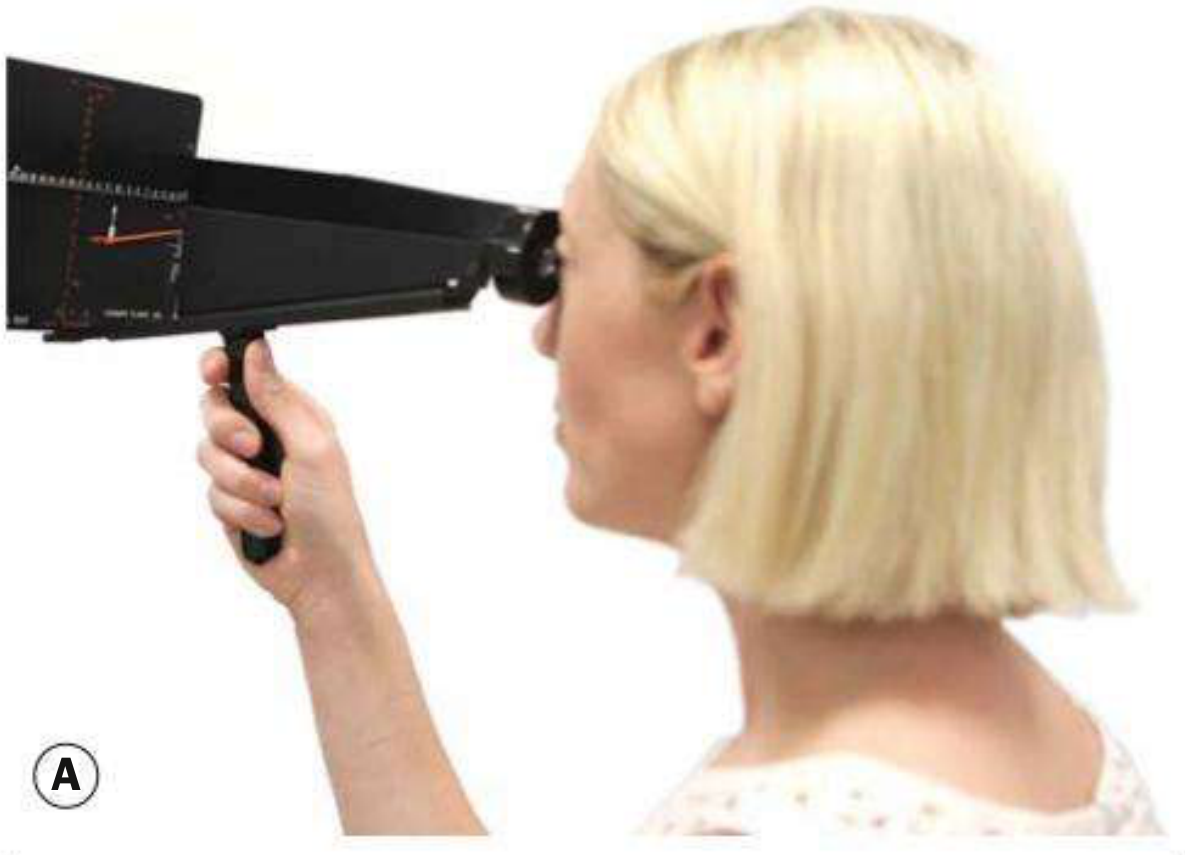
The Maddox rod consists of a series of fused cylindrical red (or white) glass rods that convert a white spot of light into a red streak oriented at 90° to the long axis of the rods. When the glass rods are held horizontally, the streak is vertical (used for horizontal phoria testing).
The rod is placed in front of one eye, which dissociates the two eyes: the right eye sees only a red streak, while the left eye sees only the white spot of light — fusion is impossible, unmasking any latent deviation (phoria).
"Both vertical and horizontal deviations can be measured in this way but the test cannot differentiate a phoria from a tropia." — Kanski's Clinical Ophthalmology, p. 743
Setup
- Patient fixates on a white point light source at 6 m (distance) or 33 cm (near).
- The Maddox rod is placed in front of the right eye (standard convention) — glass rods horizontal → produces a vertical red streak.
- Patient is asked: "Where is the red line in relation to the white dot?"
Fig. 18.36 — Maddox Rod: Instrument, Optics, and Possible Results
(A) The Maddox rod held in front of the right eye:
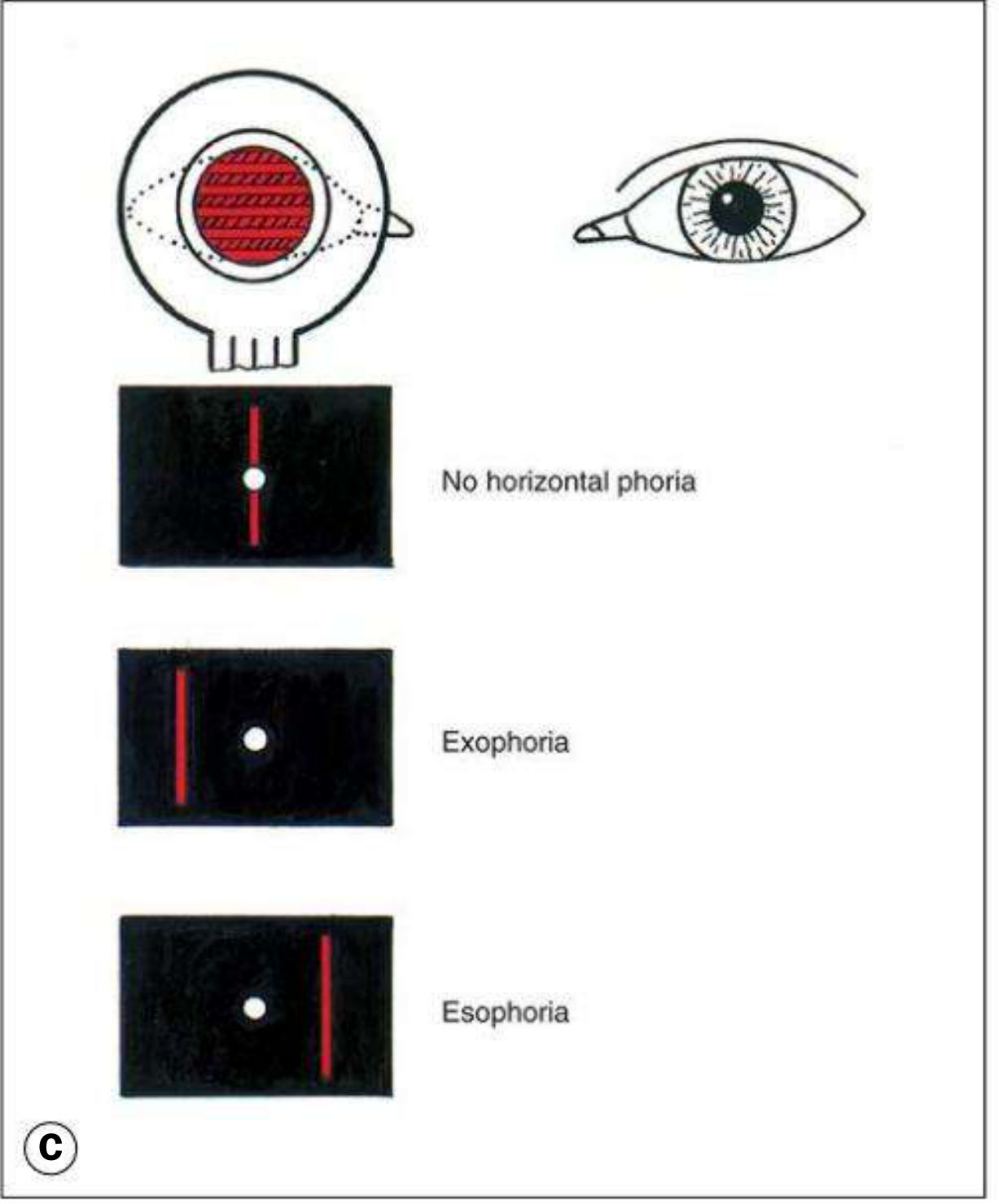
(C) What the patient sees — the three possible results:
Interpreting the Results: Right Eye vs Left Eye Testing
The key principle is: the red streak belongs to whichever eye has the Maddox rod in front of it (the deviated eye in a phoria).
🔴 Maddox Rod Before the RIGHT Eye
The right eye sees the red streak; the left eye sees the white dot.
| Finding | What the patient reports | Diagnosis |
|---|---|---|
| Red line passes through the white dot | Streak and dot are superimposed | Orthophoria (no deviation) |
| Red line is to the left of the dot | Streak displaced nasally | Right Esophoria (right eye deviates inward; streak appears on opposite side by uncrossed diplopia logic) |
| Red line is to the right of the dot | Streak displaced temporally | Right Exophoria (right eye deviates outward; streak appears on same side — crossed) |
Rule for right eye Maddox rod:
- Red line to the left → Esophoria (convergent tendency)
- Red line to the right → Exophoria (divergent tendency)
🔵 Maddox Rod Before the LEFT Eye
The rod is now transferred to the left eye. The left eye sees the red streak; the right eye sees the white dot.
| Finding | What the patient reports | Diagnosis |
|---|---|---|
| Red line passes through the white dot | No deviation | Orthophoria |
| Red line is to the right of the dot | Left eye streak displaced nasally (inward tendency) | Left Esophoria |
| Red line is to the left of the dot | Left eye streak displaced temporally (outward tendency) | Left Exophoria |
Rule for left eye Maddox rod:
- Red line to the right → Esophoria (left eye has convergent tendency)
- Red line to the left → Exophoria (left eye has divergent tendency)
Quantifying the Deviation
Once the direction is identified, prisms are placed before the eye until the patient reports the red streak passes through the white dot:
- For esophoria → prism base-out (to neutralise the inward tendency)
- For exophoria → prism base-in (to neutralise the outward tendency)
The prism power (in prism dioptres, Δ) required to superimpose the images = magnitude of the phoria.
Maddox Wing — Near Testing Reference
The Maddox wing is the near-vision (1/3 m) equivalent. The patient's view (Fig. 18.35 below) shows what the right eye sees (white vertical arrow) against the numbered scale the left eye sees. The white arrow pointing to a number gives the horizontal deviation directly in prism dioptres, labelled as exophoria (left scale) or esophoria (right scale).
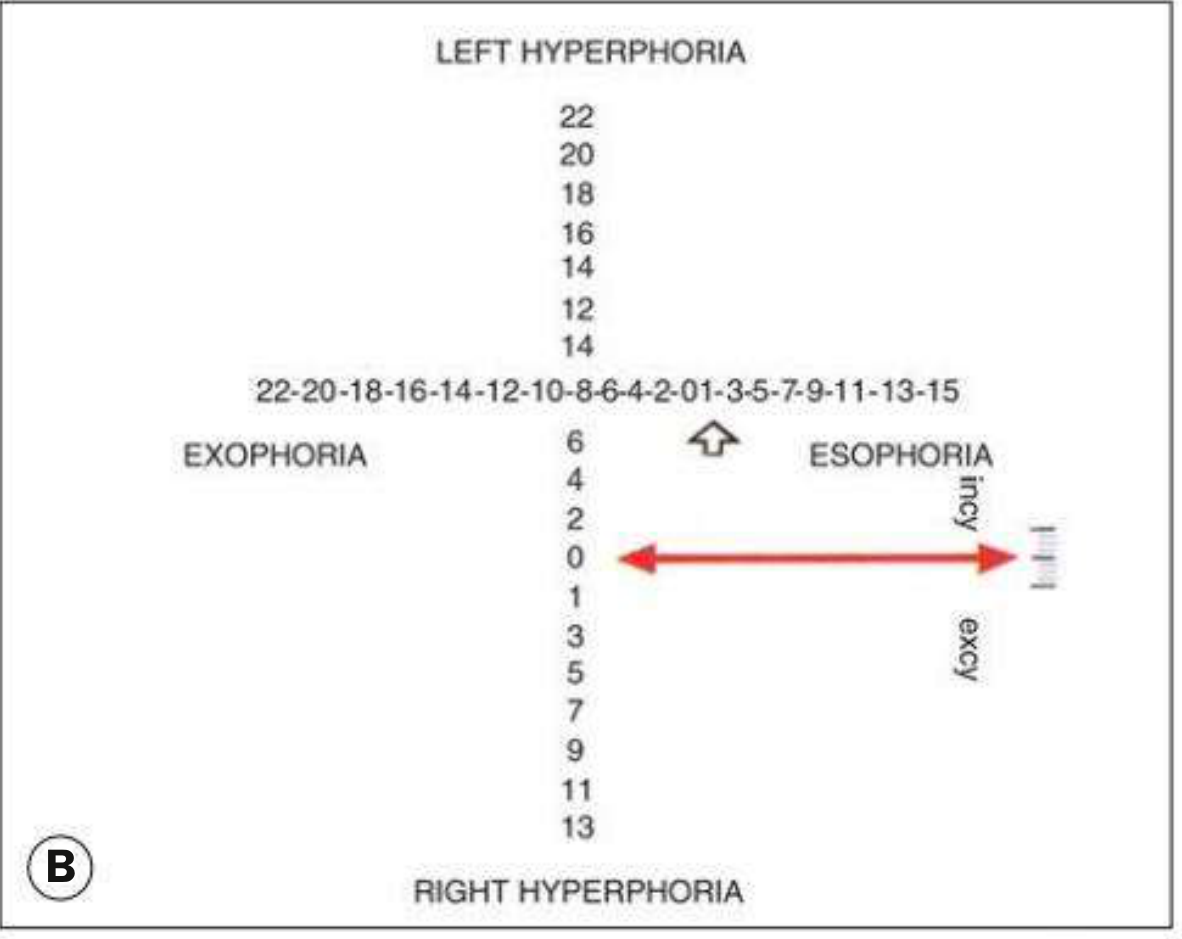
Fig. 18.35 — Patient's view using the Maddox wing, showing horizontal (esophoria/exophoria) and vertical (hyperphoria) scales.
Summary Table
| Rod before | Red line seen to the LEFT | Red line seen to the RIGHT |
|---|---|---|
| Right eye | Right Esophoria | Right Exophoria |
| Left eye | Left Exophoria | Left Esophoria |
The memory aid: "Same side = Exo (diverging), Opposite side = Eso (converging)" — applies when the Maddox rod is before the right eye. For the left eye, the laterality reverses.
— Kanski's Clinical Ophthalmology: A Systematic Approach, 10th ed., pp. 742–743
This is a shared conversation. Sign in to Orris to start your own chat.