


Ecplain weil felix test in form of flowchart in form of image make it colourful
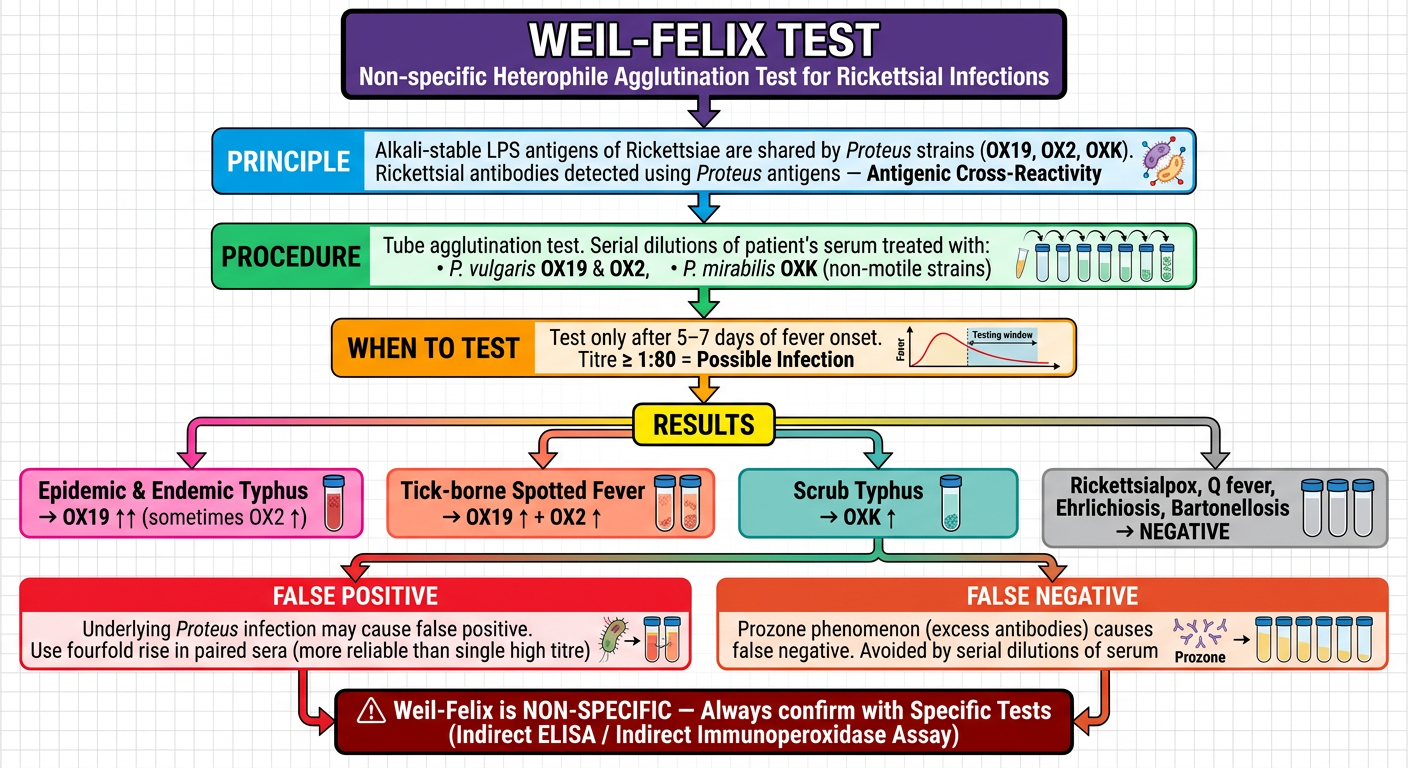
A colourful detailed medical flowchart explaining the Weil-Felix Test for Rickettsial infections. The flowchart flows top to bottom with bright, distinct colour-coded sections. Include the following nodes and branches in order: TOP (dark purple header box): "WEIL-FELIX TEST" subtitle: "Non-specific Heterophile Agglutination Test for Rickettsial Infections" Section 1 - PRINCIPLE (bright blue box): "Alkali-stable LPS antigens of Rickettsiae are shared by Proteus strains (OX19, OX2, OXK). Rickettsial antibodies detected using Proteus antigens — Antigenic Cross-Reactivity" Section 2 - PROCEDURE (green box): "Tube agglutination test. Serial dilutions of patient's serum treated with: P. vulgaris OX19 & OX2, P. mirabilis OXK (non-motile strains)" Section 3 - WHEN TO TEST (orange box): "Test only after 5–7 days of fever onset. Titre ≥ 1:80 = Possible Infection" Section 4 - RESULTS (yellow box with 4 branches): Branch 1 (pink): "Epidemic & Endemic Typhus → OX19 ↑↑ (sometimes OX2 ↑)" Branch 2 (coral): "Tick-borne Spotted Fever → OX19 ↑ + OX2 ↑" Branch 3 (teal): "Scrub Typhus → OXK ↑" Branch 4 (grey): "Rickettsialpox, Q fever, Ehrlichiosis, Bartonellosis → NEGATIVE" Section 5 - FALSE POSITIVE (red box): "Underlying Proteus infection may cause false positive. Use fourfold rise in paired sera (more reliable than single high titre)" Section 6 - FALSE NEGATIVE (orange-red box): "Prozone phenomenon (excess antibodies) causes false negative. Avoided by serial dilutions of serum" BOTTOM (dark red warning box): "⚠ Weil-Felix is NON-SPECIFIC — Always confirm with Specific Tests (Indirect ELISA / Indirect Immunoperoxidase Assay)" Use connecting arrows between all boxes. Make it vibrant, easy to read, with bold labels and clear medical typography.
| Disease | Antigen |
|---|---|
| Epidemic/Endemic Typhus | OX19 ↑↑ (±OX2) |
| Tick-borne Spotted Fever | OX19 ↑ + OX2 ↑ |
| Scrub Typhus | OXK ↑ |
| Rickettsialpox, Q fever, Ehrlichiosis, Bartonellosis | NEGATIVE |

Explain scrub thyphus in form of a floechart in form of image make it colourful
A vibrant, colourful, detailed medical flowchart titled "SCRUB TYPHUS" flowing top to bottom with clearly labelled colour-coded sections, bold text, connecting arrows between all boxes. TOP HEADER (deep maroon/crimson banner): "SCRUB TYPHUS" subtitle: "Caused by Orientia tsutsugamushi | Most Common Rickettsial Disease in India" SECTION 1 - RESERVOIR & VECTOR (bright orange box): Title: "RESERVOIR & VECTOR" - Vector: Trombiculid mites (chiggers) - Reservoir: Small mammals - field mice, rats, shrews - Habitat: Secondary scrub vegetations / forests - Season: Wet season (when mites lay eggs) SECTION 2 - EPIDEMIOLOGY (purple box): Title: "EPIDEMIOLOGY" - Endemic zone: "Tsutsugamushi Triangle" — Japan/Russia (N) → Australia (S) → Pakistan (W) - India: Most common rickettsial disease; Sub-Himalayan belt, Bihar, Rajasthan, Maharashtra, Karnataka, Tamil Nadu, Pondicherry, Kerala, Uttarakhand - Rural to Urban shift: Increasingly reported in urban areas SECTION 3 - TRANSMISSION (bright yellow box): Title: "TRANSMISSION" - Bite of infected larval trombiculid mite (chigger) - Mite acts as both vector AND reservoir SECTION 4 - LABORATORY DIAGNOSIS (teal/cyan box with 3 sub-branches): Title: "LABORATORY DIAGNOSIS" Sub-branch A (light blue): "SEROLOGY (mainstay)" - Primary infection: IgM by end of week 1, IgG by end of week 2 - Re-infection: IgG detectable by day 6, IgM variable Sub-branch B (green): "SEROLOGICAL TESTS" - Weil-Felix test: Nonspecific — detects OXK antibodies (Proteus) - IFA (Indirect Immunofluorescence): GOLD STANDARD — Specific - ELISA (56-kDa antigen): Cost-effective, alternative to IFA Sub-branch C (lime): "MOLECULAR TEST" - PCR: targets 56-kDa gene, 47-kDa gene, 16S rRNA gene SECTION 5 - TREATMENT (bright red-pink box): Title: "TREATMENT" - FIRST LINE: Doxycycline (drug of choice) - ALTERNATIVES: Chloramphenicol / Azithromycin BOTTOM (dark green warning/key point box): "KEY POINTS: Scrub typhus is a RE-EMERGING disease in India | IFA is Gold Standard | Always confirm nonspecific Weil-Felix with specific tests" Use vibrant colours, thick arrows, bold bold headings, medical style, easy to read at a glance.
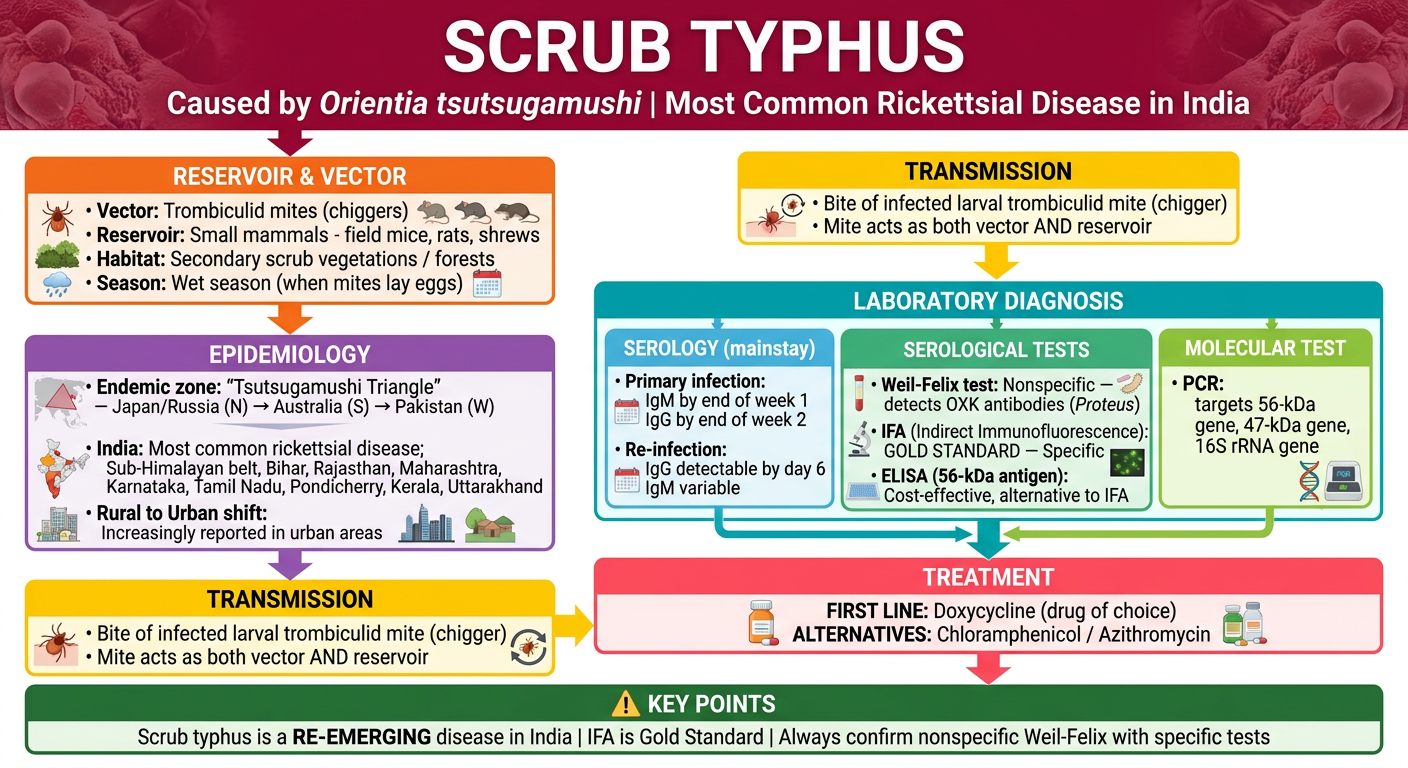
- Vector: Trombiculid mites (chiggers) - larval stage bites
- Reservoir: Field mice, rats, shrews
- Setting: Scrub vegetation/forests during wet season
- Endemic zone: "Tsutsugamushi Triangle" (Japan/Russia → Australia → Pakistan)
- India: Most common rickettsial disease - prevalent in sub-Himalayan belt, Bihar, Rajasthan, Maharashtra, Karnataka, Tamil Nadu, Kerala, Uttarakhand
- Now shifting from rural to urban areas too
| Test | Type | Detail |
|---|---|---|
| Weil-Felix (OXK) | Non-specific | Screening only |
| IFA | Specific | Gold Standard |
| ELISA (56-kDa) | Specific | Cost-effective alternative |
| PCR | Molecular | 56-kDa, 47-kDa, 16S rRNA genes |
- 1st line: Doxycycline
- Alternatives: Chloramphenicol / Azithromycin