
supraspinetis tendinitis physiotherapy protocol
Reading File
Supraspinatus tendinitis is one of the most common causes of shoulder pain, typically presenting with anterolateral shoulder pain and painful arc (60-120 degrees of abduction). Physiotherapy is the cornerstone of management, progressing through phases from pain control to full return to activity.
Searching sources...
Finding Sources
Finding Sources
Searching PubMed
"supraspinatus tendinitis" AND "physical therapy"
Reading File
Finding Sources
Searching PubMed
"rotator cuff tendinopathy" AND "exercise" AND "rehabilitation"
Reading File
Finding Sources
Reading Article
PMID: 42135016
Finding Sources
Searching the Web
supraspinatus tendinitis physiotherapy protocol phases exercises 2024
Now I have comprehensive information to compile the full protocol. Let me also fetch the anatomy images from the textbook for visual clarity.
Loading Image
Here is a structured, evidence-based physiotherapy protocol for supraspinatus tendinitis (tendinopathy), drawn from Campbell's Operative Orthopaedics (2026), Roberts and Hedges' Clinical Procedures, and the latest published network meta-analysis (Lazzarini et al., BJSM 2026).
Supraspinatus Tendinitis - Physiotherapy Protocol
Anatomy & Clinical Context
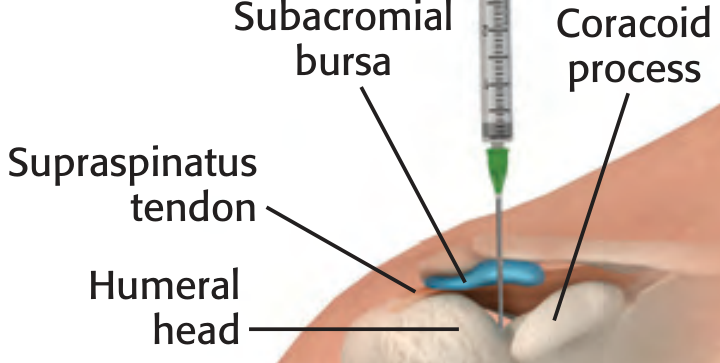
The supraspinatus tendon runs beneath the coracoacromial arch and is most vulnerable at its "critical zone" 1 cm proximal to its insertion on the greater tuberosity. Tendinitis often co-exists with subacromial bursitis. The condition is frequently driven by mechanical impingement (primary extrinsic) and scapular dyskinesis.
Key clinical tests:
- Hawkins-Kennedy test: Arm and elbow at 90°, internal rotation - pain indicates impingement under coracoacromial ligament
- Neer's test: Forward flexion with internal rotation, pain at 70-120° - greater tuberosity impinges on acromion
- Painful arc: 60-120° of abduction
Overview: 4-Phase Protocol
| Phase | Timeline | Main Goals |
|---|---|---|
| 1 - Acute / Pain Control | Weeks 1-2 | Reduce pain and inflammation, protect tissue |
| 2 - Early Recovery | Weeks 3-4 | Restore ROM, begin isometric strengthening |
| 3 - Strengthening | Weeks 5-8 | Isotonic RC and scapular strengthening |
| 4 - Functional / Return | Weeks 9-12+ | Power, endurance, sport/work-specific activity |
Phase 1: Acute Phase (Weeks 1-2)
Goals: Pain reduction, tissue protection, maintain baseline motion
Modalities (adjuncts)
- Cryotherapy (ice 15-20 min, 3-4x/day)
- TENS or high-voltage galvanic stimulation
- Therapeutic ultrasound or phonophoresis
- Iontophoresis (dexamethasone or diclofenac)
- NSAIDs (oral or topical) for short-term symptom relief
- Subacromial corticosteroid injection if pain is severe (1-2 injections max)
Range of Motion
- Pendulum (Codman's) exercises: gravity-assisted, pain-free circles and figure-of-8
- Symptom-limited active-assisted ROM: use a stick/wand or pulley
- Avoid painful arc (60-120°) initially
Strengthening
- Submaximal isometrics only in this phase:
- Isometric external rotation (ER)
- Isometric internal rotation (IR)
- Isometric biceps, deltoid
- Isometric scapular stabilizers (rhomboids, trapezius, serratus anterior)
- Keep arm at side, below 60° elevation
Joint Mobilisation
- Inferior, anterior, and posterior glides in scapular plane (Grade I-II)
Criteria to progress: Pain <3/10 at rest, able to perform pendulums and isometrics without exacerbation
Phase 2: Early Recovery Phase (Weeks 3-4)
Goals: Full pain-free ROM, initiate dynamic stabilization, begin scapular retraining
Range of Motion
- Progress wand/L-bar exercises: flexion, ER, IR
- Begin gentle posterior capsule stretch (cross-body adduction/"sleeper stretch")
- Aquatherapy may assist ROM and early strengthening
- Correct any postural abnormalities (forward head, rounded shoulder)
- Cryotherapy after exercise sessions
Scapular Retraining (Priority)
As emphasized by Campbell's Orthopaedics, scapular retraining is central to relieving impingement:
- Isometric scapular retraction and depression
- Shoulder shrugs (scapular elevation-depression)
- Seated rows (low resistance band)
- Wall slides
Target muscles: serratus anterior, trapezius (lower > upper), rhomboids, latissimus dorsi, levator scapulae
Rotator Cuff Strengthening
- Progress to multi-angle submaximal isometrics
- Theraband IR/ER at 0° (arm at side)
- Begin scaption (elevation in scapular plane) up to 60-70° only
- Cross-friction massage: supraspinatus accessed with arm in adduction + internal rotation with forearm behind back (brings tendon out from under acromion)
Neuromuscular Control
- Proprioceptive exercises: rhythmic stabilization at low elevation angles
- Begin postural correction training
Criteria to progress: Full, non-painful ROM in all planes; manual muscle test (MMT) strength >70% of contralateral side
Phase 3: Strengthening Phase (Weeks 5-8)
Goals: Progressive isotonic strengthening of rotator cuff and scapular stabilizers, eccentric loading
Key Evidence (2026 Network Meta-Analysis)
The Lazzarini et al. 2026 network meta-analysis (89 RCTs, 5532 participants) found that exercises targeting both shoulder and scapular muscles are the most effective intervention. Adding percutaneous electrolysis or trigger point dry needling to this exercise combination provided the greatest pain and function improvements.
Rotator Cuff Isotonic Exercises (Concentric + Eccentric)
- Supraspinatus (empty can / full can): Scaption to 90° with thumb down (empty can) or up (full can)
- ER with theraband: Progress from 0° abduction to 45° abduction position
- IR with theraband: Progress from neutral to 45° abduction
- Prone horizontal abduction: Arm hangs off table, raise to horizontal
- Prone extension: Arm beside body, lift toward ceiling
- Prone ER: Elbow flexed to 90°, externally rotate against gravity
Eccentric Loading (Key for Tendinopathy Remodeling)
- Eccentric ER with band: Raise concentrically with both arms, lower eccentrically with the affected arm only
- Eccentric abduction (scaption): Same principle - bilateral up, unilateral down
- Start with low resistance at slow pace; progress resistance and speed
- Early eccentric work helps with collagen remodeling and hypertrophy
Scapular Stabilizer Strengthening
- Serratus push-ups (wall to floor progression)
- Seated rows with progressive resistance
- Lat pull-downs
- Rhomboid rows
- Lower trapezius: Y-raises prone
Additional Exercises
- Forward flexion to 90° (dumbbell)
- Upright abduction to 90°
- Shoulder shrugs with weight
- Upper extremity ergometry for cardiovascular endurance
Adjunct Therapies (if needed)
- Extracorporeal shockwave therapy (ESWT): Evidence supports use for calcific and non-calcific tendinopathy - reduces pain especially when combined with exercise
- Dry needling to trigger points in supraspinatus/infraspinatus
- Ultrasound-guided PRP injection: Comparable to exercise therapy alone (RCT evidence); may add to conservative program
Phase 4: Functional / Return-to-Activity Phase (Weeks 9-12+)
Goals: Sport- or work-specific function, power, endurance, prevent recurrence
Strength & Power
- Continue isotonic strengthening with increased resistance in all planes
- Include resistance at 90° abduction and 90° ER/IR (throwing position)
- Plyometrics: medicine ball chest pass, wall throws, overhead tosses
- PNF (proprioceptive neuromuscular facilitation) diagonal patterns (D1, D2)
- Isokinetic strengthening if available
Neuromuscular Control & Sport Specificity
- High-speed, high-energy strengthening exercises
- Eccentric exercises in diagonal patterns
- Sport-specific tasks: interval throwing/tennis/golf program
- Proprioception and balance training for the shoulder
Return-to-Sport Criteria
- Full, pain-free ROM matching contralateral side
- MMT strength >90% of contralateral side
- No pain during sport-specific activities
- Satisfactory functional outcome scores (e.g., DASH, ASES)
Failure of Conservative Treatment
Per Campbell's Operative Orthopaedics, if a patient fails to respond after 3-4 months of a well-executed nonoperative regimen, surgical intervention (arthroscopic subacromial decompression) may be indicated - particularly if Hawkins-Kennedy, Neer, and Jobe tests remain positive.
Quick Reference Exercise List by Phase
| Exercise | Phase 1 | Phase 2 | Phase 3 | Phase 4 |
|---|---|---|---|---|
| Pendulum/Codman's | ✓ | ✓ | ||
| Isometrics (IR/ER) | ✓ | ✓ | ||
| Scapular isometrics | ✓ | ✓ | ||
| Theraband IR/ER (0°) | ✓ | ✓ | ||
| Scapular rows | ✓ | ✓ | ✓ | |
| Empty/full can | ✓ | ✓ | ||
| Eccentric ER/abduction | ✓ | ✓ | ||
| Serratus push-ups | ✓ | ✓ | ✓ | |
| Prone horizontal abd. | ✓ | ✓ | ||
| Plyometrics / PNF | ✓ |
Sources: Campbell's Operative Orthopaedics 15th Ed 2026, p. 2825-2826 | Roberts and Hedges' Clinical Procedures in Emergency, p. 1236 | Lazzarini et al., BJSM 2026 - network meta-analysis, PMID 42135016 | Medscape Supraspinatus Tendonitis Protocol
Here is the exercise video with the top 3 exercises for supraspinatus tendinopathy, focused on eccentric loading:
PPT
Reading File
Reading File
Reading File
Running Command
ls /home/daytona/workspace/ 2>/dev/null || mkdir -p /home/daytona/workspace/supraspinatus-ppt
Running Command
mkdir -p /home/daytona/workspace/supraspinatus-ppt && ls /home/daytona/workspace/supraspinatus-ppt
Writing File
~/supraspinatus-ppt/create_ppt.js
const pptxgen = require("pptxgenjs");

const pres = new pptxgen();
pres.layout = "LAYOUT_16x9";
pres.title = "Supraspinatus Tendinitis - Physiotherapy Protocol";
pres.author = "Orris Medical";

// ─── COLOR PALETTE ───────────────────────────────────────────────
const C = {
  navy:    "0B1F4B",   // dominant dark bg
  blue:    "1565C0",   // section headers / accents
  teal:    "00897B",   // phase color 1
  amber:   "F57F17",   // phase color 2
  green:   "2E7D32",   // phase color 3
  purple:  "6A1B9A",   // phase color 4
  white:   "FFFFFF",
  offwhite:"F0F4F8",
  light:   "E3EAF4",
  gray:    "607D8B",
  dark:    "1A1A2E",
  accent:  "29B6F6",   // sky blue highlight
};

// ─── HELPER: dark slide background ───────────────────────────────
function darkBg(slide, color) {
  slide.addShape(pres.shapes.RECTANGLE, {
    x: 0, y: 0, w: 10, h: 5.625,
    fill: { color: color || C.navy }, line: { color: color || C.navy }
  });
}

// ─── HELPER: accent bar ──────────────────────────────────────────
function accentBar(slide, color, y, h) {
  slide.addShape(pres.shapes.RECTANGLE, {
    x: 0, y: y || 0, w: 10, h: h || 0.08,
    fill: { color: color || C.accent }, line: { color: color || C.accent }
  });
}

// ─── HELPER: pill badge ──────────────────────────────────────────
function badge(slide, label, x, y, bg, fg) {
  slide.addShape(pres.shapes.ROUNDED_RECTANGLE, {
    x, y, w: 1.5, h: 0.35,
    fill: { color: bg || C.accent }, line: { color: bg || C.accent }, rectRadius: 0.05
  });
  slide.addText(label, {
    x, y, w: 1.5, h: 0.35,
    fontSize: 9, bold: true, color: fg || C.navy, align: "center", valign: "middle", margin: 0
  });
}

// ─── SLIDE 1: TITLE ──────────────────────────────────────────────
{
  const s = pres.addSlide();
  darkBg(s, C.navy);

  // decorative circles
  s.addShape(pres.shapes.OVAL, { x: 7.5, y: -1, w: 4, h: 4, fill: { color: C.blue, transparency: 75 }, line: { color: C.blue, transparency: 75 } });
  s.addShape(pres.shapes.OVAL, { x: 8.5, y: 2.5, w: 2.5, h: 2.5, fill: { color: C.accent, transparency: 80 }, line: { color: C.accent, transparency: 80 } });

  // top bar
  accentBar(s, C.accent, 0, 0.08);

  s.addText("PHYSIOTHERAPY PROTOCOL", {
    x: 0.6, y: 0.35, w: 8, h: 0.4,
    fontSize: 11, color: C.accent, bold: true, charSpacing: 4
  });

  s.addText("Supraspinatus\nTendinitis", {
    x: 0.6, y: 0.9, w: 7.5, h: 2,
    fontSize: 44, color: C.white, bold: true, lineSpacingMultiple: 1.1
  });

  s.addShape(pres.shapes.RECTANGLE, { x: 0.6, y: 3.05, w: 2.2, h: 0.06, fill: { color: C.teal }, line: { color: C.teal } });

  s.addText("Evidence-Based 4-Phase Rehabilitation Program", {
    x: 0.6, y: 3.2, w: 8, h: 0.45,
    fontSize: 14, color: C.light, italic: true
  });

  s.addText("Campbell's Operative Orthopaedics 2026  |  BJSM Network Meta-Analysis 2026 (n=5532)", {
    x: 0.6, y: 4.9, w: 9, h: 0.35,
    fontSize: 8, color: C.gray, italic: true
  });

  accentBar(s, C.teal, 5.55, 0.075);
}

// ─── SLIDE 2: ANATOMY & CLINICAL OVERVIEW ────────────────────────
{
  const s = pres.addSlide();
  darkBg(s, C.dark);
  accentBar(s, C.blue, 0, 0.07);

  s.addText("ANATOMY & CLINICAL OVERVIEW", {
    x: 0.5, y: 0.18, w: 9, h: 0.4,
    fontSize: 11, color: C.accent, bold: true, charSpacing: 3
  });

  // left column - anatomy facts
  s.addShape(pres.shapes.RECTANGLE, {
    x: 0.4, y: 0.75, w: 4.5, h: 4.4,
    fill: { color: "0D2137" }, line: { color: C.blue, transparency: 60 }
  });

  s.addText("Supraspinatus Tendon", {
    x: 0.6, y: 0.85, w: 4.1, h: 0.4,
    fontSize: 14, color: C.accent, bold: true
  });

  const anatomyPoints = [
    "Part of the rotator cuff (SITS muscles)",
    "Runs under the coracoacromial arch",
    "Most vulnerable at 'critical zone' — 1 cm proximal to insertion on greater tuberosity",
    "Often co-exists with subacromial bursitis",
    "Impingement in the 60–120° painful arc",
  ];
  s.addText(anatomyPoints.map((t, i) => ({
    text: t,
    options: { bullet: { type: "bullet" }, breakLine: i < anatomyPoints.length - 1, color: C.light, fontSize: 11 }
  })), { x: 0.6, y: 1.3, w: 4.1, h: 3.6, valign: "top", paraSpaceBefore: 6 });

  // right column - clinical tests
  s.addShape(pres.shapes.RECTANGLE, {
    x: 5.2, y: 0.75, w: 4.4, h: 4.4,
    fill: { color: "0D2137" }, line: { color: C.teal, transparency: 60 }
  });

  s.addText("Key Clinical Tests", {
    x: 5.4, y: 0.85, w: 4, h: 0.4,
    fontSize: 14, color: C.teal, bold: true
  });

  const tests = [
    { name: "Hawkins-Kennedy", desc: "Arm/elbow at 90°, IR → pain = coracoacromial impingement" },
    { name: "Neer's Test", desc: "Forward flexion + IR → pain at 70–120°; tuberosity hits acromion" },
    { name: "Painful Arc", desc: "Abduction 60–120° reproduces anterolateral shoulder pain" },
    { name: "Empty Can (Jobe)", desc: "Resisted abduction at 90° in scapular plane, thumb down → pain/weakness" },
  ];

  let ty = 1.35;
  for (const t of tests) {
    s.addText(t.name, { x: 5.4, y: ty, w: 3.9, h: 0.28, fontSize: 11, bold: true, color: C.amber });
    ty += 0.28;
    s.addText(t.desc, { x: 5.4, y: ty, w: 3.9, h: 0.45, fontSize: 10, color: C.light, lineSpacingMultiple: 1.1 });
    ty += 0.5;
  }
}

// ─── SLIDE 3: 4-PHASE OVERVIEW ────────────────────────────────────
{
  const s = pres.addSlide();
  s.addShape(pres.shapes.RECTANGLE, { x: 0, y: 0, w: 10, h: 5.625, fill: { color: C.offwhite }, line: { color: C.offwhite } });
  accentBar(s, C.navy, 0, 0.07);

  s.addText("4-PHASE REHABILITATION OVERVIEW", {
    x: 0.5, y: 0.18, w: 9, h: 0.38,
    fontSize: 11, color: C.navy, bold: true, charSpacing: 3
  });

  const phases = [
    { num: "1", title: "Acute /\nPain Control", weeks: "Weeks 1–2", color: C.teal,    goals: ["Reduce pain & inflammation", "Protect tissue", "Maintain baseline ROM"] },
    { num: "2", title: "Early\nRecovery",    weeks: "Weeks 3–4", color: C.blue,    goals: ["Restore full ROM", "Scapular retraining", "Begin dynamic stabilization"] },
    { num: "3", title: "Progressive\nStrengthening", weeks: "Weeks 5–8", color: C.purple, goals: ["Isotonic RC strengthening", "Eccentric loading", "Scapular stabilizers"] },
    { num: "4", title: "Functional\nReturn",        weeks: "Weeks 9–12+", color: C.green, goals: ["Power & endurance", "Plyometrics / PNF", "Sport/work-specific activity"] },
  ];

  phases.forEach((ph, i) => {
    const x = 0.3 + i * 2.38;

    // phase card background
    s.addShape(pres.shapes.RECTANGLE, {
      x, y: 0.72, w: 2.15, h: 4.55,
      fill: { color: C.white },
      shadow: { type: "outer", color: "000000", blur: 8, offset: 2, angle: 135, opacity: 0.1 },
      line: { color: "DDDDDD" }
    });

    // colored top accent
    s.addShape(pres.shapes.RECTANGLE, { x, y: 0.72, w: 2.15, h: 0.55, fill: { color: ph.color }, line: { color: ph.color } });

    // phase number circle
    s.addShape(pres.shapes.OVAL, { x: x + 0.7, y: 0.55, w: 0.75, h: 0.75, fill: { color: C.white }, line: { color: ph.color, pt: 2.5 } });
    s.addText(ph.num, { x: x + 0.7, y: 0.55, w: 0.75, h: 0.75, fontSize: 16, bold: true, color: ph.color, align: "center", valign: "middle", margin: 0 });

    s.addText(ph.weeks, { x, y: 0.72, w: 2.15, h: 0.55, fontSize: 9, color: C.white, align: "center", valign: "middle", margin: 0 });

    s.addText(ph.title, {
      x: x + 0.1, y: 1.35, w: 1.95, h: 0.75,
      fontSize: 13, bold: true, color: ph.color, align: "center", lineSpacingMultiple: 1.15
    });

    s.addText(ph.goals.map((g, j) => ({
      text: g,
      options: { bullet: { type: "bullet" }, breakLine: j < ph.goals.length - 1, fontSize: 10.5, color: "333333" }
    })), { x: x + 0.12, y: 2.15, w: 1.93, h: 3, valign: "top", paraSpaceBefore: 7 });
  });

  // bottom timeline arrow
  s.addShape(pres.shapes.RECTANGLE, { x: 0.5, y: 5.25, w: 8.8, h: 0.07, fill: { color: C.gray }, line: { color: C.gray } });
  s.addShape(pres.shapes.RIGHT_ARROW, { x: 9.0, y: 5.14, w: 0.45, h: 0.28, fill: { color: C.gray }, line: { color: C.gray } });
  s.addText("← 3–4 months total   (Surgery if no improvement after this period) →", {
    x: 1.5, y: 5.3, w: 7, h: 0.25, fontSize: 8, color: C.gray, align: "center"
  });
}

// ─── SLIDE 4: PHASE 1 ────────────────────────────────────────────
{
  const s = pres.addSlide();
  darkBg(s, C.navy);
  accentBar(s, C.teal, 0, 0.07);

  // phase badge
  s.addShape(pres.shapes.RECTANGLE, { x: 0, y: 0.07, w: 10, h: 0.7, fill: { color: C.teal, transparency: 85 }, line: { color: C.teal, transparency: 85 } });
  s.addText("PHASE 1  |  ACUTE / PAIN CONTROL  |  Weeks 1–2", {
    x: 0.5, y: 0.1, w: 9, h: 0.6,
    fontSize: 13, bold: true, color: C.teal, valign: "middle"
  });

  // Col 1: Modalities
  s.addShape(pres.shapes.RECTANGLE, { x: 0.3, y: 0.88, w: 3.05, h: 4.45, fill: { color: "0D2137" }, line: { color: C.teal, transparency: 70 } });
  s.addText("🧊  Modalities & Adjuncts", { x: 0.45, y: 0.95, w: 2.8, h: 0.38, fontSize: 11, bold: true, color: C.teal });
  const mod1 = ["Cryotherapy (ice 15–20 min, 3–4×/day)", "TENS / High-voltage galvanic", "Therapeutic ultrasound / phonophoresis", "Iontophoresis (dexamethasone)", "NSAIDs (oral/topical)", "Subacromial corticosteroid injection (max 1–2)"];
  s.addText(mod1.map((t, i) => ({ text: t, options: { bullet: true, breakLine: i < mod1.length - 1, fontSize: 10, color: C.light } })),
    { x: 0.45, y: 1.38, w: 2.8, h: 3.7, valign: "top", paraSpaceBefore: 7 });

  // Col 2: ROM
  s.addShape(pres.shapes.RECTANGLE, { x: 3.6, y: 0.88, w: 3.05, h: 4.45, fill: { color: "0D2137" }, line: { color: C.accent, transparency: 70 } });
  s.addText("🔄  Range of Motion", { x: 3.75, y: 0.95, w: 2.8, h: 0.38, fontSize: 11, bold: true, color: C.accent });
  const rom1 = ["Pendulum / Codman's exercises", "Symptom-limited active-assisted ROM", "Wand / pulley exercises if tolerated", "Avoid painful arc (60–120°)", "Joint mobilisation: Inferior, anterior & posterior glides (Grade I–II) in scapular plane"];
  s.addText(rom1.map((t, i) => ({ text: t, options: { bullet: true, breakLine: i < rom1.length - 1, fontSize: 10, color: C.light } })),
    { x: 3.75, y: 1.38, w: 2.8, h: 3.7, valign: "top", paraSpaceBefore: 7 });

  // Col 3: Strengthening
  s.addShape(pres.shapes.RECTANGLE, { x: 6.9, y: 0.88, w: 2.85, h: 4.45, fill: { color: "0D2137" }, line: { color: C.amber, transparency: 70 } });
  s.addText("💪  Isometric Strengthening", { x: 7.0, y: 0.95, w: 2.65, h: 0.38, fontSize: 11, bold: true, color: C.amber });
  const str1 = ["Isometric external rotation (ER)", "Isometric internal rotation (IR)", "Isometric biceps & deltoid", "Isometric scapular stabilizers:", "  • Rhomboids", "  • Trapezius", "  • Serratus anterior", "Keep arm at side / below 60°"];
  s.addText(str1.map((t, i) => ({ text: t, options: { bullet: !t.startsWith("  "), breakLine: i < str1.length - 1, fontSize: 9.5, color: C.light } })),
    { x: 7.0, y: 1.38, w: 2.65, h: 3.7, valign: "top", paraSpaceBefore: 5 });

  // progression criteria footer
  s.addShape(pres.shapes.RECTANGLE, { x: 0.3, y: 5.28, w: 9.4, h: 0.28, fill: { color: C.teal, transparency: 80 }, line: { color: C.teal, transparency: 80 } });
  s.addText("✓  Progress when: Pain < 3/10 at rest | Pendulums and isometrics pain-free", {
    x: 0.5, y: 5.28, w: 9, h: 0.28, fontSize: 9, color: C.white, valign: "middle"
  });
}

// ─── SLIDE 5: PHASE 2 ────────────────────────────────────────────
{
  const s = pres.addSlide();
  darkBg(s, C.navy);
  accentBar(s, C.blue, 0, 0.07);

  s.addShape(pres.shapes.RECTANGLE, { x: 0, y: 0.07, w: 10, h: 0.7, fill: { color: C.blue, transparency: 85 }, line: { color: C.blue, transparency: 85 } });
  s.addText("PHASE 2  |  EARLY RECOVERY  |  Weeks 3–4", {
    x: 0.5, y: 0.1, w: 9, h: 0.6, fontSize: 13, bold: true, color: C.accent, valign: "middle"
  });

  // Scapular retraining highlight box
  s.addShape(pres.shapes.RECTANGLE, { x: 0.3, y: 0.88, w: 4.6, h: 2.15, fill: { color: "0D3060" }, line: { color: C.blue } });
  s.addText("⭐  Scapular Retraining (Priority)", { x: 0.45, y: 0.92, w: 4.3, h: 0.38, fontSize: 12, bold: true, color: C.accent });
  s.addText("Per Campbell's Orthopaedics: scapular retraining is central to relieving impingement", {
    x: 0.45, y: 1.3, w: 4.3, h: 0.35, fontSize: 9, color: C.light, italic: true
  });
  const scap = ["Isometric scapular retraction & depression", "Shoulder shrugs (elevation-depression)", "Seated rows (low-resistance band)", "Wall slides"];
  s.addText(scap.map((t, i) => ({ text: t, options: { bullet: true, breakLine: i < scap.length - 1, fontSize: 10, color: C.light } })),
    { x: 0.45, y: 1.68, w: 4.3, h: 1.2, valign: "top", paraSpaceBefore: 5 });

  // Target muscles
  s.addShape(pres.shapes.RECTANGLE, { x: 0.3, y: 3.1, w: 4.6, h: 2.22, fill: { color: "0D2137" }, line: { color: C.blue, transparency: 60 } });
  s.addText("Target Muscles", { x: 0.45, y: 3.15, w: 4.3, h: 0.38, fontSize: 11, bold: true, color: C.blue });
  const musc = ["Serratus anterior", "Trapezius (lower > upper)", "Rhomboids", "Latissimus dorsi", "Levator scapulae"];
  s.addText(musc.map((t, i) => ({ text: t, options: { bullet: { type: "bullet" }, breakLine: i < musc.length - 1, fontSize: 10.5, color: C.light } })),
    { x: 0.45, y: 3.55, w: 4.3, h: 1.6, valign: "top", paraSpaceBefore: 5 });

  // ROM right col
  s.addShape(pres.shapes.RECTANGLE, { x: 5.1, y: 0.88, w: 4.6, h: 2.22, fill: { color: "0D2137" }, line: { color: C.accent, transparency: 60 } });
  s.addText("🔄  ROM & Stretching", { x: 5.25, y: 0.92, w: 4.3, h: 0.38, fontSize: 11, bold: true, color: C.accent });
  const rom2 = ["Progress wand/L-bar: flexion, ER, IR", "Posterior capsule stretch (sleeper stretch)", "Aquatherapy to assist ROM if needed", "Correct posture: forward head, rounded shoulders", "Cryotherapy after exercise sessions"];
  s.addText(rom2.map((t, i) => ({ text: t, options: { bullet: true, breakLine: i < rom2.length - 1, fontSize: 10, color: C.light } })),
    { x: 5.25, y: 1.35, w: 4.3, h: 1.6, valign: "top", paraSpaceBefore: 6 });

  // RC strengthening right col
  s.addShape(pres.shapes.RECTANGLE, { x: 5.1, y: 3.17, w: 4.6, h: 2.15, fill: { color: "0D2137" }, line: { color: C.amber, transparency: 60 } });
  s.addText("💪  RC Strengthening & Manual Therapy", { x: 5.25, y: 3.22, w: 4.3, h: 0.38, fontSize: 11, bold: true, color: C.amber });
  const rc2 = ["Multi-angle submaximal isometrics", "Theraband IR/ER at 0° (arm at side)", "Scaption to 60–70° (pain-free only)", "Cross-friction massage: supraspinatus — arm in adduction + IR with forearm behind back"];
  s.addText(rc2.map((t, i) => ({ text: t, options: { bullet: true, breakLine: i < rc2.length - 1, fontSize: 10, color: C.light } })),
    { x: 5.25, y: 3.62, w: 4.3, h: 1.5, valign: "top", paraSpaceBefore: 5 });

  s.addShape(pres.shapes.RECTANGLE, { x: 0.3, y: 5.28, w: 9.4, h: 0.28, fill: { color: C.blue, transparency: 80 }, line: { color: C.blue, transparency: 80 } });
  s.addText("✓  Progress when: Full pain-free ROM in all planes | MMT strength ≥ 70% of contralateral side", {
    x: 0.5, y: 5.28, w: 9, h: 0.28, fontSize: 9, color: C.white, valign: "middle"
  });
}

// ─── SLIDE 6: PHASE 3 ────────────────────────────────────────────
{
  const s = pres.addSlide();
  darkBg(s, C.navy);
  accentBar(s, C.purple, 0, 0.07);

  s.addShape(pres.shapes.RECTANGLE, { x: 0, y: 0.07, w: 10, h: 0.7, fill: { color: C.purple, transparency: 85 }, line: { color: C.purple, transparency: 85 } });
  s.addText("PHASE 3  |  PROGRESSIVE STRENGTHENING  |  Weeks 5–8", {
    x: 0.5, y: 0.1, w: 9, h: 0.6, fontSize: 13, bold: true, color: "CE93D8", valign: "middle"
  });

  // RC isotonic
  s.addShape(pres.shapes.RECTANGLE, { x: 0.3, y: 0.88, w: 3, h: 4.35, fill: { color: "0D2137" }, line: { color: C.purple, transparency: 60 } });
  s.addText("RC Isotonic Exercises", { x: 0.45, y: 0.93, w: 2.7, h: 0.38, fontSize: 11, bold: true, color: "CE93D8" });
  const rc3 = ["Empty/Full can (scaption to 90°)", "ER with theraband (0° → 45° abd.)", "IR with theraband", "Prone horizontal abduction", "Prone extension", "Prone ER (elbow 90°, against gravity)", "Theraband rows", "Forward flexion to 90° (dumbbell)"];
  s.addText(rc3.map((t, i) => ({ text: t, options: { bullet: true, breakLine: i < rc3.length - 1, fontSize: 10, color: C.light } })),
    { x: 0.45, y: 1.36, w: 2.7, h: 3.7, valign: "top", paraSpaceBefore: 5 });

  // Eccentric loading
  s.addShape(pres.shapes.RECTANGLE, { x: 3.55, y: 0.88, w: 3, h: 2.22, fill: { color: "0D3060" }, line: { color: C.accent } });
  s.addText("⭐  Eccentric Loading", { x: 3.7, y: 0.93, w: 2.7, h: 0.38, fontSize: 11, bold: true, color: C.accent });
  const ecc = ["Eccentric ER: bilateral up, unilateral down", "Eccentric scaption (abduction): same principle", "Low resistance → slow pace initially", "Progress resistance and speed over time", "Key for tendon remodeling & collagen repair"];
  s.addText(ecc.map((t, i) => ({ text: t, options: { bullet: true, breakLine: i < ecc.length - 1, fontSize: 10, color: C.light } })),
    { x: 3.7, y: 1.36, w: 2.7, h: 1.6, valign: "top", paraSpaceBefore: 5 });

  // Scapular strengthening
  s.addShape(pres.shapes.RECTANGLE, { x: 3.55, y: 3.17, w: 3, h: 2.06, fill: { color: "0D2137" }, line: { color: C.amber, transparency: 60 } });
  s.addText("Scapular Stabilizers", { x: 3.7, y: 3.22, w: 2.7, h: 0.38, fontSize: 11, bold: true, color: C.amber });
  const scap3 = ["Serratus push-ups (wall → floor)", "Seated rows with progressive resistance", "Lat pull-downs", "Y-raises prone (lower trapezius)", "Rhomboid rows"];
  s.addText(scap3.map((t, i) => ({ text: t, options: { bullet: true, breakLine: i < scap3.length - 1, fontSize: 10, color: C.light } })),
    { x: 3.7, y: 3.62, w: 2.7, h: 1.45, valign: "top", paraSpaceBefore: 5 });

  // Adjunct therapies
  s.addShape(pres.shapes.RECTANGLE, { x: 6.8, y: 0.88, w: 2.9, h: 4.35, fill: { color: "0D2137" }, line: { color: C.teal, transparency: 60 } });
  s.addText("Adjunct Therapies", { x: 6.95, y: 0.93, w: 2.6, h: 0.38, fontSize: 11, bold: true, color: C.teal });

  s.addText("ESWT (Shockwave)", { x: 6.95, y: 1.38, w: 2.6, h: 0.3, fontSize: 10.5, bold: true, color: C.amber });
  s.addText("Evidence supports for both calcific & non-calcific tendinopathy; reduces pain especially with exercise", {
    x: 6.95, y: 1.68, w: 2.6, h: 0.6, fontSize: 9.5, color: C.light, lineSpacingMultiple: 1.15
  });
  s.addText("Dry Needling", { x: 6.95, y: 2.4, w: 2.6, h: 0.3, fontSize: 10.5, bold: true, color: C.amber });
  s.addText("Trigger point needling to supraspinatus/infraspinatus — BJSM 2026 NMA found this + exercise most effective for function", {
    x: 6.95, y: 2.7, w: 2.6, h: 0.65, fontSize: 9.5, color: C.light, lineSpacingMultiple: 1.15
  });
  s.addText("PRP Injection", { x: 6.95, y: 3.45, w: 2.6, h: 0.3, fontSize: 10.5, bold: true, color: C.amber });
  s.addText("Comparable to exercise therapy alone in RCT; may supplement conservative program", {
    x: 6.95, y: 3.75, w: 2.6, h: 0.5, fontSize: 9.5, color: C.light, lineSpacingMultiple: 1.15
  });
  s.addText("Percutaneous Electrolysis", { x: 6.95, y: 4.35, w: 2.6, h: 0.3, fontSize: 10.5, bold: true, color: C.amber });
  s.addText("Combined with exercise: greatest pain reduction (NMA 2026)", {
    x: 6.95, y: 4.65, w: 2.6, h: 0.45, fontSize: 9.5, color: C.light
  });

  s.addShape(pres.shapes.RECTANGLE, { x: 0.3, y: 5.28, w: 9.4, h: 0.28, fill: { color: C.purple, transparency: 80 }, line: { color: C.purple, transparency: 80 } });
  s.addText("✓  Progress when: Full ROM | MMT strength ≥ 90% contralateral | Pain-free during isotonic work", {
    x: 0.5, y: 5.28, w: 9, h: 0.28, fontSize: 9, color: C.white, valign: "middle"
  });
}

// ─── SLIDE 7: PHASE 4 ────────────────────────────────────────────
{
  const s = pres.addSlide();
  darkBg(s, C.navy);
  accentBar(s, C.green, 0, 0.07);

  s.addShape(pres.shapes.RECTANGLE, { x: 0, y: 0.07, w: 10, h: 0.7, fill: { color: C.green, transparency: 85 }, line: { color: C.green, transparency: 85 } });
  s.addText("PHASE 4  |  FUNCTIONAL RETURN  |  Weeks 9–12+", {
    x: 0.5, y: 0.1, w: 9, h: 0.6, fontSize: 13, bold: true, color: "81C784", valign: "middle"
  });

  // strength power
  s.addShape(pres.shapes.RECTANGLE, { x: 0.3, y: 0.88, w: 3.05, h: 4.35, fill: { color: "0D2137" }, line: { color: C.green, transparency: 60 } });
  s.addText("⚡  Strength & Power", { x: 0.45, y: 0.93, w: 2.8, h: 0.38, fontSize: 11, bold: true, color: "81C784" });
  const str4 = ["Continue isotonic with increased resistance in all planes", "Resistance at 90° abduction, 90° ER/IR (throwing position)", "Plyometrics: medicine ball throws, wall throws, overhead tosses", "PNF diagonal patterns (D1, D2)", "Isokinetic strengthening if available", "Upper extremity ergometry for endurance"];
  s.addText(str4.map((t, i) => ({ text: t, options: { bullet: true, breakLine: i < str4.length - 1, fontSize: 10, color: C.light } })),
    { x: 0.45, y: 1.36, w: 2.8, h: 3.7, valign: "top", paraSpaceBefore: 6 });

  // NMC & sport specificity
  s.addShape(pres.shapes.RECTANGLE, { x: 3.6, y: 0.88, w: 3.05, h: 4.35, fill: { color: "0D2137" }, line: { color: C.accent, transparency: 60 } });
  s.addText("🎯  Neuromuscular & Sport-Specific", { x: 3.75, y: 0.93, w: 2.8, h: 0.38, fontSize: 11, bold: true, color: C.accent });
  const nmc = ["High-speed, high-energy exercises", "Eccentric exercises in diagonal patterns", "Proprioception & balance training", "Interval throwing program", "Tennis / Golf sport-specific drills", "Overhead athlete: progressive return protocol"];
  s.addText(nmc.map((t, i) => ({ text: t, options: { bullet: true, breakLine: i < nmc.length - 1, fontSize: 10, color: C.light } })),
    { x: 3.75, y: 1.36, w: 2.8, h: 3.7, valign: "top", paraSpaceBefore: 6 });

  // RTS criteria
  s.addShape(pres.shapes.RECTANGLE, { x: 6.9, y: 0.88, w: 2.85, h: 4.35, fill: { color: "0D3010" }, line: { color: C.green } });
  s.addText("✅  Return-to-Sport Criteria", { x: 7.0, y: 0.93, w: 2.65, h: 0.38, fontSize: 11, bold: true, color: "81C784" });
  const rts = [
    "Full pain-free ROM matching contralateral",
    "MMT strength ≥ 90% of contralateral",
    "No pain during sport-specific tasks",
    "Satisfactory DASH / ASES scores",
    "Confident proprioception & neuromuscular control",
  ];
  s.addText(rts.map((t, i) => ({ text: t, options: { bullet: { type: "bullet" }, breakLine: i < rts.length - 1, fontSize: 10.5, color: C.light } })),
    { x: 7.0, y: 1.4, w: 2.65, h: 3.2, valign: "top", paraSpaceBefore: 9 });

  s.addShape(pres.shapes.RECTANGLE, { x: 6.9, y: 4.3, w: 2.85, h: 0.93, fill: { color: "0D4010" }, line: { color: C.green, transparency: 50 } });
  s.addText("⚠️  Surgical Referral", { x: 7.0, y: 4.33, w: 2.65, h: 0.3, fontSize: 10, bold: true, color: "FF8A65" });
  s.addText("If no response after 3–4 months of conservative therapy → consider arthroscopic subacromial decompression", {
    x: 7.0, y: 4.62, w: 2.65, h: 0.55, fontSize: 9, color: C.light, lineSpacingMultiple: 1.1
  });

  s.addShape(pres.shapes.RECTANGLE, { x: 0.3, y: 5.28, w: 9.4, h: 0.28, fill: { color: C.green, transparency: 80 }, line: { color: C.green, transparency: 80 } });
  s.addText("✓  Goal: Return to full pre-injury sport or occupational activity without pain recurrence", {
    x: 0.5, y: 5.28, w: 9, h: 0.28, fontSize: 9, color: C.white, valign: "middle"
  });
}

// ─── SLIDE 8: EXERCISE SUMMARY TABLE ─────────────────────────────
{
  const s = pres.addSlide();
  s.addShape(pres.shapes.RECTANGLE, { x: 0, y: 0, w: 10, h: 5.625, fill: { color: C.offwhite }, line: { color: C.offwhite } });
  accentBar(s, C.navy, 0, 0.07);

  s.addText("EXERCISE QUICK REFERENCE", {
    x: 0.5, y: 0.15, w: 9, h: 0.4, fontSize: 12, bold: true, color: C.navy, charSpacing: 3
  });

  const headers = ["Exercise", "Phase 1", "Phase 2", "Phase 3", "Phase 4"];
  const rows = [
    ["Pendulum / Codman's",        "✓", "✓", "",  ""],
    ["Isometrics (IR/ER)",         "✓", "✓", "",  ""],
    ["Scapular isometrics",        "✓", "✓", "",  ""],
    ["Theraband IR/ER (0°)",       "",  "✓", "✓", ""],
    ["Scapular rows",              "",  "✓", "✓", "✓"],
    ["Sleeper stretch",            "",  "✓", "✓", "✓"],
    ["Empty/Full can",             "",  "",  "✓", "✓"],
    ["Eccentric ER & scaption",    "",  "",  "✓", "✓"],
    ["Serratus push-ups",          "",  "✓", "✓", "✓"],
    ["Prone horizontal abduction", "",  "",  "✓", "✓"],
    ["Prone ER & extension",       "",  "",  "✓", "✓"],
    ["Plyometrics / PNF",          "",  "",  "",  "✓"],
    ["Sport-specific drills",      "",  "",  "",  "✓"],
  ];

  const colW = [3.5, 1.4, 1.4, 1.4, 1.4];
  const colX = [0.3, 3.85, 5.25, 6.65, 8.05];
  const phaseColors = [C.teal, C.blue, C.purple, C.green];
  const rowH = 0.33;
  const startY = 0.65;

  // header row
  headers.forEach((h, ci) => {
    s.addShape(pres.shapes.RECTANGLE, {
      x: colX[ci], y: startY, w: colW[ci], h: 0.38,
      fill: { color: ci === 0 ? C.navy : phaseColors[ci - 1] },
      line: { color: C.white }
    });
    s.addText(h, {
      x: colX[ci], y: startY, w: colW[ci], h: 0.38,
      fontSize: 10, bold: true, color: C.white, align: "center", valign: "middle", margin: 0
    });
  });

  // data rows
  rows.forEach((row, ri) => {
    const y = startY + 0.38 + ri * rowH;
    const bgColor = ri % 2 === 0 ? "FFFFFF" : "EEF3FA";
    row.forEach((cell, ci) => {
      s.addShape(pres.shapes.RECTANGLE, {
        x: colX[ci], y, w: colW[ci], h: rowH,
        fill: { color: bgColor }, line: { color: "CCCCCC" }
      });
      const isCheck = cell === "✓";
      s.addText(cell, {
        x: colX[ci], y, w: colW[ci], h: rowH,
        fontSize: isCheck ? 13 : 10,
        color: isCheck ? phaseColors[ci - 1] : "333333",
        bold: isCheck,
        align: ci === 0 ? "left" : "center",
        valign: "middle",
        margin: ci === 0 ? 6 : 0
      });
    });
  });
}

// ─── SLIDE 9: KEY EVIDENCE ────────────────────────────────────────
{
  const s = pres.addSlide();
  darkBg(s, C.dark);
  accentBar(s, C.amber, 0, 0.07);

  s.addText("KEY EVIDENCE", {
    x: 0.5, y: 0.18, w: 9, h: 0.4, fontSize: 11, bold: true, color: C.amber, charSpacing: 4
  });

  const papers = [
    {
      ref: "Lazzarini et al. — Br J Sports Med (2026)",
      type: "Systematic Review + Network Meta-Analysis",
      n: "89 RCTs  |  5,532 participants",
      finding: "Exercises targeting shoulder + scapular muscles may reduce pain (SMD -0.79) and improve function. Adding trigger point dry needling to combined exercise produced greatest functional improvement. Percutaneous electrolysis + combined exercise gave greatest pain relief.",
      color: C.amber
    },
    {
      ref: "Lazzarini et al. — Physical Therapy (2025)",
      type: "Systematic Review + Meta-Analysis",
      n: "RCTs comparing CSI vs. PT",
      finding: "Corticosteroid injections provide short-term benefit (3–12 weeks) but physiotherapist-led exercise interventions are comparable or superior at medium/long-term follow-up for rotator cuff tendinopathy.",
      color: C.accent
    },
    {
      ref: "Campbell's Operative Orthopaedics 15th Ed. (2026)",
      type: "Authoritative Textbook",
      n: "Clinical Practice Guideline",
      finding: "Scapular motor control and posterior scapular strengthening offloads the anterior supraspinatus and biceps tendon. Programs targeting serratus anterior, trapezius, rhomboids, latissimus dorsi are first-line. Surgery if failure after 3–4 months.",
      color: C.teal
    },
  ];

  papers.forEach((p, i) => {
    const y = 0.7 + i * 1.6;
    s.addShape(pres.shapes.RECTANGLE, {
      x: 0.3, y, w: 9.4, h: 1.5,
      fill: { color: "0D1F35" }, line: { color: p.color, transparency: 60 }
    });
    s.addShape(pres.shapes.RECTANGLE, { x: 0.3, y, w: 0.12, h: 1.5, fill: { color: p.color }, line: { color: p.color } });
    s.addText(p.ref, { x: 0.55, y: y + 0.07, w: 5, h: 0.32, fontSize: 11, bold: true, color: p.color });
    s.addText(p.type + "  |  " + p.n, { x: 0.55, y: y + 0.38, w: 9, h: 0.25, fontSize: 9, color: C.gray, italic: true });
    s.addText(p.finding, { x: 0.55, y: y + 0.63, w: 9, h: 0.75, fontSize: 10, color: C.light, lineSpacingMultiple: 1.2 });
  });
}

// ─── SLIDE 10: SUMMARY / CLOSING ─────────────────────────────────
{
  const s = pres.addSlide();
  darkBg(s, C.navy);
  accentBar(s, C.accent, 0, 0.07);

  s.addShape(pres.shapes.OVAL, { x: -1, y: 2.5, w: 4, h: 4, fill: { color: C.blue, transparency: 85 }, line: { color: C.blue, transparency: 85 } });
  s.addShape(pres.shapes.OVAL, { x: 8, y: -1, w: 3.5, h: 3.5, fill: { color: C.teal, transparency: 85 }, line: { color: C.teal, transparency: 85 } });

  s.addText("KEY TAKEAWAYS", {
    x: 0.7, y: 0.25, w: 8, h: 0.38, fontSize: 11, color: C.accent, bold: true, charSpacing: 4
  });

  const takeaways = [
    { icon: "🎯", text: "Exercises targeting both shoulder AND scapular muscles = first-line physiotherapy (NMA 2026)" },
    { icon: "⭐", text: "Scapular retraining (serratus anterior, trapezius, rhomboids) is central to relieving impingement" },
    { icon: "📉", text: "Eccentric loading drives tendon remodeling — introduce by Phase 3" },
    { icon: "💉", text: "Corticosteroid injection: short-term benefit only; max 1–2 subacromial injections" },
    { icon: "⚡", text: "Dry needling + combined exercise = greatest functional improvement (BJSM 2026)" },
    { icon: "⏰", text: "3–4 months conservative therapy before surgical referral (arthroscopic decompression)" },
    { icon: "✅", text: "Return-to-sport: full ROM + MMT ≥ 90% contralateral + pain-free sport-specific activity" },
  ];

  takeaways.forEach((item, i) => {
    const x = i < 4 ? 0.4 : 5.3;
    const y = 0.78 + (i < 4 ? i : i - 4) * 0.9;
    s.addShape(pres.shapes.ROUNDED_RECTANGLE, {
      x, y, w: 4.5, h: 0.78,
      fill: { color: "0D1F35" }, line: { color: "1E3A5F" }, rectRadius: 0.06,
      shadow: { type: "outer", color: "000000", blur: 4, offset: 1, angle: 135, opacity: 0.1 }
    });
    s.addText(item.icon, { x: x + 0.1, y, w: 0.5, h: 0.78, fontSize: 18, align: "center", valign: "middle", margin: 0 });
    s.addText(item.text, { x: x + 0.65, y: y + 0.04, w: 3.72, h: 0.7, fontSize: 10, color: C.light, valign: "middle", lineSpacingMultiple: 1.2 });
  });

  s.addText("Sources: Campbell's Operative Orthopaedics 2026 | Lazzarini et al. BJSM 2026 (PMID 42135016) | Medscape", {
    x: 0.4, y: 5.32, w: 9.2, h: 0.25, fontSize: 7.5, color: C.gray, italic: true
  });
}

// ─── WRITE FILE ───────────────────────────────────────────────────
pres.writeFile({ fileName: "/home/daytona/workspace/supraspinatus-ppt/Supraspinatus_Tendinitis_Physiotherapy_Protocol.pptx" })
  .then(() => console.log("✅ PPT created successfully"))
  .catch(err => { console.error("❌ Error:", err); process.exit(1); });
Running Command
cd /home/daytona/workspace/supraspinatus-ppt && node create_ppt.js
Running Command
ls -lh /home/daytona/workspace/supraspinatus-ppt/
Your presentation is ready! Here's the download link:
Supraspinatus Tendinitis Physiotherapy Protocol
Presentation · PPTX
The deck has 10 slides:
| Slide | Content |
|---|---|
| 1 | Title slide (navy/teal theme) |
| 2 | Anatomy & Clinical Overview (Hawkins, Neer, painful arc tests) |
| 3 | 4-Phase Overview (visual card layout with timeline) |
| 4 | Phase 1 - Acute/Pain Control (Weeks 1-2) |
| 5 | Phase 2 - Early Recovery (Weeks 3-4) |
| 6 | Phase 3 - Progressive Strengthening (Weeks 5-8) |
| 7 | Phase 4 - Functional Return (Weeks 9-12+) |
| 8 | Exercise Quick Reference Table (all 4 phases, color-coded) |
| 9 | Key Evidence (Campbell's 2026, BJSM NMA 2026) |
| 10 | Key Takeaways & Summary |
This is a shared conversation. Sign in to Orris to start your own chat.