
Achlasia cardia
"achalasia"[MeSH Terms]
achalasia diagnosis treatment guidelines ASGE 2024
https://www.asge.org/home/resources/publications/guidelines/…
achalasia barium swallow bird beak esophagus radiograph
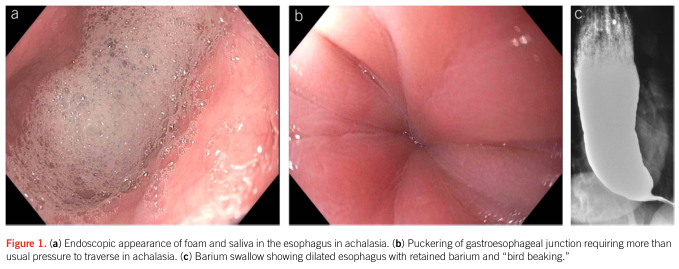
Summary : This figure presents three medical imaging views illustrating features of achalasia in the esophagus: endoscopic foam/saliva accumulation, puckering at the gastroesophageal junction, and a barium swallow radiograph showing classic "bird beak" appearance.
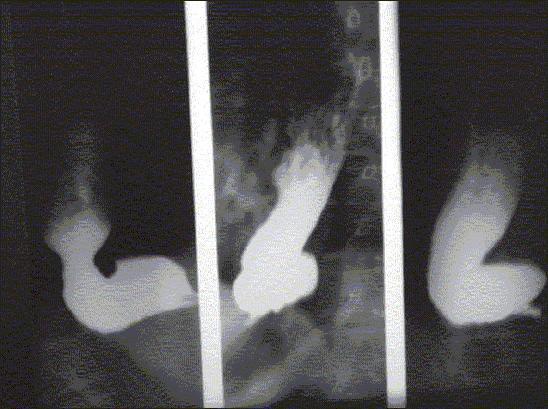
This diagnostic image is a barium swallow (barium meal) radiograph demonstrating classic features of advanced achalasia. The esophagus is severely dilated with a tortuous, 'sigmoid' morphology, indicative of chronic obstruction and loss of esophageal peristalsis (megaesophagus). At the distal end, the esophagus terminates in a smooth, tapered narrowing at the gastroesophageal junction, creating the characteristic 'bird's beak' appearance. This finding represents a failure of the lower esophageal sphincter (LES) to relax, leading to the pooling of contrast material and food within the thoracic esophagus. The image illustrates the anatomical and functional changes associated with esophageal motility disorders, specifically the late stages of achalasia where the organ becomes decompensated and redundant. It serves as a key clinical example for medical students and residents in gastroenterology and radiology for identifying esophageal outflow obstruction.
Achalasia cardia
Cause and pathophysiology
- LES remains abnormally contracted
- LES relaxation on swallowing is impaired
- Normal oesophageal peristalsis is absent
Clinical features
- Progressive dysphagia to both solids and liquids, often from the beginning
- Regurgitation of undigested, non-acidic food, especially on lying down
- Retrosternal chest pain
- Weight loss
- Nocturnal cough, aspiration, recurrent chest infections
- Halitosis or hiccups may occur
Diagnosis
-
Upper GI endoscopy
- Excludes cancer, stricture, and pseudoachalasia.
- A normal endoscopy does not rule out achalasia.
-
Barium swallow
- Dilated oesophagus
- Smooth tapering at the gastro-oesophageal junction: bird-beak appearance
- Delayed contrast emptying, absent peristaltic waves.
-
High-resolution manometry
- The diagnostic gold standard.
- Shows impaired LES relaxation and absent peristalsis.
- Subtypes:
- Type I: classic achalasia, absent pressurisation
- Type II: panesophageal pressurisation
- Type III: spastic achalasia with premature contractions
Treatment
| Treatment | Main role |
|---|---|
| Pneumatic balloon dilatation | Effective non-surgical option, particularly types I and II |
| Laparoscopic Heller myotomy plus partial fundoplication | Durable surgical treatment; fundoplication helps limit reflux |
| POEM (peroral endoscopic myotomy) | Endoscopic myotomy; particularly useful for type III because a longer myotomy can be made |
| Botulinum toxin injection | Temporary treatment for frail patients or those unfit for definitive therapy |
| Nitrates or calcium-channel blockers | Limited benefit, usually only when intervention is not feasible |
Important complications
- Aspiration pneumonia
- Progressive mega-oesophagus
- Malnutrition and weight loss
- Reflux oesophagitis after treatment
- Increased long-term risk of oesophageal carcinoma, especially with long-standing stasis
Explain the three manometric types of achalasia
"Esophageal Achalasia"[MeSH Terms] AND manometry
Chicago Classification v4 achalasia type I II III manometry diagnostic criteria
- Impaired relaxation of the lower oesophageal sphincter / oesophagogastric junction
- Absent normal peristalsis
Type I: Classic achalasia
- Impaired LES relaxation
- 100% failed peristalsis
- No significant oesophageal pressurisation
Type II: Achalasia with panesophageal pressurisation
- Impaired LES relaxation
- Absent peristalsis
- Panesophageal pressurisation in at least 20% of swallows
Type III: Spastic achalasia
- Impaired LES relaxation
- No normal peristalsis
- Premature, spastic distal oesophageal contractions in at least 20% of swallows
| Type | Pressure pattern | Key idea | Typical treatment response |
|---|---|---|---|
| I | Little or no pressurisation | Dilated, poorly contracting oesophagus | Intermediate |
| II | Panesophageal pressurisation | Oesophagus acts as a pressurised chamber | Best |
| III | Premature spastic contractions | Distal oesophageal spasm plus LES obstruction | POEM often preferred |
Defination Clinical features Types Treatment Investigation
"Esophageal Achalasia"[MeSH Terms] AND treatment
ACG clinical guidelines diagnosis management achalasia treatment POEM pneumatic dilation Heller myotomy
Achalasia cardia
Definition
- Failure of relaxation of the lower oesophageal sphincter (LES) during swallowing
- Absence of normal oesophageal peristalsis
Clinical features
- Gradually progressive dysphagia to both solids and liquids
- Regurgitation of undigested, non-acidic food, often worse at night or when lying down
- Retrosternal chest pain
- Weight loss and malnutrition
- Heartburn-like symptoms
- Nocturnal cough, choking, aspiration, or recurrent pneumonia
- Halitosis and hiccups may occur
Types: high-resolution manometry classification
| Type | Manometric finding | Description | Treatment implication |
|---|---|---|---|
| Type I - classic achalasia | No significant oesophageal pressurisation | Aperistalsis in a weak, often dilated oesophagus | Definitive LES disruption required |
| Type II - with panesophageal pressurisation | Panesophageal pressurisation in at least 20% of swallows | Oesophagus acts as a pressurised chamber against the closed LES | Best response to treatment |
| Type III - spastic achalasia | Premature spastic distal contractions in at least 20% of swallows | Spasm of distal oesophagus in addition to LES non-relaxation | POEM is often preferred because it permits a longer myotomy |
Investigations
1. Upper gastrointestinal endoscopy
- Performed to exclude carcinoma at the gastro-oesophageal junction, peptic stricture, or other causes of obstruction.
- May reveal retained food, saliva, and a dilated oesophagus.
- A normal endoscopy does not exclude achalasia.
2. Barium swallow or timed barium oesophagogram
- Dilated oesophagus with delayed emptying
- Smooth tapering at the lower end: bird-beak appearance
- Air-fluid level in oesophagus
- Absent or reduced gastric air bubble
- In late disease: tortuous sigmoid mega-oesophagus
3. High-resolution oesophageal manometry
- Gold-standard investigation
- Shows elevated integrated relaxation pressure, defective LES relaxation, and absent peristalsis.
- Also identifies type I, II, or III achalasia.
4. CT chest and abdomen or endoscopic ultrasound
- Used when pseudoachalasia is suspected, particularly with older age, rapidly progressive symptoms, or substantial weight loss.
- Helps exclude a malignancy at the gastro-oesophageal junction.
Treatment
Definitive treatment options
-
Pneumatic balloon dilatation
- Endoscopic balloon dilatation disrupts LES muscle fibers.
- Effective especially in type I and type II disease.
- Risk: oesophageal perforation and recurrence.
-
Laparoscopic Heller myotomy with partial fundoplication
- Surgical division of LES muscle.
- Fundoplication reduces postoperative reflux.
- Durable option for type I and II disease.
-
POEM - peroral endoscopic myotomy
- Endoscopic tunnelling and myotomy of the LES, with or without a longer oesophageal myotomy.
- Particularly useful for type III spastic achalasia.
- Post-procedure gastro-oesophageal reflux is relatively common.
Temporary or non-definitive options
-
Botulinum toxin injection into LES
- Produces temporary symptom relief.
- Used mainly in frail patients or people unfit for dilatation or myotomy.
- Not preferred as definitive treatment.
-
Drug treatment
- Nitrates, calcium-channel blockers, or phosphodiesterase inhibitors may lower LES pressure slightly.
- Limited effectiveness and generally reserved for patients unable to undergo definitive therapy.
Explain the treatment algorithm by manometric type
"Esophageal Achalasia"[MeSH Terms] AND treatment
achalasia treatment algorithm type I type II type III ACG guideline POEM Heller pneumatic dilation
Treatment algorithm for achalasia by manometric type
Before selecting treatment
- Confirm achalasia with high-resolution manometry.
- Perform endoscopy to exclude pseudoachalasia due to malignancy or a mechanical stricture.
- Assess:
- Manometric subtype: I, II, or III
- Fitness for anaesthesia and surgery
- Oesophageal dilatation or sigmoid mega-oesophagus
- Local expertise in POEM, pneumatic dilatation, and Heller myotomy
- Patient preference, especially regarding reflux risk and repeat procedures
Algorithm
Confirmed achalasia
        ↓
Is the patient fit for definitive therapy?
        ↓
  Yes                                  No / very frail
  ↓                                    ↓
Choose treatment by HRM type        Botulinum toxin injection
  ↓                                ± smooth-muscle relaxant drugs
Type I or II → PD / LHM / POEM          (temporary palliation)
Type III     → POEM preferred
        ↓
Assess symptoms and oesophageal emptying after treatment
        ↓
Persistent/recurrent obstruction?
        ↓
PD, repeat or alternative myotomy, or POEM depending on prior treatment
        ↓
End-stage sigmoid mega-oesophagus with failed therapies
        ↓
Consider oesophagectomy in a specialist centre
Type I achalasia: classic achalasia
Preferred definitive options
- Pneumatic dilatation (PD)
- Laparoscopic Heller myotomy (LHM) with partial fundoplication
- POEM (peroral endoscopic myotomy)
Practical choice
- PD: reasonable first option, especially when a less invasive approach is preferred and the patient can return for repeat dilatation if needed.
- LHM plus fundoplication: good durable option, particularly where reflux prevention is an important consideration.
- POEM: effective alternative where experienced operators are available, but counsel regarding increased post-procedure reflux.
Type II achalasia: panesophageal pressurisation
Preferred definitive options
- Pneumatic dilatation
- LHM with partial fundoplication
- POEM
Practical choice
- This subtype has the best overall response to LES-disrupting treatment.
- PD or LHM are commonly selected, but POEM is also appropriate where expertise exists.
- Choice is mainly determined by patient preference, local expertise, operative risk, and anticipated reflux.
Type III achalasia: spastic achalasia
Preferred treatment: POEM
- POEM is generally preferred.
- It allows a longer, tailored myotomy extending proximally over the spastic oesophageal segment, as identified on manometry.
Alternatives
- LHM can be used if POEM expertise is unavailable, but the myotomy must be sufficiently long to cover the spastic segment.
- PD is less favoured because it primarily disrupts the LES and does not adequately treat the proximal/distal oesophageal spasm.
Patients unfit for definitive therapy
Botulinum toxin injection
- Injected endoscopically into the LES.
- Provides rapid but often temporary benefit.
- Use for frail older adults or those unable to undergo PD, POEM, or surgery.
- Repeated injections may be needed and can make later myotomy technically more difficult.
Drugs
- Nitrates or calcium-channel blockers may reduce LES pressure slightly.
- Their benefit is limited, so they are used only when invasive therapy is not feasible.
After failed initial therapy
| Previous treatment | Common next option |
|---|---|
| Failed pneumatic dilatation | Repeat graded PD, POEM, or LHM |
| Failed LHM | PD or rescue POEM |
| Failed POEM | PD, repeat/redo myotomy, or LHM in selected cases |
| End-stage dilated sigmoid oesophagus with repeated failures | Specialist assessment, occasionally oesophagectomy |
Compare POEM, Heller myotomy, and pneumatic dilatation
"Esophageal Achalasia"[MeSH Terms] AND myotomy
ASGE guideline achalasia POEM laparoscopic Heller myotomy pneumatic dilation comparative reflux efficacy
Comparison: POEM vs Heller myotomy vs pneumatic dilatation
| Feature | POEM | Laparoscopic Heller myotomy (LHM) | Pneumatic dilatation (PD) |
|---|---|---|---|
| Full form | Peroral endoscopic myotomy | Surgical division of LES muscle | Endoscopic balloon disruption of LES muscle |
| Access | Through the mouth, via endoscopy | Laparoscopic abdominal surgery | Endoscopy plus fluoroscopic balloon dilatation |
| Procedure | A submucosal tunnel is made, then circular muscle of oesophagus and LES is cut | LES and lower oesophageal muscle are surgically divided | Large balloon is inflated across LES to tear muscle fibres |
| Fundoplication | No, so no built-in anti-reflux procedure | Yes, usually partial Dor or Toupet fundoplication | No |
| Best use by type | Effective in all types; preferred in type III | Effective in type I and II; can be used in type III if adequate long myotomy possible | Best suited to type I and particularly type II |
| Myotomy length | Can be tailored and extended proximally | Usually shorter and less easily extended | No myotomy |
| Efficacy | Comparable to LHM; often superior to PD in comparative studies | Durable, established treatment | Effective but repeat sessions and later retreatment may be needed |
| Reflux risk | Highest | Lower because fundoplication is added | Lower than POEM |
| Key complications | Capnoperitoneum, mucosal injury, bleeding, reflux oesophagitis | Mucosal perforation, operative risks, reflux, dysphagia if fundoplication is too tight | Oesophageal perforation, bleeding, reflux, symptom recurrence |
| Hospital/recovery | Usually short stay and quick recovery | Short stay but surgical recovery | Often outpatient or brief stay |
| Repeatability / rescue | Useful after failed PD or Heller myotomy | Can be used after failed PD or selected failed POEM cases | Can be repeated; may be used after myotomy failure |
| Main limitation | Reflux surveillance and long-term acid suppression may be required | Requires surgery and general anaesthesia | Less durable in some patients; perforation risk; may require serial dilatations |
1. POEM
- No external incisions.
- Enables a long tailored myotomy, making it especially useful for type III spastic achalasia.
- Strong symptomatic outcomes, comparable with Heller myotomy.
- Can be used after unsuccessful pneumatic dilatation or prior Heller myotomy.
- No fundoplication can be performed at the same procedure.
- Therefore it has the highest rate of pathological gastro-oesophageal reflux and reflux oesophagitis.
- Requires a centre with experienced advanced endoscopists.
2. Laparoscopic Heller myotomy with partial fundoplication
- Established, durable treatment.
- Myotomy directly divides LES muscle.
- A partial fundoplication is added to reduce postoperative reflux.
- Excellent option for type I and type II achalasia.
- Requires laparoscopy, general anaesthesia, and surgical recovery.
- The myotomy is usually shorter than with POEM, so it may be less suitable for extensive type III spasm.
- Adhesions or prior surgery can make future intervention more complex.
3. Pneumatic dilatation
- Least invasive definitive treatment.
- No incision or surgical myotomy.
- Often less costly initially.
- Good results, especially in type II achalasia.
- May be preferable in patients wishing to avoid surgery, if they can tolerate and access repeat procedures.
- May require graded or repeat dilatations.
- Risk of oesophageal perforation, so the patient should be fit for surgical rescue if perforation occurs.
- Less effective for type III achalasia because it mainly treats the LES and not the oesophageal spasm.
- Recurrence or need for retreatment is more common than after a well-performed myotomy in some patients.
Practical subtype-based choice
| Manometric type | Usually preferred approach |
|---|---|
| Type I | PD, LHM with fundoplication, or POEM are all reasonable |
| Type II | PD, LHM, or POEM are all effective. This type has the best overall treatment response |
| Type III | POEM preferred because the extended myotomy treats both LES obstruction and oesophageal spasm |
Bottom line
- POEM: most flexible and preferred for type III, but reflux is a major trade-off.
- Heller myotomy with fundoplication: durable surgery with better reflux protection, especially good for types I and II.
- Pneumatic dilatation: least invasive and cost-effective initially, but may need repeat treatment and is less suitable for type III.