
PcOS PCOD
Reading File
Now let me search the library for PCOS/PCOD content in parallel:
Finding Sources
Finding Sources
Searching PubMed
"polycystic ovary syndrome"[MeSH Terms] AND management
Now let me read the key textbook sections - Goldman-Cecil and Harrison's for a solid clinical overview, plus Berek & Novak for the gynecological perspective:
Reading File
Reading File
Reading File
Now let me read further sections on pathophysiology, clinical features, and treatment:
Reading File
Searching the Web
PCOS PCOD difference polycystic ovary syndrome disease 2025 guidelines
Let me also fetch the diagnostic algorithm image and read more of the treatment section:
Loading Image
Reading File
Reading File
Reading File
I now have comprehensive information to deliver a thorough answer. Let me compile it:
PCOS and PCOD - A Complete Clinical Overview
PCOS vs. PCOD: Terminology
PCOD (Polycystic Ovarian Disease) and PCOS (Polycystic Ovary Syndrome) are terms often used interchangeably, but they carry a clinical distinction:
- PCOD refers specifically to the ultrasound finding of polycystic-appearing ovaries (multiple small follicles). It is considered a milder, often reversible condition.
- PCOS is a broader endocrine syndrome - a diagnosis of multiple features including hyperandrogenism, ovulatory dysfunction, and/or polycystic ovarian morphology. It is NOT just about ovarian appearance on ultrasound.
Having polycystic-appearing ovaries on ultrasound alone (~23% of reproductive-age women) does NOT mean a woman has PCOS. PCOS requires the full clinical picture.
What is PCOS?
PCOS is the most common endocrine disorder in women of reproductive age, affecting 10-13% of women worldwide. It was first described by Stein and Leventhal in 1935 as amenorrhea with bilateral polycystic ovaries and obesity. It is familial with polygenic/multifactorial inheritance.
It is the most common cause of:
- Hyperandrogenism (HA)
- Hirsutism
- Anovulatory infertility
Diagnostic Criteria (Rotterdam 2003 - Still Current)
Diagnosis requires 2 out of 3 criteria (after excluding other disorders):
| Criterion | Details |
|---|---|
| 1. Menstrual/Ovulatory dysfunction | Oligomenorrhea, amenorrhea, or anovulation |
| 2. Hyperandrogenism (HA) | Clinical (hirsutism, acne, alopecia) OR biochemical (elevated androgens) |
| 3. Polycystic ovarian morphology | ≥20 follicles (2-9 mm) in either ovary OR ovarian volume >10 mL on ultrasound |
This gives 4 phenotypes:
- HA + ovarian dysfunction + PCO morphology (classic full picture)
- HA + ovarian dysfunction (no PCO on USS)
- HA + PCO morphology (regular cycles)
- Ovarian dysfunction + PCO morphology (no HA)
In adolescents, diagnosis requires persistent anovulation + clinical or biochemical HA (ultrasound is non-specific up to 8 years post-menarche).
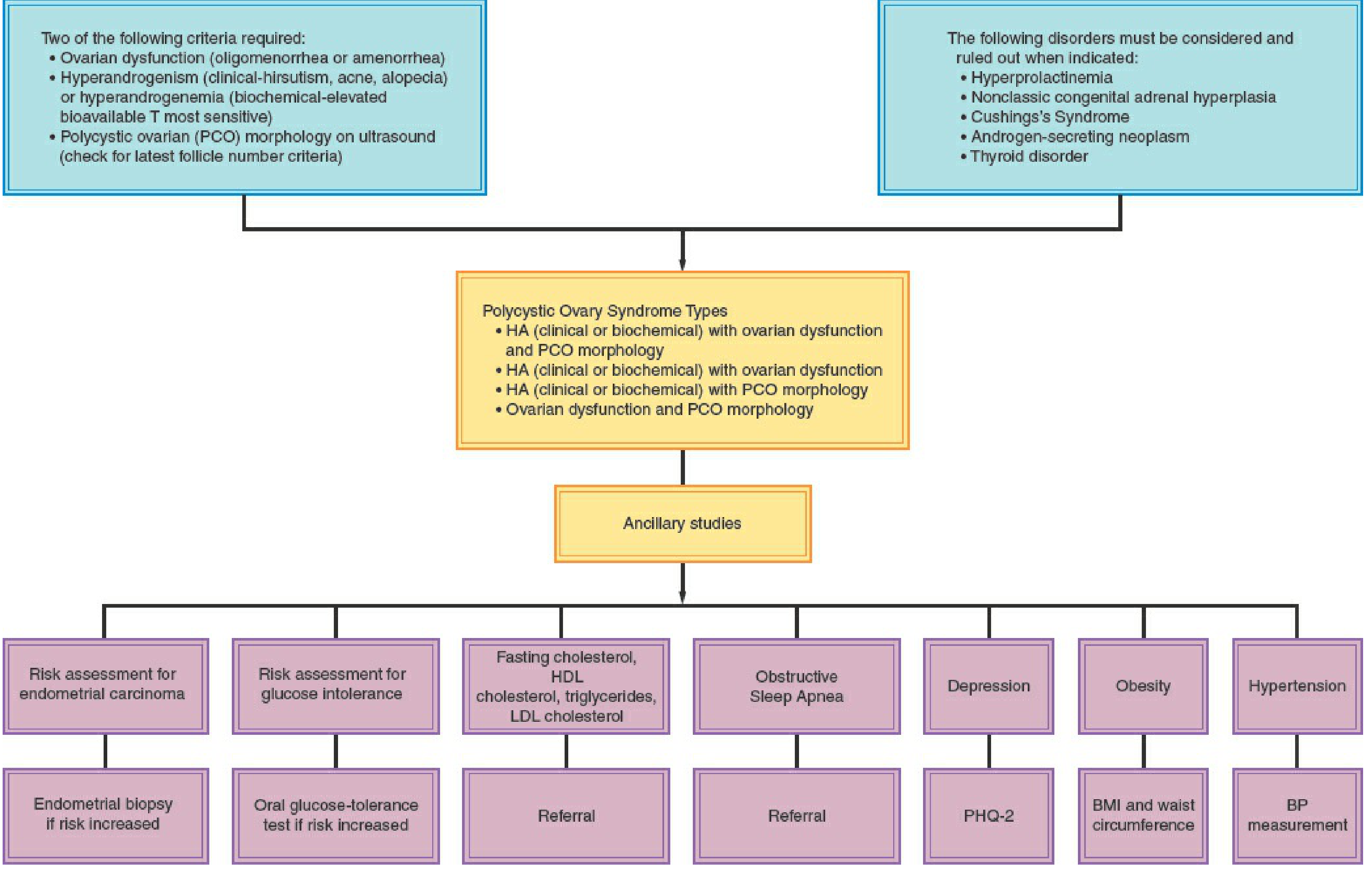
Conditions to Rule Out First
- Hyperprolactinemia
- Non-classic congenital adrenal hyperplasia (measure 17-OHP in all hirsute women)
- Cushing syndrome
- Androgen-secreting neoplasm (ovarian or adrenal)
- Thyroid disorder
- Hypo/hypergonadotropic disorders
Pathophysiology
PCOS is driven by a triad:
1. Hyperandrogenism
- LH hypersecretion stimulates ovarian theca cells to overproduce androgens
- Basal LH elevated in ~2/3 of cases
- Elevated androgens: testosterone, DHEAS, androstenedione
2. Insulin Resistance (IR)
- Present in the majority of PCOS women regardless of obesity
- A unique post-receptor defect (diminished insulin receptor autophosphorylation) found in ~50% of women with PCOS
- IR leads to compensatory hyperinsulinemia, which:
- Collaborates with LH to stimulate theca cell androgen production
- Inhibits hepatic SHBG synthesis, increasing free (bioavailable) testosterone
3. Chronic Anovulation
- Follicular arrest due to androgen excess and abnormal gonadotropin secretion
- Multiple small antral follicles accumulate = polycystic appearance on USS
Clinical Features
Reproductive
- Irregular periods (oligomenorrhea/amenorrhea) - from menarche
- Anovulatory infertility
- Elevated risk of: miscarriage, gestational diabetes, gestational hypertension, preeclampsia, preterm birth
Hyperandrogenic
- Hirsutism (70% in the US; much less common in East Asian women due to lower 5α-reductase activity)
- Acne
- Male-pattern alopecia (androgenic alopecia)
Metabolic
- Obesity in >50% of women with PCOS (predominantly android/central obesity)
- Insulin resistance and compensatory hyperinsulinemia
- 30-45% of obese women with PCOS have glucose intolerance or type 2 diabetes
- Dyslipidemia, elevated cardiovascular risk
- Acanthosis nigricans - a skin marker of IR (vulva, axilla, nape of neck, inner thigh)
- HAIR-AN syndrome: Hyperandrogenism + Insulin Resistance + Acanthosis Nigricans (extreme form)
Psychological
- Depression in 35-40% (vs. ~10% in controls)
- Anxiety and eating disorders are common
- Poor body image, low self-esteem
Investigations
| Test | Purpose |
|---|---|
| LH, FSH | Elevated LH:FSH ratio (>2:1 classic, but not required) |
| Free testosterone, DHEAS | Confirm biochemical HA |
| 17-OHP (follicular phase) | Rule out non-classic CAH |
| Prolactin | Rule out hyperprolactinemia |
| TSH | Rule out thyroid disorder |
| Fasting glucose/HbA1c or OGTT | Screen for diabetes/IGT |
| Fasting lipid profile | Cardiovascular risk in overweight/obese |
| Pelvic ultrasound | PCO morphology |
| AMH | Elevated; correlates with antral follicle count |
Glucose-to-insulin ratio <4.5 suggests IR. Using 2-hour OGTT: 10% of non-obese and 40-50% of obese PCOS women have impaired glucose tolerance or frank T2DM.
Management
Treatment is individualized based on the patient's primary concern.
1. Lifestyle Modification (ALL patients)
- Weight loss as little as 5% body weight can restore ovulation, reduce insulin, lower androgens, and improve SHBG
- Diet and exercise are first-line for overweight/obese women
- Recent systematic review (2025, PMID 39861440) confirms lifestyle intervention improves hormonal, metabolic, and reproductive outcomes
2. Not Trying to Get Pregnant
Menstrual regulation + hyperandrogenism:
- Combined oral contraceptive pills (COCPs) - first-line: regulate cycles, increase SHBG, reduce free testosterone (takes 2-3 months for androgens to fall; hirsutism/acne improvement may take longer)
- If inadequate response after 6 months: add antiandrogens - spironolactone or flutamide
- Endometrial protection (prevent unopposed estrogen/endometrial hyperplasia):
- Periodic progestins (medroxyprogesterone acetate 10 mg or progesterone 200 mg for 10-14 days every 3 months)
- Levonorgestrel IUD
Insulin sensitization:
- Metformin - for prevention of cardiometabolic risk in overweight/obese; NOT recommended alone for endometrial protection, hyperandrogenism, or infertility
New evidence: A 2024 meta-analysis (PMID 39178623) shows GLP-1 receptor agonists (e.g., semaglutide) are effective in obese PCOS women for weight loss and hormonal regulation.
3. Wanting to Get Pregnant (Ovulation Induction)
| Agent | Role |
|---|---|
| Letrozole (aromatase inhibitor) | First-line for ovulation induction |
| Clomiphene citrate (SERM) | Second-line, with or without metformin |
| Injectable gonadotropins | Used by experienced practitioners for monofollicular growth (PCOS patients at high risk of ovarian hyperstimulation) |
| Metformin | Adjunct with diet/exercise in obese women |
4. Hirsutism-Specific
- Weight loss
- COCPs
- 5α-reductase inhibitors: finasteride
- Antiandrogens: spironolactone, cyproterone acetate, flutamide
- GnRH analogues
- Mechanical: temporary (shaving, waxing) or permanent (electrolysis, laser)
Long-Term Complications & Monitoring
Screen at diagnosis and at regular intervals:
- Endometrial carcinoma - chronic anovulation causes unopposed estrogen; endometrial biopsy if at increased risk (young PCOS women can develop well-differentiated stage I endometrial cancer as early as the second decade)
- Type 2 diabetes - screen with OGTT, especially if obese or family history
- Cardiovascular disease - lipid profile, BP, waist circumference
- Obstructive sleep apnea - refer if suspected
- Depression/anxiety - PHQ-2 screening at each visit
- Vitamin D - assess and supplement if deficient (common in this population)
Key Points Summary
| Feature | Detail |
|---|---|
| Prevalence | 10-13% of reproductive-age women |
| Diagnosed by | Rotterdam criteria: 2 of 3 features |
| Core triad | HA + insulin resistance + anovulation |
| First-line (no pregnancy) | COCP + lifestyle modification |
| First-line (infertility) | Letrozole > clomiphene |
| Metabolic risk | T2DM, CVD, endometrial cancer |
| Reversibility | Partial - lifestyle changes significantly improve outcomes |
Sources: Berek & Novak's Gynecology, pp. 1919-1935 | Harrison's Principles of Internal Medicine 22E, p. 3179 | Goldman-Cecil Medicine, p. 2551 | ESHRE 2023 International Evidence-Based Guideline | Recent PubMed evidence (PMIDs 39861440, 39178623, 39599701)
This is a shared conversation. Sign in to Orris to start your own chat.