
How to differentiate mumps ,measles,rubella,herpes,
Reading File
Searching across the clinical features, rash characteristics, and differentiating features of these viral exanthems in parallel.
search_medical_text
mumps measles rubella clinical features rash differentiation
Harrison's Principles of Internal Medicine, Twenty First Edition
Page 6035
search_medical_text
herpes simplex herpes zoster clinical features diagnosis differential
Prevention and Treatment of Opportunistic Infections in Adults and Adolescents with HIV
Page 666
GradeResponse
GradeResponse
GradeResponse
Here is a comprehensive comparison to differentiate Mumps, Measles (Rubeola), Rubella (German Measles), and Herpes (HSV/VZV):
Differentiating Mumps, Measles, Rubella, and Herpes
Quick Overview Table
| Feature | Measles (Rubeola) | Mumps | Rubella | Herpes (HSV/VZV) |
|---|---|---|---|---|
| Pathogen | Measles virus (Paramyxovirus) | Mumps virus (Paramyxovirus) | Rubella virus (Togavirus) | HSV-1, HSV-2 / Varicella-Zoster Virus |
| Vaccine | MMR | MMR | MMR | Varicella / Shingrix (VZV) |
| Transmission | Respiratory droplets | Respiratory droplets | Respiratory droplets | Direct contact / reactivation |
| Incubation | 8–12 days | 14–25 days | 14–21 days | 2–12 days (primary) |
| Prodrome | High fever, 3 Cs | Malaise, fever | Mild fever, malaise | Prodromal burning/tingling |
1. Measles (Rubeola)
- Classic triad (3 Cs): Cough, Coryza (runny nose), Conjunctivitis
- Fever: High-grade (up to 40°C), appears first
- Pathognomonic sign: Koplik's spots — bluish-white spots on a red base on the buccal mucosa, appearing 1–2 days before the rash
- Rash: Maculopapular, starts on face/hairline, spreads head-to-toe (cephalocaudal) over 3–4 days; lesions may coalesce; lasts ~5–6 days
- Lymphadenopathy: Generalized, non-tender
- Lab: Leukopenia is characteristic
- Complications: Pneumonia, encephalitis, subacute sclerosing panencephalitis (SSPE)
2. Mumps
- No skin rash — this is the key distinguishing feature
- Hallmark: Parotid gland swelling (parotitis) — unilateral or bilateral, tender, doughy swelling; raises the earlobe
- Fever: Moderate
- Other gland involvement: Submandibular, sublingual salivary glands
- Complications:
- Orchitis (in post-pubertal males) — leading cause of viral orchitis
- Oophoritis, pancreatitis, aseptic meningitis, sensorineural deafness
- Lab: Elevated serum amylase/lipase; lymphocytosis
3. Rubella (German Measles)
- Milder than measles — often called "3-day measles"
- Prodrome: Low-grade fever, malaise — much less severe than measles; no cough
- Pathognomonic sign: Forchheimer spots — petechiae on the soft palate (less reliable than Koplik's)
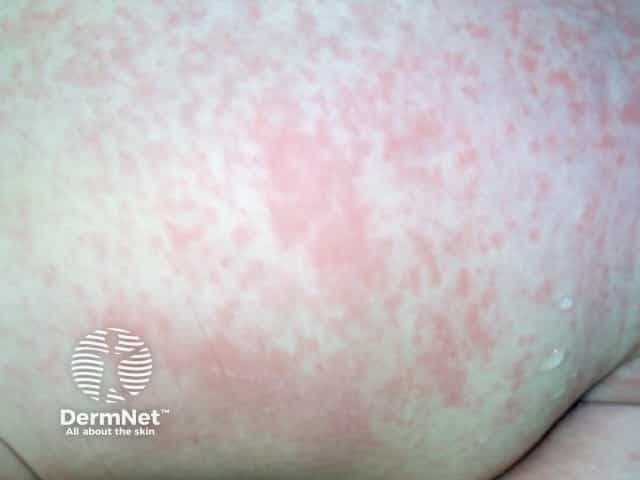
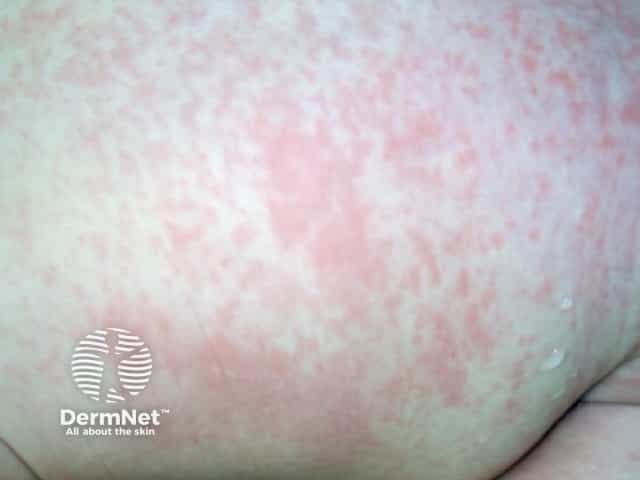
- Rash: Fine, pink maculopapular, starts on face, spreads caudally in 24–48 hours; lesions remain discrete (do not coalesce); resolves in ~3 days
- Lymphadenopathy: Postauricular, occipital, and posterior cervical — tender, appears before the rash — classic distinguishing feature from measles
- No conjunctivitis or cough (key difference from measles)
- Most dangerous in pregnancy: Congenital Rubella Syndrome (cataracts, cardiac defects, deafness)
Rubella: discrete, blanching pink maculopapular rash spreading caudally, with postauricular lymphadenopathy (DermNetNZ)
4. Herpes (HSV & VZV)
Unlike the above three, herpes presents as vesicular lesions, not maculopapular rash:
Herpes Simplex Virus (HSV-1 / HSV-2)
- HSV-1: Orolabial herpes — "cold sores" on lips/perioral; clustered vesicles on erythematous base
- HSV-2: Genital herpes — vesicles/ulcers on genitalia; painful
- Prodrome: Tingling/burning/itching before vesicle formation
- Lesion pattern: Grouped vesicles → rupture → painful ulcers → crust
- Recurrent: Virus remains latent in dorsal root/trigeminal ganglia
Herpes Zoster (VZV Reactivation / "Shingles")
- Dermatomal distribution — unilateral, does not cross midline
- Prodrome: Severe dermatomal pain/burning before rash appears (can mimic MI, pleuritis, etc.)
- Rash: Vesicles on erythematous base in a belt-like (zoster = belt) distribution
- Common dermatomes: T3–L3; also ophthalmic branch of trigeminal (Herpes Zoster Ophthalmicus)
- Complications: Postherpetic neuralgia, Ramsay Hunt syndrome (CN VII), encephalitis
- Diagnosis: Clinical; PCR of vesicular fluid for confirmation in atypical cases
Varicella (Primary VZV / Chickenpox)
- Rash: Pleomorphic — lesions in different stages simultaneously (macules, papules, vesicles, pustules, crusts)
- Distribution: Centripetal (starts on trunk, spreads to face and extremities)
- Intensely pruritic
- Prodrome: 1–2 days of fever before rash
Key Differentiating Summary
| Distinguishing Clue | Points To |
|---|---|
| Koplik's spots + 3 Cs + high fever + coalescing rash | Measles |
| Parotid swelling, no rash, orchitis | Mumps |
| Postauricular lymphadenopathy + mild rash + no cough | Rubella |
| Dermatomal vesicular rash + pain | Herpes Zoster |
| Grouped perioral/genital vesicles + ulcers | HSV |
| Pleomorphic rash all stages at once + pruritus | Varicella (primary VZV) |
Diagnosis Confirmation
| Disease | Confirmatory Test |
|---|---|
| Measles | Serum IgM, RT-PCR (urine/throat) |
| Mumps | Serum IgM, viral PCR (saliva/CSF) |
| Rubella | Serum IgM/IgG, RT-PCR |
| HSV | Tzanck smear, PCR of vesicular fluid |
| VZV/Zoster | Clinical ± PCR, DFA of vesicular scraping |
(Harrison's Principles of Internal Medicine, 21st Ed., p. 6035)
This is a shared conversation. Sign in to Orris to start your own chat.