
Accomodation Reflex
Reading File
The accommodation reflex is a set of three coordinated responses that occur when the eye shifts focus from a distant to a near object: convergence of both eyes, pupillary constriction, and increased lens curvature (increased convexity) via ciliary muscle contraction.
Searching sources...
Finding Sources
Finding Sources
Finding Sources
Finding Sources
Reading File
Finding Sources
Reading File
Reading File
Reading File
Finding Sources
Loading Image
Loading Image
Reading File
Here is a detailed breakdown of the Accommodation Reflex (also called the near triad or near response):
Accommodation Reflex (Near Triad)
When gaze shifts from a distant object to a near one, three simultaneous responses occur:
| Component | Mechanism |
|---|---|
| 1. Lens accommodation | Ciliary muscle contracts → suspensory ligaments relax → lens becomes more convex (increases refractive power) |
| 2. Pupillary constriction (miosis) | Sphincter pupillae contracts parasympathetically → reduces spherical aberration, increases depth of focus |
| 3. Convergence | Both medial recti contract → visual axes align on the near object |
Ciliary Muscle Mechanics
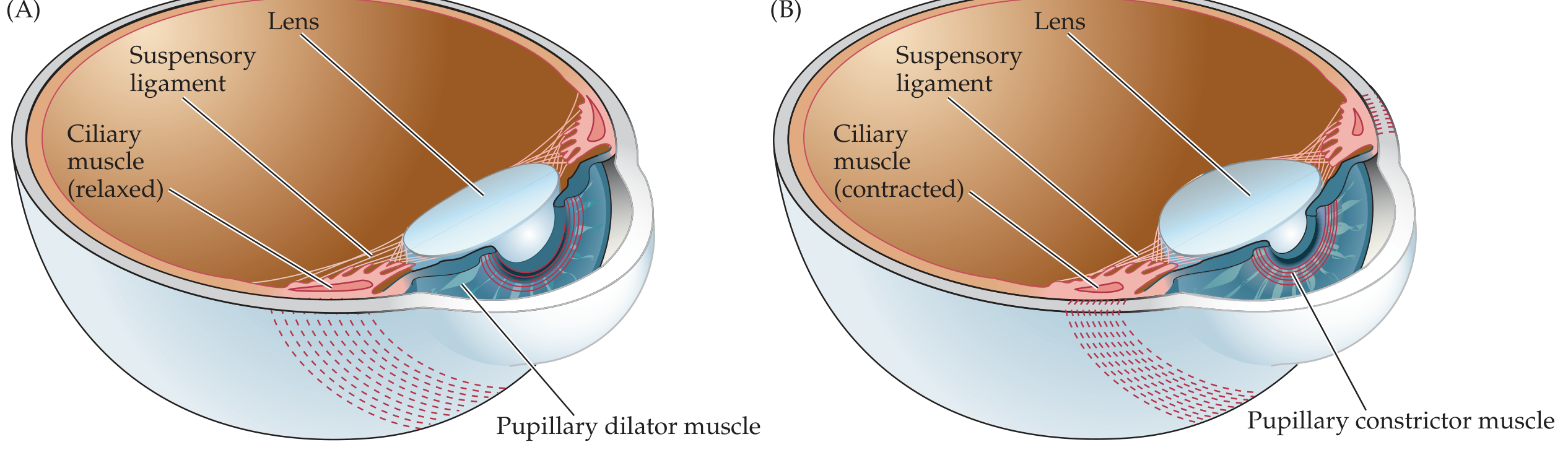
- (A) Distance vision: Ciliary muscle is relaxed → suspensory ligaments (zonules) are taut → lens is flattened (low power)
- (B) Near vision: Ciliary muscle contracts → zonules slacken → lens rounds up (high power, high refractive index)
This is the Helmholtz mechanism of accommodation.
Neural Pathway
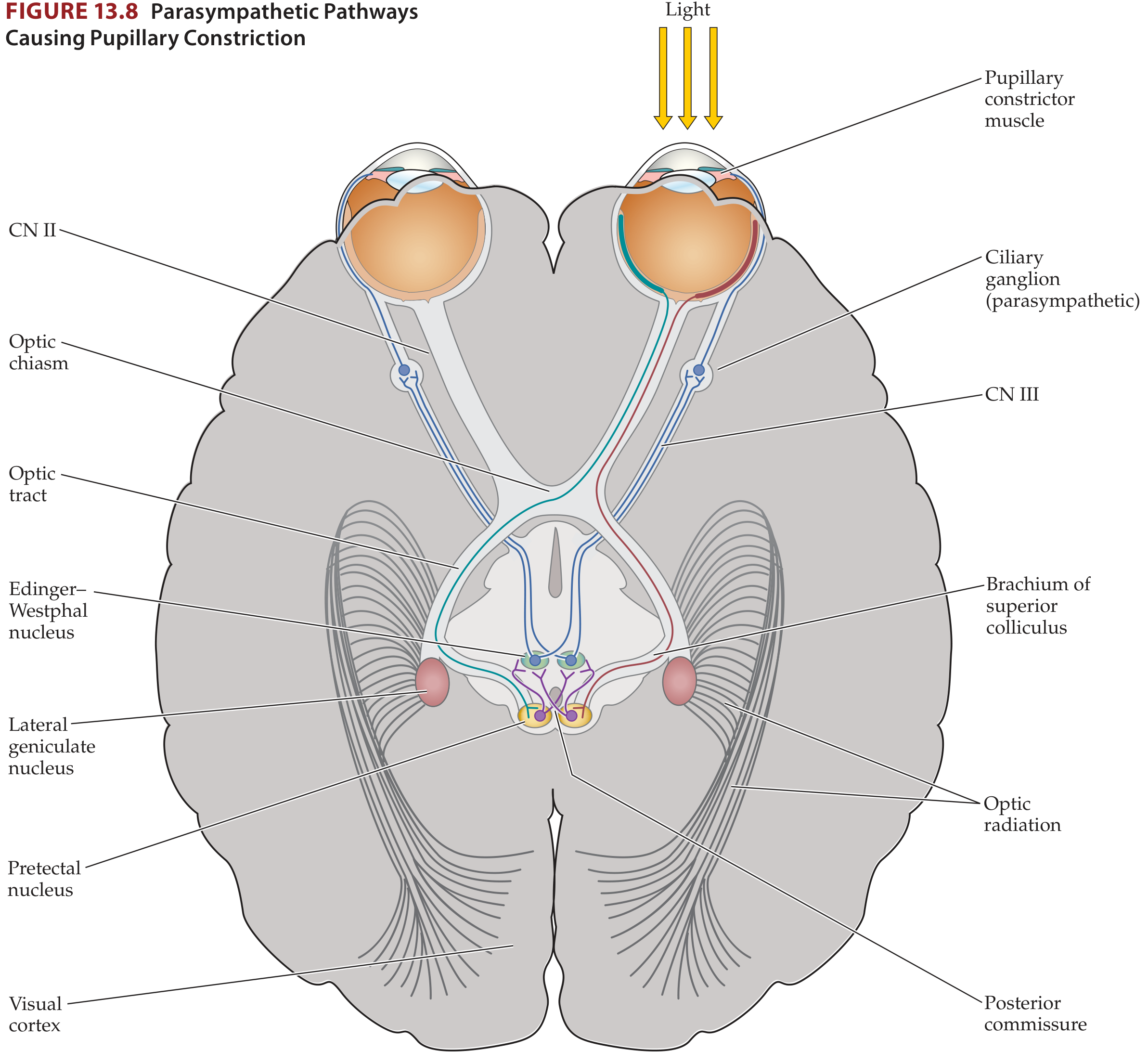
The accommodation response is activated by visual signals relayed to the visual cortex. From there, via occipitomesencephalic pathways (still partially under investigation), the signal reaches:
- Visual cortex (occipital lobe) - detects blur/disparity of near object
- Pretectal nuclei (midbrain) - relay station, activates bilaterally
- Edinger-Westphal nucleus (CN III complex, dorsal midbrain) - parasympathetic preganglionic neurons
- CN III (oculomotor nerve) - carries preganglionic parasympathetic fibers
- Ciliary ganglion (orbit) - synapse
- Short ciliary nerves - postganglionic fibers to:
- Sphincter pupillae (miosis)
- Ciliary muscle (lens rounding)
- Medial rectus neurons (convergence) via CN III motor fibers
- Neuroanatomy through Clinical Cases 3rd Edition, p. 605
- Localization in Clinical Neurology 8e, p. 579
- Bradley and Daroff's Neurology in Clinical Practice
Key Differences: Accommodation vs. Light Reflex
| Feature | Light Reflex | Accommodation Reflex |
|---|---|---|
| Afferent | Retina → optic nerve → pretectum (bypasses cortex) | Retina → optic nerve → lateral geniculate → visual cortex |
| Center | Pretectal nuclei → bilateral EW nuclei | Occipitomesencephalic tract → EW nuclei |
| Response | Direct + consensual miosis | Miosis + lens rounding + convergence |
| Cortex needed? | No | Yes |
This difference explains light-near dissociation: if the pretectal relay is damaged (but cortical pathway is spared), the light reflex is lost but accommodation is preserved.
Clinical Relevance
Argyll Robertson Pupil (classic in neurosyphilis):
- Pupils are small, irregular, bilateral (often asymmetric)
- Absent light reflex but intact accommodation reflex = light-near dissociation
- Lesion: rostral midbrain (pretectal area), disrupting the retinomesencephalic light reflex pathway while sparing the occipitomesencephalic accommodation pathway
- Other causes of light-near dissociation: dorsal midbrain syndrome (Parinaud), diabetes, Adie's tonic pupil, midbrain encephalitis, pineal tumors, aberrant CN III regeneration
Cycloplegia / Mydriasis (anticholinergic drugs):
- Muscarinic blockade → paralysis of ciliary muscle (cycloplegia, loss of accommodation) + pupillary dilation (mydriasis)
- Goodman & Gilman's Pharmacological Basis of Therapeutics
Presbyopia:
- Age-related hardening of the lens → reduced ability to change shape despite ciliary muscle contraction → loss of near accommodation
Summary
The accommodation reflex is a coordinated parasympathetic (CN III / Edinger-Westphal) response. It requires an intact visual cortex and occipitomesencephalic pathway. Its three components - lens rounding, miosis, convergence - work together to bring a near object into sharp, single focus. It is clinically tested by asking the patient to shift gaze from far to near and observing pupil constriction and convergence.
For 2nd year MBBS
Finding Sources
Finding Sources
Finding Sources
This is a shared conversation. Sign in to Orris to start your own chat.