
Resting membrane potential ..definition and ionic basis general physiology 5 marks
I'll read the medical library skill first, then search for resting membrane potential content.
Reading File
Now let me search the library for resting membrane potential content in parallel:
Finding Sources
Finding Sources
Excellent results. Let me now read the most relevant physiology textbook sections in parallel - Guyton & Hall, Costanzo, and Ganong:
Reading File
Reading File
Reading File
Let me read the Guyton section on "Origin of the Normal Resting Membrane Potential" for more ionic detail, and also fetch the key diagram:
Reading File
Loading Image
Loading Image
Also fetch the key Guyton Figure 5.5 diagram showing the three conditions:
Loading Image
I now have everything needed for a comprehensive, exam-focused 5-mark answer. Here it is:
Resting Membrane Potential - Definition and Ionic Basis
Definition
The resting membrane potential (RMP) is the electrical potential difference that exists across the cell membrane of an excitable cell (nerve or muscle) between action potentials, i.e., when the cell is at rest and not generating any signals.
- It is expressed as the intracellular potential relative to the extracellular potential (by convention).
- In a typical large myelinated nerve fiber, RMP = -70 mV (Ganong) to -70 to -80 mV (Costanzo); Guyton gives approximately -90 mV for nerve when all factors are combined.
- The negative sign indicates the inside of the cell is negative relative to the outside.
Two conditions must be met for a membrane potential to exist:
- An unequal distribution of ions across the membrane (concentration gradient).
- Selective permeability of the membrane to those ions (via ion channels).
(Ganong's Review of Medical Physiology, 26th ed.)
Ionic Basis
The RMP is determined by three interrelated factors:
1. Ion Concentration Gradients (Established by the Na⁺-K⁺ ATPase)
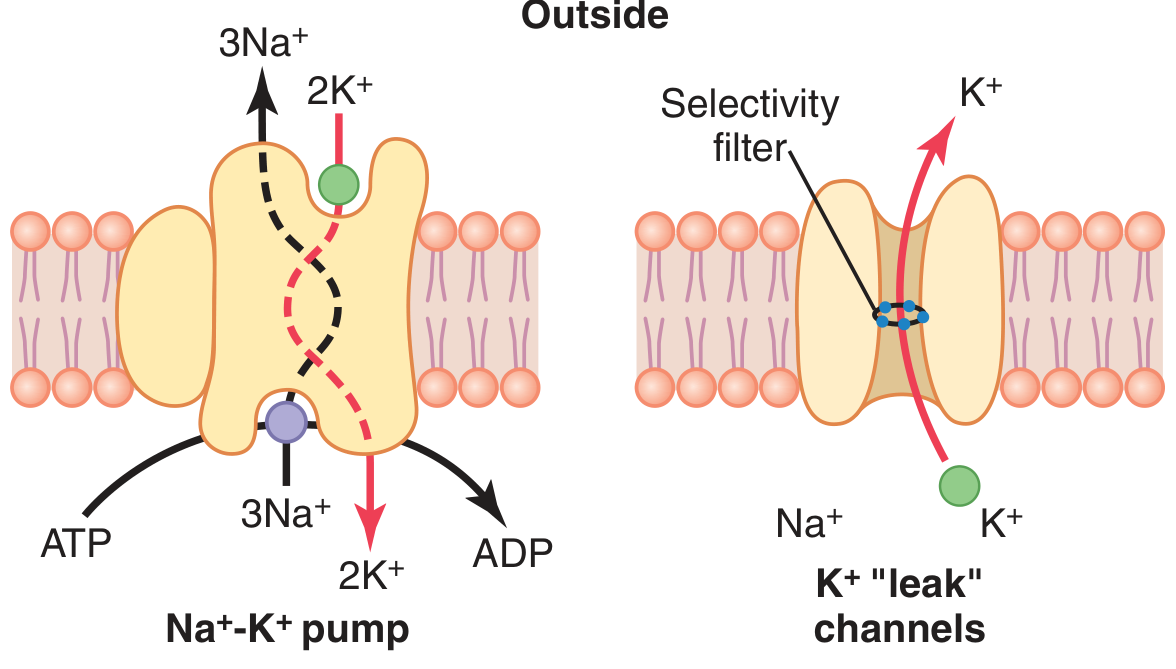
The Na⁺-K⁺ pump actively transports 3 Na⁺ out and 2 K⁺ in per cycle, creating the following gradients:
| Ion | Inside | Outside |
|---|---|---|
| K⁺ | 140 mEq/L | 4 mEq/L |
| Na⁺ | 14 mEq/L | 142 mEq/L |
(Guyton & Hall Textbook of Medical Physiology)
2. Differential Membrane Permeability at Rest
At rest, the membrane has far more open K⁺ channels (leak channels) than Na⁺ channels:
- Permeability to K⁺ is ~100x greater than to Na⁺.
- K⁺ therefore diffuses outward down its concentration gradient, making the inside more negative.
- Na⁺ attempts to diffuse inward but is largely restricted by low permeability.
- K⁺ is the dominant determinant of the RMP.
The Nernst potential for K⁺ (using the 35:1 inside-to-outside ratio) = -94 mV.
The Nernst potential for Na⁺ (inside/outside = 0.1) = +61 mV.
(Costanzo Physiology, 7th ed.)
3. Three-Step Origin of RMP (Goldman Equation Framework)
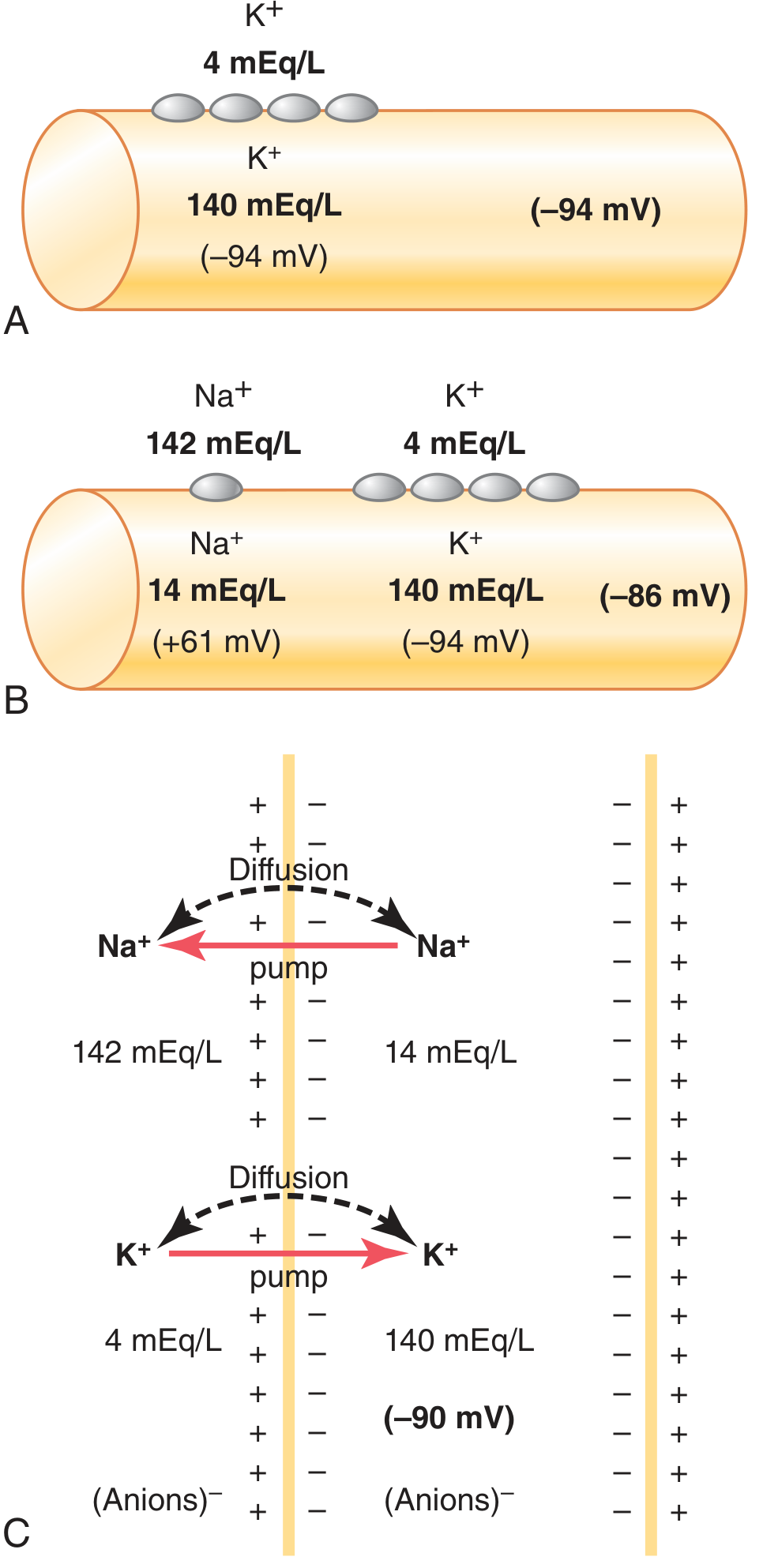
The Guyton diagram below illustrates the stepwise build-up:
| Condition | Potential |
|---|---|
| (A) K⁺ diffusion only | -94 mV |
| (B) K⁺ + Na⁺ diffusion (Goldman equation, PK:PNa = 100:1) | -86 mV |
| (C) + Electrogenic Na⁺-K⁺ pump (adds ~-4 mV) | -90 mV |
The Goldman-Hodgkin-Katz (GHK) equation accounts for all permeant ions simultaneously:
Em = (RT/F) × ln [ (PK[K⁺]o + PNa[Na⁺]o + PCl[Cl⁻]i) / (PK[K⁺]i + PNa[Na⁺]i + PCl[Cl⁻]o) ]
(Guyton & Hall, 14th ed.)
4. Role of the Na⁺-K⁺ ATPase (Electrogenic Contribution)
The pump contributes in two ways:
- Direct (electrogenic) contribution: Pumps 3 Na⁺ out for every 2 K⁺ in - net loss of one positive charge per cycle, adding approximately -4 mV directly.
- Indirect (more important) contribution: Maintains the K⁺ concentration gradient, which drives the K⁺ diffusion potential that is the primary determinant of the RMP.
(Costanzo Physiology, 7th ed.)
5. Role of Cl⁻ and Fixed Anions
- Cl⁻ has a high permeability at rest; it distributes passively until its equilibrium potential equals the RMP (approximately -70 mV in most cells), contributing little net change.
- Large intracellular organic anions (proteins, phosphates) are impermeant and contribute to the fixed negative charge inside the cell, reinforcing the negative interior.
Summary Table
| Factor | Effect on RMP |
|---|---|
| High intracellular K⁺ | K⁺ diffuses out → inside becomes negative |
| High extracellular Na⁺ | Na⁺ tends to enter but low permeability at rest |
| Membrane: PK >> PNa | RMP driven close to EK (-94 mV) |
| Na⁺-K⁺ pump (electrogenic) | Additional -4 mV |
| Fixed intracellular anions | Reinforce negativity |
| Net RMP | -70 to -90 mV (cell dependent) |
Key point for exam: The RMP is primarily a potassium diffusion potential - it exists because the resting membrane is predominantly permeable to K⁺ (via K⁺ leak channels) and K⁺ diffuses outward down its steep concentration gradient maintained by the Na⁺-K⁺ ATPase. The resulting negative interior is what we measure as the resting membrane potential.
Sources: Guyton & Hall Textbook of Medical Physiology (14th ed.) | Costanzo Physiology (7th ed.) | Ganong's Review of Medical Physiology (26th ed.)
This is a shared conversation. Sign in to Orris to start your own chat.