
Development and growth of musculoskeletal system. In simple easy English
Reading File
Now let me search the medical library for musculoskeletal development content.
Finding Sources
Finding Sources
Finding Sources
Finding Sources
Finding Sources
Finding Sources
Reading File
Finding Sources
Reading File
Finding Sources
Reading File
Reading File
Reading File
Reading File
I have excellent content now. Let me fetch a couple of key images to include in the answer.
Loading Image
Loading Image
I now have rich textbook content and diagrams. Here is the full, easy-to-understand explanation:
Development and Growth of the Musculoskeletal System
The musculoskeletal system includes bones, cartilage, joints, and muscles. All of these start from a simple layer of embryonic cells and gradually build the framework of the human body.
1. Where Does It All Come From? - The Starting Material
Everything begins with a tissue called mesenchyme - think of it as a "raw clay" made of loosely arranged embryonic cells. This mesenchyme comes mainly from the middle layer of the embryo (mesoderm), specifically from structures called somites - small blocks of tissue that form along either side of the developing spine starting around week 3.
Each somite splits into two parts:
- Sclerotome (inner part) - forms the vertebrae and ribs
- Dermomyotome (outer part) - forms muscles and skin
2. How Bones Form - Two Ways
A) Intramembranous Ossification (Direct Bone Formation)
Think of this as bone growing straight from connective tissue, without any cartilage in between.
- Mesenchymal cells cluster together and directly turn into osteoblasts (bone-making cells)
- These cells secrete collagen and minerals to form bone matrix
- This is how the flat bones of the skull (frontal, parietal bones) are made
- Also how the clavicle (collarbone) forms
B) Endochondral Ossification (Bone Through a Cartilage Blueprint)
This is the most common method - a cartilage model is made first, then replaced by bone. Think of it like building with a wax mold that then gets replaced with metal.
Steps:
- Mesenchymal cells condense and turn into chondrocytes (cartilage cells) - forming a miniature cartilage "skeleton"
- The center of the cartilage enlarges and dies (hypertrophy + apoptosis)
- Blood vessels grow in, bringing osteoblasts (bone-making cells)
- Osteoblasts lay down bone around the dying cartilage - this forms the primary ossification center in the shaft (diaphysis)
- By the 12th week, all long bones have a primary ossification center
- After birth, secondary ossification centers form at the ends (epiphyses)
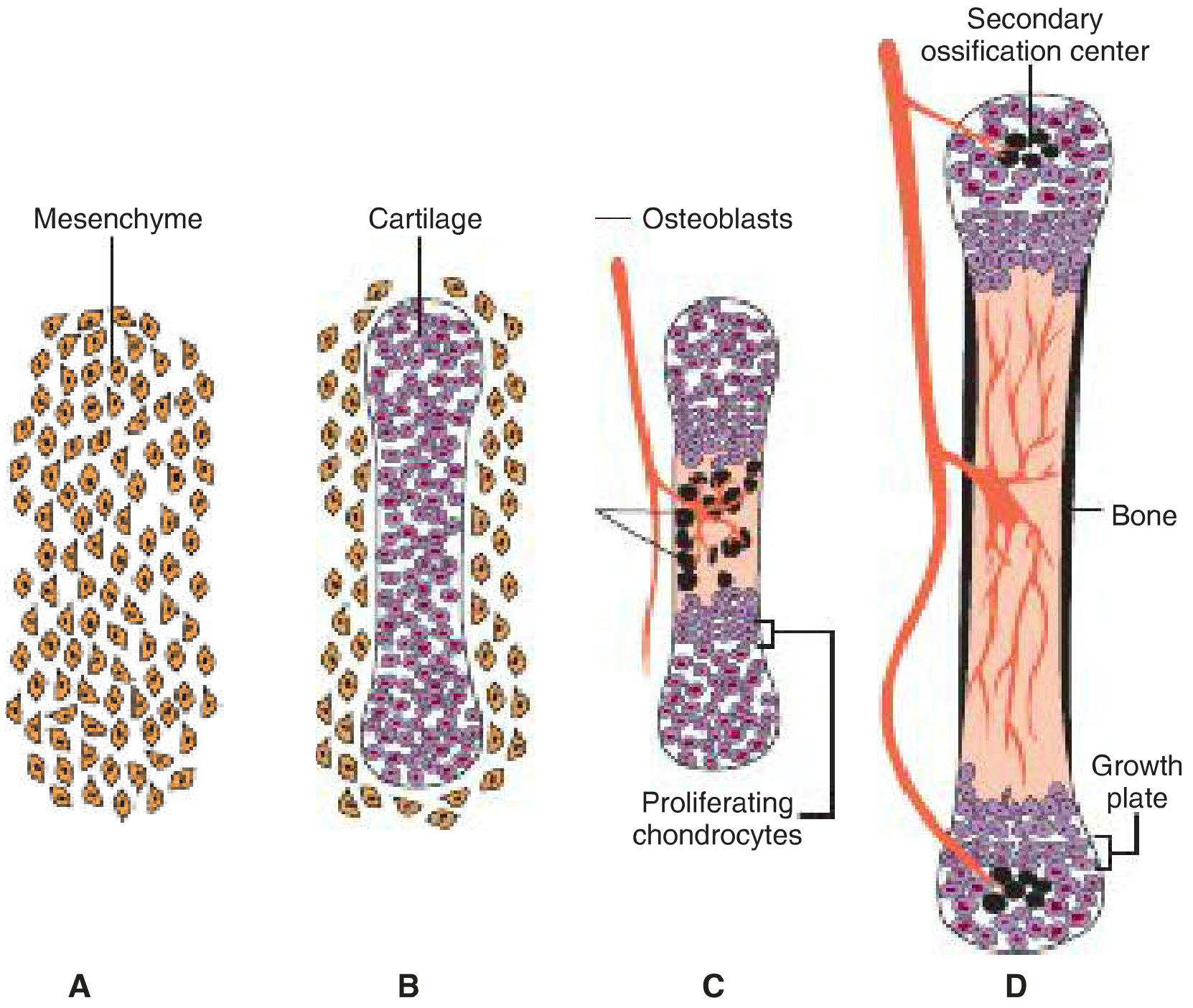
Endochondral bone formation: A=mesenchyme condensing, B=cartilage model, C=blood vessels invade with osteoblasts, D=mature bone with growth plates and secondary ossification centers - Langman's Medical Embryology
3. The Growth Plate - How Bones Get Longer
Between the shaft (diaphysis) and the ends (epiphyses) lies the epiphyseal plate (growth plate) - a thin layer of cartilage that keeps producing new cells. Ossification happens on both sides of it, progressively lengthening the bone.
- Growth plates are active throughout childhood and adolescence
- When growth stops (usually late teens), the growth plate closes (fuses), and the epiphysis merges with the shaft
- Hormones (growth hormone, thyroid hormone, sex hormones) heavily influence this process
4. Development of Cartilage
Cartilage forms by week 5 from mesenchyme condensations called "chondrification centers."
Three types develop:
| Type | Where | Example |
|---|---|---|
| Hyaline cartilage | Most common | Joint surfaces, nose, trachea |
| Fibrocartilage | Shock absorber | Intervertebral discs, knee menisci |
| Elastic cartilage | Flexible | Ear, epiglottis |
5. Development of Joints
Joints form at the same time as bones are being made:
- Where two bones meet, the mesenchyme between them forms an interzone
- This interzone differentiates into:
- Articular cartilage (covering bone ends)
- Synovial membrane (lining the joint cavity)
- Ligaments and menisci inside the joint
- Joint capsule from the surrounding mesenchyme
- Fibrous joints (like skull sutures) form when the interzone stays as dense fibrous tissue
6. Development of the Axial Skeleton (Spine and Skull)
Vertebral Column
- Sclerotome cells from somites migrate to surround the notochord (the embryo's central rod)
- They form the bodies of the vertebrae
- The notochord remnant becomes the nucleus pulposus (the soft center of intervertebral discs)
Skull
- The skull base forms by endochondral ossification (through cartilage)
- The skull vault (top and sides) forms by intramembranous ossification (directly from membrane)
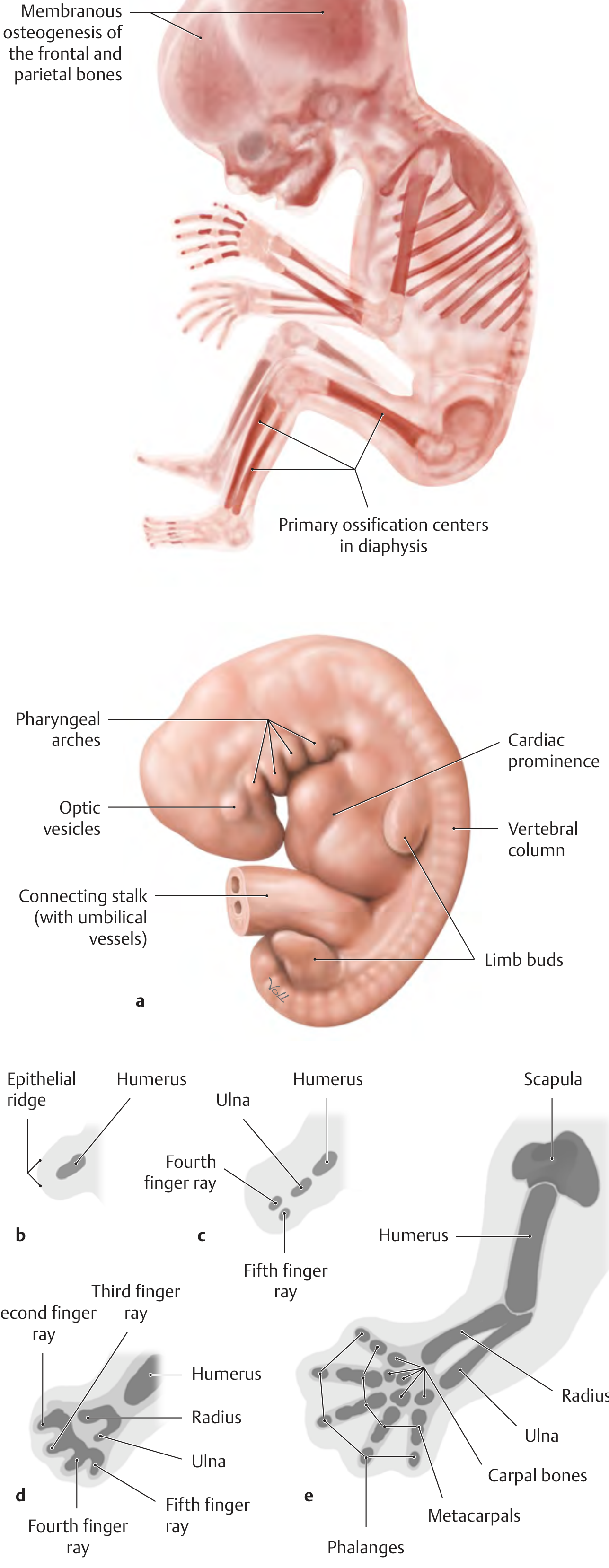
Top: 11-week fetus skull showing membranous bone formation of frontal/parietal bones and primary ossification centers in diaphyses. Bottom: Limb bud development showing progressive formation of arm bones from simple buds to distinct phalanges - THIEME Atlas of Anatomy
7. Development of the Limbs (Appendicular Skeleton)
- Limb buds appear around week 4 (arms first, then legs)
- The buds are driven by the apical ectodermal ridge (AER) - a thickened tip of ectoderm that signals the bud to grow outward
- Mesenchyme inside the bud condenses into cartilage models of future limb bones
- Fingers and toes form from "rays" - cells between them die (apoptosis) to separate the digits
- By week 12, ossification centers are present in all long limb bones
8. Development of Skeletal Muscle
Muscles develop from myogenic precursor cells that originate from somites - specifically the dermomyotome region.
- Cells migrate from somites into target areas (limbs, trunk, head)
- They express genes like MYOD (a key "master switch" for muscle differentiation)
- Precursor cells called myoblasts fuse together to form long, multinucleated muscle fibers
- Limb muscles split into flexor and extensor groups as the limb buds elongate
- Further splittings and fusions create the complex muscle pattern we have in adults
Quick Summary Timeline
| Week | What Happens |
|---|---|
| 3 | Somites form from paraxial mesoderm |
| 4 | Sclerotome cells form mesenchyme; limb buds appear |
| 5 | Cartilage (chondrification) begins |
| 6-8 | Primary ossification centers start in long bones |
| 12 | Ossification centers in ALL long bones |
| Birth | Diaphyses fully ossified; epiphyses still cartilage |
| After birth | Secondary ossification centers form in epiphyses |
| Late teens | Growth plates close; bone growth stops |
Sources: The Developing Human: Clinically Oriented Embryology, pp. 901-906 | Langman's Medical Embryology, p. 189 | THIEME Atlas of Anatomy: General Anatomy and Musculoskeletal System, p. 32
Can you explain from the beginning. From the very start till end. Of development and growth of musculoskeletal systemsystem. In simple easy English.
Finding Sources
Finding Sources
Reading File
Finding Sources
Reading File
Reading File
Reading File
Reading File
Reading File
Loading Image
Reading File
Loading Image
Loading Image
I now have everything needed for a complete, detailed, easy-English walkthrough. Here it is:
Development and Growth of the Musculoskeletal System
From Fertilization to Adulthood - Complete Guide in Simple English
PART 1 - THE VERY BEGINNING (Weeks 1-2): The Raw Material
When a sperm fertilizes an egg, the resulting cell divides over and over to form a tiny ball of cells. By the end of week 2, this ball organizes into three germ layers - think of them as three different kinds of "dough" that will make different body parts:
| Layer | What it becomes |
|---|---|
| Ectoderm (outer layer) | Skin, nervous system |
| Mesoderm (middle layer) | Bones, muscles, cartilage, joints - this is the important one for us |
| Endoderm (inner layer) | Gut, lungs |
So the entire musculoskeletal system comes from the middle layer (mesoderm).
PART 2 - THE FIRST BUILDING BLOCKS (Week 3): Somites Form
Around day 18-22, the mesoderm on either side of the developing spine thickens into two long strips. By the end of week 3, these strips break into small cube-shaped blocks called SOMITES - like beads on a string running down the back of the embryo.
Think of somites as starter packs - each one contains the ingredients to build specific bones and muscles.
Each somite splits into three regions:
- Sclerotome (inner bottom part) - will form the vertebrae and ribs
- Myotome (middle part) - will form skeletal muscles
- Dermatome (outer top part) - will form the skin
Eventually about 42-44 pairs of somites form, giving rise to the entire axial skeleton and muscles of the trunk.
PART 3 - MAKING THE RAW CLAY (Week 4): Mesenchyme
The sclerotome cells break away and spread out to form a loose, jelly-like tissue called MESENCHYME - think of this as the "raw clay" of the body. It has one amazing property: it can turn into almost anything - bone, cartilage, muscle, or connective tissue - depending on where it is and what signals it receives.
At this stage, the embryo is still tiny (about 4-5 mm), but the blueprint of the entire skeleton is already being laid out.
PART 4 - TWO WAYS BONES ARE MADE (Weeks 5-8): Ossification Begins
Bone can form in two completely different ways:
WAY 1: Intramembranous Ossification (Direct Bone Formation)
Simple version: Mesenchyme turns straight into bone - no cartilage needed in between.
How it works:
- Mesenchyme cells clump together and multiply
- Blood vessels grow in, making the area very rich in blood supply
- Cells turn into osteoblasts (bone-building cells)
- Osteoblasts secrete collagen + minerals (calcium phosphate) to form bone matrix
- Some osteoblasts get trapped in the matrix and become osteocytes (mature bone cells that maintain bone)
- Bone forms in spiky strands (spicules) that weave together into flat plates
- Osteoclasts (bone-dissolving cells) carve out spaces, which fill with bone marrow
Which bones form this way?
- Flat bones of the skull (frontal, parietal, temporal bones)
- The clavicle (collarbone) - one of the first bones to ossify
- Parts of the mandible (lower jaw) and maxilla (upper jaw)
WAY 2: Endochondral Ossification (Bone via a Cartilage Blueprint)
Simple version: A cartilage model is built first, like a rough draft, and then gradually replaced by real bone.
How it works - step by step:
Step 1 - Mesenchyme condenses into clusters (week 5)
Step 2 - These clusters turn into chondroblasts, which produce cartilage matrix (collagen + proteoglycans). The result is a miniature cartilage "model" of the future bone - shaped exactly like the real bone but made entirely of cartilage.
Step 3 - The center of the cartilage model (the shaft, called the diaphysis) starts to change. Cartilage cells (chondrocytes) grow very large (hypertrophy), then die.
Step 4 - As cells die, they release signals (VEGF) that attract blood vessels. Blood vessels grow into the dying cartilage, carrying bone-making cells (osteoblasts) with them.
Step 5 - Osteoblasts settle on the dead cartilage framework and lay down real bone matrix on top of it. This spot is called the Primary Ossification Center and it forms in the shaft (diaphysis). This starts at week 6-8.
Step 6 - By week 12, every long bone in the body has a primary ossification center in its shaft.
Step 7 - Ossification spreads outward from the shaft toward both ends, replacing cartilage with bone. But the very tips (called epiphyses) remain as cartilage at birth.
Step 8 - After birth, Secondary Ossification Centers form inside the epiphyses (the bony ends). These appear at different times for different bones - some shortly after birth, others during childhood.
Which bones form this way? Almost all bones of the body:
- All long bones (femur, tibia, humerus, radius, etc.)
- Short bones (carpals, tarsals)
- Vertebrae and ribs
- Skull base
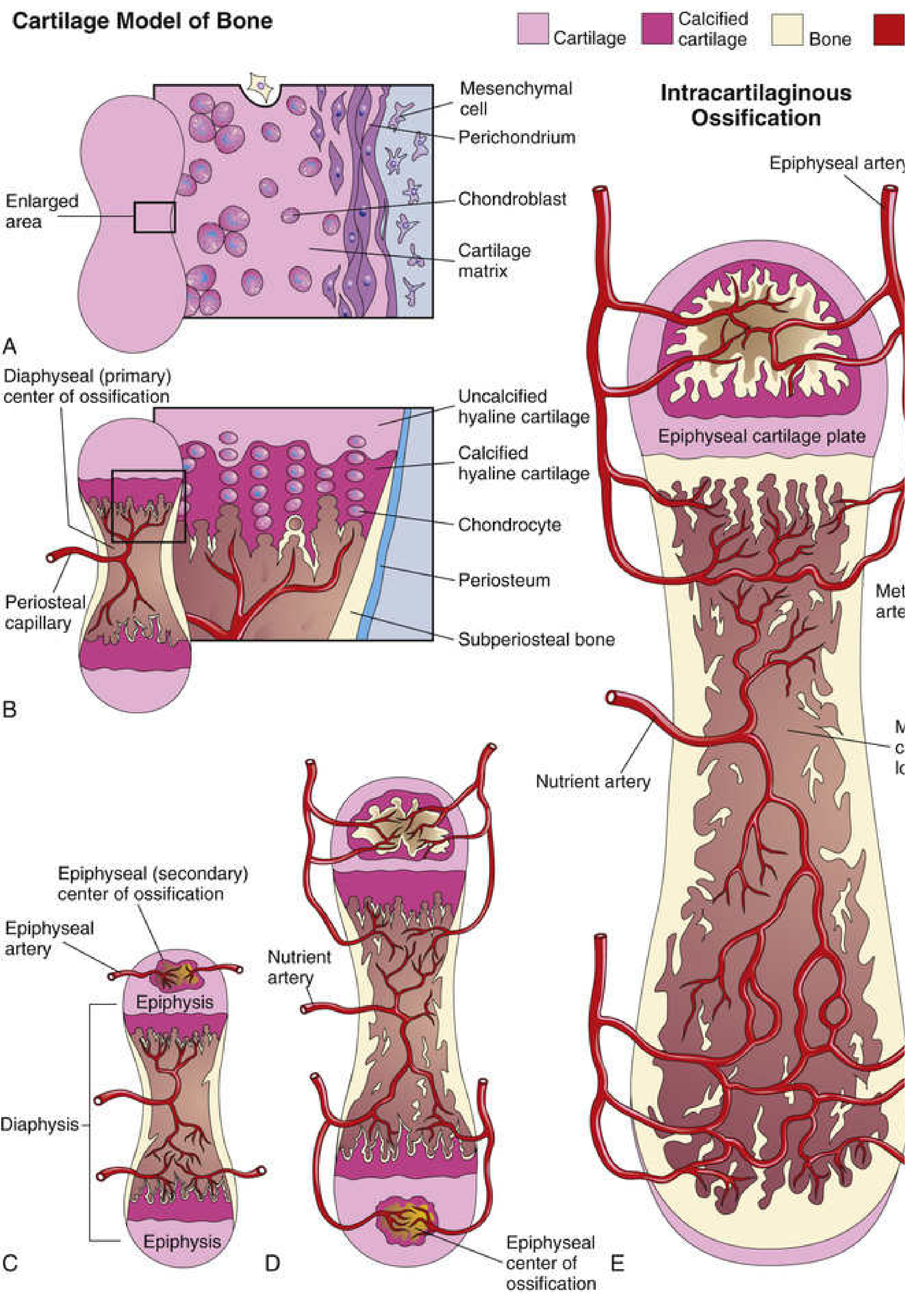
PART 5 - THE GROWTH PLATE: How Bones Get Taller
After primary and secondary ossification centers form, there is a thin disc of cartilage left between the shaft and each end - this is the EPIPHYSEAL PLATE (growth plate).
This is one of the most important structures in the growing skeleton. Here's why:
- Cartilage cells in the growth plate keep dividing and multiplying
- New cartilage cells push older ones toward the shaft side
- On the shaft side, old cartilage is constantly being replaced by bone
- This process pushes the ends further apart, making the bone longer
The growth plate has distinct zones (from top to bottom):
- Resting zone - cartilage cells sitting quietly
- Proliferating zone - cells rapidly dividing (this is where length is added)
- Hypertrophic zone - cells enlarge and prepare to die
- Calcification zone - dead cartilage gets mineralized
- Ossification zone - bone replaces the mineralized cartilage
Growth stops when sex hormones (estrogen, testosterone) during puberty signal the plate to close. The cartilage disappears, the epiphysis fuses with the diaphysis, and no more lengthening is possible. Fusion happens 1-2 years earlier in girls than boys.
PART 6 - DEVELOPMENT OF THE AXIAL SKELETON (Spine, Ribs, Skull)
The Vertebral Column (Spine)
Week 3-4: Sclerotome cells migrate from somites and surround the notochord (a temporary rod that acts as the embryo's backbone). The notochord is then incorporated into the vertebrae.
Key fact: Each vertebra actually comes from TWO neighboring somites (the bottom half of one + top half of the next). This is called resegmentation and it's why spinal nerves exit between vertebrae (not through them).
The notochord remnant squeezed between vertebrae becomes the nucleus pulposus - the soft jelly-like center of each intervertebral disc.
Ossification of vertebrae:
- Each vertebra has 3 primary ossification centers - one for the body (centrum) and one for each half of the vertebral arch
- These fuse together during the first few years of life
- Secondary ossification centers (5 total per vertebra) appear after puberty and fuse around age 25
Ribs
- Ribs grow from mesenchymal costal processes of thoracic vertebrae
- They turn to cartilage in the embryonic period
- They ossify during the fetal period
- 7 true ribs attach directly to sternum; 3 false ribs attach via another rib's cartilage; 2 floating ribs don't attach at all
Sternum
- Two vertical bars of mesenchyme (sternal bars) develop on the front of the chest
- They fuse in the midline from top to bottom (craniocaudally) by week 10
- Ossification centers appear before birth; the xiphoid process (the bottom tip) may never fully ossify
Skull
The skull has two parts that develop differently:
Neurocranium (the dome protecting the brain):
- Vault (top bones like frontal, parietal) = intramembranous ossification (flat bones directly from membrane)
- Base (floor of the skull) = endochondral ossification (through cartilage)
Viscerocranium (the face):
- Forms from pharyngeal arch cartilages and neural crest cells
- Lower jaw (mandible), upper jaw (maxilla), cheekbones all come from here
The bones of the baby's skull are separate at birth, connected by soft spots called fontanelles (the "soft spots" you can feel on a newborn's head). These allow the skull to squeeze through the birth canal and allow for rapid brain growth after birth.
PART 7 - LIMB DEVELOPMENT (Weeks 4-8): Arms and Legs
This is where things get very exciting.
Week 4: Tiny limb buds appear - small paddle-shaped swellings on the sides of the embryo. The arm buds appear first (day 26-27), followed by leg buds (day 28-30).
Each limb bud has:
- A core of mesenchyme (loose mesoderm) that will form all the bones and connective tissue
- An Apical Ectodermal Ridge (AER) - a thickened strip of ectoderm at the tip that acts like a "progress signal," telling the bud to keep growing outward
How fingers and toes form:
- "Digital rays" (condensed mesenchyme strips) appear in the hand plate
- The cells between the rays die by programmed cell death (apoptosis) - like a sculptor removing excess material
- This separation creates individual fingers and toes by week 7-8
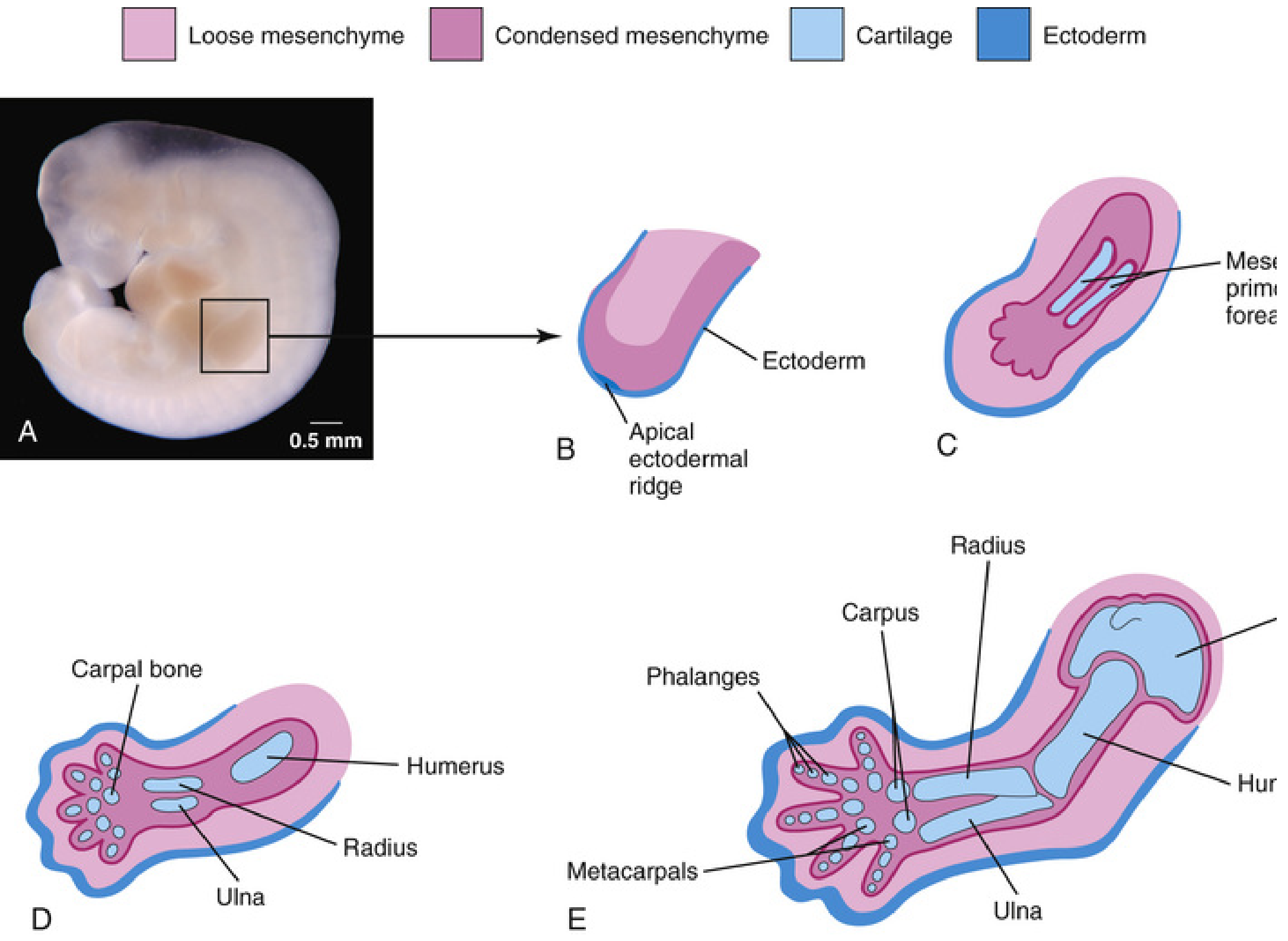
Ossification of limb bones:
- Bone formation begins week 8 in the diaphyses of long limb bones
- By week 12, ALL long bones of the limbs have primary ossification centers
- Bones develop in a proximal-to-distal order (shoulder before elbow before wrist before fingers)
Joints of the limbs form from the mesenchyme between neighboring bone models (called the interzone). The interzone gradually develops a cavity filled with fluid - this becomes the synovial joint cavity (like the knee or shoulder). Joint capsules, ligaments, and menisci all form from the same interzone mesenchyme.
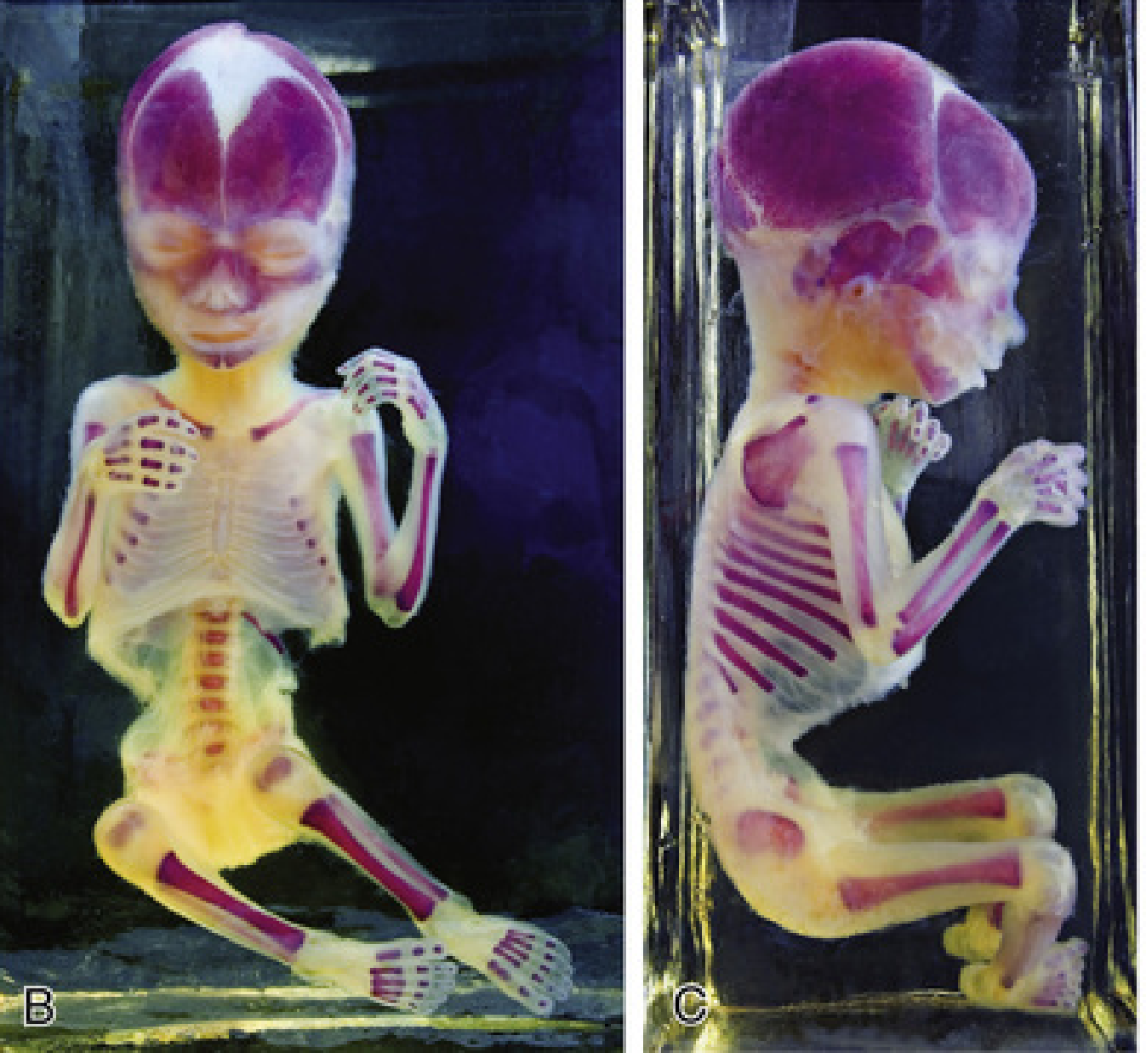
PART 8 - DEVELOPMENT OF MUSCLES
Muscles develop from myogenic precursor cells that come from the myotome region of somites.
How muscle fibers form:
- Week 4-5: Myotome cells break away and migrate to their destination (limbs, trunk, head, face)
- These cells express a gene called MYOD - a master switch that commits cells to becoming muscle
- Cells become myoblasts (baby muscle cells)
- Myoblasts line up and fuse together to form long, multi-nucleated tubes called myotubes
- Myotubes mature into full muscle fibers, filling up with the contractile proteins actin and myosin
Muscle of the trunk:
- Form directly from somite myotomes
- Arranged in an orderly, segmental pattern
Muscle of the limbs:
- Myoblasts migrate from somites at specific levels (upper limb from C5-T2, lower limb from L2-S2)
- Once inside the limb bud, muscles split into dorsal (extensor) and ventral (flexor) groups as the limb elongates
- Further splittings and fusions create the 600+ individual muscles we have as adults
Nerve supply to muscles:
- Nerves grow into the limb buds at almost the same time as muscle cells arrive
- Early contact between nerve and muscle cells is required for complete muscle development
- This is why cutting a nerve early in development can prevent a muscle from forming properly
Head and face muscles:
- Most head mesenchyme comes from neural crest cells (not from somites)
- Face and neck muscles (chewing, facial expression) come from pharyngeal arch mesenchyme
PART 9 - POSTNATAL GROWTH (Birth to Adulthood)
After birth, the musculoskeletal system continues to grow for about 18-25 years.
Bone growth after birth:
Length growth: Driven by the growth plates (endochondral ossification) at the ends of long bones. Growth hormone (from the pituitary) stimulates growth plates to produce new cartilage cells.
Width growth: New bone is added to the outside surface (periosteum) by osteoblasts, while osteoclasts hollow out the inside (medullary canal). This makes bones wider and stronger with age.
Remodeling: Old bone is constantly being broken down by osteoclasts and new bone laid down by osteoblasts. In children, formation is faster than resorption. In old age, resorption can outpace formation, leading to osteoporosis.
Hormones that control growth:
| Hormone | Effect |
|---|---|
| Growth hormone | Stimulates cartilage cell division in growth plates |
| Thyroid hormone | Essential for normal bone maturation |
| Estrogen/Testosterone | Accelerate growth, then cause growth plate closure |
| Parathyroid hormone (PTH) | Controls calcium balance in bone |
| Vitamin D | Needed for calcium absorption and mineralization |
Growth plate closure (Epiphyseal fusion):
| Bone | Approximate fusion age |
|---|---|
| Distal femur / Proximal tibia | 14-17 years |
| Proximal humerus | 18-21 years |
| Iliac crest (hip) | ~25 years |
| Vertebral epiphyses | ~25 years |
Girls fuse 1-2 years earlier than boys due to earlier estrogen surge.
Muscle growth after birth:
- Muscles grow by individual muscle fibers getting thicker (hypertrophy) - not by producing more fibers
- Exercise and loading cause fibers to enlarge and produce more contractile proteins
- New satellite cells (stem cells of muscle) can repair minor damage
COMPLETE TIMELINE AT A GLANCE
| Time | Event |
|---|---|
| Week 2 | Mesoderm (middle germ layer) forms |
| Week 3 | Somites form (the "starter packs") |
| Week 4 | Limb buds appear; sclerotomes form mesenchyme |
| Week 5 | Cartilage formation begins (chondrification) |
| Week 5-6 | Cartilage models of all limb bones complete |
| Week 6-8 | Ossification starts in bone shafts (primary centers) |
| Week 7-8 | Fingers and toes separated by apoptosis |
| Week 10 | Sternum fuses in midline |
| Week 12 | Primary ossification centers in ALL long bones |
| Birth | Shafts fully ossified; bone ends (epiphyses) still cartilage |
| Birth - teens | Secondary ossification centers appear in epiphyses |
| Puberty | Growth spurts; sex hormones begin closing growth plates |
| ~18-25 years | Growth plates fully closed; skeletal growth complete |
QUICK RECAP IN ONE PARAGRAPH
The musculoskeletal system starts from the middle germ layer (mesoderm) of the embryo. In week 3, this layer organizes into block-like structures called somites. By week 4, these release a raw material called mesenchyme. This mesenchyme condenses into cartilage "blueprints" of every bone by week 5-6. Starting week 6-8, bone cells (osteoblasts) replace the cartilage with real bone from the center outward. Growth plates - thin strips of cartilage at the ends of bones - keep producing new cartilage to make bones longer all through childhood. Meanwhile, muscle cells migrate out of somites, fuse together into muscle fibers, and split into the hundreds of muscles of the body. Growth continues until the late teens or mid-20s when the last growth plates close and skeletal growth stops.
Sources: The Developing Human: Clinically Oriented Embryology (Moore & Persaud), pp. 901-943 | Langman's Medical Embryology, pp. 188-191 | THIEME Atlas of General Anatomy and Musculoskeletal System, p. 32
This is a shared conversation. Sign in to Orris to start your own chat.