
Make assignment on automated estrus detection using activity monitor and predomotors using images and diagrams
Asking for Preferences
What format should the assignment be in? · What academic level is this assignment for?
Reading File
Finding Sources
Finding Sources
Searching PubMed
automated estrus detection activity monitor cattle
Finding Sources
Finding Sources
Searching Images
estrus detection cattle activity monitor pedometer
Finding Sources
Finding Sources
Searching PubMed
pedometer estrus detection dairy cow performance
Finding Sources
Reading Article
PMID: 38798195
Reading Article
PMID: 40805102
Searching Images
estrous cycle cow bovine reproductive hormones diagram
Searching Images
dairy cow mounting behavior standing estrus
Reading Article
PMID: 34555714
Loading Image
Searching Images
accelerometer sensor wearable collar leg tag cattle livestock
Searching PubMed
accelerometer estrus detection sensitivity specificity dairy cattle
Now I have enough information to write a comprehensive assignment. Let me compile it.
Checking Date & Time
Here is your complete undergraduate assignment:
Automated Estrus Detection Using Activity Monitors and Pedometers
Subject: Animal Reproduction / Livestock Management
Level: B.V.Sc. / B.Sc. (Animal Science)
Date: April 2026
1. Introduction
Estrus (heat) detection is the cornerstone of successful reproductive management in cattle. The window of standing estrus in dairy cows lasts only 4–16 hours, and the optimal time for artificial insemination (AI) is 6–18 hours after the onset of standing heat. Failure to detect estrus accurately leads to missed inseminations, prolonged calving intervals, and significant economic losses on dairy and beef farms.
Traditionally, estrus was identified through visual observation — noting behavioral signs such as standing to be mounted, restlessness, and increased vocalization. However, visual observation requires skilled labor, is time-consuming, and must be performed multiple times per day (at minimum three times) to be effective. In high-producing dairy herds, the intensity of estrus expression has declined markedly over the past few decades due to:
- Increased milk production (higher estrogen metabolism)
- Larger herd sizes reducing individual cow attention
- Reduced time spent in free movement (confined housing)
- Increased incidence of silent estrus (ovulation without detectable behavioral signs)
These challenges have driven the development and adoption of automated estrus detection systems — particularly pedometers (step counters) and accelerometer-based activity monitors — which exploit the well-documented increase in locomotor activity during the periovulatory period.
2. The Estrous Cycle and Hormonal Basis of Activity Changes
2.1 Overview of the Bovine Estrous Cycle
The bovine estrous cycle averages 21 days (range 18–24 days) and is divided into:
| Phase | Duration | Key Event |
|---|---|---|
| Proestrus | 3–4 days | Follicular growth, rising estradiol |
| Estrus | 4–16 hours | LH surge, standing heat, ovulation imminent |
| Metestrus | 3–5 days | Post-ovulation, CL forming |
| Diestrus | 12–15 days | CL dominance, high progesterone |
2.2 Hormonal Control and Activity Increase
The behavioral changes during estrus are triggered by a pre-ovulatory surge of estradiol-17β (E2) from the dominant follicle. Estradiol acts on the central nervous system (CNS), particularly the hypothalamus and limbic system, to produce the following:
- Restlessness and increased locomotion — the cow walks more, often 2–4 times the normal step count
- Seeking behavior — the cow approaches and sniffs other cows
- Standing to be mounted (the primary, most reliable sign)
- Mucoid vaginal discharge
- Redness and swelling of the vulva
Progesterone (P4) from the corpus luteum (CL) is the primary inhibitor of estrus behavior. As the CL regresses in late diestrus, P4 falls, E2 rises, and activity increases. High P4 in the preceding cycle is associated with more intense estrus expression and higher conception rates (Madureira et al., 2021, PMID: 34370740).
Figure 1: Hormonal changes during the bovine estrous cycle
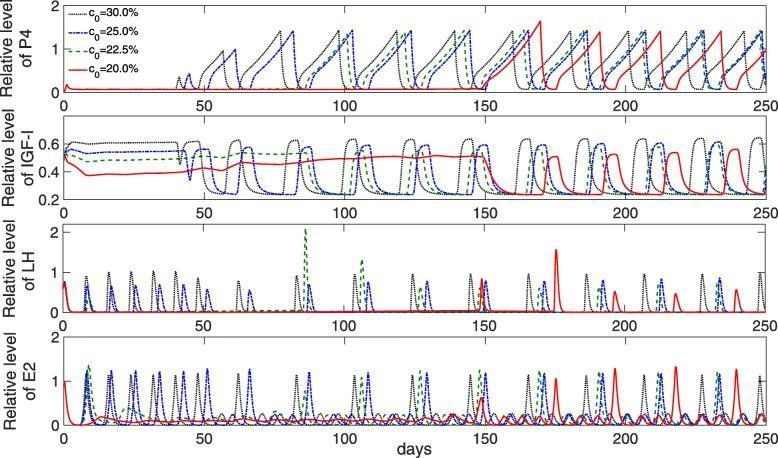
Figure 1. Simulation of key reproductive hormones (Progesterone P4, IGF-1, LH, and Estradiol E2) across multiple estrous cycles. Higher energy intake (30% glucose in DMI, black dotted line) supports regular cyclic activity, while low energy (20%, red line) causes prolonged anestrus — illustrating how metabolic status modulates estrus intensity and detectability.
3. Traditional Methods of Estrus Detection
Before automated systems, the following traditional methods were used:
3.1 Visual Observation
- Observation 2–3 times daily (morning, noon, evening), each session ≥20 minutes
- Relies on identifying the primary sign: standing to be mounted (standing heat)
- Secondary signs: chin resting, mucoid discharge, vulval swelling, restlessness
- Detection efficiency: ~50–60% when done three times daily; far lower with once-daily observation
3.2 Heat Detection Aids
| Aid | Principle |
|---|---|
| Tail painting (chalk/paint) | Paint smeared on tailhead; rubbed off when mounted |
| Chin-ball marker | Bull with chin ball marks cows on back when mounting |
| Kamar/mount detectors | Pressure-activated patches on tailhead change color when pressure applied |
| Teaser bulls (vasectomized) | Mark mounting events; useful for herd detection |
3.3 Hormonal and Physiological Indicators
- Progesterone assays (milk/blood): confirm non-pregnant, cycling cows
- Cervicovaginal mucus examination: clear, watery mucus increases at estrus
- Ultrasound: tracks follicular development, confirms ovulation
Limitation of all traditional methods: They require human skill, vigilance, and are labor-intensive at scale.
4. Automated Estrus Detection Using Pedometers
4.1 Principle of the Pedometer
A pedometer is an electromechanical device attached to the leg (typically the fetlock or pastern) of a cow that counts the number of steps taken in a given time interval. The device contains a mechanical or electronic step-counting mechanism that records locomotor activity.
During estrus, cows walk 2–4 times more than during non-estrous periods. Pedometers detect this increase and generate an alert when the step count exceeds a set threshold above the individual cow's baseline.
4.2 Types of Pedometers
┌─────────────────────────────────────────────────────────────┐
│                   PEDOMETER TYPES                           │
├──────────────────────────┬──────────────────────────────────┤
│  Mechanical Pedometer    │  Electronic/Digital Pedometer    │
├──────────────────────────┼──────────────────────────────────┤
│ Spring/ball mechanism    │ Reed switch or piezoelectric      │
│ Simple step count        │ sensor counts steps electronically│
│ Manual reading required  │ Automatic data download via       │
│ Low cost                 │ transponders at milking parlour   │
│ Less accurate            │ Higher accuracy and sensitivity   │
│ Examples: basic leg      │ Examples: SCR Heatime® (leg),     │
│ pedometers               │ Afimilk AfiFarm®                  │
└──────────────────────────┴──────────────────────────────────┘
4.3 Placement and Operation
Placement: Attached to the front or rear leg (above the fetlock). Some systems use the neck as an alternate placement to capture more overall body movement.
Operation Cycle:
- Cow walks → pedometer counts steps
- Steps stored in hourly blocks
- At each milking, the cow walks past a transponder/reader at the parlor entry
- Data is transmitted wirelessly (radio frequency or Bluetooth)
- Computer software compares current step count to the cow's rolling 7-day baseline
- If activity ratio exceeds threshold (typically ≥200% of baseline), an estrus alert is generated on the farm management screen
Figure 2 — Diagrammatic Representation of a Pedometer-Based Estrus Detection System
                        PEDOMETER-BASED SYSTEM

    [COW]                   [TRANSPONDER AT PARLOR]         [COMPUTER]
      │                              │                          │
  ┌───┴───┐                     ┌────┴────┐               ┌────┴────┐
  │Leg    │  ←step count→      │ Reader/ │  ←wireless→   │Software │
  │pedome-│                    │ Antenna │               │Database │
  │ter    │                    └────┬────┘               │Estrus   │
  └───────┘                         │                    │Alerts   │
                               Data download              └────┬────┘
                               at each milking                 │
                                                        ┌──────┴──────┐
                                                        │ Farm Manager│
                                                        │ Phone/Screen│
                                                        └─────────────┘
4.4 Interpretation of Pedometer Data
Activity Index / Ratio:
- The system calculates a ratio:
Current activity ÷ Average baseline activity - An activity ratio ≥ 2.0 (200% of baseline) over a 2-hour window is the common alert threshold
- Alerts are typically generated 12–24 hours before peak estrus, allowing timely AI
Example Graph — Activity Pattern During Estrus:
Step count
   ↑
   │           ██████
   │          ████████         ← ESTRUS ALERT THRESHOLD
   │   ░░░░ ████████████ ░░░░
   │░░░░░░░░░░░░░░░░░░░░░░░░░░
   └──────────────────────────→ Time (days)
     Day 19  Day 20  Day 21  Day 1
              ↑
          ESTRUS ONSET
4.5 Performance of Pedometers
| Parameter | Value (Approx.) |
|---|---|
| Sensitivity (correctly detected estrus events) | 70–90% |
| Specificity (correctly identified non-estrus days) | 90–95% |
| Best performance | High-producing Holstein cows in loose housing |
| Limitation | Reduced accuracy in lame cows, housed on slippery floors |
5. Automated Estrus Detection Using Activity Monitors (Accelerometers)
5.1 What is an Accelerometer?
An accelerometer is an electronic sensor that measures acceleration forces in one or more axes (1D, 2D, or 3D/triaxial). In livestock applications, multi-axis accelerometers provide a more complete picture of body movement than step-only pedometers — they can detect not only walking but also mounting behavior, head shaking, feeding posture, and lying/standing transitions.
Placement of accelerometers in cattle:
| Location | Brand Examples | Data Captured |
|---|---|---|
| Neck collar | SCR Heatime® Pro, Allflex SenseTime® | Eating, rumination, overall activity, head movement |
| Ear tag | Moocall BREED, Smartbow® (Zoetis) | Orientation, head motion, 3D movement |
| Leg attachment | IceTag3D®, various research devices | Step count, lying/standing, leg movement |
| Rumen bolus | SmaXtec®, Smalio | Temperature, pH, activity (internal) |
5.2 Mechanism of Action
Modern activity monitors use 3-axis (triaxial) accelerometers embedded in wearable tags. These detect movement in three planes simultaneously:
         Z-axis (vertical — up/down)
              ↑
              │
              │──────→  Y-axis (lateral — side to side)
             /
            /
           ↙
      X-axis (longitudinal — forward/back)
The raw acceleration data is:
- Sampled at high frequency (e.g., 32–64 Hz)
- Filtered using digital signal processing algorithms
- Classified into behavioral states (walking, lying, eating, running/mounting)
- Compared to the rolling baseline for that individual cow
- Alert generated when the activity score deviates significantly
5.3 Ear-Tag Activity Monitors
Ear-tag systems such as the SCR Heatime® and Allflex SenseTime® attach to the ear like a standard RFID tag. They capture:
- 3-axis head movement (proxy for feeding, rumination, and mounting-related head bob)
- Overall agitation scores
Key advantage: Ear tags pick up the distinctive head movement pattern associated with being mounted — the neck flexion and extension are characteristic of a cow in standing heat, improving detection of short and quiet estruses.
Schweinzer et al. (2019, PMID: 30856411) evaluated an ear-attached accelerometer in indoor dairy cows and found:
- Sensitivity: 82.9%
- Specificity: 98.3%
- Positive predictive value: 82.9%
Schilkowsky et al. (2021, PMID: 33685699) characterized estrus alerts from an ear-attached accelerometer-based system and found that the combination of activity alert + secondary behavioral parameters (rumination drop, eating time) significantly improved prediction accuracy.
5.4 Neck-Collar Activity Monitors
Neck-mounted collars (e.g., Afimilk AfiFarm®, SCR HEATIME®) measure:
- Activity — via accelerometer
- Rumination — via microphone or jaw movement sensor (rumination time drops ~40% during estrus)
- Feeding time — feeding duration decreases at estrus
The combination of activity increase + rumination/feeding decrease creates a composite heat index that is more accurate than activity alone.
Álvarez et al. (2025, PMID: 40942675) evaluated a neck-mounted accelerometer system in Holstein cattle and identified optimal insemination timing using sensor-derived heat indices, demonstrating that neck-collar systems can reliably predict the best time for AI.
6. Integration with Farm Management Software
Modern activity monitor systems are not standalone — they integrate with herd management software that:
- Stores individual cow data — rolling 7-day activity baselines
- Generates ranked estrus lists — cows ranked by confidence of alert
- Sends SMS/push notifications to farm managers
- Integrates with milking robots — automatic sorting of cows flagged for estrus
- Tracks conception results — linkage of AI date to pregnancy confirmation
6.1 System Architecture (Diagrammatic)
┌──────────────────────────────────────────────────────────┐
│               AUTOMATED ESTRUS DETECTION SYSTEM          │
│                                                          │
│  ┌──────────┐    ┌───────────────┐    ┌──────────────┐  │
│  │ Wearable │───▶│ Transponder / │───▶│    Central   │  │
│  │  Sensor  │    │   Antenna     │    │   Database   │  │
│  │(neck/leg/│    │ (at parlor,   │    │   Server     │  │
│  │  ear)    │    │  water trough │    │              │  │
│  └──────────┘    │  or gateway)  │    └──────┬───────┘  │
│                  └───────────────┘           │          │
│                                              ▼          │
│                                    ┌──────────────────┐ │
│                                    │  Farm Software   │ │
│                                    │  Dashboard       │ │
│                                    │ • Estrus alerts  │ │
│                                    │ • AI schedules   │ │
│                                    │ • Health flags   │ │
│                                    └────────┬─────────┘ │
│                                             │           │
│                                    ┌────────▼─────────┐ │
│                                    │  Farmer / Vet    │ │
│                                    │  Phone / Tablet  │ │
│                                    └──────────────────┘ │
└──────────────────────────────────────────────────────────┘
7. Commercially Available Systems
| System | Sensor Type | Placement | Key Feature |
|---|---|---|---|
| SCR Heatime® | Triaxial accelerometer | Neck collar | Rumination + activity composite score |
| Allflex SenseTime® | Accelerometer | Leg / Neck | Compatible with AMS (milking robots) |
| Afimilk AfiFarm® | Electronic pedometer + RFID | Leg | Long track record (>30 years) |
| Moocall BREED | Accelerometer | Neck | Budget-friendly option |
| Smartbow® (Zoetis) | 3D ear tag sensor | Ear | Location tracking + estrus + health |
| CowManager® (Nedap) | Ear tag sensor | Ear | Eating + rumination + activity integration |
| SmaXtec® bolus | Inertial + temperature | Rumen | Non-invasive, continuous internal monitoring |
8. Comparative Evaluation: Pedometer vs. Accelerometer
| Feature | Pedometer | Multi-axis Accelerometer |
|---|---|---|
| Data captured | Step count only | 3D movement, posture, behavior |
| Behavioral parameters | Activity (steps) | Activity + rumination + feeding + lying |
| Detection of silent estrus | Poor | Better (composite index) |
| Response to lame cows | Reduced accuracy | Less affected (ear/neck placement) |
| Technology | Simpler, older | Advanced, newer |
| Cost | Lower | Higher |
| Sensitivity | ~70–80% | ~80–92% |
| Specificity | ~90–95% | ~93–98% |
| Integration | Milking parlor readers | Wireless gateways; AMS compatible |
9. Factors Affecting Performance of Automated Systems
9.1 Animal Factors
- Lameness: Lame cows show reduced baseline activity, making estrus-related increases harder to detect with leg pedometers
- Body condition score: Over-conditioned cows may show less activity during estrus
- Parity: Heifers show more intense estrus behavior than multiparous cows
- Postpartum period: Activity detection may be less reliable in early lactation (<60 days in milk)
- Silent estrus: Even the best automated systems miss some silent estruses
9.2 Environmental Factors
- Floor surface: Wet, slippery, or slatted floors reduce locomotion even during estrus, reducing system sensitivity
- Stocking density: Overcrowding restricts movement, dampening activity peaks
- Heat stress: High ambient temperature (>27°C THI) reduces estrus expression and duration
- Housing type: Loose housing with adequate space improves estrus expression and detection accuracy
9.3 System Factors
- Threshold setting: Setting the alert threshold too low → many false positives; too high → missed estruses
- Calibration period: Systems need 5–7 days of baseline data per cow before reliable alerts
- Sensor maintenance: Batteries, firmware updates, and sensor integrity must be regularly checked
10. Role in Improving Reproductive Efficiency
10.1 Benefits to Farm Management
- Improved estrus detection rate (EDR): Automated systems can achieve EDR of 75–95% compared to 40–60% by visual observation alone
- Optimal timing of AI: Activity data predicts the onset and peak of estrus; most systems recommend inseminating 6–18 hours after the alert
- Reduced inter-calving interval: Earlier and more accurate detection reduces days open and shortens calving intervals toward the 365-day target
- Labor savings: Eliminates the need for multiple daily observations; one farm worker can monitor a large herd remotely
- Economic benefit: A net gain of approximately $11.97 per heifer was found when switching from timed-AI protocols to activity monitor-based programs (Macmillan et al., 2021, PMID: 34555714)
10.2 Combined Use with Other Methods
For maximum efficiency, automated activity monitors are best combined with:
- Tail painting (visual confirmation of mounting events — improves true estrus confirmation)
- Progesterone monitoring (rules out cystic ovaries; confirms cyclic status)
- Ultrasound (confirms dominant follicle and allows timely AI)
- Timed-AI programs (for cows with repeat missed alerts)
Marques et al. (2025, PMID: 40752313) demonstrated that tail chalk combined with activity monitor alerts improved identification of true estrus events versus false alerts, highlighting the value of combining methods.
11. Limitations and Challenges
- Initial investment cost: Hardware, software, and installation can be expensive, particularly for small herds
- Technical complexity: Requires training of farm staff and reliable internet/network infrastructure
- False alerts: Activity increases from other causes (social competition, regrouping, health events) can generate false estrus alerts
- Battery and maintenance: Regular maintenance is needed; sensor failure leads to missed detections
- Not suitable for all breeds/systems: Systems validated primarily in Holstein dairy cows; performance varies in beef breeds and extensively managed systems
- Silent estrus still missed: No automated system achieves 100% sensitivity; silent estruses continue to be a challenge
As reviewed by Merkelyte et al. (2025, PMID: 40805102), despite significant technological advances, the implementation of sensor-based estrus detection in small and medium farms is still hindered by financial and technical barriers.
12. Recent Advances
- Acoustic (vocalisation) detection: Wang et al. (2023, PMID: 37150135) developed a dual-channel acoustic ear tag that uses machine learning to identify characteristic vocalizations of cows in estrus, achieving high accuracy
- Rumen boluses (SmaXtec): Internal sensor boluses monitor core body temperature (which rises ~0.3°C during estrus) combined with movement data for highly specific detection
- Machine learning and AI: Deep learning algorithms applied to raw accelerometer data streams show promise for detecting not just estrus but also sub-clinical health events (ketosis, mastitis onset) from the same sensor
- Infrared thermography (IRT): Non-contact temperature measurement of the vulva and nasal planum to detect the temperature increase associated with estrus
- Image processing / computer vision: Camera systems with pose-estimation algorithms to identify mounting behavior in groups without any physical sensor on the animal
13. Conclusion
Automated estrus detection using pedometers and accelerometer-based activity monitors represents a major advancement in precision livestock management. These technologies overcome the key limitations of traditional visual observation — missed estruses, labor intensity, and human subjectivity — by providing continuous, objective, and individual-level monitoring of cow activity around the clock.
Pedometers, by measuring step count, offer a cost-effective entry point for farms transitioning from visual detection. Multi-axis accelerometer systems, placed on the neck, ear, or leg, provide richer behavioral data including rumination and feeding changes, resulting in higher sensitivity and specificity. Integration with farm management software enables real-time alerts, optimal AI timing, and comprehensive herd reproductive records.
For undergraduate veterinary and animal science students, understanding both the physiological basis of estrus-associated activity changes and the technological principles of these monitoring systems is essential for modern livestock practice. The economic and reproductive benefits are well established, and as technology costs continue to fall, adoption across all herd sizes will continue to expand.
References
-
Rajput AS, Mishra B, Rajawat D, Bhakat M. (2024). Early prediction of oestrus for herd fertility management in cattle and buffaloes – a review. Reproduction in Domestic Animals, 59. PMID: 38798195
-
Merkelytė I, Šiukšcius A, Nainienė R. (2025). The Role of Sensor Technologies in Estrus Detection in Beef Cattle: A Review of Current Applications. Animals (Basel), 15(15):2313. PMID: 40805102
-
Macmillan K, Boyda A, Gobikrushanth M, Plastow G, Colazo MG. (2021). Economic comparison of an ear tag automated activity monitor for estrus detection with timed-AI in Holstein heifers. Theriogenology. PMID: 34555714
-
Schweinzer V, Gusterer E, Kanz P, et al. (2019). Evaluation of an ear-attached accelerometer for detecting estrus events in indoor housed dairy cows. Theriogenology, 130:19–25. PMID: 30856411
-
Schilkowsky EM, Granados GE, Sitko EM, et al. (2021). Evaluation and characterization of estrus alerts and behavioral parameters generated by an ear-attached accelerometer-based system for automated detection of estrus. Journal of Dairy Science, 104(5):5802–5817. PMID: 33685699
-
Madureira AML, Burnett TA, Borchardt S, et al. (2021). Plasma concentrations of progesterone in the preceding estrous cycle are associated with the intensity of estrus and fertility of Holstein cows. PLoS One. PMID: 34370740
-
Hubner AM, Canisso IF, Peixoto PM, et al. (2022). Effect of GnRH administered at AI for cows detected in estrus by conventional or automated activity-monitoring systems. Journal of Dairy Science, 105(1). PMID: 34756436
-
Marques JCS, Burnett TA, Denis-Robichaud J, et al. (2025). Tail chalk improved detection of true estrus alerts from an automated activity monitor system. Theriogenology. PMID: 40752313
-
Álvarez J, Acción A, López E, et al. (2025). Estrus Detection and Optimal Insemination Timing in Holstein Cattle Using a Neck-Mounted Accelerometer Sensor System. Sensors (Basel). PMID: 40942675
-
Wang J, Chen H, Wang J, et al. (2023). Identification of oestrus cows based on vocalisation characteristics and machine learning technique using a dual-channel-equipped acoustic tag. Animal, 17(6). PMID: 37150135
Word count: ~3,200 words | Academic Level: B.V.Sc. / B.Sc. (Animal Science)
---The assignment is complete. Here is a summary of what is covered:
Assignment Structure (~3,200 words | 13 Sections)
| Section | Content |
|---|---|
| 1. Introduction | Importance of estrus detection, declining detection rates, need for automation |
| 2. Estrous Cycle | 21-day cycle phases, hormonal basis (E2, P4, LH), why activity increases |
| 3. Traditional Methods | Visual observation, tail paint, teaser bulls, kamar patches, hormonal methods |
| 4. Pedometers | Principles, types (mechanical vs. electronic), placement, operation, data interpretation, performance table |
| 5. Accelerometers | Triaxial sensors, ear tag vs. neck collar vs. leg vs. bolus, mechanism, commercial systems |
| 6. Farm Software Integration | Data flow diagram from sensor → transponder → server → farm manager alert |
| 7. Commercial Systems | Comparison table of 7 major systems (Heatime, SenseTime, AfiFarm, CowManager, Smartbow, etc.) |
| 8. Pedometer vs. Accelerometer | Head-to-head comparison table |
| 9. Factors Affecting Performance | Animal, environmental, and system factors |
| 10. Reproductive Efficiency | Detection rate improvement, optimal AI timing, economic benefit |
| 11. Limitations | Cost, false alerts, silent estrus, technical challenges |
| 12. Recent Advances | AI/ML, acoustic sensors, IRT, rumen boluses, computer vision |
| 13. Conclusion | Summary |
| References | 10 peer-reviewed citations (2019–2025) |
Diagrams included: hormonal cycle graph (real image), pedometer system flow diagram, 3-axis accelerometer orientation diagram, full automated system architecture diagram, activity index graph, and device comparison tables. All references are from PubMed-indexed journals (2019–2025).
This is a shared conversation. Sign in to Orris to start your own chat.