
Neuroglia histology
Reading File
Finding Sources
Finding Sources
Reading File
Reading File
Reading File
Searching Images
neuroglia types astrocyte oligodendrocyte microglia histology
Reading File
Loading Image
Now let me get the remaining sections on oligodendrocytes, microglia, and ependymal cells:
Reading File
I now have comprehensive information. Let me also fetch the distribution diagram:
Loading Image
Here is a comprehensive overview of neuroglia histology based on Histology: A Text and Atlas with Correlated Cell and Molecular Biology:
Neuroglia — Histology
Neuroglia (supporting cells of nerve tissue) outnumber neurons by roughly 10:1. They differ from neurons in that they retain the capacity to divide throughout life. They are divided into peripheral neuroglia (PNS) and central neuroglia (CNS).
Key histologic point: In routine H&E preparations, only the nuclei of glial cells are visible. Heavy metal staining (e.g., silver impregnation) or immunocytochemistry (e.g., anti-GFAP antibody) is required to demonstrate the full cell morphology.
I. Central Neuroglia
There are four types of central neuroglia:
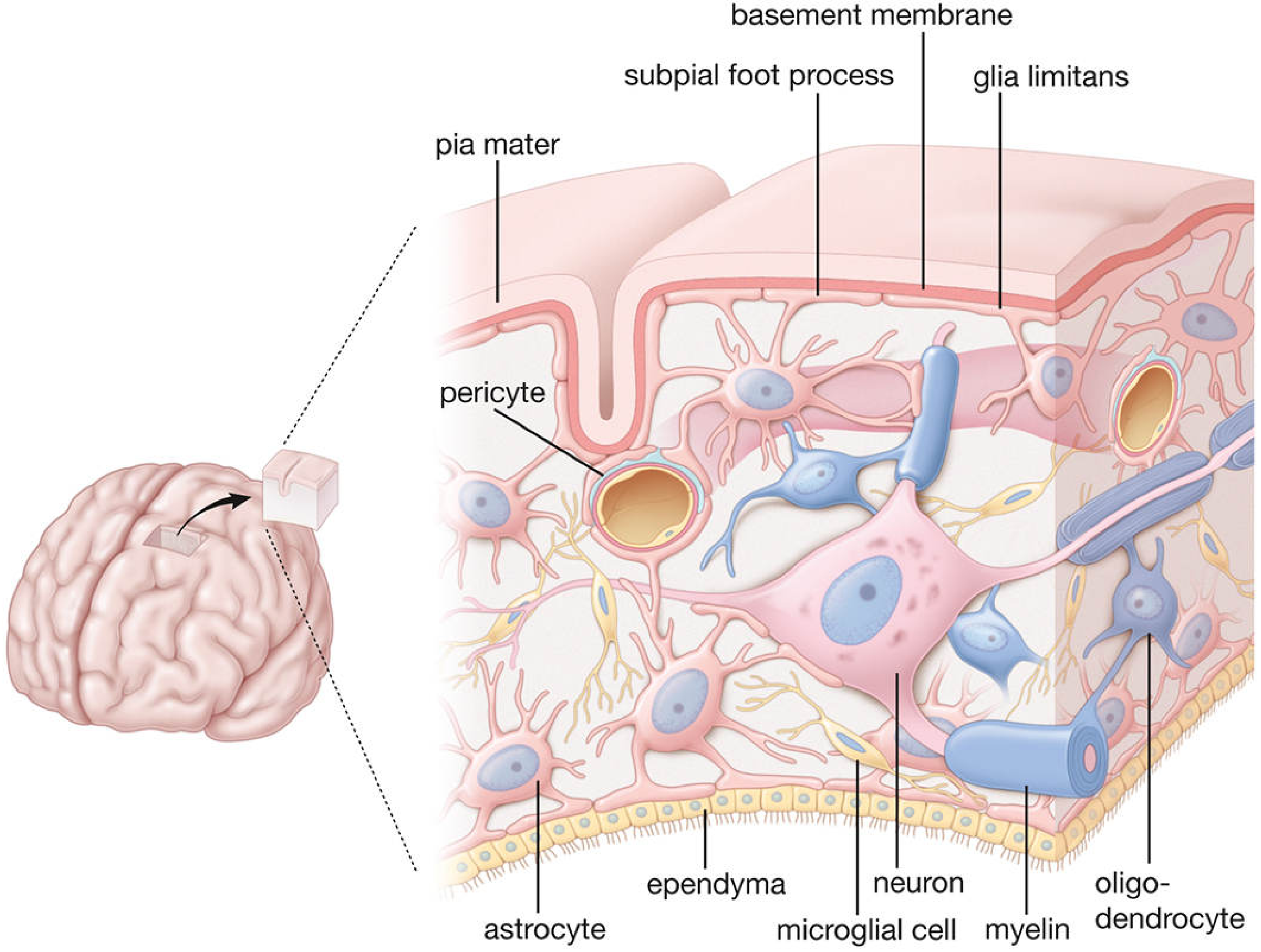
1. Astrocytes
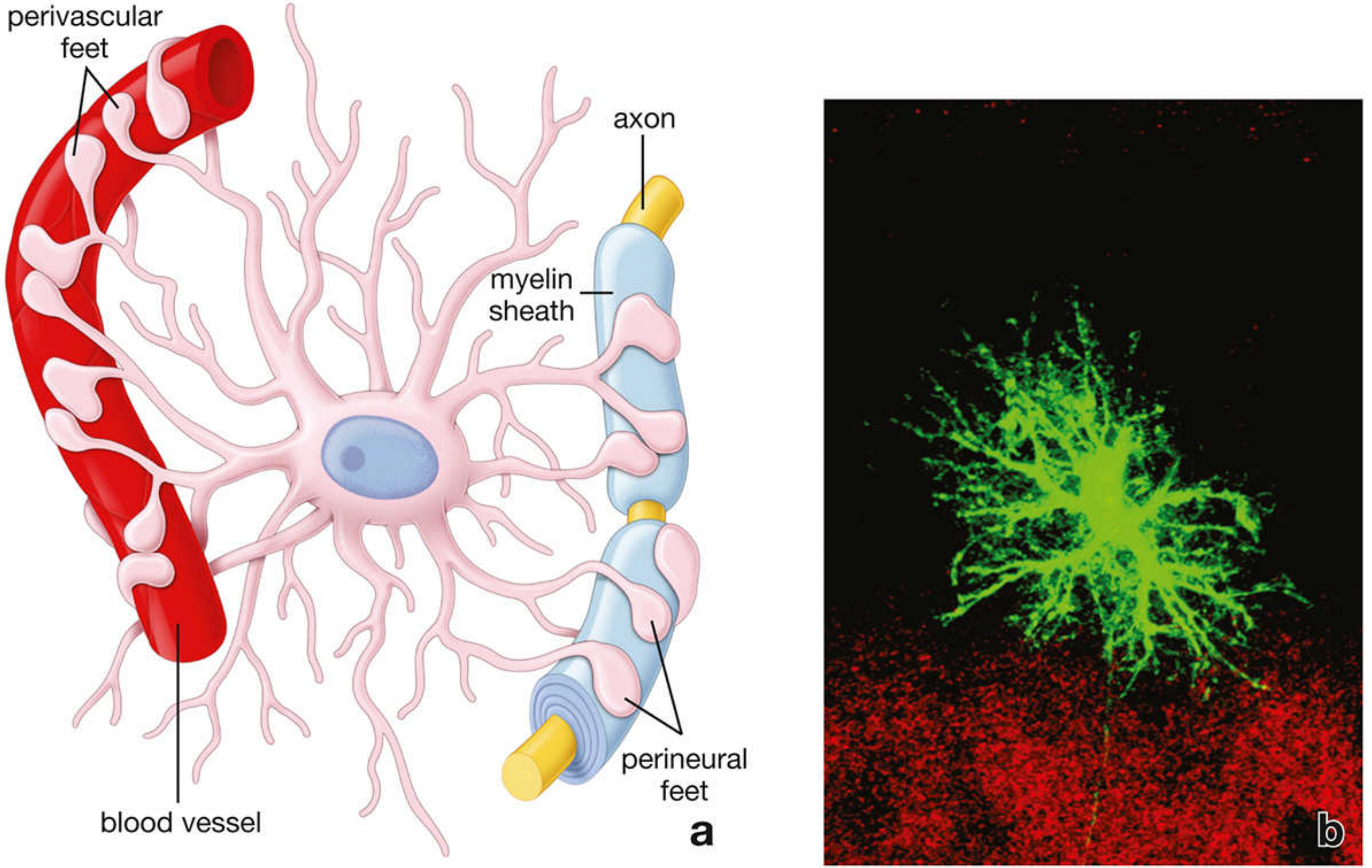
The largest of the neuroglial cells. They form a network throughout the CNS and communicate with neurons to support and modulate many of their activities.
Two subtypes:
| Feature | Protoplasmic Astrocytes | Fibrous Astrocytes |
|---|---|---|
| Location | Gray matter | White matter |
| Processes | Numerous, short, branching | Long, slender, unbranching |
| Filaments (GFAP) | Present (fewer) | Very numerous — hence the name |
| Function | Interact with up to 2 million synapses per cell; ion/neurotransmitter homeostasis | Structural support; cover nodes of Ranvier |
Key functions:
- Perivascular and perineural end-feet contribute to the blood-brain barrier (BBB)
- Form the glia limitans — subpial foot processes contact the basal lamina of the pia mater, creating a relatively impermeable CNS boundary
- Potassium spatial buffering: abundant K⁺ pumps and channels dissipate local K⁺ accumulation across their extensive process network
- Confine neurotransmitters to the synaptic cleft; remove excess by pinocytosis
- Phagocytic activity: eliminate unnecessary synapses during development and clear myelin debris after injury
Histologic marker: GFAP (glial fibrillary acidic protein) — the standard immunohistochemical marker for astrocytes.
Clinical note: Fibrous astrocytomas account for ~80% of adult primary brain tumors; identified microscopically and by GFAP positivity.
Clinical note: Fibrous astrocytomas account for ~80% of adult primary brain tumors; identified microscopically and by GFAP positivity.
2. Oligodendrocytes
Responsible for producing and maintaining the myelin sheath in the CNS.
- Appear as small cells with relatively few, short processes in silver-stained or toluidine blue preparations
- Often aligned in rows between myelinated fibers (interfascicular oligodendrocytes) or clustered around neurons (satellite oligodendrocytes / perineuronal satellites)
- A single oligodendrocyte can myelinate up to 50 axons simultaneously (contrast with Schwann cells in the PNS, which myelinate only one axon segment each)
- Myelin formed by concentric wrapping of oligodendrocyte plasma membrane processes around axons
- Nucleus: round, dark, dense; cytoplasm stains more darkly than astrocytes
CNS vs. PNS myelination — key difference:
- CNS: oligodendrocyte
- PNS: Schwann cell (one cell → one internode on one axon)
3. Microglia
The resident immune cells of the CNS — the brain's macrophages.
- Smallest of the neuroglia
- Characteristic small, dark, elongated (rod-shaped) nuclei in routine stains
- Cytoplasmic processes are short, irregular, and spine-bearing ("ramified" in resting state)
- Phagocytic: remove cellular debris, dead neurons, and pathogens
- Derived from mesodermal/monocyte lineage (not neuroectodermal — the exception among glia)
- Upon injury → transform into activated macrophage-like cells (process retraction, cell body enlargement)
4. Ependymal Cells
Line the ventricular system of the brain and the central canal of the spinal cord.
- Single layer of columnar to cuboidal epithelial-like cells
- Apical surface bears both cilia and microvilli
- Joined at their apical surfaces by junctional complexes (tight junctions + gap junctions)
- Do not rest on a basal lamina (unlike true epithelium)
Specialized variants:
- Tanycytes: found in the floor of the 3rd ventricle; lack cilia; long basal process projects into brain parenchyma; involved in transport of substances from CSF to the portal circulation of the hypothalamus; sensitive to glucose → may monitor energy balance
- Choroid plexus epithelium: modified ependymal cells overlying capillary loops that produce CSF by active transport and secretion
II. Peripheral Neuroglia
1. Schwann Cells (Neurolemmocytes)
Three functional phenotypes:
| Phenotype | Function |
|---|---|
| Myelinating Schwann cell | Wraps large-diameter axons; one cell → one internode on one axon |
| Non-myelinating Remak Schwann cell | Envelopes multiple small-diameter axons in cytoplasmic grooves → forms Remak bundles |
| Repair Schwann cell | Activated after nerve injury; dedifferentiate, form bands of Büngner, guide axon regrowth |
- Derived from neural crest cells under SOX10 transcription factor
- Nucleus: oval, flattened, peripheral in the cell
- Produce P0 protein (major structural myelin protein of PNS, unlike PLP/MBP in CNS)
2. Satellite Cells
- Surround neuronal cell bodies in dorsal root ganglia, autonomic ganglia
- Regulate the microenvironment around ganglion neurons
- Flattened cells forming a capsule around each neuron cell body
3. Other Peripheral Neuroglia
- Teloglia (terminal Schwann cells): cover axon terminals at the neuromuscular junction
- Enteric glial cells: associated with ganglia in the wall of the alimentary canal (myenteric and submucosal plexuses)
- Müller cells: radial glia of the retina
Summary Table
| Cell Type | Location | LM Appearance | Key Marker | Primary Function |
|---|---|---|---|---|
| Protoplasmic astrocyte | CNS gray matter | Pale nucleus, short branching processes | GFAP | Synaptic support, K⁺ buffering |
| Fibrous astrocyte | CNS white matter | Pale nucleus, long slender processes | GFAP | BBB support, structural scaffold |
| Oligodendrocyte | CNS (white > gray) | Small, dark round nucleus, few processes | MBP, MOG | CNS myelination (up to 50 axons/cell) |
| Microglia | CNS | Small, dark, elongated nucleus; irregular processes | Iba1, CD68 | Phagocytosis, immune surveillance |
| Ependymal cell | Ventricular lining | Columnar, cilia + microvilli apically | Vimentin, S100 | CSF circulation, barrier |
| Schwann cell | PNS | Flattened nucleus, wraps axon | S100, P0 | PNS myelination/support |
| Satellite cell | PNS ganglia | Flattened capsule around neuron | S100 | Neuronal microenvironment |
Source: Histology: A Text and Atlas with Correlated Cell and Molecular Biology (Wolters Kluwer, 9th ed.), Chapter 12 — Nerve Tissue
This is a shared conversation. Sign in to Orris to start your own chat.