

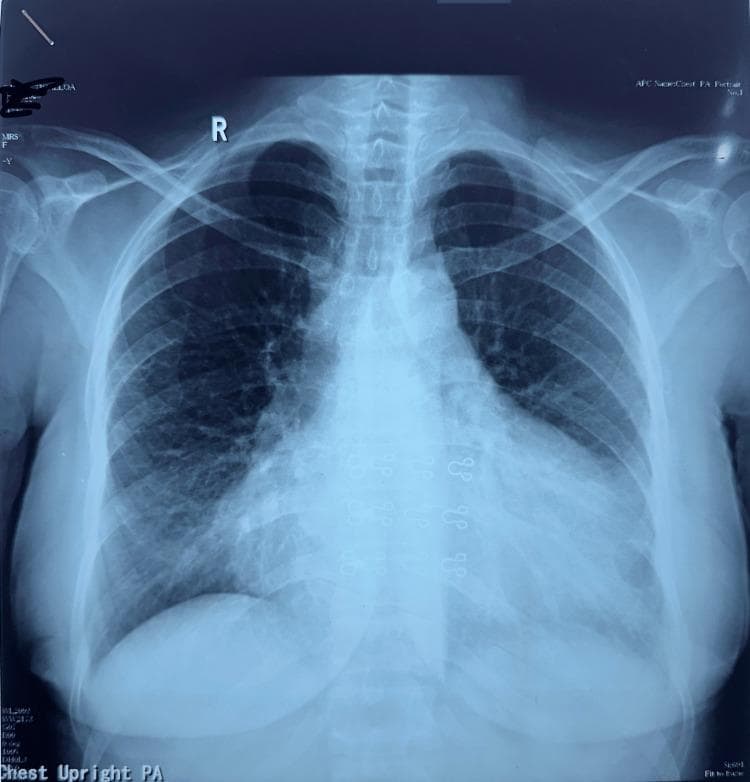
21 year old female with breathlessness. Whats the diagnosis also differentials.
massive cardiomegaly chest X-ray young female breathlessness
Hugging Face pmc clinical VQA raw
Page 0
cardiomegaly young female breathlessness causes dilated cardiomyopathy pericardial effusion
Harrison's Principles of Internal Medicine, Twenty First Edition
Page 7218
pericardial effusion water bottle heart CXR diagnosis management
Harrison's Principles of Internal Medicine, Twenty First Edition
Page 7444
dilated cardiomyopathy young adults etiology clinical features chest X-ray
CXR Analysis: 21-Year-Old Female with Breathlessness
Key Radiological Findings
- Massively enlarged cardiac silhouette with a cardiothoracic (CT) ratio well above 0.5
- Globular, symmetric "water-bottle" shaped cardiac contour
- Relatively clear lung fields — no overt pulmonary vascular congestion, Kerley B lines, or interstitial edema
- No significant pleural effusions visible
- Mediastinal structures above the heart appear normal
Primary Diagnosis
🫀 Large Pericardial Effusion (most likely)
"The chest roentgenogram may show enlargement of the cardiac silhouette with a 'water bottle' configuration" — Harrison's Principles of Internal Medicine, 21st Ed. (p. 7444)
- Muffled heart sounds
- Raised JVP
- Hypotension → Beck's Triad if tamponade is developing
- Ewart's sign (dullness at left scapular angle)
- Pulsus paradoxus >10 mmHg
| Etiology | Notes |
|---|---|
| Viral/idiopathic pericarditis | Most common in young adults |
| Tuberculosis | High prevalence in endemic regions |
| Autoimmune (SLE, RA) | Young women are predisposed to SLE |
| Hypothyroidism | Can cause large, slow-accumulating effusions |
| Malignancy | Less likely at this age but possible |
| Bacterial (purulent) | Septic picture usually present |
Differential Diagnoses
1. Dilated Cardiomyopathy (DCM)
- Also causes a large cardiac silhouette, but typically with pulmonary congestion (haziness, Kerley B lines)
- In young females: consider peripartum cardiomyopathy, myocarditis, or genetic DCM
- Harrison's (p. 7218) lists major causes including familial/genetic, myocarditis, peripartum, toxin-mediated, and inflammatory
2. Myocarditis
- Can cause acute cardiomegaly in a young person
- Often preceded by viral illness
- Can overlap with pericarditis (myopericarditis)
- Lung fields may remain clear early
3. Rheumatic Heart Disease
- Common in young patients in developing countries
- Typically mitral/aortic valve disease leading to chamber dilation
- Would expect signs of pulmonary hypertension or congestion depending on stage
4. Congenital Heart Disease (undiagnosed)
- Atrial septal defect (ASD), Ebstein's anomaly — can present in young adults
- Usually specific chamber enlargement pattern
5. Hypothyroid Cardiomegaly
- Thyroid disease is common in young females
- Can cause both pericardial effusion and myocardial dysfunction
Immediate Next Steps
| Investigation | Purpose |
|---|---|
| Echocardiogram (URGENT) | Differentiates pericardial effusion from DCM; assesses for tamponade physiology |
| ECG | Low-voltage complexes + electrical alternans → effusion; LBBB → DCM |
| Troponin / BNP | Myocardial injury / heart failure marker |
| TFTs (TSH, fT4) | Rule out hypothyroidism |
| ANA, anti-dsDNA | Screen for SLE in young female |
| CBC, ESR, CRP | Inflammatory/infective cause |
| Mantoux / IGRA | TB workup (if endemic region) |
| Sputum/cultures | If infection suspected |
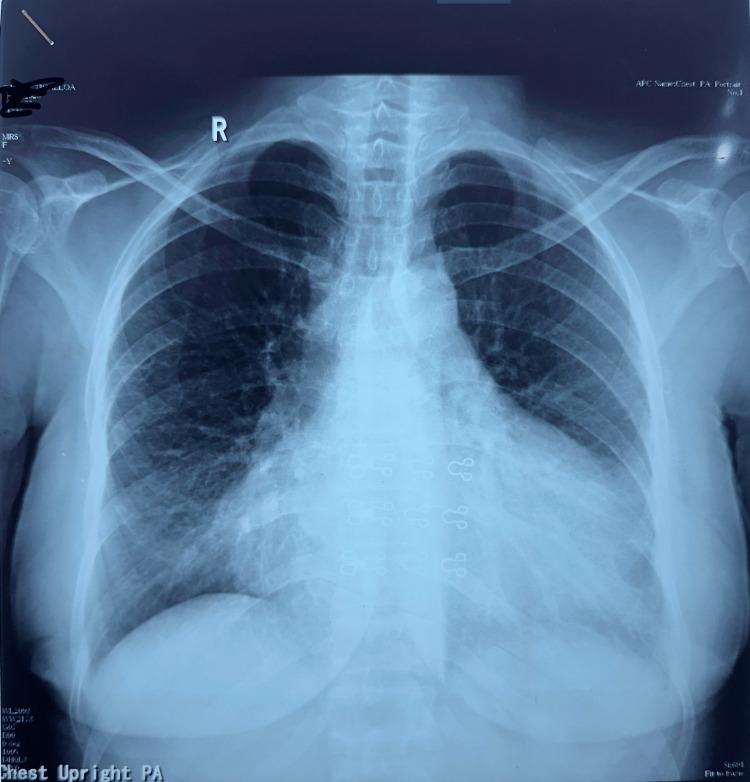
Can it be bronchopneumonia as there are bronchial markings
bronchopneumonia chest X-ray findings bronchial markings vs cardiomegaly differentiation
Management of Heart Failure
Page 24
The Dominant Finding is Cardiomegaly
What About the Bronchial Markings?
| Explanation | Why |
|---|---|
| Pulmonary venous congestion | A large pericardial effusion or dilated cardiomyopathy raises pulmonary venous pressure, engorging the vessels and making markings more prominent |
| Increased vascularity | Seen in left-to-right shunts (e.g. ASD) — relevant in a young patient |
| Superimposed lower respiratory tract infection | Can co-exist, but is not the primary diagnosis |
| Technical/film quality | A slightly underpenetrated or AP film accentuates markings |
Could Both Coexist?
How to measure cardiomegaly on such xray
Cardiothoracic (CT) Ratio — The Standard Method
Step-by-Step Measurement
- Draw a vertical midline through the spine/vertebral bodies
- Measure A = maximum distance from midline to the rightmost border of the heart
- Measure B = maximum distance from midline to the leftmost border of the heart
- Cardiac diameter = A + B
- Measure C = maximum internal transverse diameter of the thoracic cage
- Taken at the level of the right hemidiaphragm (inner rib margin to inner rib margin)
CT Ratio = (A + B) / C
Interpretation
| CT Ratio | Interpretation |
|---|---|
| < 0.5 | Normal |
| 0.5 – 0.55 | Borderline |
| > 0.5 | Cardiomegaly (PA film) |
| > 0.55 | Cardiomegaly (AP film threshold) |
Important Caveats
| Factor | Effect |
|---|---|
| AP vs PA film | AP films magnify the heart — always use PA for accurate measurement |
| Expiration film | Diaphragm pushed up → heart appears wider, falsely elevated ratio |
| Rotation | Patient rotation shifts the cardiac shadow, skewing measurements |
| Pericardial effusion | CT ratio increases rapidly — can exceed 0.65–0.7 |
| Paediatric patients | Normal CT ratio up to 0.55 in infants |
Alternative Methods (Less Commonly Used)
- Cardiac Volume Estimation (Danzer method) — uses PA + lateral views, more accurate but cumbersome
- CTR on CT scan — gold standard for true cardiac dimensions
- Echocardiography — best for chamber-specific enlargement, not overall silhouette