
Diabetes inspidus evaluation
Reading File
Now let me search the library for diabetes insipidus evaluation content in parallel:
Finding Sources
Finding Sources
Searching PubMed
"diabetes insipidus" AND diagnosis
Good results. Let me read the most comprehensive sources in parallel — Goldman-Cecil, Tietz Lab Medicine, and Henry's Clinical Diagnosis:
Reading File
Reading File
Reading File
Excellent content. Now let me get the Goldman-Cecil diagnosis section and more of the Tietz/Henry tables, plus look for copeptin and water deprivation test details:
Reading File
Reading File
Finding Sources
Now let me get the Goldman-Cecil diagnosis section and Harrison's content on DI evaluation:
Reading File
Reading File
Searching Images
diabetes insipidus diagnostic evaluation water deprivation test algorithm
Let me fetch the diagnostic flowchart and the copeptin diagnostic image, and also get the Goldman-Cecil DI diagnosis/treatment section:
Loading Image
Loading Image
Reading File
I now have comprehensive material for a thorough answer. Let me compile it.
Diabetes Insipidus: Evaluation
Definition
Diabetes insipidus (DI) is the excretion of a large volume of hypotonic (tasteless) urine — typically >50–60 mL/kg/day — caused by either inadequate vasopressin (AVP) secretion or end-organ resistance to AVP. It must be distinguished from increased frequency of small urinary volumes and from isotonic/hypertonic polyuria. — Goldman-Cecil Medicine
Pathophysiology & Classification
Five mechanisms must be considered in the differential diagnosis:
| Type | Mechanism | Key Feature |
|---|---|---|
| Central (neurogenic) DI | Hypothalamus/posterior pituitary fails to secrete AVP | AVP levels low; kidney responds to exogenous DDAVP |
| Nephrogenic DI | Renal tubular resistance to AVP | AVP levels normal/high; kidney does NOT respond to DDAVP |
| Osmoreceptor dysfunction | Anterior hypothalamic osmoreceptors damaged; neurohypophysis intact | Euvolemic hypernatremia; no thirst ("essential hypernatremia") |
| Gestational DI | Placental vasopressinase degrades AVP | Develops in 3rd trimester; responds to DDAVP (not AVP) |
| Primary polydipsia | Excessive fluid intake suppresses AVP; not a true DI | Low serum Na, maximally dilute urine at 50 mOsm/L |
— Goldman-Cecil Medicine
Step 1: Confirm Polyuria
- Polyuria is defined as >3 L/24 h in adults (or >50 mL/kg/day).
- Exclude osmotic diuresis first: glucose, mannitol, urea (high-protein feeding), post-obstructive diuresis, resolving ATN.
- Initial labs: serum Na, serum osmolality, urine osmolality, urine glucose, BMP.
Step 2: Urine Osmolality — First Branch Point
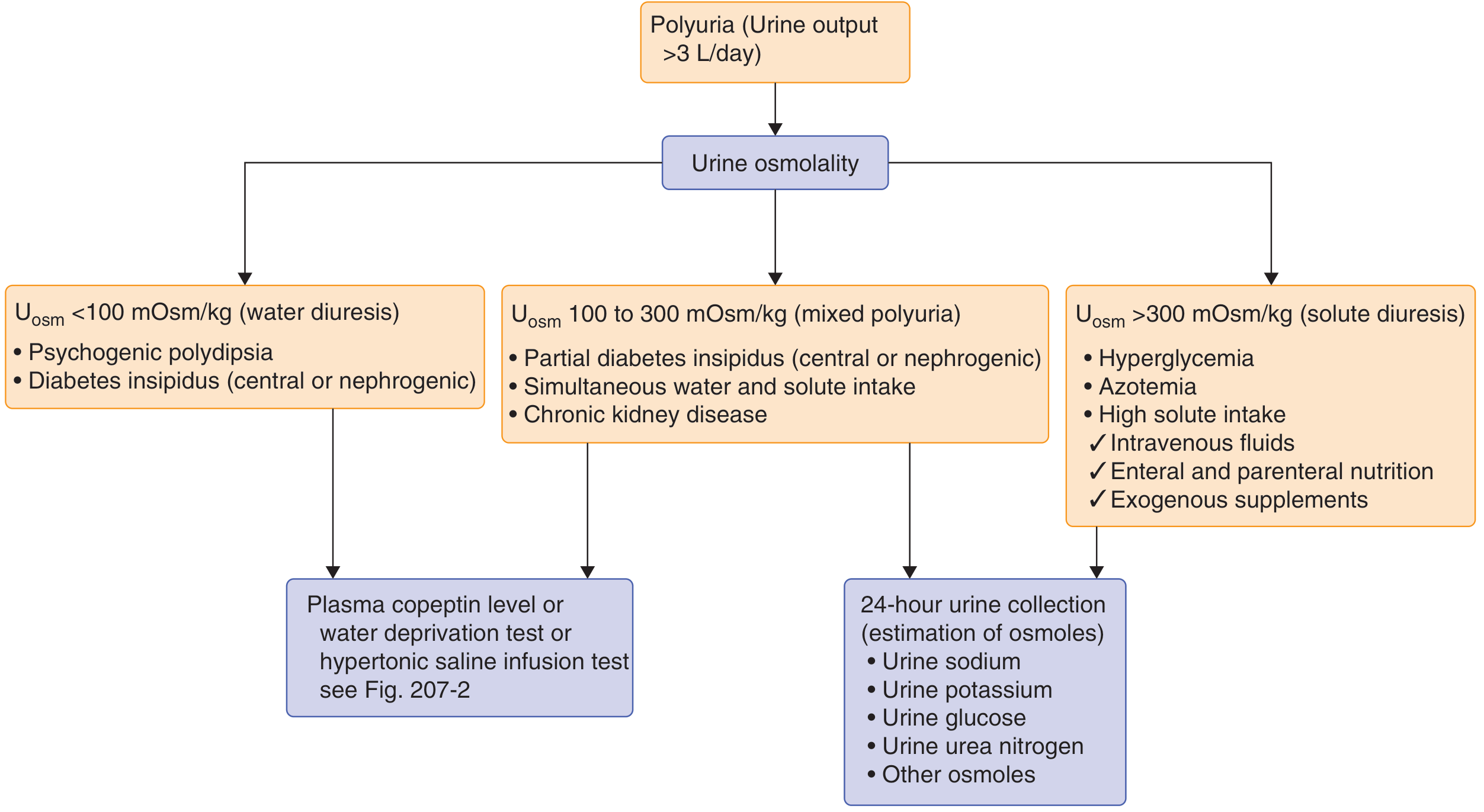
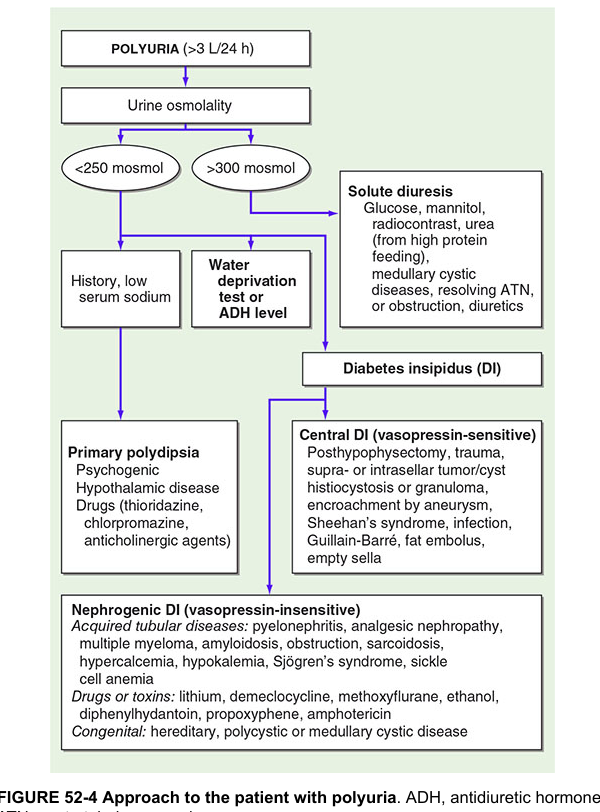
| Urine Osmolality | Interpretation | Next Step |
|---|---|---|
| <100 mOsm/kg | Water diuresis | DI vs. primary polydipsia — proceed to provocative testing |
| 100–300 mOsm/kg | Mixed polyuria | Partial DI, partial polydipsia, or CKD |
| >300 mOsm/kg | Solute diuresis | 24-h urine collection: Na, K, glucose, urea, osmoles |
| >800 mOsm/kg | Excludes DI | — |
A urine osmolality <800 mOsm/kg in the setting of elevated serum osmolality/hypernatremia is inappropriate and confirms hypotonic polyuria. A low serum Na + low plasma osmolality points toward primary polydipsia. — Goldman-Cecil Medicine
Step 3: Plasma Copeptin — Modern First-Line Biomarker
Copeptin is the 39-amino-acid C-terminal segment of pre-pro-AVP. It is secreted in equimolar amounts with AVP, is highly stable ex vivo, and has become the preferred surrogate for AVP measurement.
| Baseline Copeptin Level | Interpretation |
|---|---|
| ≥21.4 pmol/L (without pre-thirsting) | Confirms nephrogenic DI |
| <2.6 pmol/L | Confirms complete central DI |
| Intermediate | Requires provocative testing (water deprivation or hypertonic saline) |
Normal range: 1.0–13.8 pmol/L (higher median in men).
Copeptin after hypertonic saline infusion has 97% diagnostic accuracy to distinguish primary polydipsia from central DI, using a cutoff of >4.9 pmol/L. In complete/partial DI, copeptin is ≤4.9 pmol/L; in primary polydipsia, it is >4.9 pmol/L (sensitivity 93.2%, specificity 100%). — Henry's Clinical Diagnosis and Management by Laboratory Methods; Tietz Textbook of Laboratory Medicine
Step 4: Provocative Testing
A. Water Deprivation Test (Classic Method)
Performed under hospital supervision. The protocol (per Henry's):
- Baseline: Urine volume (Uvol), urine osmolality (Uosm), plasma osmolality (Posm), plasma Na, weight, BP/pulse (seated + standing)
- Nothing by mouth throughout; patient must not smoke
- Measure Uvol, Uosm, Posm, weight, BP/pulse hourly
- Stop dehydration phase when:
- Uosm plateau (hourly increase <30 mOsm/kg for 3 consecutive hours), OR
- Body weight decreases 3–5%, OR
- Systolic BP drops >20 mmHg
- Obtain plasma AVP. Then administer 1 µg desmopressin IV/IM (or 5 µg AVP SC)
- Measure Uosm at 30, 60, and 120 min post-injection
Interpretation
| Condition | Max Uosm Before AVP | Response to DDAVP |
|---|---|---|
| Normal | > Posm | <10% increase in Uosm |
| Complete Central DI | < Posm | >50% increase in Uosm |
| Partial Central DI | May exceed Posm (not maximally) | 10–50% increase |
| Complete Nephrogenic DI | < Posm | <10% increase |
| Partial Nephrogenic DI | May exceed Posm | >10% increase |
| Primary Polydipsia | Often somewhat concentrated | <10% increase (usually) |
— Henry's Clinical Diagnosis and Management by Laboratory Methods
Precautions: Discontinue medications affecting ADH secretion. Monitor for hypotension, nausea (which can stimulate ADH and confound results).
B. Hypertonic Saline Infusion Test (Preferred When Copeptin Available)
- Infuse 3% NaCl for 2 hours to achieve serum Na ≥150 mmol/L
- Measure plasma copeptin at end of infusion
- Copeptin >4.9 pmol/L → primary polydipsia; ≤4.9 pmol/L → central DI
- Advantage: Superior to water deprivation test, especially for partial central DI vs. primary polydipsia; diagnostic accuracy 97%
- Alternative: Arginine infusion test — copeptin <3.5 pmol/L at 60 min confirms DI
C. Desmopressin (DDAVP) Trial
- Administer DDAVP 2 µg IV/SQ
- Marked urine concentration (>50% increase in Uosm) → central DI
- No response → nephrogenic DI
- Caution: Can cause dangerous hyponatremia in primary polydipsia — do not use without confirming concentrated urine during dehydration phase
Step 5: Distinguishing Partial Forms — Nomogram Approach
For difficult cases (partial central DI vs. partial nephrogenic DI vs. primary polydipsia), plot basal and post-dehydration Uosm against plasma AVP on the Zerbe and Robertson nomograms. This allows further discrimination when responses overlap. — Henry's Clinical Diagnosis and Management by Laboratory Methods
Step 6: Serum Uric Acid
Uric acid >5 mg/dL favors DI over primary polydipsia, due to modest intravascular volume contraction and lack of V1a receptor-mediated uric acid clearance. — Goldman-Cecil Medicine
Step 7: Etiologic Workup (After Type is Established)
Central DI — Causes to Investigate
- MRI pituitary/hypothalamus (T1-weighted, with and without gadolinium): loss of posterior pituitary "bright spot"; look for stalk thickening, mass lesions (germinoma, craniopharyngioma, metastases, LCH, sarcoidosis, IgG4-related disease)
- Trauma/neurosurgical history
- Idiopathic (30–50% of cases, often autoimmune destruction of AVP neurons)
- Genetic: autosomal dominant (signal peptide or neurophysin mutations)
Nephrogenic DI — Causes to Investigate
Congenital:
- AVPR2 mutation (X-linked, >90% of congenital cases): affects V2 receptor; 4–8 per million male births
- AQP2 mutation (<10%): autosomal dominant or recessive
Acquired (more common):
- Drugs: lithium (most common), demeclocycline, amphotericin, methoxyflurane
- Metabolic: hypercalcemia, hypokalemia
- Renal: CKD, obstructive uropathy, pyelonephritis, amyloidosis, multiple myeloma, Sjögren's syndrome, sickle cell anemia
Pitfalls in Evaluation
- Anterior pituitary insufficiency (hypothyroidism, adrenal insufficiency) co-existing with DI can mask polyuria; glucocorticoid replacement may unmask it suddenly
- Medullary washout from chronic polydipsia impairs urine concentration even after DDAVP, mimicking nephrogenic DI — takes days-weeks to recover
- Plasma AVP measurement is unreliable clinically (low accuracy ~38%), hence copeptin is preferred
- Uosm >800 mOsm/kg effectively excludes DI regardless of other findings
Summary Algorithm
Polyuria (>3 L/day)
       ↓
  Urine Osmolality
  ├─ >300 mOsm/kg → Solute diuresis (glucose, urea, etc.)
  ├─ 100–300 mOsm/kg → Mixed; consider partial DI or CKD
  └─ <100–300 mOsm/kg → Water diuresis
         ↓
  Serum Na/Osmolality
  ├─ Low serum Na + low Posm → Primary polydipsia (likely)
  └─ Normal/high serum Na → Measure Plasma Copeptin
         ├─ ≥21.4 pmol/L → Nephrogenic DI (confirmed)
         ├─ <2.6 pmol/L → Complete Central DI (confirmed)
         └─ Intermediate → Water deprivation test OR
                           Hypertonic saline + copeptin
                               ↓
                    DDAVP challenge distinguishes central vs. nephrogenic
         ↓
  Etiologic workup:
  Central DI → MRI brain/pituitary, autoimmune markers
  Nephrogenic DI → Drug history, Ca²⁺, K⁺, AVPR2/AQP2 genetics
Sources: Goldman-Cecil Medicine (26th ed.); Henry's Clinical Diagnosis and Management by Laboratory Methods; Tietz Textbook of Laboratory Medicine (7th ed.); Harrison's Principles of Internal Medicine (22nd ed.)
This is a shared conversation. Sign in to Orris to start your own chat.