

Interpret this xray.
Reading File
Searching for chest X-ray interpretation findings to support the analysis of this image.
search_medical_image
chest X-ray cardiomegaly pleural effusion pulmonary congestion findings
Hugging Face pmc clinical VQA raw
Page 0
search_medical_text
chest X-ray systematic interpretation cardiomegaly pulmonary edema pleural effusion
Harrison's Principles of Internal Medicine, Twenty First Edition
Page 7154
GradeResponse
GradeResponse
Chest X-Ray Interpretation
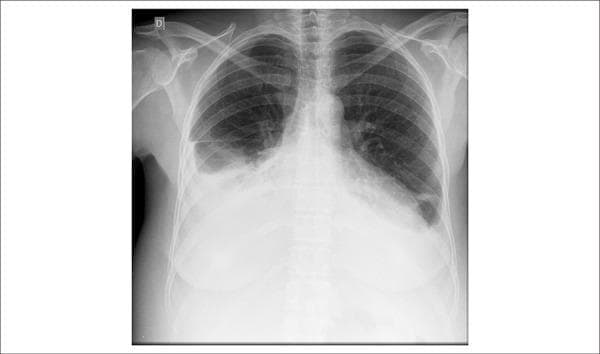
This is a PA (posteroanterior) chest radiograph with the following findings:
Key Findings
1. Cardiomegaly
The cardiac silhouette is significantly enlarged, with a cardiothoracic ratio visually well above 0.5. The enlargement appears global, suggesting biventricular dilatation rather than isolated chamber enlargement.
2. Bilateral Pleural Effusions
- The right costophrenic angle is blunted with opacity in the right lower zone — consistent with a moderate-to-large pleural effusion.
- The left lower zone also shows haziness and blunting, indicating a smaller effusion on the left.
3. Pulmonary Vascular Congestion
There is increased interstitial markings bilaterally, with haziness in the lower lung fields consistent with pulmonary venous hypertension / interstitial edema. Kerley B lines may be present at the bases.
4. Upper Lobe Vascular Redistribution
Upper zone vessels appear relatively prominent, indicating raised pulmonary venous pressure — a hallmark of left heart failure.
5. Devices / Lines
Several clips or metallic markers are visible bilaterally (likely surgical clips or ECG lead artifacts from positioning).
Impression
The overall picture is strongly consistent with decompensated congestive heart failure (CHF) with:
- Marked cardiomegaly (global pattern)
- Bilateral pleural effusions (right > left), likely transudative
- Pulmonary venous congestion / interstitial edema
Differential considerations include:
- Dilated cardiomyopathy
- Ischemic cardiomyopathy with biventricular failure
- Valvular disease (e.g., mitral or aortic regurgitation causing volume overload)
Recommended Next Steps (Clinical Correlation)
- Echocardiogram to assess ejection fraction, wall motion, and valvular function
- BNP / NT-proBNP to quantify degree of heart failure
- Renal and electrolyte panel, especially if diuresis is being considered
- Clinical history for ischemic disease, alcohol use, hypertension, or viral myocarditis
⚠️ This interpretation is for educational/clinical support purposes. Final radiological diagnosis should be confirmed by a licensed radiologist with access to the original DICOM images.
21 year old female with mild breathlessness
search_medical_text
young female cardiomegaly pleural effusion differential diagnosis causes
Harrison's Principles of Internal Medicine, Twenty First Edition
Page 8094
search_medical_text
dilated cardiomyopathy young patient peripartum myocarditis evaluation management
Management of Cardiovascular Disease and Pregnancy
Page 37
GradeResponse
GradeResponse
Given the clinical context — 21-year-old female, mild breathlessness — this changes the interpretation significantly. The CXR findings (marked cardiomegaly + bilateral pleural effusions + pulmonary congestion) in a young woman demand a different differential than an older patient.
Clinical Interpretation in Context
Revised Differentials (Priority Order)
| Diagnosis | Key Points |
|---|---|
| Peripartum Cardiomyopathy (PPCM) | #1 priority to exclude — occurs in last month of pregnancy or within 5 months postpartum. Can present with only mild symptoms despite severe CXR changes |
| Viral Myocarditis | Common in young patients; often post-viral prodrome. Can cause dilated cardiomyopathy picture |
| Idiopathic Dilated Cardiomyopathy | Diagnosis of exclusion in young adults |
| Rheumatic Heart Disease | Prevalent in developing countries; mitral stenosis/regurgitation can cause this exact picture |
| Autoimmune / Connective Tissue Disease | SLE, mixed CTD — more common in young women; can cause pericardial effusion mimicking cardiomegaly + pleural effusions |
| Thyroid Disease | Hypothyroidism can cause cardiomegaly and effusions |
| Anaemia-related high-output failure | Young women are prone to iron deficiency anaemia |
Critical Questions to Ask
- Is she pregnant or recently postpartum? → PPCM must be ruled out urgently
- Recent viral illness (fever, myalgia)? → Myocarditis
- Joint pains, rash, oral ulcers? → SLE / connective tissue disease
- Menstrual history / dietary habits? → Anaemia
- Family history of cardiomyopathy? → Familial DCM
- History of rheumatic fever? → RHD
- Thyroid symptoms? → Hypothyroidism
Recommended Workup
Urgent:
- Echocardiogram — assess EF, wall motion, valve morphology, pericardial effusion
- ECG
- BNP / NT-proBNP
- Troponin (myocarditis)
Blood tests:
- CBC (anaemia), TFTs (thyroid), ANA/anti-dsDNA (SLE), ESR/CRP
- Urine pregnancy test / beta-hCG if applicable
- Viral serology (Coxsackie, CMV, EBV)
- Serum ferritin, iron studies
If myocarditis suspected: Cardiac MRI (CMR) with gadolinium — gold standard for myocardial inflammation
Important Note on Symptoms vs. CXR
The discrepancy between mild symptoms and dramatic CXR findings is a red flag. It may indicate:
- Chronic or slowly progressive disease (the body has compensated)
- PPCM — which is notorious for mild early symptoms despite severe cardiac dysfunction
- Pericardial effusion contributing to apparent cardiomegaly (which may not produce symptoms until tamponade)
⚠️ This patient should be seen urgently by a cardiologist. Mild breathlessness with this degree of cardiomegaly and effusions in a 21-year-old is not reassuring — it warrants same-day evaluation, not outpatient deferral.
This is a shared conversation. Sign in to Orris to start your own chat.