
Give four steps involved in a beta-oxidation of saturated fatty acids.
Beta-oxidation of saturated fatty acids involves four repeating steps that progressively shorten the fatty acid chain by two carbons per cycle, releasing acetyl-CoA each time.
Searching sources...
Reading File
Finding Sources
Finding Sources
Finding Sources
Harper's has a dedicated section. Let me read the full content:
Reading File
Excellent - I have all the information needed from Harper's Illustrated Biochemistry. Let me also fetch the diagram for visual clarity:
Loading Image
Here are the four steps of beta-oxidation of saturated fatty acids, drawn directly from Harper's Illustrated Biochemistry (32nd Ed):
Overview
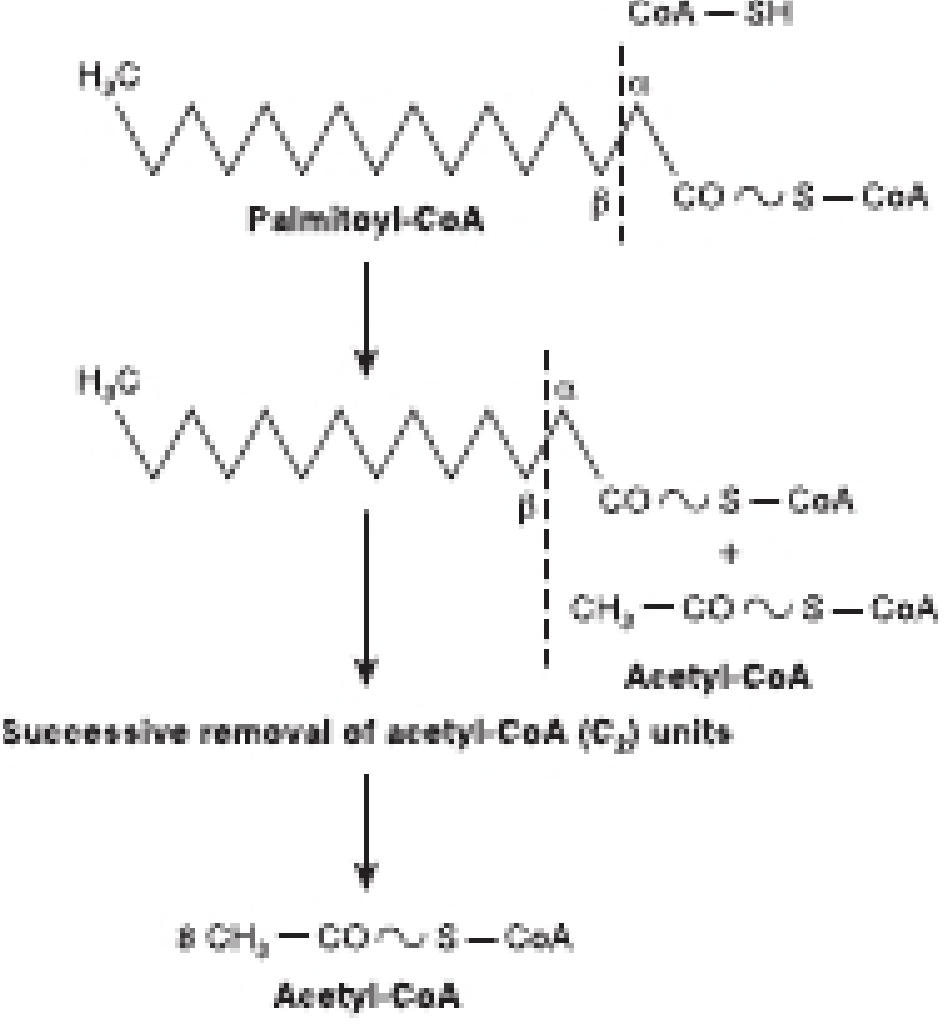
Beta-oxidation takes place in the mitochondrial matrix. The fatty acid is first activated to a fatty acyl-CoA, then enters a repeating four-step cycle. Each cycle shortens the chain by two carbons and releases one acetyl-CoA.
The Four Steps
Step 1 - Oxidation (Dehydrogenation)
Enzyme: Acyl-CoA dehydrogenase (FAD-dependent)
Two hydrogen atoms are removed from the 2(alpha)- and 3(beta)-carbon atoms of the acyl-CoA molecule. This produces a Δ²-trans-enoyl-CoA (a trans double bond between C-2 and C-3) and reduces FAD to FADH₂.
Acyl-CoA + FAD → Δ²-trans-Enoyl-CoA + FADH₂
Step 2 - Hydration
Enzyme: Δ²-Enoyl-CoA hydratase
Water is added across the trans double bond to saturate it, forming L-3-hydroxyacyl-CoA (the hydroxyl group appears on the beta-carbon).
Δ²-trans-Enoyl-CoA + H₂O → L-3-Hydroxyacyl-CoA
Step 3 - Oxidation (Second Dehydrogenation)
Enzyme: L-3-Hydroxyacyl-CoA dehydrogenase (NAD⁺-dependent)
The hydroxyl group on the 3-carbon is oxidized, producing a 3-ketoacyl-CoA compound and reducing NAD⁺ to NADH.
L-3-Hydroxyacyl-CoA + NAD⁺ → 3-Ketoacyl-CoA + NADH + H⁺
Step 4 - Thiolysis (Cleavage)
Enzyme: 3-Ketoacyl-CoA thiolase (thiolase)
The 3-ketoacyl-CoA is cleaved at the 2,3-position by CoA-SH, releasing one molecule of acetyl-CoA and a new acyl-CoA that is two carbons shorter than the original. This shorter acyl-CoA re-enters the cycle at Step 1.
3-Ketoacyl-CoA + CoA-SH → Acetyl-CoA + (n-2) Acyl-CoA
Key Products Per Cycle
| Product | Yield per cycle |
|---|---|
| Acetyl-CoA | 1 |
| FADH₂ | 1 |
| NADH | 1 |
For a 16-carbon fatty acid like palmitate, seven cycles are needed to produce 8 acetyl-CoA molecules. The acetyl-CoA then enters the citric acid cycle for complete oxidation to CO₂ and H₂O.
(Source: Harper's Illustrated Biochemistry, 32nd Ed., Chapter 22 - The β-Oxidation Cycle Generates FADH₂ & NADH)
Give me the cycle of beta oxidation.
The beta-oxidation cycle repeats four enzymatic steps - oxidation, hydration, oxidation, thiolysis - each time removing a 2-carbon acetyl-CoA unit from the fatty acyl chain until the entire chain is degraded.
Searching sources...
Finding Sources
Reading File
Now let me search for the cycle diagram (Figure 22-3) which shows the detailed cycle:
Finding Sources
Finding Sources
Reading File
Reading File
Now let me look for the Figure 22-3 image (the detailed cycle diagram) and the ATP yield table:
Reading File
I have everything needed. Let me fetch Figure 22-3 - the detailed cycle diagram:
Loading Image
Loading Image
I now have all the textbook diagrams and detailed content. Here is the complete beta-oxidation cycle:
The Beta-Oxidation Cycle
(Source: Harper's Illustrated Biochemistry, 32nd Ed., Chapter 22)
Beta-oxidation is an entirely aerobic, mitochondrial process. The fatty acid must first be prepared before it can enter the repeating cycle.
Before the Cycle: Activation & Transport into the Mitochondria
Step 1 - Activation (Cytosol / Outer Mitochondrial Membrane)
Enzyme: Acyl-CoA synthetase (thiokinase)
The free fatty acid is converted to a fatty acyl-CoA using ATP (consuming 2 high-energy phosphate bonds - ATP → AMP + PPi, and PPi is further hydrolyzed by pyrophosphatase).
Fatty acid + CoA-SH + ATP → Acyl-CoA + AMP + PPi
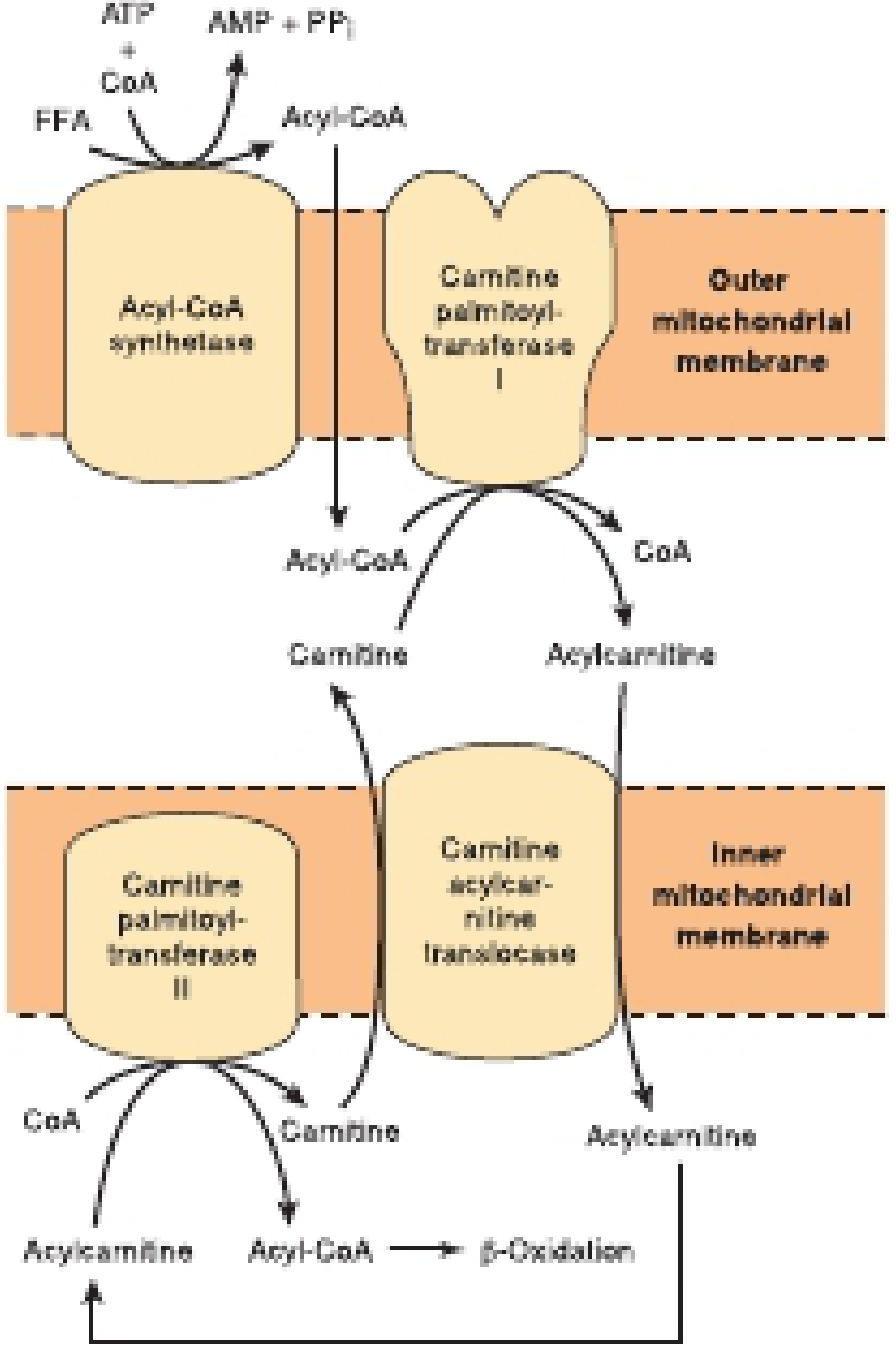
Step 2 - Carnitine Transport (Inner Mitochondrial Membrane)
Long-chain acyl-CoA cannot cross the inner mitochondrial membrane on its own. The acyl group is transferred to carnitine by carnitine palmitoyltransferase-I (CPT-I) on the outer membrane, forming acylcarnitine. The acylcarnitine is shuttled across by carnitine-acylcarnitine translocase, then CPT-II on the inner membrane reconverts it back to acyl-CoA inside the matrix, releasing carnitine.
The Four-Step Repeating Cycle (Reactions 2-5 in the diagram)
Once acyl-CoA is inside the mitochondrial matrix, it enters the cycle:
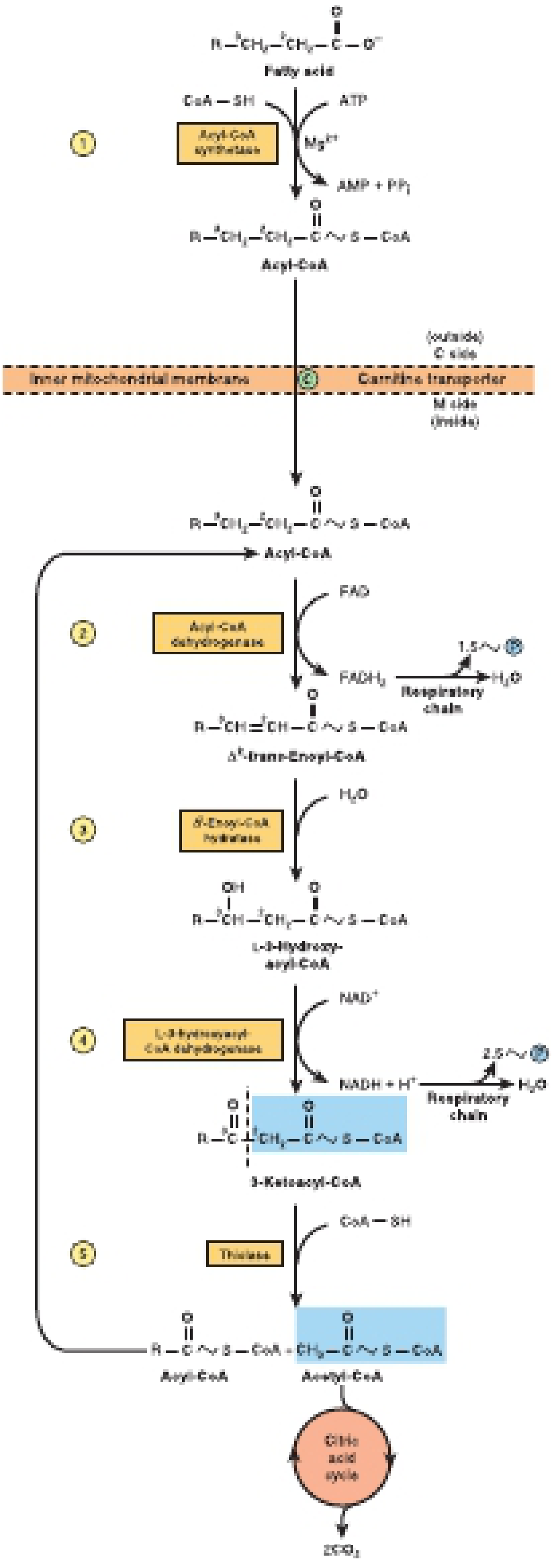
Reaction 2 - Oxidation (FAD-dependent)
Enzyme: Acyl-CoA dehydrogenase
Coenzyme: FAD → FADH₂
Two hydrogen atoms are removed from the alpha (C-2) and beta (C-3) carbons, introducing a trans double bond between them. This forms Δ²-trans-enoyl-CoA and reduces FAD to FADH₂, which feeds directly into the respiratory chain (yielding ~1.5 ATP).
Acyl-CoA + FAD → Δ²-trans-Enoyl-CoA + FADH₂
Reaction 3 - Hydration
Enzyme: Δ²-Enoyl-CoA hydratase
Coenzyme: None (water is added)
A water molecule is added across the trans double bond, saturating it and producing L-3-hydroxyacyl-CoA (hydroxyl group on the beta-carbon, L-stereoisomer).
Δ²-trans-Enoyl-CoA + H₂O → L-3-Hydroxyacyl-CoA
Reaction 4 - Oxidation (NAD⁺-dependent)
Enzyme: L-3-Hydroxyacyl-CoA dehydrogenase
Coenzyme: NAD⁺ → NADH
The hydroxyl group on the beta-carbon is oxidized to a ketone, producing 3-ketoacyl-CoA and reducing NAD⁺ to NADH + H⁺. NADH feeds into the respiratory chain (yielding ~2.5 ATP).
L-3-Hydroxyacyl-CoA + NAD⁺ → 3-Ketoacyl-CoA + NADH + H⁺
Reaction 5 - Thiolysis (Cleavage)
Enzyme: 3-Ketoacyl-CoA thiolase (thiolase)
Coenzyme: CoA-SH
The C2-C3 bond of 3-ketoacyl-CoA is cleaved by a molecule of free CoA. This releases one unit of acetyl-CoA and a new acyl-CoA that is 2 carbons shorter than the original. The shortened acyl-CoA loops back to Reaction 2, beginning the next cycle.
3-Ketoacyl-CoA + CoA-SH → Acetyl-CoA + (n-2)Acyl-CoA
Summary of One Cycle
| Product | Quantity | ATP Yield |
|---|---|---|
| FADH₂ | 1 | ~1.5 ATP |
| NADH | 1 | ~2.5 ATP |
| Acetyl-CoA | 1 | ~10 ATP (via citric acid cycle) |
Complete Oxidation Example: Palmitate (C16)
- Requires 7 cycles to fully degrade
- Produces 8 acetyl-CoA + 7 FADH₂ + 7 NADH
- Gross ATP: 108 mol - 2 mol used for activation = net 106 mol ATP per mole of palmitate
- This represents ~33% of the free energy of combustion of palmitic acid
| Step | Product | ATP/mol palmitate |
|---|---|---|
| Activation | - | -2 |
| β-Oxidation (×7) | FADH₂ | +10.5 |
| β-Oxidation (×7) | NADH | +17.5 |
| Citric acid cycle (×8 acetyl-CoA) | CO₂ + H₂O | +80 |
| Net total | 106 mol ATP |
This is a shared conversation. Sign in to Orris to start your own chat.