
Treatment of whitish vaginal discharge
I'll start by reading the medical library skill as required for this medical question.
Searching sources...
Reading File
Now I'll search the medical library for whitish vaginal discharge (likely candidiasis/leucorrhoea) and run parallel searches.
Finding Sources
Finding Sources
Searching PubMed
vaginal candidiasis treatment
Now let me read the most relevant sections from multiple textbooks in parallel.
Reading File
Reading File
Reading File
Reading File
Reading File
Reading File
Finding Sources
Reading File
Reading File
Now let me get information on recurrent candidiasis and physiological discharge, plus search for a relevant image.
Finding Sources
Searching Images
vaginal candidiasis white curdy discharge KOH wet mount hyphae
Reading File
Reading File
I now have comprehensive information from multiple authoritative textbooks. Let me fetch the Candida hyphae image that was referenced in Tintinalli's.
Loading Image
I now have all the information needed for a thorough, well-sourced answer. Here is the complete response:
Whitish Vaginal Discharge - Causes and Treatment
Understanding the Causes
Whitish (white) vaginal discharge most commonly indicates vulvovaginal candidiasis (VVC), but it can also be part of bacterial vaginosis (BV) or be physiological. Distinguishing between causes guides treatment.
| Cause | Discharge character | pH | Odour | Itching |
|---|---|---|---|---|
| Candidiasis | Thick, curdy/cottage-cheese-like, white | <4.5 (normal) | None | Marked vulvar pruritus |
| Bacterial vaginosis | White-gray, thin, homogeneous | >4.5 | Fishy ("whiff test" positive) | Mild or none |
| Trichomoniasis | Greenish, frothy, profuse | >5 | Malodorous | Yes |
| Physiological | Clear/white, thin, non-offensive | Normal | None | None |
On per-speculum examination: candidiasis gives a curdy white discharge, BV gives adherent discharge, and trichomoniasis gives greenish frothy discharge - Park's Textbook of Preventive and Social Medicine, p. 383
Vulvovaginal Candidiasis (Most Common Cause of White Discharge)
Pathophysiology & Diagnosis
- Caused almost entirely by Candida albicans (commensal that overgrows)
- Risk factors: antibiotics, corticosteroids, diabetes, immunosuppression, high oestrogen states, IUD use
- Signs: vulvar erythema, oedema, fissures, tenderness, thick white curdy/thrush-like plaques adhering to vaginal epithelium
- Diagnosis: KOH wet mount showing pseudohyphae or budding yeast (see image below); fungal culture is gold standard but reserved for refractory cases
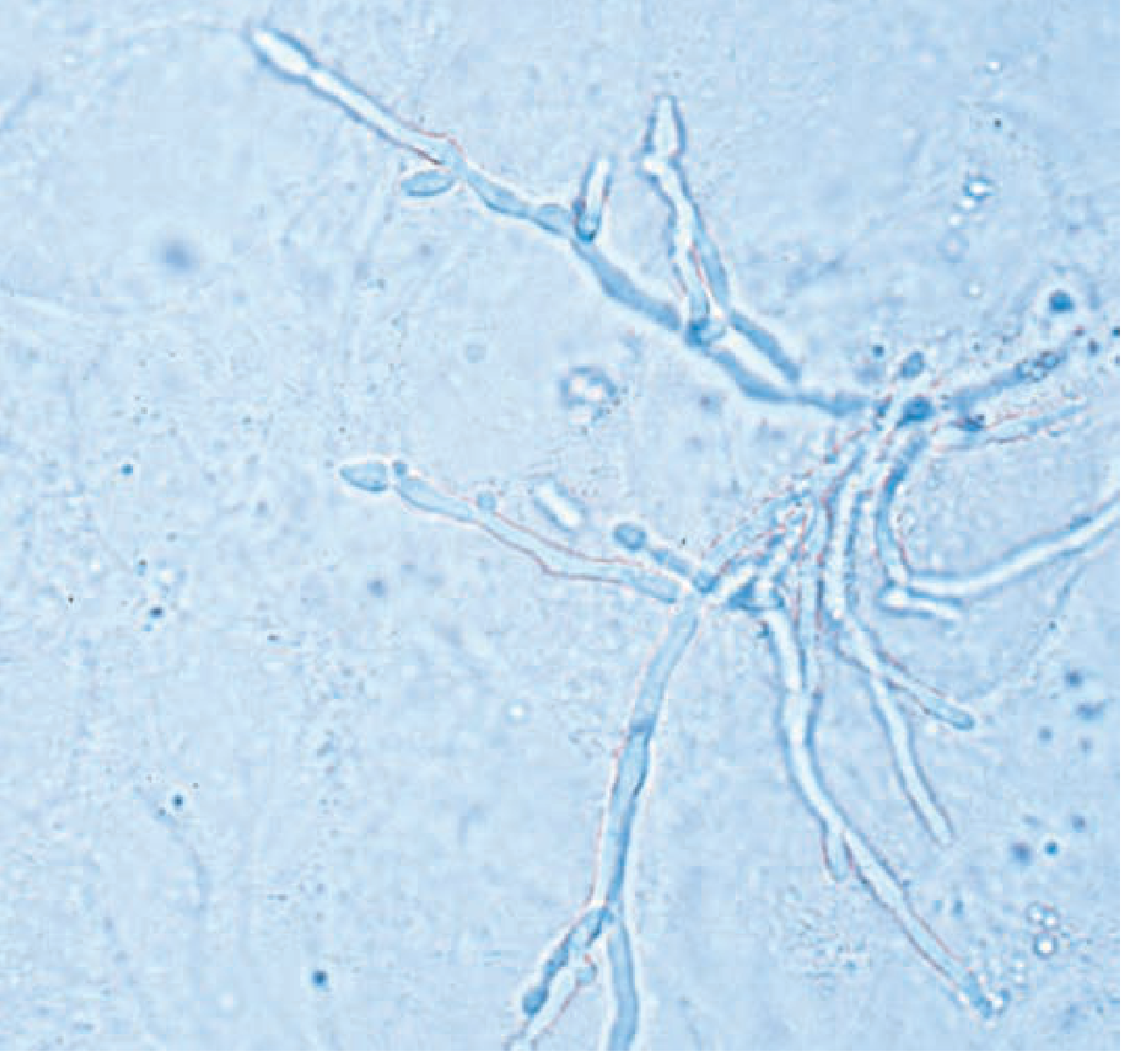
Treatment
1. Uncomplicated VVC (< 3 episodes/year, mild-moderate, immunocompetent, non-pregnant)
First-line options (cure rate 80-90%):
Oral (preferred by many patients):
- Fluconazole 150 mg orally - single dose (not in pregnancy)
Topical intravaginal azoles (all equally efficacious):
| Agent | Formulation | Regimen |
|---|---|---|
| Clotrimazole | 1% cream | 1 applicator intravaginally nightly x 7 days |
| Clotrimazole | 2% cream | 1 applicator intravaginally nightly x 3 days |
| Miconazole | 2% cream | 1 applicator intravaginally nightly x 7 days |
| Miconazole | 4% cream | 1 applicator intravaginally nightly x 3 days |
| Butoconazole | 2% cream | 1 applicator intravaginally nightly x 3 days |
| Terconazole | 0.4% cream | 1 applicator intravaginally nightly x 7 days |
| Tioconazole | 6.5% ointment | Single dose intravaginally |
| Nystatin | 100,000-unit tablet | 1 vaginal tablet nightly x 14 days (less effective than azoles) |
Topical azoles are more effective than nystatin, with symptom relief in 80-90% - Tintinalli's Emergency Medicine, Table 102-5
Newer approved agent:
- Ibrexafungerp 300 mg (two 150 mg tablets) twice in one day - FDA-approved for uncomplicated VVC; also useful in severe or refractory disease - Current Surgical Therapy 14e
2. Complicated VVC
Complicated disease = recurrent (≥4 episodes/year), severe symptoms, non-albicans species, or occurring in pregnancy/diabetes/immunocompromise.
- Two doses of fluconazole 150 mg taken 72 hours apart
- Can extend to 7-14 days of therapy
- Suppressive therapy for recurrent VVC: fluconazole 150 mg once weekly for 6 months after induction
- Refractory disease: investigate for C. glabrata or C. krusei (azole-resistant); consider nystatin intravaginal suppositories for C. glabrata
- Chronic mucocutaneous candidiasis: lifelong suppressive fluconazole 200-400 mg daily
- Oteseconazole (600 mg day 1, 450 mg day 2, then 150 mg weekly for 2-12 weeks) - a newer option for recurrent VVC - Goldman-Cecil Medicine
3. Pregnancy
- Oral fluconazole is contraindicated in pregnancy (Category C/teratogenic risk)
- Use topical azoles only (clotrimazole, miconazole) for 7 days
- In the first trimester: clotrimazole vaginal pessary/cream only
- Second and third trimester: topical treatment preferred - Park's Preventive and Social Medicine, p. 383
Bacterial Vaginosis (White-Gray Discharge with Odour)
If the discharge is more white-gray and homogeneous with a fishy odor (positive whiff test) and pH >4.5 with clue cells on wet mount, the diagnosis is BV.
Treatment of BV:
- Metronidazole 500 mg orally twice daily for 7 days (preferred course; more effective than single dose)
- Metronidazole 0.75% vaginal gel once daily x 5 days
- Clindamycin 2% vaginal cream x 7 days
- Secnidazole 2 g orally - single dose (alternative)
- Tinidazole 500 mg orally twice daily x 5 days (alternative; fewer GI side effects)
- Male partner treatment with metronidazole does NOT reduce BV recurrence (unlike trichomoniasis)
- Harrison's Principles of Internal Medicine 22E, p. 1146
Syndromic Management (When Lab Tests Unavailable)
When speculum examination is not possible or results are uncertain, treat empirically for both vaginitis causes:
- Tab. Secnidazole 2 g orally, single dose (covers TV + BV) with metoclopramide 30 min before
- Plus Tab. Fluconazole 150 mg orally single dose OR Clotrimazole 500 mg vaginal pessary once (covers candidiasis)
- If cervicitis also suspected (mucopurulent cervical discharge): add Cefixime 400 mg + Azithromycin 1 g
- Park's Textbook of Preventive and Social Medicine
Partner Management & General Advice
- Sexual partners of VVC patients: routine treatment not indicated unless symptomatic (Candida balanitis responds to topical antifungals)
- For TV/BV: treat partner if symptomatic or if patient fails initial treatment
- Advise sexual abstinence during treatment course
- Provide and educate on condom use
- Avoid vaginal douching
- Address predisposing factors: glycaemic control in diabetes, review antibiotic/steroid use
- Follow-up at 1 week
Recent Evidence Note
A 2025 umbrella systematic review (PMID 39907782) confirms current azole regimens remain effective for VVC, with ibrexafungerp emerging as a validated alternative (PMID 39892065) - particularly useful in azole-refractory or recurrent cases.
This is a shared conversation. Sign in to Orris to start your own chat.