
Structure of megasporangium along with diagram 5 marks
Reading File
Searching the Web
megasporangium structure diagram botany
Loading Image
Reading Web Page
https://plantlet.org/the-megasporangium-and-the-female-gamet…
I have enough information to provide a comprehensive answer. Here it is:
Structure of Megasporangium (Ovule)
Definition
The megasporangium is commonly referred to as the ovule in angiosperms. It is the female reproductive structure found within the ovary of the pistil, where megasporogenesis (formation of megaspores) takes place. After fertilization, it develops into the seed.
Diagram

Parts of Megasporangium
1. Funiculus (Funicle)
- A stalk-like structure that attaches the ovule to the placenta of the ovary wall.
- It contains a vascular strand that transports nutrients to the developing ovule.
- The point where the funiculus joins the body of the ovule is called the hilum.
2. Integuments
- One or two protective outer coverings (layers) that surround the nucellus.
- In most angiosperms, two integuments are present (bitegmic ovule): inner integument and outer integument.
- They do not completely enclose the ovule — they leave a small opening called the micropyle.
- After fertilization, integuments develop into the seed coat (testa and tegmen).
3. Micropyle
- A small pore or opening at one end of the ovule, left by the integuments.
- It serves as the entry point for the pollen tube during fertilization.
- Also involved in water absorption during seed germination.
4. Nucellus
- The central mass of parenchymatous tissue enclosed by the integuments.
- It is the actual sporangial tissue — the megaspore mother cell (MMC) is housed within it.
- Provides nutrition to the developing embryo sac.
- In crassinucellate ovules, the nucellus is well-developed (thick); in tenuinucellate ovules, it is reduced.
5. Megaspore Mother Cell (MMC) / Megasporocyte
- A diploid (2n) cell located in the nucellus.
- Undergoes meiosis to produce four haploid (n) megaspores.
- Only one functional megaspore survives (at the chalazal end); the remaining three degenerate.
- The functional megaspore develops into the embryo sac (female gametophyte).
6. Chalaza
- The basal region of the ovule, opposite to the micropyle, where the integuments and nucellus merge.
- It is the point of attachment of the integuments to the nucellus.
7. Embryo Sac (Female Gametophyte)
- Develops from the functional megaspore by three successive mitotic divisions.
- A mature 7-celled, 8-nucleate embryo sac (Polygonum type) contains:
- Egg cell (1) + Synergids (2) — at the micropylar end
- Central cell with 2 polar nuclei (1 cell)
- Antipodal cells (3) — at the chalazal end
Types of Ovules (based on orientation)
| Type | Description | Example |
|---|---|---|
| Orthotropous | Micropyle and hilum are in a straight line | Polygonum |
| Anatropous | Ovule is inverted 180°; most common in angiosperms | Sunflower |
| Campylotropous | Ovule is curved; micropyle and hilum are at right angles | Legumes |
| Amphitropous | Both ovule and embryo sac are curved | Ranunculus |
| Circinotropous | Ovule rotates 360° | Opuntia |
Summary Table
| Part | Function |
|---|---|
| Funiculus | Attachment + nutrient transport |
| Integuments | Protection; forms seed coat |
| Micropyle | Entry of pollen tube |
| Nucellus | Nourishment; contains MMC |
| Chalaza | Base; nutrient channelling |
| MMC | Undergoes meiosis → megaspores |
| Embryo sac | Site of fertilization; female gametophyte |
Key point for 5 marks: The megasporangium = ovule. It has two protective integuments, a central nucellus with the megaspore mother cell, a micropyle for pollen tube entry, a funiculus for attachment, and a chalaza at the base. The MMC undergoes meiosis to form the functional megaspore, which develops into the 7-celled embryo sac.
Explain in detail the process of megaspore formation
Searching the Web
megasporogenesis process megaspore formation detailed steps botany
Searching the Web
megasporogenesis meiosis megaspore mother cell linear tetrad functional megaspore
Loading Image
Reading Web Page
https://microbenotes.com/megasporogenesis/
Loading Image
Megasporogenesis — Process of Megaspore Formation
Megasporogenesis is the process by which haploid megaspores are formed from the diploid megaspore mother cell (MMC) through meiosis inside the megasporangium (ovule). It is the first step of female gametophyte development.
Process Flow Diagram
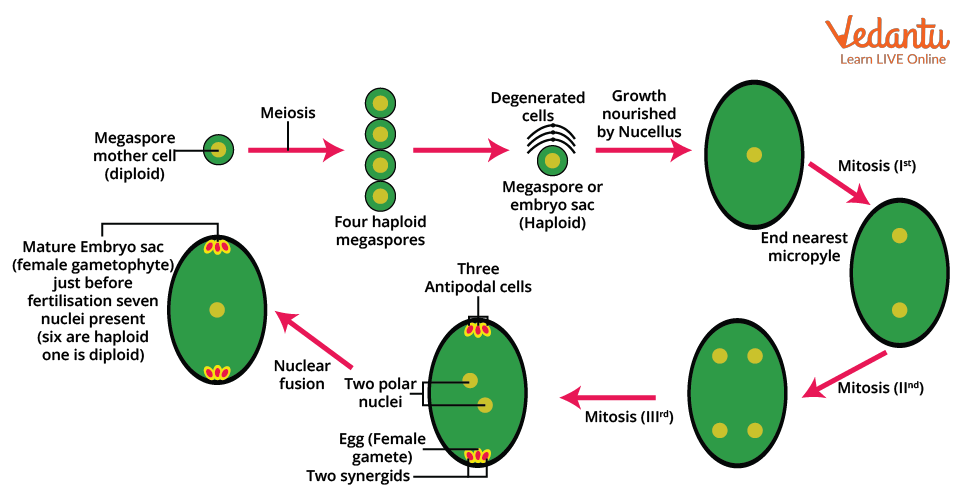
Step-by-Step Process
Step 1 — Differentiation of Archesporial Cell
- In the nucellus (tissue of the ovule), a hypodermal (subepidermal) cell at the micropylar end becomes enlarged, with a dense cytoplasm and a prominent nucleus.
- This cell is called the archesporial cell.
- The archesporial cell either:
- Directly functions as the Megaspore Mother Cell (MMC), OR
- Divides periclinally (parallel to the surface) to form:
- An outer parietal cell → divides further to form parietal tissue (nutritive)
- An inner sporogenous cell → becomes the MMC
In tenuinucellate ovules: parietal cell is absent; MMC lies directly below the nucelllar epidermis. In crassinucellate ovules: parietal cell is present and forms several layers.
Step 2 — Megaspore Mother Cell (MMC)
- The MMC is a large, diploid (2n) cell with:
- A dense, granular cytoplasm
- A conspicuous nucleus with a prominent nucleolus
- Thick callosic walls (β-1,3-glucan) that isolate it from surrounding cells
- The callose wall is significant — it cuts off plasmodesmatal connections, allowing the MMC to develop independently.
- Only one MMC is differentiated per ovule (controlled by genetic and epigenetic mechanisms).
Step 3 — Meiosis I (Reductional Division)
- The diploid MMC (2n) undergoes the first meiotic division (Meiosis I).
- This is a reductional division — homologous chromosomes separate.
- Result: Two haploid (n) cells called the megaspore dyad.
- A cell wall is laid between the two cells (though in some taxa it may be absent at this stage).
- At this stage, crossing over occurs during prophase I, contributing to genetic recombination.
Step 4 — Meiosis II (Equational Division)
- Each of the two cells in the dyad undergoes the second meiotic division (Meiosis II).
- This is an equational division — sister chromatids separate.
- Result: Four haploid (n) megaspores.
- These are arranged in a linear tetrad (one above the other, in a row along the micropyle-chalaza axis).
- The arrangement is called a linear or axial tetrad.
In some species, a T-shaped or isobilateral tetrad can also form depending on the plane of the second division.
Step 5 — Linear Tetrad Formation
The four megaspores in a row are positioned as follows:
[ Micropylar end ]
    ┌──────────┐
    │Megaspore 1│  ← degenerates
    ├──────────┤
    │Megaspore 2│  ← degenerates
    ├──────────┤
    │Megaspore 3│  ← degenerates
    ├──────────┤
    │Megaspore 4│  ← FUNCTIONAL (chalazal)
    └──────────┘
[ Chalazal end ]
- Each megaspore is surrounded by a callose wall.
- The four megaspores are all genetically distinct (due to meiotic recombination).
Step 6 — Degeneration of Three Megaspores
- Three megaspores (the three toward the micropylar end) degenerate.
- Their degeneration is controlled by programmed cell death (PCD).
- The callose walls dissolve around the functional megaspore, which is then exposed to the nucellus for nutrition.
- The chalazal-most megaspore survives as the functional megaspore in most angiosperms (Polygonum-type development).
Why the chalazal megaspore? It is closest to the nutrient-supplying chalazal tissue and vascular bundle, giving it a nutritional advantage.
Step 7 — Functional Megaspore
- The surviving functional megaspore is haploid (n).
- It enlarges considerably, absorbing water and nutrients from the nucellus.
- Its callose wall is dissolved and replaced by a cellulosic wall.
- It now undergoes megagametogenesis — three successive mitotic divisions to form the embryo sac (female gametophyte).
Summary of Megasporogenesis
| Stage | Cell/Structure | Ploidy |
|---|---|---|
| Archesporial cell | Single hypodermal cell | 2n |
| Megaspore Mother Cell (MMC) | Enlarged, dense cell in nucellus | 2n |
| After Meiosis I | Megaspore dyad | n + n |
| After Meiosis II | Linear tetrad | 4 × n |
| Functional megaspore | Chalazal megaspore | n |
| After megagametogenesis | Embryo sac | 7 cells, 8 nuclei |
Types of Embryo Sac Development (Post-Megasporogenesis)
After the functional megaspore is formed, it can develop into the embryo sac in three ways:
| Type | Megaspores Involved | Example |
|---|---|---|
| Monosporic | Only 1 (chalazal) | Polygonum — most common |
| Bisporic | 2 nuclei (after Meiosis I, no wall) | Allium |
| Tetrasporic | All 4 nuclei | Peperomia |
Significance of Megasporogenesis
- Maintains ploidy — meiosis ensures that the egg cell is haploid; after fertilization, the diploid state is restored.
- Genetic diversity — crossing over during Meiosis I generates genetic variation in offspring.
- Produces female gametophyte — the functional megaspore is the precursor of the embryo sac, which contains the egg cell for fertilization.
- Links sporophyte and gametophyte generations — it is the transition point from the diploid sporophyte to the haploid gametophyte in the plant life cycle.
Key equation to remember:
1 MMC (2n) → Meiosis → 4 megaspores (n) → 3 degenerate → 1 functional megaspore (n) → Mitosis (×3) → Embryo sac (7-celled, 8-nucleate)
This is a shared conversation. Sign in to Orris to start your own chat.