
Vascular dementia management
"vascular dementia"[MeSH Terms] AND management
vascular dementia management guidelines 2024 2025
"vascular dementia" treatment cholinesterase inhibitors
vascular dementia pathology MRI white matter hyperintensities lacunar infarcts
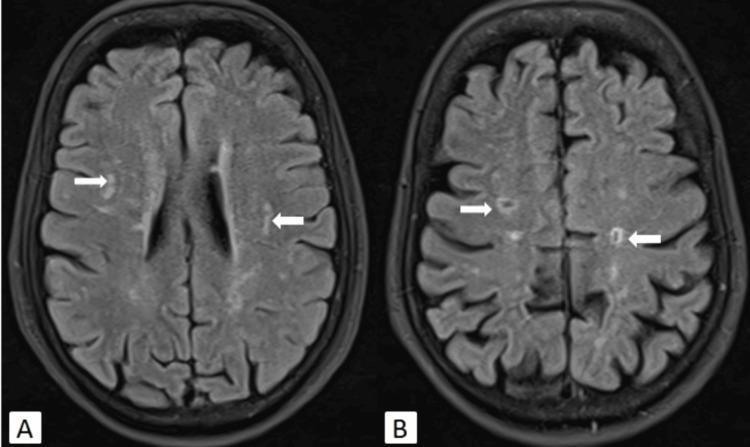
This diagnostic image consists of two axial Fluid-Attenuated Inversion Recovery (FLAIR) MRI scans of the brain, labeled A and B, demonstrating chronic cerebrovascular pathology. Image A shows bilateral, multifocal hyperintense signal foci within the periventricular white matter and centrum semiovale (indicated by white arrows). These findings are characteristic of chronic small vessel ischemic changes, often graded using the Fazekas scale. Image B displays similar anatomical regions but highlights specific old lacunar infarcts. These are distinguished by central hypointensities (representing fluid-filled cavities) surrounded by a rim of hyperintense gliosis. The lesions are distributed symmetrically across the white matter tracts. These images serve as an educational example of the radiological progression from diffuse white matter hyperintensities to discrete lacunar infarctions in the context of chronic ischemia. The content is suitable for medical students and neurology residents studying neuroimaging of vascular dementia and small vessel disease.
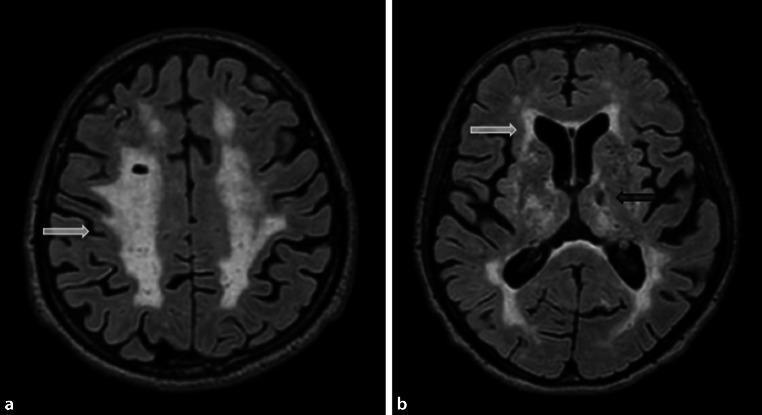
Two axial Magnetic Resonance Imaging (MRI) brain scans using Fluid-Attenuated Inversion Recovery (FLAIR) sequences, illustrating hallmarks of small vessel disease and vascular dementia in an elderly patient. Image (a) demonstrates extensive, confluent periventricular white matter hyperintensities (WMH), indicated by a white arrow, reflecting Fazekas grade 3 changes. These bright, diffuse signals surround the lateral ventricles and extend deep into the subcortical white matter. Image (b) shows a similar pattern of confluent WMH alongside a focal structural abnormality: a lacune in the left thalamus (black arrow). The lacune appears as a small, well-defined, ovoid area of low signal intensity, matching the suppressed signal of cerebrospinal fluid (CSF), indicating a chronic lacunar infarct. Collectively, these findings represent severe leukoaraiosis and multi-infarct pathology, characteristic of chronic cerebral microvascular compromise.
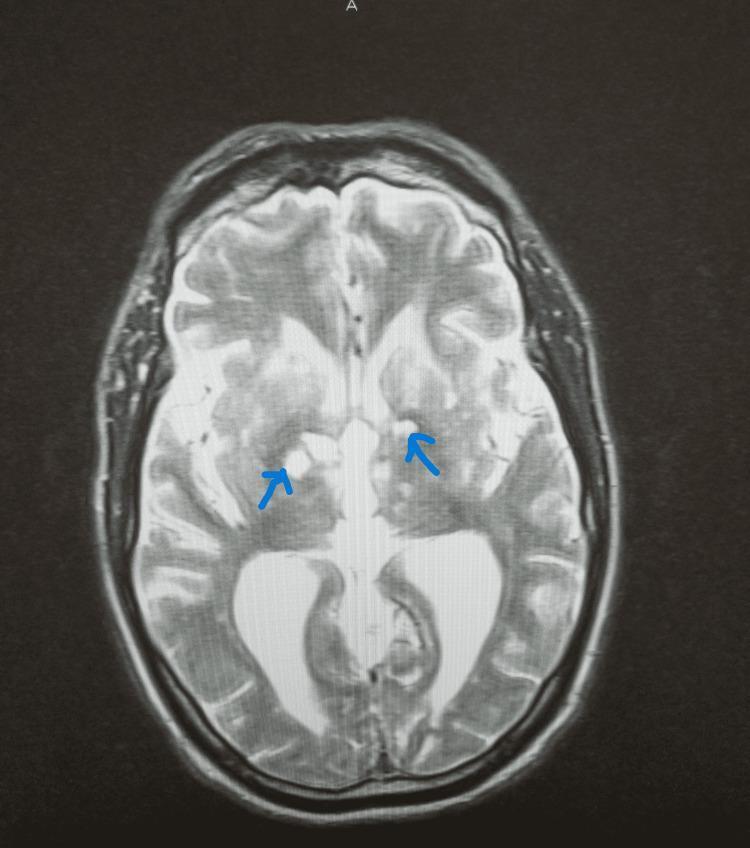
This diagnostic image is an axial T2-weighted magnetic resonance imaging (MRI) scan of the human brain. The image reveals significant pathology within the deep gray matter structures and white matter. Bilateral hyperintensities are prominent in the thalamus and basal ganglia, indicated by blue arrows, which are characteristic of chronic infarcts. These lesions demonstrate increased signal intensity compared to the surrounding parenchyma, suggesting encephalomalacia or gliosis. Additionally, the scan shows extensive periventricular and deep white matter hyperintensities, consistent with chronic microvascular ischemic disease and leukoencephalopathy. There is mild ventriculomegaly, particularly affecting the posterior horns of the lateral ventricles. This visual evidence supports a clinical context of vascular cognitive impairment or pseudobulbar affect arising from multi-infarct dementia. The educational focus of this image is to demonstrate the radiological presentation of strategic subcortical infarcts and their impact on neuroanatomical structures responsible for motor and emotional regulation.
Vascular Dementia: Management
Definition and Terminology
Neuroimaging of VaD

Management Framework
1. Vascular Risk Factor Control (PRIMARY STRATEGY)
| Risk Factor | Target / Intervention |
|---|---|
| Blood pressure | <140/90 mmHg (all patients); <130/80 mmHg if 10-year CV risk ≥10%; SPRINT-MIND showed SBP <120 mmHg reduced mild cognitive impairment (HR 0.81) |
| Cholesterol | Statin therapy for LDL control; reasonable for embolic or large-vessel infarcts |
| Diabetes / blood glucose | Fasting glucose <100 mg/dL (ideal); tight glycemic control |
| Smoking | Complete cessation - strongly recommended |
| Obesity | Target BMI <25 kg/m² |
| Physical inactivity | Regular aerobic exercise at guideline-recommended levels |
| Diet | Heart-healthy diet (Mediterranean-style) |
| Sleep | Adequate, restorative sleep; screen for OSA |
| Alcohol | Limit intake |
- Harrison's 22E, 2025; Bradley & Daroff's Neurology in Clinical Practice
2. Antithrombotic / Secondary Stroke Prevention
- Antiplatelet therapy (aspirin, clopidogrel, or aspirin + dipyridamole): indicated for patients with prior ischemic stroke or TIA; reasonable for those with imaging showing embolic or large-vessel infarcts.
- Anticoagulation (warfarin or DOACs): indicated when atrial fibrillation is identified as the source of cardioembolic strokes - all patients with asymptomatic infarcts should be screened for AF.
- Carotid endarterectomy or stenting: indicated per standard stroke prevention guidelines when symptomatic high-grade carotid stenosis is present.
- Warfarin is not indicated for non-cardioembolic VaD - antiplatelet agents are preferred.
- Harrison's 22E, p.1515-1519; Medscape VaD Management
3. Symptomatic Cognitive Therapy (Modest Benefit)
| Severity | Agent | Notes |
|---|---|---|
| Mild to moderate | Donepezil 5-10 mg/day | Best evidence in VaD among cholinesterase inhibitors |
| Mild to moderate | Rivastigmine 6-12 mg/day (or patch) | Particularly considered in mixed VaD+AD or VaD+Parkinson's disease |
| Mild to moderate | Galantamine 16-24 mg/day | Randomized trial data available |
| Moderate to severe | Memantine 10-20 mg/day | NMDA receptor antagonist; used for moderate-severe impairment |
| Moderate to severe | High-dose donepezil 23 mg/day | For more advanced disease |
4. Neuropsychiatric Symptom Management
- Depression: SSRIs (sertraline, citalopram) are first-line; vascular depression is common and may precede or accompany VaD.
- Apathy: No established pharmacotherapy; structured activity and behavioral interventions are used.
- Agitation / psychosis: Low-dose atypical antipsychotics (quetiapine, risperidone) with caution - increased stroke risk in elderly patients (black box warning).
- Pseudobulbar affect: Dextromethorphan/quinidine (Nuedexta) if present.
- Sleep disturbances: Sleep hygiene, melatonin; avoid sedative-hypnotics where possible.
5. Lifestyle and Non-Pharmacological Interventions
- Cognitive stimulation therapy and occupational therapy to maintain function.
- Physical rehabilitation after strokes.
- Caregiver education and support - VaD caregivers need specific training for the stepwise and fluctuating course.
- Social engagement and structured daily routines.
- Stress management strategies (per Indian CPG 2025).
6. Monitoring and Follow-Up
- Regular follow-up every 4-6 months to assess cognitive and non-cognitive symptoms.
- More frequent visits for patients with behavioral problems or on specific pharmacotherapies.
- MRI (FLAIR + DWI + T2*) is the mainstay for detecting new lesions, microbleeds, and WMH progression.
- Screen for atrial fibrillation (Holter monitoring if embolic-appearing infarcts).
- Genetic testing (e.g., NOTCH3 for CADASIL) in young-onset VaD, positive family history, or suggestive MRI. - Harrison's 22E 2025
7. Special Situations
| Situation | Management Note |
|---|---|
| CADASIL | Migraine prophylaxis; avoid vasoconstrictors and OCP; no proven stroke prevention; consider antiplatelet |
| Cerebral amyloid angiopathy (CAA) | Avoid anticoagulation (high hemorrhage risk); antiplatelet use with caution |
| Post-stroke dementia | Aggressive secondary prevention + early cognitive rehabilitation |
| Mixed VaD + AD | Combined approach; cholinesterase inhibitors and memantine both reasonable |
Key Takeaways
- Primary prevention = the best treatment: blood pressure control, statins, smoking cessation, and exercise have the strongest evidence for preventing progression.
- No disease-modifying therapy exists specifically for VaD; current drugs only modestly slow cognitive decline.
- Mixed VaD + AD is the rule, not the exception; treatments for AD (cholinesterase inhibitors, memantine) have modest applicability.
- The Lancet 2024 Standing Commission identified 14 modifiable risk factors accounting for ~45% of dementia cases - cardiovascular factors figure prominently.
- Shared decision-making is particularly important in VaD, where treatment benefits are small and individual risk profiles vary widely.
Pt already on rivastigmine 3 mg bd Memantine 10 mg od Me
What would you like to know about this patient on rivastigmine 3mg BD + memantine 10mg OD?
Dose Optimization for This Patient
Current Doses vs. Therapeutic Targets
| Drug | Current Dose | Starting Dose | Therapeutic Target | Maximum |
|---|---|---|---|---|
| Rivastigmine | 3 mg BD (6 mg/day) | 1.5 mg BD | 6 mg BD (12 mg/day) | 6 mg BD oral |
| Memantine | 10 mg OD | 5 mg OD | 10 mg BD (20 mg/day) | 10 mg BD |
Rivastigmine Uptitration Plan
| Step | Dose | Duration |
|---|---|---|
| Current | 3 mg BD | - |
| Step 2 | 4.5 mg BD | ≥4 weeks |
| Step 3 (target) | 6 mg BD ✓ | Maintenance |
- Maximum oral dose: 6 mg BD (12 mg/day)
- The 6 mg BD dose is where clinical trials showed significant benefit
- Take with food to reduce nausea/vomiting
- If GI side effects are limiting, consider switching to the transdermal patch (9.5 mg/24h → 13.3 mg/24h) which has a much better GI tolerability profile with equivalent or better efficacy
Memantine Uptitration Plan
| Step | Dose | Duration |
|---|---|---|
| Current | 10 mg OD (morning) | - |
| Step 2 | 10 mg OD + 5 mg OD (evening) = 15 mg/day | 1 week |
| Target | 10 mg BD ✓ | Maintenance |
- Target dose: 10 mg BD (20 mg/day) - this is both the FDA target and the dose used in clinical trials
- Memantine XR (28 mg once daily) is an alternative formulation that simplifies dosing once titrated
- Memantine is generally well tolerated; adverse effects include dizziness, headache, and confusion (rare)
- Dose reduce to 5 mg BD in severe renal impairment (CrCl <30 mL/min)
Combination Use: Rivastigmine + Memantine
Practical Checklist Before Uptitrating
-
Check renal function (eGFR) before uptitrating memantine - dose cap at 5 mg BD if CrCl <30
-
Assess GI tolerance of rivastigmine (nausea, vomiting, diarrhoea) - if present, consider patch
-
Confirm the patient has been on the current doses for ≥4 weeks
-
Reassess cognition at each visit with a validated scale (MMSE or MoCA)
-
Continue to optimise vascular risk factors in parallel (BP, lipids, glycaemia, antiplatelet)
-
Kaplan & Sadock's Comprehensive Textbook of Psychiatry; Harrison's Principles of Internal Medicine 22E
I added donep m instead of memantine
- Rivastigmine 3 mg BD
- Donepezil (dose not specified yet)
What dose of donepezil was added?
donepezil rivastigmine combination dual cholinesterase inhibitor contraindication safety
⚠️ Problem: Dual Cholinesterase Inhibitor Combination
What's Happening
- Rivastigmine 3 mg BD - cholinesterase inhibitor (ChEI)
- Donepezil 10 mg OD - also a cholinesterase inhibitor
Why This Is a Problem
| Risk | Mechanism |
|---|---|
| Excess cholinergic stimulation | Additive ACh accumulation at muscarinic and nicotinic receptors |
| GI toxicity | Nausea, vomiting, diarrhoea, anorexia - amplified |
| Bradycardia / heart block | Vagotonic effect on SA/AV node - additive risk |
| Syncope | Cardiac + vasovagal |
| Seizures | Excess cholinergic activity lowers seizure threshold |
| Muscle weakness / cramps | Peripheral nicotinic overstimulation |
What To Do
Option A: Keep Donepezil 10 mg OD → Stop Rivastigmine
- Donepezil 10 mg OD is already at a full therapeutic dose - no further uptitration needed
- Better GI tolerability than rivastigmine oral
- Once-daily dosing = better adherence
- Most widely used and best-evidenced ChEI in VaD
- → Taper rivastigmine off (no need to gradually taper - can stop directly since the patient is on a low dose of 3 mg BD)
Option B: Keep Rivastigmine → Stop Donepezil (and uptitrate rivastigmine)
- Preferred if the patient has comorbid Parkinson's disease / Parkinson's disease dementia (rivastigmine is the only ChEI with a specific licence for PDD)
- Or if there is a specific reason donepezil is not tolerated
- Uptitrate rivastigmine to 6 mg BD (target dose)
- → Stop donepezil
Option C: Switch to Rivastigmine Patch
- If oral GI side effects are a problem, switch to rivastigmine 9.5 mg/24h patch (equivalent to oral 6-12 mg/day) and stop donepezil
After Resolving the ChEI Issue: Add Memantine Back
ChEI + Memantine = Evidence-based combination (complementary mechanisms: cholinergic + NMDA antagonism) ChEI + ChEI = Avoid (same mechanism, additive toxicity, no added benefit)
Recommended Action Summary
- Stop one of the two ChEIs - donepezil is the pragmatic choice to keep at 10 mg OD (already therapeutic)
- Discontinue rivastigmine (low dose, easy to stop)
- Add memantine - start 5 mg OD, increase by 5 mg/week to target 10 mg BD
- Monitor for GI symptoms, bradycardia, and syncope over the next 2-4 weeks
- ECG check if there is any concern about cardiac conduction
- Kaplan & Sadock's Comprehensive Textbook of Psychiatry; Lippincott Pharmacology; Harrison's 22E 2025
Find recent guidelines on ChEI selection in vascular dementia
"vascular dementia" AND "cholinesterase inhibitors"
cholinesterase inhibitor selection vascular dementia guidelines 2023 2024 2025 donepezil rivastigmine galantamine
https://pmc.ncbi.nlm.nih.gov/articles/PMC11813556
PMID: 36404026
PMID: 40421258
Recent Guidelines: ChEI Selection in Vascular Dementia
Key Bottom Line From Current Evidence
None of the three ChEIs (donepezil, rivastigmine, galantamine) is approved specifically for VaD - all use is off-label. Efficacy profiles are broadly similar across meta-analyses. Selection is driven by comorbidities, tolerability, dosing convenience, and cost - not differential cognitive efficacy.
1. Korean Clinical Practice Guidelines for Dementia (2025)
"The use of cholinesterase inhibitors in vascular dementia is effective in improving cognitive function, ADL, and reducing dementia severity." Level of Evidence: Moderate | Strength: Conditional/Weak (Grade B)
- Evidence came from studies of donepezil and rivastigmine showing significant effects on MMSE and ADCS-ADL vs placebo
- Rivastigmine and galantamine showed significant effects on ADAS-Cog
- The guideline does not recommend one ChEI over another for VaD - all three are considered equivalent in efficacy
- Off-label status noted as a potential barrier
| Dementia Type | ChEI Recommendation | Grade |
|---|---|---|
| Alzheimer's disease | Strongly recommended | A |
| Vascular dementia | Conditionally recommended | B |
| Lewy body dementia | Strongly recommended | A |
| Parkinson's disease dementia | Conditionally recommended | B |
2. Perlett & Smith, Clinics in Geriatric Medicine (2023)
- Efficacy profiles of donepezil, rivastigmine, and galantamine are similar across multiple meta-analyses
- Selection based on individual factors:
| Factor | Preferred Agent |
|---|---|
| Comorbid Parkinson's disease / PDD | Rivastigmine (only ChEI licensed for PDD; also inhibits BChE) |
| GI intolerance to oral ChEI | Rivastigmine patch (better GI tolerability, equivalent efficacy) |
| Adherence / once-daily preference | Donepezil OD or galantamine XR OD |
| Mild-to-severe AD overlap | Donepezil (only ChEI approved across all stages of AD) |
| Cost sensitivity | Generics of all three are available |
3. Ravi et al., Stroke Research and Treatment (2025)
- Donepezil, galantamine, and rivastigmine all show potential in improving cognition post-stroke
- Effectiveness remains inconsistent across studies and patient populations
- Emerging agents with promise: citicoline, cilostazol, antidepressants (need further validation)
- No head-to-head data favouring one ChEI over another in post-stroke VaD
4. Efficacy Evidence Summary Across Agents in VaD
| Agent | RCT Evidence in VaD | Effect Size |
|---|---|---|
| Donepezil | Most RCT data; Black et al. (2003), Wilkinson et al. (2003) | Significant MMSE improvement vs placebo |
| Galantamine | Auchus et al. (2007) - mixed VaD/AD | Modest; ADAS-Cog benefit |
| Rivastigmine | Limited VaD-specific RCT data; more data in mixed/PDD | ADAS-Cog benefit in mixed populations |
| Memantine | Orgogozo et al. 2002, Mobius & Stöffler 2003 | Modest MMSE and CGI benefit |
5. What Guidelines Say About Combination (Relevant to Your Patient)
- ChEI + memantine: rational combination, commonly used in moderate-severe disease, supported by evidence in AD and extrapolated to VaD
- Donepezil + memantine XR (Namzaric): approved fixed-dose combination
- One RCT caution: galantamine + memantine combination showed diminished efficacy vs galantamine alone - mechanism unclear; generally this finding is not replicated with donepezil + memantine
- Dual ChEI: no guideline supports this; consistent evidence of no added benefit + additive toxicity - [Perlett & Smith 2023]
Practical Recommendation for Your Patient (Applying Guidelines)
| Consideration | Recommendation |
|---|---|
| No comorbid Parkinson's | No specific reason to prefer rivastigmine over donepezil |
| Donepezil 10 mg OD already prescribed | Already at full therapeutic dose - keep it |
| Rivastigmine 3 mg BD | Stop - no added benefit, additive cholinergic risk |
| Next step | Add memantine 5 mg OD → 10 mg BD once dual ChEI resolved |
- Korean CPG for Dementia 2025 (PMC11813556) - most recent formal CPG
- Perlett & Smith, Clin Geriatr Med 2023 (PMID 36404026) - comprehensive treatment review
- Ravi et al., Stroke Res Treat 2025 (PMID 40421258) - post-stroke VaD pharmacotherapy
Search for emerging VaD therapies beyond ChEI/memantine
"vascular dementia" OR "vascular cognitive impairment" AND treatment emerging novel
emerging therapies vascular dementia beyond cholinesterase inhibitors 2024 2025 2026 clinical trials
PMID: 41498480
https://pmc.ncbi.nlm.nih.gov/articles/PMC13160922
Emerging Therapies for VaD Beyond ChEI / Memantine
Pipeline Overview (2025 Systematic Review)
| Category | No. of Drugs | % of Pipeline |
|---|---|---|
| Cardiovascular disease-targeted | 23 | 37% |
| Synthetic cognitive enhancers | 13 | 21% |
| Plant-based cognitive enhancers | 13 | 21% |
| Neuropsychiatric symptom agents | 6 | 10% |
| Biological / disease-modifying | 3 | 5% |
| Other | 4 | 6% |
Category 1: Cardiovascular / Cerebrovascular Targeted Agents
Cilostazol ⭐ (Most Advanced)
- Mechanism: PDE3 inhibitor → increases cAMP → vasodilation, antiplatelet, anti-inflammatory, promotes white matter integrity
- Evidence: Phase 2 and Phase 2/3 RCTs in participants with symptomatic lacunar ischaemic stroke (LACI-2 trial, UK)
- Cilostazol ± isosorbide mononitrate combination trialled - isosorbide arm showed greater improvement in Trail Making Test (processing speed)
- Particularly promising for small vessel disease subtype of VaD
- Phase 3 trials ongoing
Isosorbide Mononitrate
- Mechanism: NO donor → improves cerebral blood flow and endothelial function
- Trialled as adjunct to cilostazol in LACI-2; cognitive signal encouraging
Pentoxifylline
- Mechanism: Reduces blood viscosity, increases cerebral perfusion, anti-inflammatory
- Improved cognition in two VaD RCTs (European Pentoxifylline Multi-Infarct Dementia Study)
- Available now but infrequently used; evidence modest
Nicergoline
- Alpha-adrenergic blocker with vasodilatory + neuroprotective properties
- Shown cognitive protective effects in mild-to-moderate dementia including VCID
- Available in some European/Asian markets
Category 2: Metabolic / Repurposed Agents ⭐⭐ (Exciting New Territory)
Metformin
- Mechanism: AMPK activation → neuroprotection, reduced neuroinflammation, improved mitochondrial function, and cerebrovascular effects
- Observational data: associated with reduced dementia risk in type 2 diabetes patients
- Phase 2 trials in VCID ongoing (MANGO trial)
- Cognitive protective effects through non-vascular pathways in VCID uncertain but being investigated
GLP-1 Receptor Agonists (Semaglutide, Liraglutide)
- Mechanism: Neuroprotection, anti-neuroinflammation, reduced amyloid burden, vascular protection
- EVOKE+ trial (2024-2025): Semaglutide reduced AD biomarkers in AD patients with comorbid vascular pathology - directly relevant to mixed VaD+AD
- Potential dual benefit: cardiovascular risk reduction + direct neuroprotection
- Active Phase 2/3 trials in VCID specifically
SGLT2 Inhibitors (Empagliflozin, Dapagliflozin)
- Associated with reduced dementia risk in T2DM populations
- Mechanism in VCID may involve reduced vascular inflammation, cerebral perfusion improvement, mitochondrial protection
- No completed VCID-specific RCTs yet; observational data promising
Category 3: Neurotrophic / Biological Disease-Modifying Agents
Cerebrolysin
- Mechanism: Mixture of neuropeptides with BDNF/NGF-like neurotrophic activity
- Phase 3 trials in VCID ongoing (used in VaD in Europe and Asia)
- Meta-analysis suggests modest cognitive benefit; regulatory status varies by country
ACP-01 (Hemostemix) - Phase 1
- Autologous angiogenic cell precursor stem cell therapy
- Intrathecal injection to promote cerebral angiogenesis and microvascular repair
- Early Phase 1 - most speculative but mechanistically novel
Category 4: Plant-Based / Phytochemical Agents
Butylphthalide (NBP) ⭐ (Phase 3, China)
- Extracted from Chinese celery seed
- Mechanism: Antioxidant, mitochondrial protection, reduces Aβ, anti-neuroinflammatory, improves cerebral microcirculation
- Phase 3 RCT (Capital Medical University, March 2026): multicentre, double-blind, placebo-controlled in mild-to-moderate VaD
- Approved in China for ischaemic stroke; being evaluated for VaD specifically
- 2024 meta-analysis (Liu et al.): Butylphthalide + donepezil superior to donepezil alone on MMSE
Ginkgo Biloba (EGb 761)
- Cochrane 2026 review (PMID 41641880): updated systematic review on cognitive impairment/dementia
- Modest evidence for some cognitive measures; high heterogeneity across trials
- Not recommended in major Western guidelines; more accepted in European/Asian practice
Fufangdanshen Tablets (Compound Danshen)
- Traditional Chinese Medicine (Salvia miltiorrhiza-based)
- Active Phase 3 trials in China for VaD
Category 5: Gut-Brain Axis / Emerging Biology
Microbiome-Targeted Therapies (PMID 41126840)
- 2025 systematic review: gut microbiome dysbiosis implicated in VCI pathogenesis
- Proposed targets: prebiotics, probiotics, fecal microbiota transplantation (FMT)
- Purely experimental; no human VaD RCT data yet
Nitric Oxide Pathway Agents (PMID 40300885)
- NO deficiency in cerebral vasculature is a key mediator in VaD pathogenesis
- Targets: eNOS enhancers, NO donors, PDE inhibitors
- Predominantly preclinical
Category 6: Non-Pharmacological Emerging Approaches
Transcranial Direct Current Stimulation (tDCS) / TMS
- Neuromodulation approaches being trialled for cognitive symptoms
- Phase 2 data in AD/VaD mixed populations; VaD-specific data emerging
Precision Medicine / Biomarker-Guided Therapy
- (JACC 2026, PMID 41498480): The discovery of VCID-specific biomarkers (plasma p-tau, GFAp, NfL, vessel wall MRI) will enable precision-medicine approaches - matching therapy to underlying biology (amyloid vs pure vascular vs mixed)
- This is the most significant paradigm shift anticipated in the next 5 years
Summary Table: Pipeline Readiness
| Agent | Mechanism | Phase | Evidence Strength |
|---|---|---|---|
| Cilostazol | PDE3 inhibitor / vasodilation | Phase 2/3 | ⭐⭐⭐ |
| Butylphthalide | Mitochondrial / antioxidant | Phase 3 | ⭐⭐⭐ |
| Semaglutide (GLP-1) | Neuroprotection / vascular | Phase 2/3 | ⭐⭐⭐ |
| Metformin | AMPK / neuroprotection | Phase 2 | ⭐⭐ |
| Cerebrolysin | Neurotrophic | Phase 3 | ⭐⭐ |
| Pentoxifylline | Rheology / perfusion | Phase 4 | ⭐⭐ |
| SGLT2 inhibitors | Vascular / metabolic | Observational | ⭐⭐ |
| Isosorbide mononitrate | NO donor / CBF | Phase 2/3 | ⭐⭐ |
| Microbiome / FMT | Gut-brain axis | Preclinical | ⭐ |
| Stem cells (ACP-01) | Angiogenesis | Phase 1 | ⭐ |
- Goodall et al., JACC 2026 (PMID 41498480) - most current comprehensive review
- VCID Drug Pipeline Systematic Review 2025 (PMC13160922) - 88 trials, 62 drugs
- Markus & Joutel, Physiol Rev 2025 (PMID 39965059) - pathogenesis targets
- Liu et al., JIMR 2024 (PMID 38546241) - butylphthalide + donepezil meta-analysis
Donepezul dosage
Donepezil Dosage
Standard Dosing
| Stage | Dose | Notes |
|---|---|---|
| Starting dose | 5 mg OD | Take at bedtime (reduces daytime nausea/insomnia) |
| Uptitration | → 10 mg OD after 4 weeks | Most patients maintained here |
| Advanced/severe AD | → 23 mg OD after ≥3 months on 10 mg | US only; not widely used elsewhere |
Key Points
- Once daily dosing - take at bedtime (minimises GI side effects and insomnia)
- 10 mg OD is the standard therapeutic maintenance dose for most patients
- The 23 mg tablet is approved in the US for moderate-to-severe AD only - not relevant for VaD
- No dose adjustment needed for mild-to-moderate hepatic impairment
- Use with caution in severe hepatic impairment (limited data)
- Renal impairment: no dose adjustment required
For Your Patient
Indications by Dose
| Dose | Indication |
|---|---|
| 5-10 mg OD | Mild-to-moderate AD; off-label for VaD, LBD |
| 10 mg OD | Moderate-to-severe AD |
| 23 mg OD | Severe AD (US only) |
Side Effects to Monitor (dose-dependent)
- GI: Nausea, vomiting, diarrhoea, anorexia - most common at initiation and dose increases
- Cardiac: Bradycardia, heart block, syncope (vagotonic effect) - check ECG if symptomatic
- CNS: Insomnia, vivid dreams, headache
- Muscle: Cramps
- Discontinuation rate due to adverse effects: 7-16%
Hipposurge tablet
Hipposurge tablet composition ingredients dementia
"Hipposurge" - Not Found
- Medical textbook databases
- PubMed / clinical literature
- Web search results
Possible Explanations
| Possibility | Notes |
|---|---|
| Spelling variation | Could be a misspelling - did you mean a different name? |
| Regional brand name | May be a very localised brand name not indexed internationally |
| Nutraceutical / supplement | May be an unlicensed supplement sold in a specific market |
| New / unreleased product | Possibly post-training data cutoff |
Could You Have Meant...?
- Hippocampal - anatomical term (hippocampus is the memory structure targeted in dementia)
- Cerebrolysin - neurotrophic peptide mixture used in some markets
- HippoBrain / similar nutraceutical brands with hippocampus-themed names
- A specific Indian or regional brand of a known compound (e.g., donepezil, galantamine, or a herbal combination)