
Adult onset stil disease explanation and management
Reading File
Finding Sources
Searching PubMed
"adult-onset Still's disease" AND management
Finding Sources
Searching PubMed
"adult-onset Still disease" treatment
Reading File
Reading File
Reading File
Reading File
Reading File
Now let me find the AOSD-specific section in Fitzpatrick's:
Finding Sources
Reading File
Reading File
Now let me get the Fitzpatrick's dedicated AOSD section and the Yamaguchi criteria:
Finding Sources
Finding Sources
Reading File
I have a very rich output here. Let me read more of this detailed AOSD section:
Reading File
I now have comprehensive data from the textbooks. Let me also fetch the AOSD rash image:
Loading Image
Searching Images
adult onset Still disease salmon pink rash fever
I now have all the material needed for a comprehensive answer. Let me compile it.
Adult-Onset Still Disease (AOSD)
Overview
Adult-onset Still disease (AOSD) is a rare systemic autoinflammatory disorder — not autoimmune — characterized by the triad of quotidian spiking fevers, polyarthritis, and an evanescent salmon-pink rash. The term was coined by Bywaters in 1971 for adults presenting with a syndrome identical to systemic juvenile idiopathic arthritis (sJIA). It is a diagnosis of exclusion; infection and malignancy must be ruled out first.
Epidemiology
- Primarily affects young adults, with onset before age 30 in the majority; rarely occurs after age 60
- Slight female predominance
- Estimated prevalence: 1–34 per million; incidence ~0.16–0.4 per 100,000/year
- No consistent HLA association, though HLA-DRB1:11 linkage has been reported
— Dermatology 2-Volume Set 5e; Fitzpatrick's Dermatology Vol. 1–2
Pathogenesis
The etiology is unknown. AOSD is considered a macrophage-driven autoinflammatory disease (an "inflammasomopathy"):
- Triggered in genetically susceptible individuals, possibly by infectious agents (enteroviruses, herpesviruses, bacteria causing pneumonia/enterocolitis) — but no agent has been consistently implicated
- Key cytokines involved: IL-1β, IL-6, IL-18, TNF-α, IFN-γ — all markedly elevated
- IL-18 in particular appears pathogenic; levels correlate with disease activity and macrophage activation syndrome (MAS)
- The disease shares pathogenesis with sJIA, though familial cases are uncommon
— Dermatology 2-Volume Set 5e; Fitzpatrick's Dermatology Vol. 1–2
Clinical Features
Fever
- Hallmark: daily quotidian spiking fever ≥39°C, typically occurring in the late afternoon or early evening, resolving within hours
- Fever precedes other manifestations in many cases; it is often the presenting complaint
Skin Rash
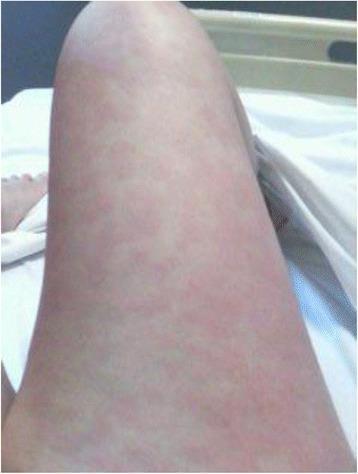
- Occurs in ~85–95% of patients; the most distinctive sign
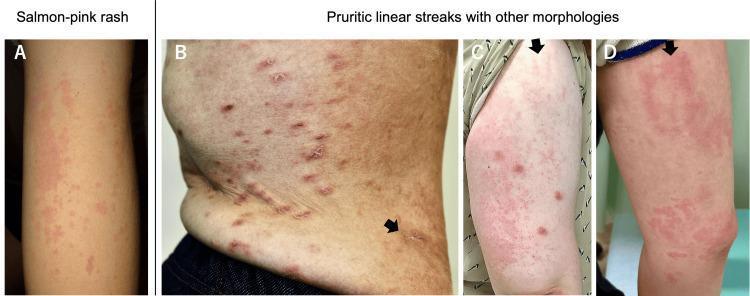
- Classic (evanescent) rash: salmon-pink maculopapular eruption, asymptomatic, appearing synchronously with fever spikes and fading within hours
- Favors pressure sites; demonstrates the Koebner phenomenon; most common on trunk but can involve extremities, palms, and soles
Atypical (persistent) variants — now increasingly recognized:
- Persistent pruritic papules and plaques, often with linear distribution (flagellate pattern)
- Persistent erythematous eyelid edema (can mimic dermatomyositis)
- Flagellate erythema
- Atypical persistent lesions are associated with a worse prognosis and a possible link to malignancy
Arthritis
- Occurs in 65–100% of patients
- Arthralgia/arthritis, often polyarticular; carpal ankylosis is a distinctive long-term feature
- Joint disease can be the dominant feature in the "chronic articular" phenotype
Other Systemic Features
- Sore throat / pharyngitis (common early symptom, often at onset)
- Lymphadenopathy (cervical most common) and splenomegaly
- Hepatomegaly with elevated transaminases
- Serositis: pleuritis, pleural effusions; pericarditis (up to 50%), cardiac tamponade (rare); myocarditis
- Pulmonary involvement: rare (fibrosis, pulmonary arterial hypertension)
- Renal: nephritis (rare)
Disease Patterns
Three recognized clinical courses:
- Monocyclic (self-limited, single episode) — ~20%
- Polycyclic / intermittent (recurrent flares with remissions) — ~30%
- Chronic articular (persistent disease, dominant joint involvement) — ~50%
Laboratory Findings
| Test | Finding |
|---|---|
| Ferritin | Markedly elevated; >3× normal in ~60%; sometimes >4,000 ng/mL |
| Glycosylated ferritin | <20% (normally 50–80%); highly characteristic |
| WBC | Leukocytosis ≥10,000/mm³ in 85%; ≥80% neutrophils in 69% |
| CRP | Elevated in ~93% |
| ESR | Elevated (≥20 mm/h) in 85% |
| Liver enzymes | Elevated in ~62% |
| Platelets | Thrombocytosis (>400 × 10⁹/L) in ~46% |
| Hemoglobin | Anemia <10 g/dL in 50–75% |
| ANA, RF, anti-CCP | Negative or low titer |
A markedly elevated ferritin with glycosylated ferritin fraction <20% is strongly suggestive of AOSD, though not pathognomonic.
— Fitzpatrick's Dermatology Vol. 1–2
Diagnosis: Classification Criteria
AOSD is a diagnosis of exclusion. Two validated criteria sets are used:
Yamaguchi Criteria (1992) — most widely used
Requires ≥5 criteria, of which ≥2 must be major, plus no exclusion criteria
Major:
- Fever ≥39°C lasting ≥1 week
- Arthralgia lasting ≥2 weeks
- Typical salmon-pink maculopapular rash coinciding with fever
- Leukocytosis ≥10,000/mm³ with ≥80% neutrophils
Minor:
- Pharyngitis or sore throat
- Lymphadenopathy and/or splenomegaly
- Abnormal liver enzymes
- Negative ANA and RF
Exclusion criteria: active infection (especially EBV, sepsis), malignancy (especially lymphoma), inflammatory disease (polyarteritis nodosa)
Fautrel Criteria (2002)
Requires 4 major, OR 3 major + 2 minor — no exclusion criteria required
Major: Spiking fever ≥39°C · Arthralgia · Transient erythema · Pharyngitis · Neutrophils ≥80% · Glycosylated ferritin fraction ≤20%
Minor: Typical rash · Leukocytosis >10,000/mm³
The Fautrel criteria include glycosylated ferritin as a specific major criterion and require no exclusions, making it easier to apply.
— Fitzpatrick's Dermatology Vol. 1–2 (Table 66-5)
Histopathology
Evanescent lesions: Interstitial and perivascular neutrophil-dominant mixed infiltrate with lymphocytes — indistinguishable from sJIA
Persistent/atypical lesions: Additional epidermal changes — acanthosis, spongiosis, necrotic keratinocytes in the spinous layer
Complications
Macrophage Activation Syndrome (MAS)
- The most dangerous complication (~10% of patients); a form of secondary hemophagocytic lymphohistiocytosis (HLH)
- Heralded by a change from spiking to continuous fever, worsening hepatosplenomegaly, lymphadenopathy, cytopenias, and CNS dysfunction
- Ferritin often 5,000–10,000 ng/mL
- Coagulopathy (prolonged PT/PTT), triglycerides elevated, fibrinogen decreased
- Life-threatening: requires urgent treatment
Management
Treatment is stepwise based on severity:
Step 1 — Mild-Moderate Disease
- NSAIDs / high-dose aspirin: useful in mild systemic disease; majority require escalation
- Corticosteroids (prednisone 40–60 mg/day): cornerstone of acute management; controls fever, rash, and serositis
Step 2 — Steroid-Sparing / Corticosteroid-Dependent Disease
- Methotrexate (7.5–20 mg/week): most commonly used DMARD, especially for persistent arthritis and steroid tapering
- Hydroxychloroquine: sometimes used for milder disease
Step 3 — Refractory / Severe Disease (Biologics)
| Agent | Target | Notes |
|---|---|---|
| Anakinra (IL-1R antagonist) | IL-1 | Highly effective in systemic form; first choice in many centers |
| Canakinumab (anti-IL-1β) | IL-1β | Long-acting; approved for sJIA; increasingly used in AOSD |
| Tocilizumab (anti-IL-6R) | IL-6 | Effective, especially for systemic inflammation without predominant joints |
| TNF inhibitors (etanercept, infliximab) | TNF-α | Particularly useful in chronic polyarticular disease |
| Rituximab (anti-CD20) | B cells | Used for refractory disease |
| Ruxolitinib (JAK inhibitor) | JAK-STAT | Emerging evidence, especially for refractory MAS |
IL-1 and IL-6 blockers are increasingly used as first-line therapy for moderate-to-severe disease with prominent systemic inflammation (as opposed to purely articular disease).
MAS Management
- High-dose IV corticosteroids (first-line)
- Cyclosporine for corticosteroid-resistant cases
- Anakinra / canakinumab (IL-1 blockade)
- Etoposide for refractory/fulminant HLH
- Emapalumab (anti-IFN-γ) in refractory cases
— Dermatology 2-Volume Set 5e; Fuster & Hurst's The Heart 15e; Fitzpatrick's Dermatology Vol. 1–2
Differential Diagnosis
| Condition | Distinguishing features |
|---|---|
| Sepsis / EBV / viral syndrome | Positive cultures/serology, different fever pattern |
| Lymphoma | Lymph node biopsy, no typical rash |
| Schnitzler syndrome | Monoclonal IgM gammopathy, bone pain (hyperostosis), urticarial rash |
| Dermatomyositis | Interface dermatitis on biopsy, myositis-specific antibodies, Gottron's papules |
| SLE | Positive ANA/dsDNA, photosensitive rash, renal involvement |
| Reactive arthritis | Preceding infection, asymmetric oligoarthritis, HLA-B27 |
| AOSD rash vs. urticaria | AOSD rash: non-pruritic, evanescent, salmon-pink, fever-synchronous |
Prognosis
- Monocyclic: favorable; disease resolves within 1 year
- Chronic articular form: risk of joint destruction and disability; may need long-term DMARDs/biologics
- MAS: ~10% mortality even with treatment in severe cases
- Atypical persistent cutaneous lesions are associated with higher risk of associated malignancy — vigilance is warranted
This is a shared conversation. Sign in to Orris to start your own chat.