
What is basal and luminal type of breast cancer that is seen in BRCA1 and BRCA2 mutation?
Reading File
Now let me search the medical library and web in parallel for comprehensive information.
Finding Sources
Searching the Web
BRCA1 BRCA2 mutation basal luminal breast cancer molecular subtypes
Good results. Now let me read the specific textbook sections found:
Reading File
Reading File
Reading File
I have comprehensive information from all three textbooks. Let me also fetch the molecular classification image from Robbins for the user.
Loading Image
Loading Image
I now have all the information needed for a comprehensive answer. Here it is:
Basal-Like vs. Luminal Breast Cancer in BRCA1 and BRCA2 Mutations
Background: Molecular Subtypes of Breast Cancer
Breast cancers are classified into four major molecular subtypes based on gene expression profiling:
| Subtype | ER | PR | HER2 | Ki-67 | Frequency |
|---|---|---|---|---|---|
| Luminal A | + | + | - | Low | 40-55% |
| Luminal B | + | +/- | -/+ | High | 20-30% |
| HER2-enriched | - | - | + | High | 10-20% |
| Basal-like (TNBC) | - | - | - | High | ~15-20% |
(Robbins, Cotran & Kumar, Table 23.4; Sabiston Textbook of Surgery)
BRCA1 Mutations - Strongly Associated with Basal-Like Cancer
BRCA1-associated breast cancers are predominantly basal-like (triple-negative). This is the key and well-established association.
Why "basal-like"?
The term comes from the cell of origin - these tumors resemble the basal/myoepithelial cells that surround the mammary ducts, rather than the milk-producing luminal cells. Females with a pathogenic BRCA1 mutation are much more likely to develop a basal-like (triple-negative) cancer than any other subtype.
Histologic and immunophenotypic features of BRCA1-associated tumors:
- High nuclear grade (poorly differentiated)
- Central acellular scar-like zone (pushing margins rather than infiltrative)
- Tumor-infiltrating lymphocytes - medullary carcinoma-like histology
- Triple negative: ER negative, PR negative, HER2 negative
- Negative for luminal cytokeratins (CK8/18)
- Positive for basal cell markers: CK5/6, EGFR, vimentin
- High genomic instability with widespread chromosomal changes
- Frequent TP53 mutations (~80%)
This constellation is called the "basal-like phenotype" - though it is important to note that basal-like carcinoma is also frequently seen sporadically (not all basal-like tumors carry BRCA1 mutations).
(Quick Compendium of Clinical Pathology, p. 407)
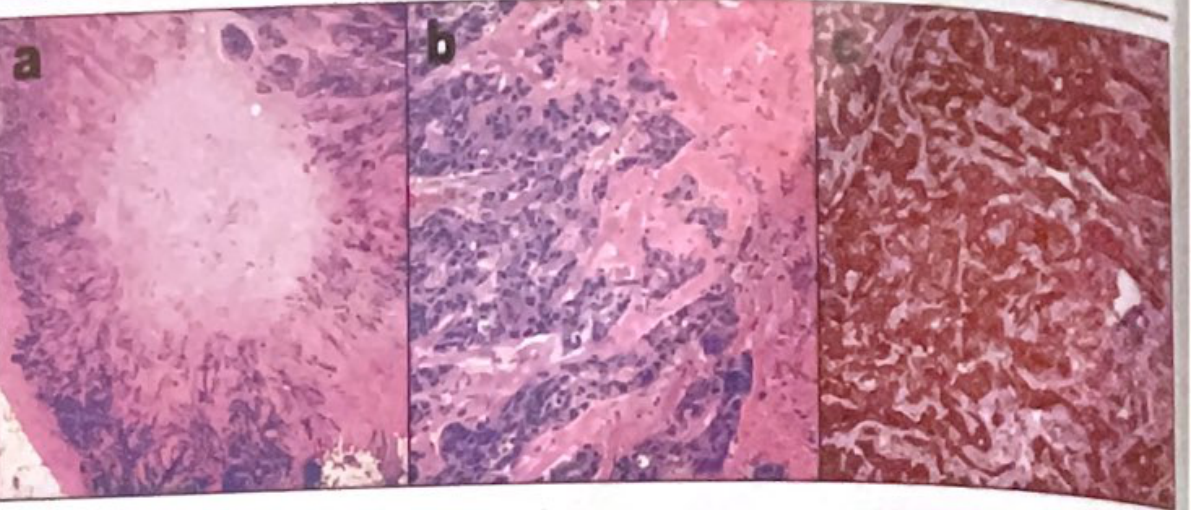
Basal-like invasive breast carcinoma: (a) circumscribed tumor with central scar-like zone, (b) high-grade syncytial tumor cells, (c) strong CK5/6 positivity - Quick Compendium of Clinical Pathology
BRCA2 Mutations - Associated with Luminal-Type Cancer
BRCA2-associated tumors are notably different from BRCA1 tumors:
- They do not have characteristic morphologic features that distinguish them from sporadic breast cancers
- The distribution of morphologic variants is similar to that of the general population
- They are more commonly ER-positive / luminal subtype (hormone receptor positive)
- BRCA2 tumors trend toward luminal A or luminal B phenotype with ER/PR positivity
- They are generally not triple-negative
In essence: BRCA2 = luminal (ER+), BRCA1 = basal-like (triple-negative). This is the most testable and clinically important distinction.
Molecular Classification Diagram (Robbins)
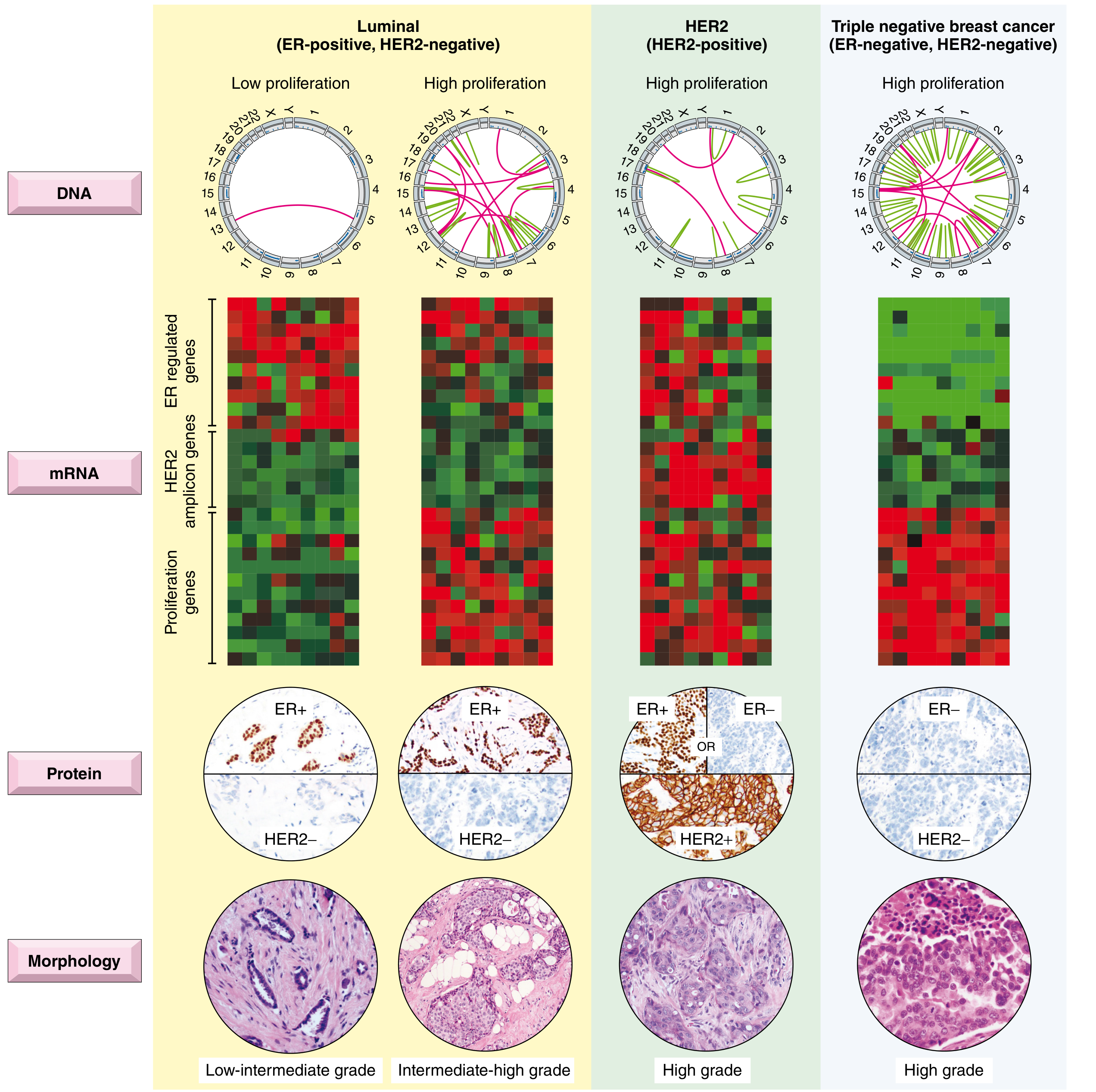
Fig. 23.18 from Robbins, Cotran & Kumar - Molecular classification of invasive breast cancer
Risk Comparison: BRCA1 vs. BRCA2
| Feature | BRCA1 | BRCA2 |
|---|---|---|
| Lifetime female breast cancer risk | ~80% | ~30% |
| Male breast cancer risk | Lower (~1%) | ~5-6% |
| Molecular subtype | Basal-like / TNBC | Luminal (ER+) |
| Morphology | Distinctive (medullary-like, high grade, TILs) | Not distinctive |
| Other cancer risks | Ovary, fallopian tube, colon | Pancreas, prostate (strongly associated), ovary |
| Inheritance | Autosomal dominant, high penetrance | Autosomal dominant, high penetrance |
(Quick Compendium of Clinical Pathology, p. 407)
Clinical Importance
- BRCA1/basal-like (TNBC): No hormone receptor therapy or trastuzumab; treated with chemotherapy (platinum agents especially effective due to impaired DNA repair) + PARP inhibitors (olaparib, niraparib) which exploit the homologous recombination deficiency
- BRCA2/luminal: Responds to endocrine therapy (tamoxifen, aromatase inhibitors); PARP inhibitors are also an option
- ~20-30% of triple-negative breast cancer patients carry germline BRCA1 or BRCA2 mutations
- BRCA mutations are especially prevalent in the Ashkenazi Jewish population, where 25% of women with breast cancer carry a BRCA mutation (founder mutations: 185delAG and 5385insC in BRCA1, 6174delT in BRCA2)
Summary mnemonic: BRCA1 = Basal (Triple-Negative), BRCA2 = luminal (ER+)
This is a shared conversation. Sign in to Orris to start your own chat.