
Diarrhea causing bacteria
Reading File
Finding Sources
Finding Sources
Reading File
Reading File
Finding Sources
Finding Sources
Reading File
Reading File
Reading File
Searching Images
diarrhea causing bacteria pathogens table
Loading Image
Here is a comprehensive overview of diarrhea-causing bacteria, organized by mechanism:
Bacteria That Cause Diarrhea
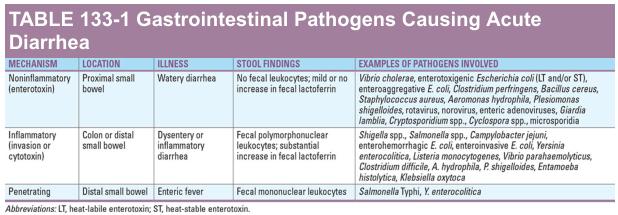
1. Noninflammatory (Enterotoxin-Mediated) — Watery Diarrhea
These organisms act on the proximal small bowel, producing toxins that stimulate fluid secretion without invading the mucosa. Stool contains no fecal leukocytes.
| Organism | Key Feature |
|---|---|
| Vibrio cholerae | Cholera toxin activates adenylate cyclase → massive watery diarrhea ("rice-water stools"); requires large inoculum (~10⁵–10⁸ organisms) |
| Enterotoxigenic E. coli (ETEC) | Most common cause of traveler's diarrhea; produces heat-labile (LT) and/or heat-stable (ST) enterotoxins |
| Enteroaggregative E. coli (EAEC) | Persistent watery diarrhea, especially in children and travelers |
| Clostridium perfringens | Food poisoning from reheated meat; crampy diarrhea 8–24 h after ingestion, self-limited |
| Bacillus cereus | Two syndromes: emetic (preformed toxin, 1–6 h, from rice) and diarrheal (8–16 h, from meats/vegetables) |
| Staphylococcus aureus | Preformed enterotoxin; rapid onset (1–6 h) nausea, vomiting, diarrhea; common in catered foods |
| Aeromonas hydrophila | Watery diarrhea, particularly in children and immunocompromised |
2. Inflammatory (Invasive or Cytotoxin) — Dysentery / Bloody Diarrhea
These organisms invade the colon or distal small bowel, causing mucosal destruction. Stool contains fecal leukocytes (pus cells) and often blood.
| Organism | Key Feature |
|---|---|
| Shigella spp. | Requires only 10 organisms to cause disease (very low inoculum); person-to-person spread; causes classic dysentery with fever and bloody mucoid stools; can cause seizures in children |
| Salmonella spp. | From undercooked poultry, eggs, milk; can cause septicemia and invasive disease (osteomyelitis, mycotic aneurysm); postinfectious reactive arthritis |
| Campylobacter jejuni | #1 food-borne bacterial pathogen in developed countries; from undercooked poultry; associated with Guillain-Barré syndrome as a complication |
| Enterohemorrhagic E. coli (EHEC) O157:H7 | Shiga toxin; from undercooked ground beef; causes hemorrhagic colitis; can cause HUS (hemolytic uremic syndrome) and TTP |
| Enteroinvasive E. coli (EIEC) | Invades colonic epithelium; mimics Shigella dysentery |
| Yersinia enterocolitica | Waterborne/foodborne (pork, unpasteurized milk); can mimic appendicitis; associated with reactive arthritis, thyroiditis |
| Vibrio parahaemolyticus | From raw shellfish; produces cytotoxin; self-limited |
| Clostridioides difficile | Most common cause of nosocomial (healthcare-associated) diarrhea; occurs after antibiotic use disrupts gut flora; produces toxin A (enterotoxin) and toxin B (cytotoxin); watery to bloody diarrhea; can progress to pseudomembranous colitis |
| Listeria monocytogenes | Unpasteurized dairy, deli meats; invasive disease especially dangerous in pregnancy and immunocompromised |
3. Penetrating — Enteric Fever
| Organism | Key Feature |
|---|---|
| Salmonella Typhi | Typhoid fever; penetrates intestinal epithelium to systemic circulation; fever, relative bradycardia, rose spots |
| Yersinia enterocolitica / pseudotuberculosis | Can penetrate mesenteric nodes |
Key Pathogenic Mechanisms (Summary)
| Mechanism | Examples |
|---|---|
| Enterotoxin (↑cAMP/cGMP → secretion) | V. cholerae, ETEC, S. aureus, B. cereus |
| Cytotoxin (mucosal cell destruction) | Shigella dysenteriae type 1, EHEC, C. difficile |
| Invasion (penetrate mucosa) | Shigella, Salmonella, Campylobacter, EIEC |
| Neurotoxin (CNS/PNS) | S. aureus, B. cereus (vomiting center) |
Epidemiological Clues
- Traveler's diarrhea: ETEC (#1), Shigella, Campylobacter, Salmonella
- Undercooked poultry: Campylobacter, Salmonella
- Undercooked beef: EHEC O157:H7
- Raw shellfish: Vibrio species, norovirus
- Unpasteurized dairy: Salmonella, Campylobacter, Yersinia
- Post-antibiotics/hospital: C. difficile
- Institutional outbreaks: Norovirus, C. difficile, Shigella
- Person-to-person (very low inoculum): Shigella, EHEC, Giardia
Systemic Complications to Know
| Organism | Complication |
|---|---|
| EHEC O157:H7 | HUS (hemolytic uremic syndrome) |
| Campylobacter | Guillain-Barré syndrome |
| Salmonella, Shigella, Campylobacter, Yersinia | Reactive arthritis / Reiter syndrome |
| Shigella | Seizures and encephalopathy (children) |
| C. difficile | Pseudomembranous colitis, toxic megacolon |
| V. cholerae, ETEC | Severe dehydration, shock, death |
Sources: Harrison's Principles of Internal Medicine 22E; Yamada's Textbook of Gastroenterology 7E; ROSEN's Emergency Medicine; Sleisenger and Fordtran's GI and Liver Disease
This is a shared conversation. Sign in to Orris to start your own chat.