
Explain hypersensitivity reaction concepts to solve problrm based learning and1 in simplewords
Reading File
Now let me search the medical library for comprehensive hypersensitivity reaction content:
Finding Sources
Finding Sources
Excellent! Let me now read the comprehensive content from the best sources:
Reading File
Reading File
Reading File
Now let me fetch the diagram image and read more detailed content on Types III and IV:
Loading Image
Reading File
Searching Images
hypersensitivity reactions types I II III IV diagram
I now have comprehensive content from authoritative textbooks. Let me compile the full, clear explanation:
Hypersensitivity Reactions — Simple Guide for PBL
Core Concept: Hypersensitivity = an exaggerated immune response that damages the host instead of protecting it. It always requires prior sensitization — the first exposure sensitizes you; the second exposure causes the reaction. — Jawetz Medical Microbiology, 28e
The Gell & Coombs Classification (1963)
Four types, split into Antibody-mediated (I, II, III) and T-cell mediated (IV).
TYPE I — Immediate Hypersensitivity (Allergy/Anaphylaxis)
Simple word: "IgE explodes mast cells"
Antibody involved: IgE
Timing: Seconds to minutes after re-exposure
How it works (step by step):
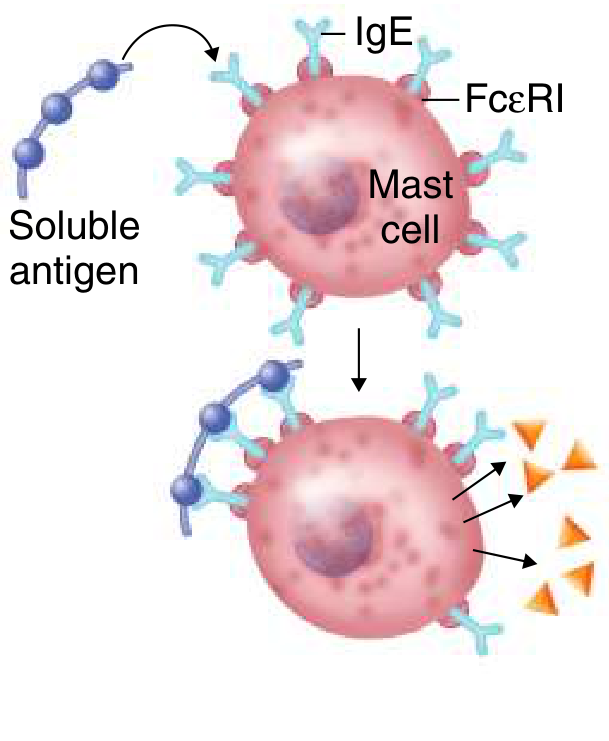
- First exposure (sensitization): Antigen (allergen) → body makes IgE antibodies → IgE sticks to mast cells and basophils via FcεRI receptors — the cell is now "armed"
- Second exposure: Same allergen cross-links the IgE on the mast cell → mast cell degranulates (explodes)
- Released mediators cause the symptoms:
| Mediator | Effect |
|---|---|
| Histamine (preformed) | Vasodilation, itching, bronchospasm |
| Leukotrienes C4, D4 | Vasodilatation, increased permeability |
| Leukotriene B4 | Chemoattractant for leukocytes |
| Prostaglandins | Edema, bronchoconstriction |
Clinical examples:
- Anaphylaxis (systemic — most severe, can be fatal)
- Hay fever (allergic rhinitis)
- Asthma, urticaria (hives), angioedema
- Atopy: Genetic tendency → elevated IgE → environmental/food allergens
Treatment:
- Epinephrine (first-line for anaphylaxis — reverses bronchospasm and vasodilation)
- Antihistamines, corticosteroids
- Antigen avoidance
TYPE II — Cytotoxic Hypersensitivity
Simple word: "Antibodies attack cells directly"
Antibody involved: IgG (or IgM)
Timing: Hours
How it works:
- IgG antibodies bind to antigens on cell surfaces (or extracellular matrix)
- This activates complement → membrane attack complex → cell lysis
- OR: opsonization → phagocytes eat the cells
- Alternatively: antibody blocks/stimulates a receptor (no cell killing — just dysfunction)
Clinical examples:
| Disease | Mechanism |
|---|---|
| ABO transfusion reaction | Anti-A or anti-B IgM/IgG → RBC lysis |
| Hemolytic disease of newborn (Rh) | Maternal anti-Rh IgG crosses placenta → fetal RBC destruction |
| Autoimmune hemolytic anemia | Penicillin haptens on RBC surface → antibody → hemolysis |
| Goodpasture syndrome | Anti-GBM (basement membrane) antibodies → kidney + lung damage |
| Graves disease | Anti-TSH receptor antibody → stimulates thyroid → hyperthyroidism (no cell death, just stimulation) |
| Myasthenia gravis | Anti-AChR antibodies → block receptors → muscle weakness |
Key PBL tip: If antibody is against a receptor that stimulates (Graves) or blocks (Myasthenia), this is sometimes called Type V (stimulatory hypersensitivity). Same mechanism as Type II but functionally distinct.
TYPE III — Immune Complex Hypersensitivity
Simple word: "Immune complexes get stuck and cause inflammation"
Antibody involved: IgG
Timing: Hours to days (6–12 hours for Arthus reaction)
How it works:
- Antigen + IgG → form immune complexes (Ag-Ab complexes)
- Normally these are cleared — but when they persist or are excessive, they deposit in tissues (kidneys, joints, blood vessel walls)
- Deposited complexes → activate complement → recruit neutrophils/macrophages → inflammation and tissue damage
Two classic forms:
| Form | Description |
|---|---|
| Arthus reaction (local) | Low-dose antigen injected into skin → local IgG + complement → local vasculitis within 12 hours |
| Serum sickness (systemic) | Large dose foreign antigen (e.g., horse serum, some drugs) → systemic immune complex deposition → fever, arthritis, rash, nephritis |
Clinical examples:
- Post-streptococcal glomerulonephritis (strep Ag-Ab complexes in glomeruli → complement → neutrophil influx → nephritis; low complement, lumpy deposits on immunofluorescence)
- SLE (DNA-anti-DNA complexes in kidneys)
- Subacute bacterial endocarditis, Rheumatoid arthritis
PBL clue: Think Type III when you see low complement levels + immune complexes + nephritic picture weeks after infection
TYPE IV — Delayed-Type Hypersensitivity (DTH)
Simple word: "T cells do the damage — takes days"
No antibody — this is T-cell mediated
Timing: 48–72 hours (that's why it's called "delayed")
How it works:
- Sensitization: Antigen processed by APCs → presented to T helper (Th1) cells → memory T cells formed
- Re-exposure: Antigen re-presented → Th1 cells release IFN-γ and IL-2 → activates macrophages → macrophage-driven inflammation and tissue damage
- Cytotoxic T cells (CD8+) can also kill antigen-bearing cells directly
Subtypes (modified Janeway classification):
| Subtype | Cells | Examples |
|---|---|---|
| Th1-mediated | CD4+ Th1 → macrophage activation | Tuberculin skin test, contact dermatitis |
| Th2-mediated | CD4+ Th2 → eosinophil activation | Chronic asthma, chronic allergic rhinitis |
| Th17-mediated | Th17 → neutrophil activation | Rheumatoid arthritis, atopic dermatitis |
| Cytotoxic T cell (CTL) | CD8+ direct killing | Poison ivy, virus-infected cells, graft rejection |
Clinical examples:
- Tuberculin (Mantoux) test: Inject PPD → if sensitized, induration at 48–72 hours (positive = prior TB exposure)
- Contact dermatitis: Poison ivy, nickel, formaldehyde — hapten binds protein → T cell reaction in skin
- Granulomatous disease: TB, leprosy, sarcoidosis — macrophages frustrated → form granulomas
- Graft rejection (cell-mediated component)
Quick Comparison Table
| Feature | Type I | Type II | Type III | Type IV |
|---|---|---|---|---|
| Immunology | IgE | IgG/IgM | IgG | T cells |
| Antigen location | Soluble | Cell surface | Soluble (circulating) | Cell-associated / tissue |
| Key cells | Mast cells, basophils | Complement, phagocytes | Neutrophils, complement | T cells, macrophages |
| Timing | Seconds–minutes | Hours | 6–12 hours | 48–72 hours |
| Key mediator | Histamine, leukotrienes | Complement (MAC) | Complement + cytokines | IFN-γ, IL-2 |
| Examples | Anaphylaxis, asthma | Transfusion reaction, Goodpasture | Serum sickness, post-strep GN | TB test, contact dermatitis |
| Complement? | No | Yes | Yes | No |
Memory Tricks for PBL
| Type | Mnemonic |
|---|---|
| I | "I"mmediately (seconds) — IgE, mast cells, histamine |
| II | "II" = direct hit on the cell — antibody attacks the cell surface |
| III | "III" = Immune complex litter — complexes deposit everywhere |
| IV | "IV" = Very delayed — T cells take days |
PBL Scenario Cues
- Patient develops anaphylaxis minutes after penicillin injection → Type I (IgE-mediated)
- Blood transfusion → immediate hemolysis → Type II
- Joint pain, fever, rash 10 days after horse antiserum injection → Type III (serum sickness)
- Skin induration 48 hours after PPD injection → Type IV
- Post-strep kidney disease, low complement, lumpy deposits on immunofluorescence → Type III
- Goodpasture syndrome → Type II (linear deposits on IF)
- Graves disease / Myasthenia gravis → Type II (receptor-mediated)
Sources: Jawetz Melnick & Adelberg's Medical Microbiology, 28e; Goldman-Cecil Medicine; Janeway's Immunobiology, 10e
This is a shared conversation. Sign in to Orris to start your own chat.