


Make a handwritten quick revision notes from this
Handwritten quick revision notes on ruled notebook paper with a slightly yellowish tint, written in blue ink pen in a neat but natural handwriting style. The notes are titled "Lecture 14 - Nutraceuticals & Cosmeceuticals" at the top underlined. Content organized as follows: 📌 DEFINITION • Term coined in 1989 by Stephen DeFelice • Nutraceutical = food/part of food → provides medical/health benefits (prevention & treatment of disease) 📌 CLASSIFICATION A. By Food Source 1. Plants – Ascorbic acid, Quercetin, Lycopene, β-Carotene, Curcumin, Catechins, Ellagic acid, Allicin, α-Tocopherol, Pectin 2. Animals – CLA, EPA, DHA, Choline, Lecithin, Ubiquinone, Sphingolipids 3. Microbial – Yeast, L. acidophilus, Streptococcus salivarius B. By Therapeutic Activity 1. Antioxidants – Vit C, β-carotene, Lycopene, Tocopherols, Catechins, Glutathione 2. Anti-inflammatory – Curcumin, Quercetin, Capsaicin, EPA, DHA 3. Anticancer – Genistein, Limonene, Daidzein, Diallylsulfide 4. Bone Protective – Soy-protein, Genistein, Calcium 5. Antibacterial – Garlic, Curcumin C. By Chemical Nature 1. Phenolic – Tannins, Anthocyanins, Isoflavones, Flavonols, Coumarins 2. Protein-based – Choline, Capsaicinoids, Amino acids, Indoles 3. Isoprenoids – Carotenoids, Tocopherols, Tocotrienols 4. Carbohydrate – Ascorbic acid, Oligosaccharides 5. Fatty acids – CLA, Sphingolipids, Lecithin, PUFA, MUFA 6. Microbial – Prebiotics, Probiotics 7. Minerals – Ca, Se, K, Zn, Mn, B, P 📌 PROBIOTICS vs PREBIOTICS • Probiotics = Live microorganisms → health benefits (Lactobacillus, Bifidobacterium, E. coli, Bacillus) • Prebiotics = Non-digestible substances → stimulate growth of indigenous bacteria (Oligofructose, Inulin, Lactulose) 📌 DIETARY FIBRES • Water insoluble – wheat bran, whole grains, vegetables • Water soluble – oats, beans, peas, apples, citrus fruits • Daily intake: 30-40 gm The handwriting has slight variations in letter size, some words underlined for emphasis, small asterisks or stars next to key points, ink slightly varying in pressure, making it look like genuine student revision notes. Margins have small doodles or arrows. Paper has faint ruled lines.
Handwritten quick revision notes on ruled notebook paper, yellowish tint, blue ink pen, neat student handwriting style. Second page of revision notes continuing from Nutraceuticals lecture. Title at top (underlined): "Herbs as Nutraceuticals - Quick Revision" Content: 🌿 FLAX SEEDS Source: Linum usitatissimum | Family: Linaceae Constituents: γ-linolenic acid, α-linolenic acid, Secoisolariciresinol, Lignans Uses: Prevents mammary/colon/rectal cancers, ↓ hypertension, diabetes, coronary heart disease 🌿 GINKGO BILOBA Source: Ginkgo biloba | Family: Ginkgoaceae Constituents: Bilobelin, ginkgetin, isoginkgetin, flavanols, ginkgolides A,B,C Uses: Treats asthma, memory impairment; alleviates effects of platelet-activating factor 🌿 SPIRULINA Source: Blue-green algae (Cyanobacteria) – Spindina platensis / S. maxima | Family: Oscillatoriaceae Constituents: γ-linoleic acid, oleic acid, glycolipids, sulpholipids, vit B, β-carotenes, phycocyanin Uses: Immunostimulant; HIV, herpes, cytomegalovirus, influenza, mumps; arthritis, atherosclerosis, diabetes, aging 🌿 BITTER GOURD (Karela) Source: Momordica charantia | Family: Cucurbitaceae Constituents: Polypeptide-p (plant insulin), charantin, pyrimidine nucleoside, vicine, glycosides Uses: ↓ blood sugar (hypoglycemic); ↑ glycogen synthesis by 4-5x in liver 🌿 TURMERIC Source: Rhizomes of Curcuma longa | Family: Zingiberaceae Constituents: Curcumin, desmethoxy curcumin, bisdesmethoxy curcumin Uses: Antimicrobial; integrase enzyme (HIV replication) inhibitor 🌿 SOYA Source: Glycine max | Family: Leguminosae Constituents: Daidzein, genistein Uses: Prevents estrogen-dependent cancers; genistein inhibits protein tyrosine kinase & DNA topoisomerase-II 🌿 GARLIC Source: Bulbs of Allium sativum | Family: Liliaceae Constituents: Allicin, alliin, ajoene Uses: Antihyperlipidaemic, antihypertensive, hypoglycemic, antispasmodic; prevents colon & lung cancers 🌿 TOMATO Source: Lycopersicon esculentum | Family: Solanaceae Constituents: Lycopene Uses: Prevents prostate cancer; ↓ risk of cancers of digestive tract, pancreas, cervix, bladder, skin Handwriting is natural with slight unevenness, important words underlined or circled, arrows for "uses", ruled paper lines visible, some text in slightly larger font for herb names
Handwritten quick revision notes on ruled notebook paper, yellowish tint, blue/black ink pen, neat student handwriting. Third and final page of Nutraceuticals revision notes. Title at top (underlined): "Herbs as Nutraceuticals - cont." 🌿 FENUGREEK Source: Trigonella foenum-graecum | Family: Leguminosae Constituents: Alkaloids (gentianine, trigonelline), flavanoids, coumarins, proteins, amino acids, steroid saponins Uses: Anorexia, gastritis; laxative + expectorant + demulcent; hypoglycemic + hypocholesterolemic 🌿 GINSENG Source: Panax ginseng | Family: Araliaceae Constituents: Protopanaxadiol, polysaccharides, starch, sterols, polyacetylenes, choline, vit B1, B2, B12, pantothenic acid, biotin Uses: Cope with stress & fatigue; hypertension, hypoglycemia; modifies liver function & metabolism ──────────────────────────────── 📝 QUICK MEMORY AIDS: Antioxidants → "APPLE-G" Ascorbic acid, Polyphenolics, Lycopene, Ellagic acid, carotenoids (β-carotene), Glutathione Anticancer → "GLD-S" Genistein, Limonene, Daidzein, Sphingolipids Phenolic nutraceuticals → "TAIF-FC-L" Tannins, Anthocyanins, Isoflavones, Flavonones, Flavonols, Coumarins, Lignin Herb families: • Linaceae → Flax | Ginkgoaceae → Ginkgo • Cucurbitaceae → Karela | Zingiberaceae → Turmeric • Liliaceae → Garlic | Solanaceae → Tomato • Leguminosae → Soya & Fenugreek | Araliaceae → Ginseng Probiotics vs Prebiotics: PRObiotics = PROducing live organisms (Lactobacillus, Bifidobacterium) PREbiotics = PREparing the gut (Inulin, Oligofructose, Lactulose) ★ Dietary Fibre daily intake = 30-40 gm ★ Bottom of page has a small doodle of a leaf or plant. Notes feel personal and study-ready, with some words boxed or circled, arrows showing connections, natural handwriting pressure variation.
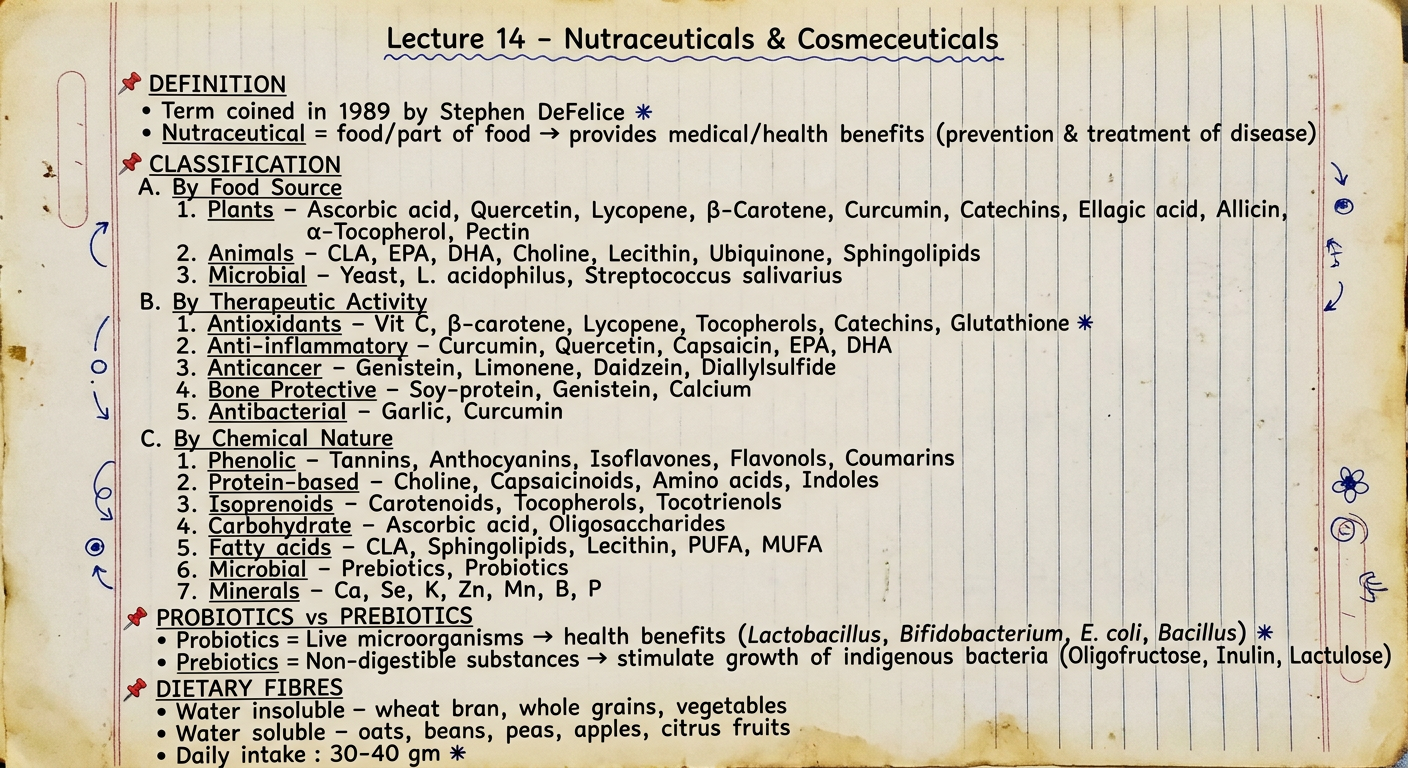
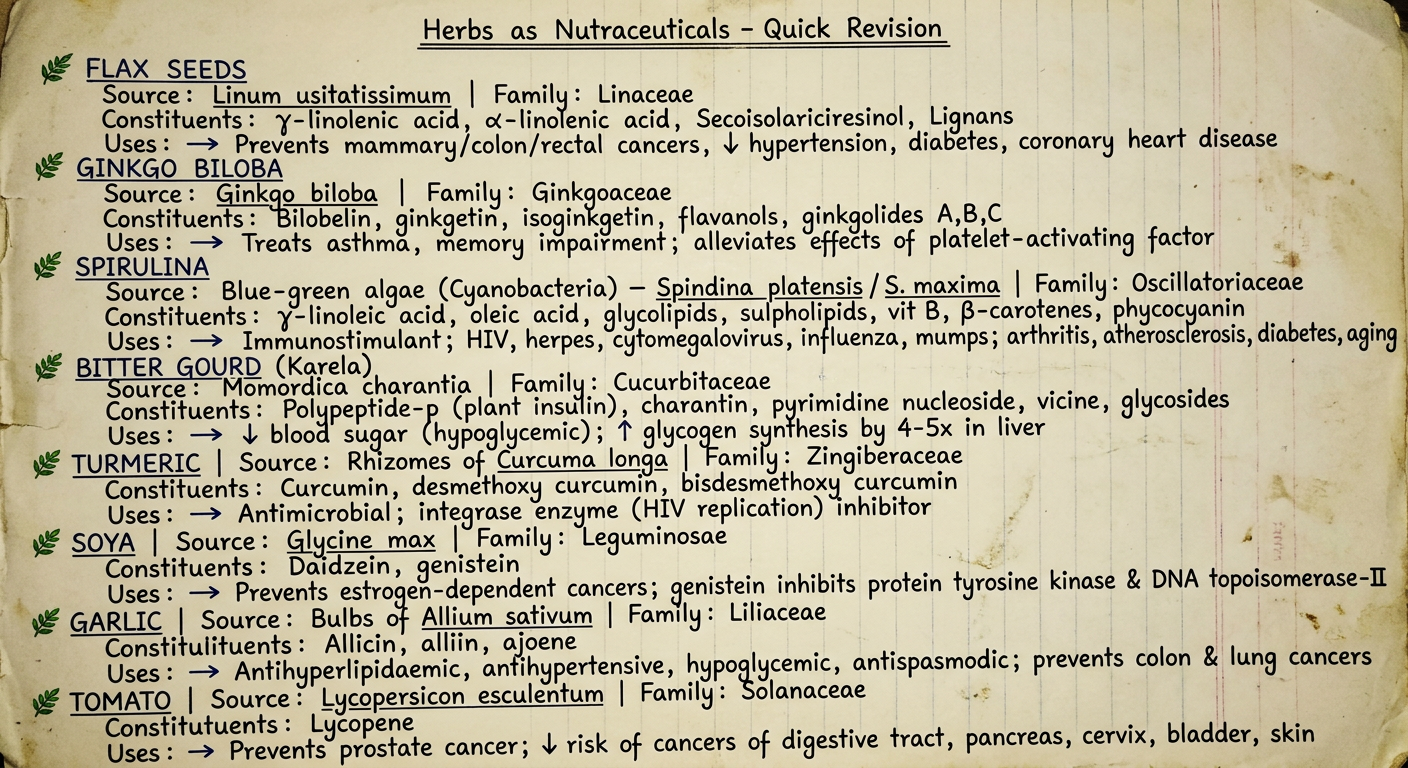
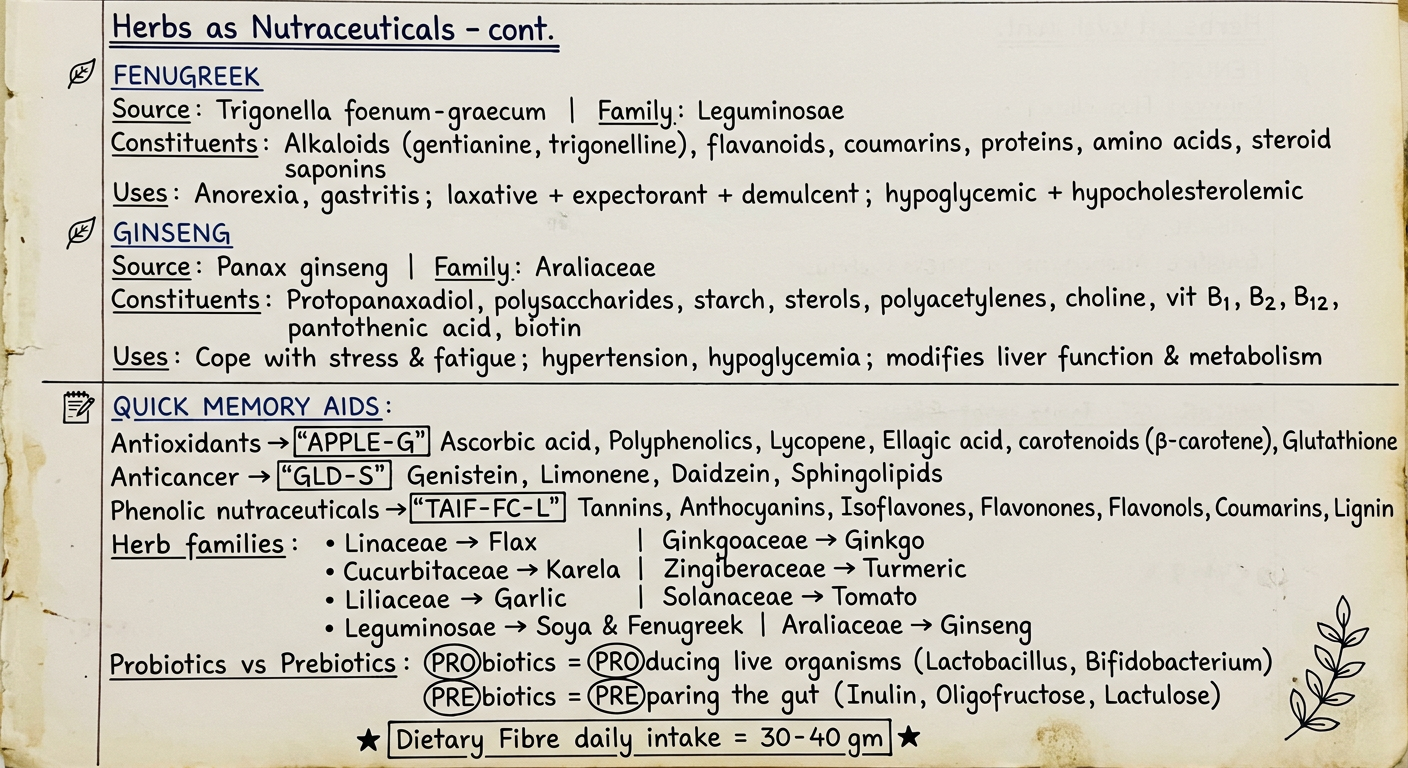
- Definition - coined 1989, Stephen DeFelice
- Classification - by Food Source (Plants/Animals/Microbial), Therapeutic Activity (Antioxidant/Anti-inflammatory/Anticancer/Bone Protective/Antibacterial), and Chemical Nature (Phenolics/Proteins/Isoprenoids/Carbs/Fatty acids/Microbial/Minerals)
- Probiotics vs Prebiotics - definitions + examples
- Dietary Fibres - types + daily intake (30-40 gm)
- All 10 herbs - Source, Family, Constituents, Uses for each (Flax, Ginkgo, Spirulina, Karela, Turmeric, Soya, Garlic, Tomato, Fenugreek, Ginseng)
- Memory mnemonics for antioxidants, anticancer agents, phenolics, and herb families
Create a revision poster with visual herb illustrations
A beautiful, detailed A3-style educational revision poster titled "Herbs as Nutraceuticals" in elegant botanical illustration style. Dark forest green background with cream/parchment colored text boxes. At the top center: large decorative title "HERBS AS NUTRACEUTICALS" in gold serif font, with a decorative botanical border of leaves and flowers. Arranged in a 2x5 grid layout, each herb has a realistic hand-drawn botanical illustration in watercolor style alongside its key facts in a small cream card: 1. FLAX SEEDS - illustration of flax plant with blue flowers and seed pods Card: Family: Linaceae | Key: γ-linolenic acid, Lignans | Uses: Cancer prevention, ↓ hypertension 2. GINKGO BILOBA - illustration of distinctive fan-shaped ginkgo leaves Card: Family: Ginkgoaceae | Key: Bilobelin, Ginkgolides | Uses: Memory, asthma, PAF inhibitor 3. SPIRULINA - illustration of spiral blue-green algae strands under microscope view Card: Family: Oscillatoriaceae | Key: Phycocyanin, β-carotene | Uses: Immunostimulant, antiviral 4. BITTER GOURD (KARELA) - illustration of warty green karela fruit with leaves Card: Family: Cucurbitaceae | Key: Polypeptide-p (plant insulin), Charantin | Uses: Hypoglycemic 5. TURMERIC - illustration of turmeric rhizomes and yellow flowers Card: Family: Zingiberaceae | Key: Curcumin | Uses: Antimicrobial, HIV integrase inhibitor 6. SOYA - illustration of soybean pods and leaves Card: Family: Leguminosae | Key: Genistein, Daidzein | Uses: Anticancer (estrogen-dependent) 7. GARLIC - illustration of garlic bulb with cloves and green shoots Card: Family: Liliaceae | Key: Allicin, Alliin, Ajoene | Uses: Antihypertensive, anticancer 8. TOMATO - illustration of bright red ripe tomatoes on vine with leaves Card: Family: Solanaceae | Key: Lycopene | Uses: Prevents prostate & digestive cancers 9. FENUGREEK - illustration of fenugreek plant with small yellow flowers and seed pods Card: Family: Leguminosae | Key: Trigonelline, Saponins | Uses: Hypoglycemic, hypocholesterolemic 10. GINSENG - illustration of ginseng root (human-shaped) with berries Card: Family: Araliaceae | Key: Protopanaxadiol, Ginsenosides | Uses: Adaptogen, stress, hypertension At the bottom: a small legend box "Source → Family → Active Constituents → Uses" Decorative botanical border around entire poster with herbs, leaves, berries. Soft watercolor style illustrations, rich and detailed, poster looks like a premium pharmacy or herbal medicine reference chart.
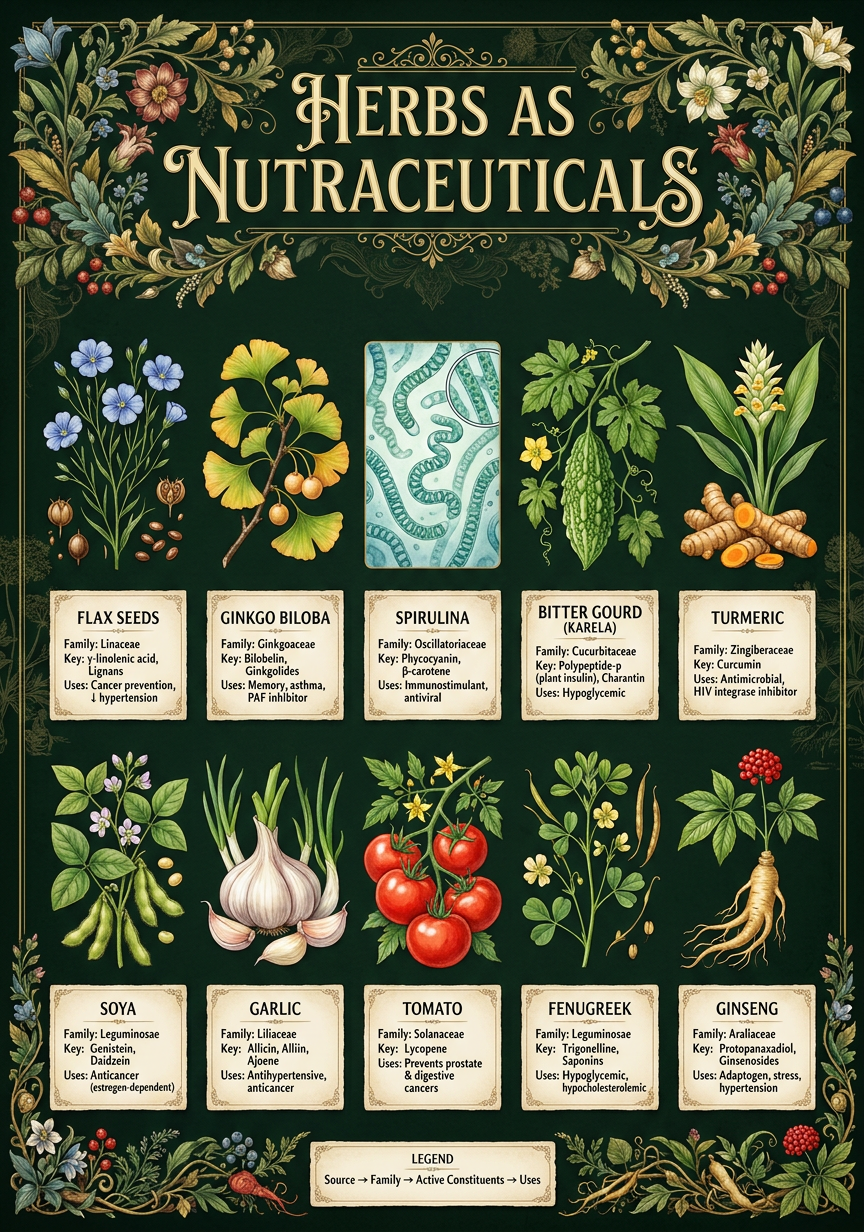
| Herb | Key Active Constituent | Main Use |
|---|---|---|
| 🌾 Flax Seeds | γ-linolenic acid, Lignans | Cancer prevention, ↓ hypertension |
| 🍃 Ginkgo Biloba | Bilobelin, Ginkgolides A/B/C | Memory, asthma, anti-PAF |
| 🌀 Spirulina | Phycocyanin, β-carotene | Immunostimulant, antiviral |
| 🥒 Bitter Gourd | Polypeptide-p (plant insulin) | Hypoglycemic |
| 🟡 Turmeric | Curcumin | Antimicrobial, HIV integrase inhibitor |
| 🫘 Soya | Genistein, Daidzein | Anticancer (estrogen-dependent) |
| 🧄 Garlic | Allicin, Alliin, Ajoene | Antihypertensive, anticancer |
| 🍅 Tomato | Lycopene | Prostate & digestive cancer prevention |
| 🌿 Fenugreek | Trigonelline, Saponins | Hypoglycemic, hypocholesterolemic |
| 🌱 Ginseng | Protopanaxadiol | Adaptogen, stress, hypertension |
Make a study guide document for nutraceuticals with practice questions