
Sleeve circumcision in detail
Reading File
Now let me search the medical library for sleeve circumcision content in parallel.
Finding Sources
Finding Sources
Searching Images
sleeve circumcision surgical technique foreskin
Good - found content in three textbooks. Let me read all the relevant sections in parallel.
Reading File
Reading File
Reading File
Good content found. Let me read more of the sleeve technique section and the Campbell-Walsh section on circumcision.
Reading File
Reading File
I have detailed content. Let me read more of the Campbell-Walsh section on sleeve circumcision and the Pfenninger sleeve technique section for more detail, and also the Hinman's atlas content.
Reading File
Reading File
Reading File
I now have comprehensive content from three major urology textbooks. Let me also read the postprocedure management section and fetch the key images.
Reading File
Loading Image
Loading Image
I now have comprehensive textbook content and excellent surgical diagrams. Let me compile the full detailed response.
Sleeve Circumcision - Detailed Review
Overview
Sleeve circumcision (also called the "two-incision" or "sleeve resection" technique) is the preferred method of circumcision in adults and older boys. Unlike clamp-based methods (Gomco, Plastibell, Mogen) used in neonates, the sleeve technique provides precise control over the amount of foreskin removed and allows direct vessel management. It is considered the gold standard surgical approach for adult circumcision.
- Campbell-Walsh-Wein Urology, p. 2419
- Pfenninger and Fowler's Procedures for Primary Care, p. 832
Indications
- Phimosis (ICD-9: 605) - inability to retract foreskin
- Paraphimosis (recurrent)
- Balanitis (recurrent or balanitis xerotica obliterans / lichen sclerosus)
- Recurrent urinary tract infections in boys with redundant preputial skin
- Sexually transmitted infection risk reduction (HIV, HSV-2, HPV)
- Elective/ritual/religious reasons
- Penile pain and discomfort
Contraindication: Never perform on a boy with penile anomalies (hypospadias, chordee, webbing, penile torsion) that may require the foreskin for future surgical repair.
Anesthesia
- Neonates: Penile dorsal nerve block + topical EMLA; ring block
- Children: General anesthesia preferred (avoids psychological trauma)
- Adults/older boys: Local anesthesia via dorsal nerve block at the base of the penis, combined with circumferential infiltration of the superficial penile base layers (ring block)
- Supplementary sedation may be offered as an alternative to general anesthesia in older children
Surgical Anatomy - Key Layers
Understanding the tissue planes is essential:
- Outer foreskin: keratinized squamous epithelium
- Dartos fascia: just beneath the outer skin - contains vessels
- Buck's fascia: deep penile fascia - the plane to which incisions are carried
- Frenulum (ventral): richly vascularized; requires special attention
- Frenular vessels / dorsal vein: sites of significant potential hemorrhage
Operative Technique - Step by Step
The sleeve technique creates two circumferential incisions, one on the inner prepuce and one on the outer prepuce, and removes the "sleeve" of foreskin between them.
Step 1 - Mark the Outer (Proximal/External) Incision
With the foreskin in its natural (unreduced) position over the glans, use a marking pen to draw a circumferential line at the level of the corona on the outer skin surface. This defines how much external preputial skin will be removed.
- Apply gentle downward pressure on the prepubic fat pad to avoid burying the penis and marking too proximally
- Leave a small preputial cuff (5-10 mm from the edge of the glans on the inner mark)
Step 2 - Mark the Inner (Distal/Internal) Incision
Retract the foreskin to expose the inner aspect. Mark circumferentially approximately 1 cm proximal to the coronal sulcus on the inner preputial mucosa. On the ventral side, this mark follows the V-shape of the retracted frenulum - or runs straight across the frenulum if a frenuloplasty is planned.
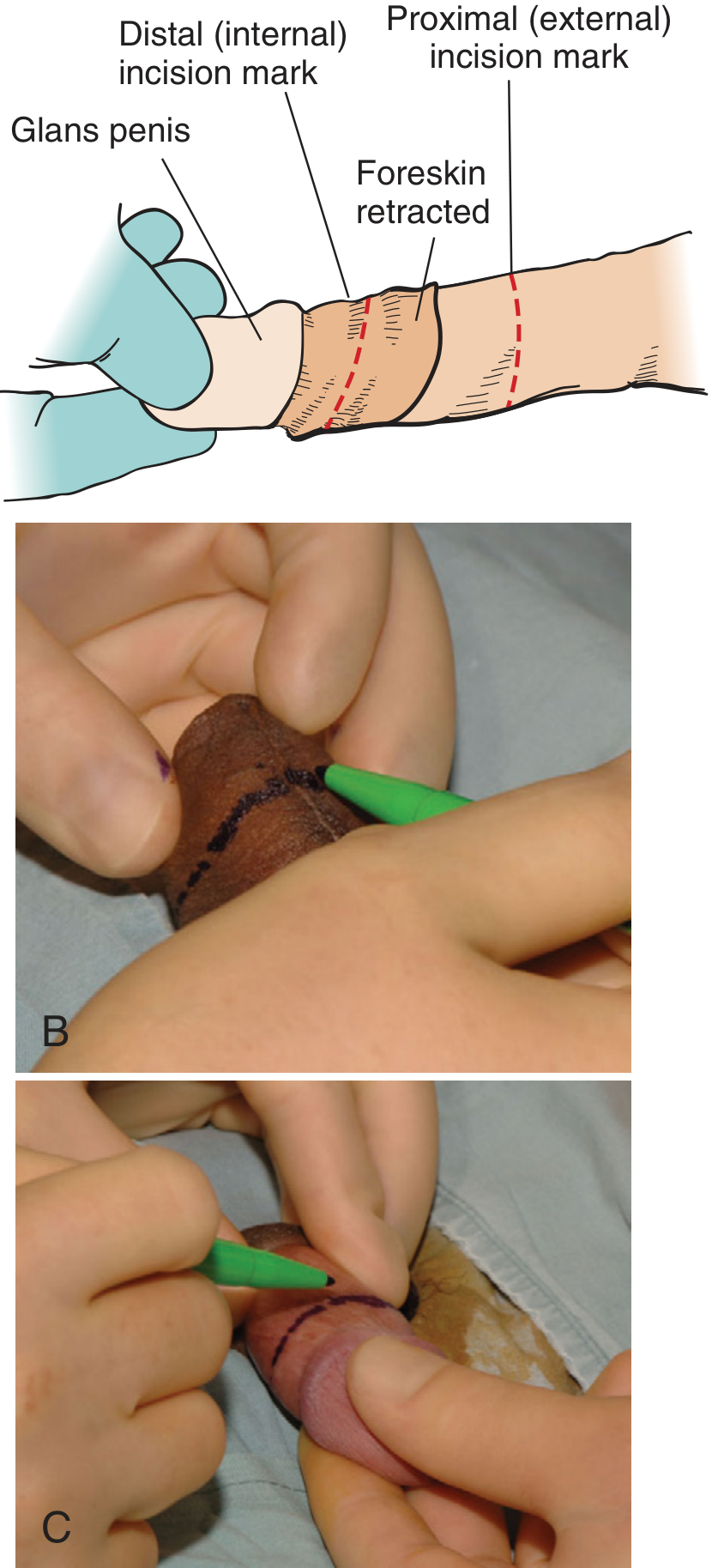
Check both marks before cutting - this is the most critical step for achieving the correct result.
Step 3 - Make the External (Proximal) Incision
Using a #15 blade (or electrocautery on low settings), make the proximal circumferential incision through the outer preputial skin and dartos fascia down to Buck's fascia. Extra caution is needed around the frenular vessels.
Step 4 - Make the Internal (Distal) Incision
With the foreskin again retracted, make the internal circumferential incision at the previously marked line on the inner prepuce, carried to Buck's fascia. On the ventral side, cut straight across the frenulum.
After both incisions, a discrete "sleeve" of preputial tissue now exists between them - this is the foreskin.
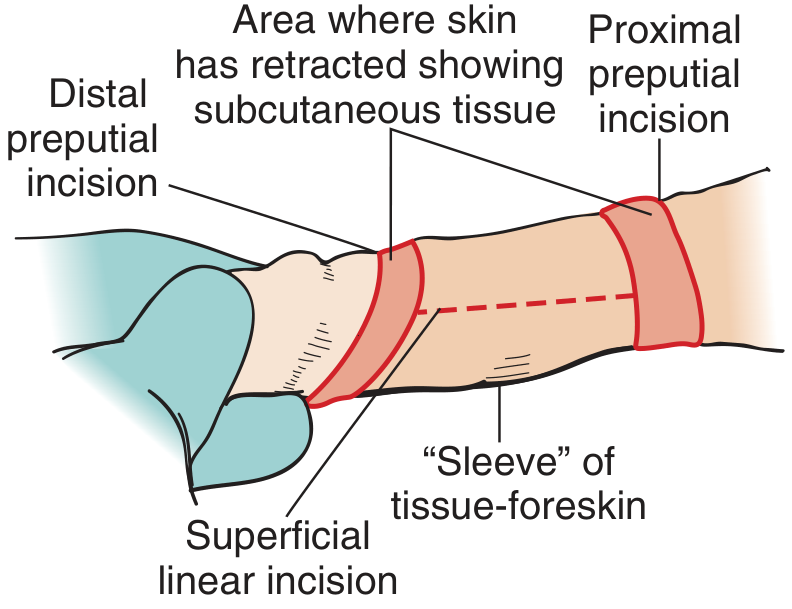
Step 5 - Develop the Plane and Excise the Sleeve
- Place hemostats dorsally on the sleeve for traction
- Make a superficial linear incision along the dorsum of the sleeve with electrocautery
- Separate subcutaneous attachments between Buck's fascia and the prepuce
- Excise the sleeve with electrocautery, tissue scissors, or scalpel
In some cases (especially in younger boys where the two-incision approach is tedious), a dorsal slit through both layers of the prepuce back to the coronal level is made first, and then the two circumferential incisions through each layer are completed separately.
Step 6 - Hemostasis
This step is critical and cannot be rushed. Vessels in adult men are substantially larger than in neonates and cannot be controlled by simple compression.
- Use bipolar cautery to fulgurate all bleeders as the incision is deepened
- If the large dorsal vein is cut, ligate with absorbable sutures
- Monopolar cautery must be avoided in neonates (risk of current spread and penile loss)
- The frenular vessels and ventral tissues require particular attention
Step 7 - Frenuloplasty (if indicated)
If the frenulum is short or tight, the edges of the V can be closed longitudinally (Heineke-Mikulicz principle) - converting a short transverse defect into a longer longitudinal closure - thereby lengthening the frenulum. If frenuloplasty is performed, the proximal incision does not need to follow the V of the retracted frenulum.
The frenulum is reapproximated initially with a "U" stitch.
Step 8 - Skin Closure
After complete hemostasis:
- Place four quadrant sutures at 12, 3, 6, and 9 o'clock positions
- Approximate the outer skin edge to the inner mucosal cuff (1 cm of inner prepuce retained at the corona) with multiple 4-0 or 5-0 interrupted absorbable sutures (chromic gut or equivalent) at 4-7 mm intervals
- On the ventral side, the skin is sewn to the shaft mucosa just proximal to the corona
- Continuous closure with 3-0 or 4-0 absorbable suture is also acceptable, but care must be taken not to strangulate tissue
Leaving ~1 cm of inner preputial skin ("cup") prevents painful erections during healing.
Step 9 - Dressing
Apply two layers of petroleum (Vaseline) gauze (nonadherent) over the suture line circumferentially, overlaid with a light wrap of Kerlix or Kling gauze.
Comparison with Alternative Techniques
| Feature | Sleeve (Two-Incision) | Dorsal Slit + Excision | Clamp Methods (Gomco/Mogen) |
|---|---|---|---|
| Best for | Adults, older boys | Younger boys (if sleeve too difficult) | Neonates only |
| Hemostasis | Direct, precise | Direct | Compression-based |
| Cosmesis | Excellent | Good | Good |
| Clamp | Not used | Not used | Required |
| Frenuloplasty | Easily incorporated | Easily incorporated | Not possible |
Postoperative Management
- Analgesia: 5 days of adequate pain relief (e.g., codeine/acetaminophen combination, NSAIDs, or topical 5% lidocaine ointment)
- Dressing care: Soak in warm water 24-36 hours postoperatively to remove dressing. Replace petroleum gauze daily until 1-week follow-up.
- Erection management: Nocturnal erections risk dehiscence. Amyl nitrite (1 ampule, crush and inhale 1-6 times as needed, may repeat after 5 minutes) can abort erections during the recovery week.
- Sexual activity: Avoid sexual arousal and intercourse for 4 weeks
- When to call: Active bleeding, severe undue pain, signs of infection (fever, erythematous streaking, purulent drainage)
Complications
| Complication | Details / Management |
|---|---|
| Bleeding / Hematoma | Most common immediate complication. Prevent with meticulous hemostasis before closure. Treat with direct pressure, cautery, or suture ligation. |
| Infection | Sterile technique essential intraoperatively. Local wound care; antibiotics if spreading cellulitis. |
| Too much skin removed | Most distressing long-term complaint. Prevented by careful marking BEFORE cutting. If entire penis is "scalped," may require split-thickness skin graft (STSG) or scrotal burying. |
| Too little skin removed | Prevented by correct pre-operative planning. |
| Pain with erections | Prevented by leaving an adequate 1-cm coronal cuff of inner preputial skin. |
| Meatal stenosis | Late complication from ammoniacal meatitis (especially post-neonatal circumcision). |
| Wound dehiscence | Usually from nocturnal erections. Amyl nitrite prophylaxis helps. |
| Stricture / scarring | Rare. |
| Hyperesthesia of the glans | Common initially, usually resolves spontaneously. |
| Urethrocutaneous fistula | Very rare; from inadvertent inclusion of urethra in clamp (clamp methods). |
Key pitfall: Adults requesting circumcision for psychosexual reasons should be carefully evaluated - those most persistent in requesting it are often most dissatisfied post-operatively. - Campbell-Walsh-Wein Urology
Benefits of Male Circumcision (Evidence Base)
- HIV reduction: Multiple well-conducted RCTs show ~50-60% reduction in HIV acquisition in heterosexual men in high-prevalence settings (Auvert et al., 2005; Bailey et al., 2007; Gray et al., 2007). Retrospective US data suggest similar benefit in heterosexual American men.
- Other STIs: Reduces risk of HSV-2, HPV, genital ulcer disease, and some bacterial STIs (Tobian et al., 2014)
- Biological mechanism: The inner foreskin is rich in Langerhans cells and CD4+/CD8+ T cells with poor keratin protection - a large susceptible surface area exposed during intercourse. Circumcision also reduces genital microtears and ulcers.
- MSM: A large meta-analysis (>53,000 MSM) did not show statistically significant HIV protection overall, though a trend exists for predominantly insertive partners. - Campbell-Walsh-Wein, p. 2420
Billing / Coding
- CPT 54161: Circumcision, surgical excision other than clamp device or dorsal slit, other than newborn (applies to sleeve technique in adults/older boys)
Sources: Campbell-Walsh-Wein Urology (3-Volume Set), p. 2419-2420; Hinman's Atlas of Urologic Surgery (4th ed.), Figs. 120.1-120.3; Pfenninger and Fowler's Procedures for Primary Care (3rd ed.), pp. 832-833.
This is a shared conversation. Sign in to Orris to start your own chat.