
Milia skin condition with treatment protocol modern and ayurvedic perspective
I'll read the medical library skill first, then research milia comprehensively from both modern and Ayurvedic perspectives.
Reading File
Now I'll run parallel searches across the medical library, PubMed, and web simultaneously.
Finding Sources
Searching PubMed
milia treatment management
Searching the Web
milia skin condition ayurvedic treatment modern protocol 2024
Good - found rich textbook content. Now let me read the full milia sections from Andrews' and the Dermatology 5e textbooks, and search for Ayurvedic content in parallel.
Reading File
Reading File
Finding Sources
Searching the Web
milia ayurvedic treatment sharavana tiladi kshara Ayurveda skin cyst
Excellent - I have rich content from both textbooks and Ayurvedic sources. Let me fetch the milia image from Andrews' textbook and extract the Ayurvedic article for deeper detail.
Loading Image
Reading Web Page
https://www.flowfacials.com.au/blog/milia-an-ayurvedic-persp…
Reading File
I now have comprehensive information from three major dermatology textbooks plus detailed Ayurvedic sources. Let me also fetch the second clinical image from Fitzpatrick's.
Loading Image
I now have everything needed for a comprehensive answer. Here is the full detailed response:
Milia - Complete Clinical Guide: Modern & Ayurvedic Perspectives
What Are Milia?
Milia (singular: milium) are small, superficial keratinous cysts measuring 1-4 mm in diameter. They appear as firm, white to yellowish, dome-shaped subepidermal papules. The name comes from the Latin word for millet seed, reflecting their characteristic appearance.
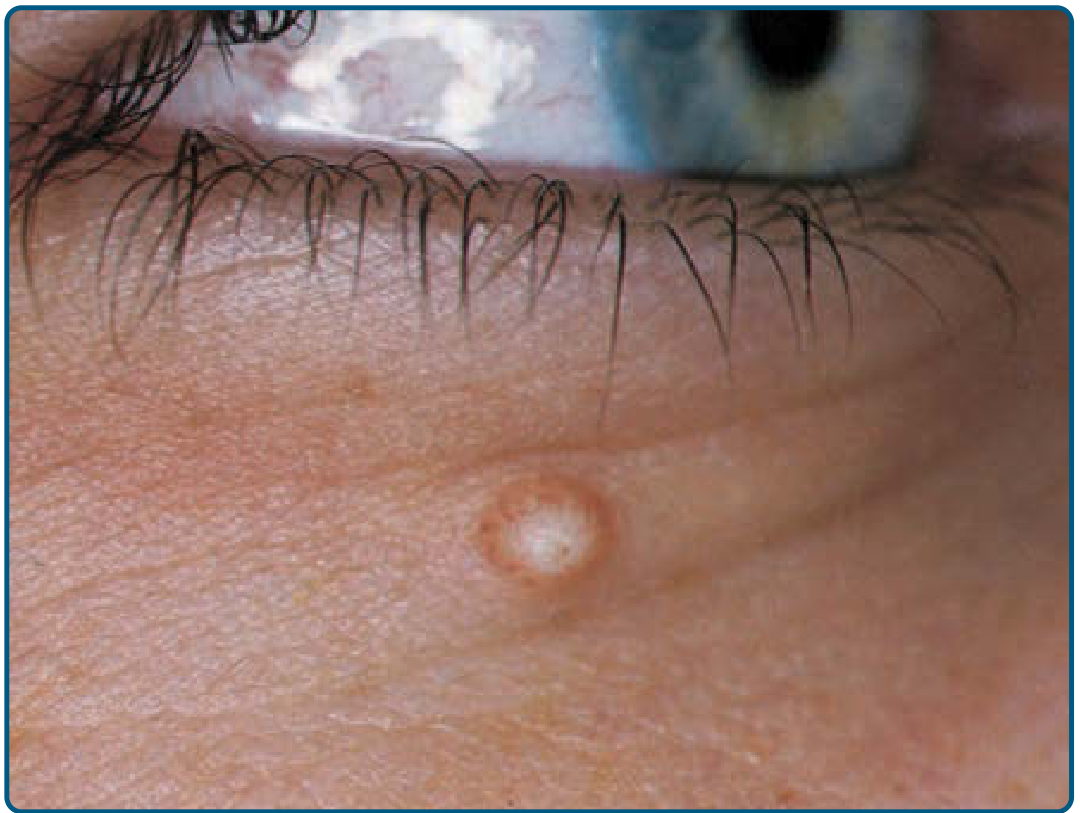
Primary milium - a 3mm, hard, seed-like white papule on the lower eyelid (Fitzpatrick's Dermatology)
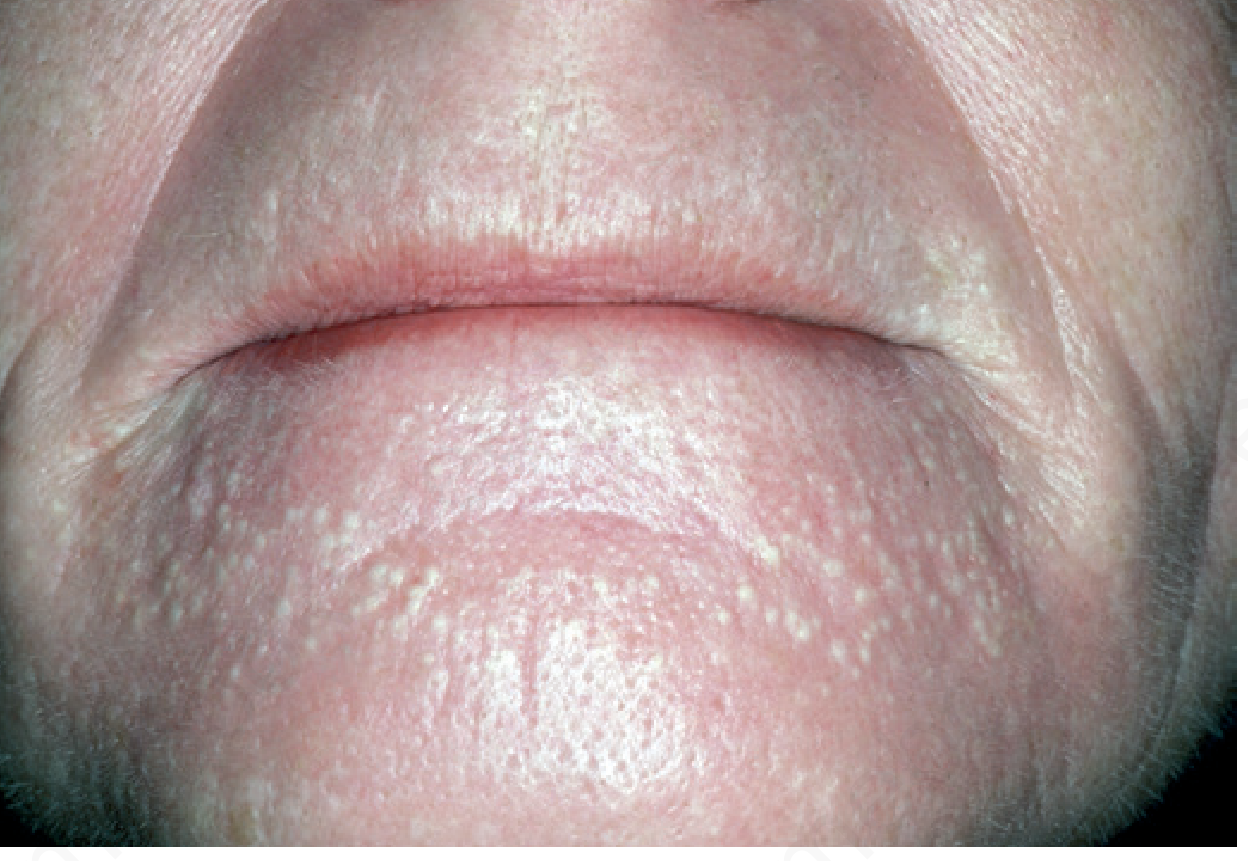
Multiple milia on the lower face (Andrews' Diseases of the Skin, courtesy Steven Binnick, MD)
Pathogenesis
Milia arise from plugging of the pilosebaceous unit or eccrine sweat duct. Histologically, they are minute epidermoid cysts lined by stratified squamous epithelium with a granular layer, and filled with laminated keratin. Bacteria are not usually present (distinguishing them from infected comedones).
-
Primary milia originate from the infundibulum of vellus hair follicles. They are fixed and persistent.
-
Secondary milia arise from eccrine ducts or hair follicles attempting to reepithelialize eroded or blistered epidermis.
-
Fitzpatrick's Dermatology, p. 1843
-
Dermatology 2-Volume Set 5e, p. 2313
Classification and Clinical Types
1. Primary Milia
| Type | Features |
|---|---|
| Congenital/Neonatal | Affects 40-50% of newborns; face, nose, scalp, upper trunk; resolve spontaneously in 4 weeks |
| Epstein Pearls | Milia on the hard palate in neonates; self-resolving |
| Bohn Nodules | Milia on alveolar ridges in neonates |
| Benign primary (children/adults) | Cheeks, eyelids, forehead, genitalia; tend to persist |
| Nasal crease milia | Horizontal row in the nasal crease; may be congenital |
| Multiple eruptive milia | Numerous lesions appearing over weeks to months; head-favoring; can be idiopathic or familial |
| Milia en plaque | Rare - multiple milia within an erythematous edematous plaque; most common postauricular or periorbital; middle-aged women predominate |
2. Secondary Milia
These develop due to damage to the basement membrane or superficial trauma:
-
Blistering diseases: Epidermolysis bullosa, pemphigus, bullous pemphigoid, porphyria cutanea tarda, herpes zoster, Stevens-Johnson syndrome, lupus erythematosus, polymorphic light eruption
-
Cosmetic/procedural trauma: Dermabrasion, chemical peel, ablative laser, skin grafts, radiotherapy
-
Drug-induced: Long-term topical corticosteroids, occlusive moisturizers, cyclosporine, 5-fluorouracil, BRAF inhibitors
-
Syndromic associations: Basal cell nevus syndrome, Rombo syndrome, Bazex syndrome, pachyonychia congenita type 2, Naegeli-Franceschetti-Jadassohn syndrome, oral-facial-digital syndrome type 1
-
Andrews' Diseases of the Skin, p. 782
Differential Diagnosis
| Condition | Distinguishing Feature |
|---|---|
| Closed comedones (whiteheads) | Mix of bacteria, keratin debris, hair fragments; tend to be larger and extractable differently |
| Syringoma | Flesh-coloured papules; histology shows eccrine duct proliferation |
| Sebaceous hyperplasia | Yellowish lobular papules with central dell |
| Fordyce spots | Sebaceous glands on lips/mucosa; not cystic |
| Xanthelasma | Yellow, flat plaques; associated with lipid disorders |
Modern Treatment Protocol
Treatment is not medically necessary as milia are benign. Management is indicated for cosmetic reasons or patient preference.
A. Watchful Waiting
- Neonatal/congenital milia: almost always self-resolve within 4-6 weeks - no treatment required
- Acquired adult milia: may resolve spontaneously over weeks to months but are less predictable
B. At-Home / Topical Measures
| Approach | Agent/Method | Notes |
|---|---|---|
| Topical retinoids (OTC) | Retinol 0.025-0.1% | Speeds cell turnover, reduces new milia formation, softens existing cysts for easier removal |
| Chemical exfoliants | Salicylic acid, glycolic acid, citric acid cleansers | Use 1-2x/week; prevents keratin buildup |
| Mild cleansing | Gentle non-comedogenic cleanser | Daily routine; avoids occlusive products |
| Steam | Facial steam 5-8 minutes | Opens pores, loosens trapped debris |
| Sun protection | Broad-spectrum SPF 30+ | Prevents secondary milia from UV-induced skin damage |
Do not squeeze or pick - this risks infection and scarring.
C. Prescription Topical Therapy
- Tretinoin (0.025-0.05%) - prescription retinoid; first-line for multiple facial milia and milia en plaque; reduces new lesion formation and aids ease of extraction
- Tazarotene - alternative retinoid for refractory cases
D. In-Office Procedures
| Procedure | Technique | Indication |
|---|---|---|
| Manual extraction (gold standard) | Incise overlying epidermis with sterile needle, #11 scalpel or lancet; express contents with comedo extractor | Single or few lesions; most common office procedure |
| Electrodesiccation | Light electrocautery disrupts overlying epidermis | Multiple lesions; effective and quick |
| Laser ablation | CO2 or Er:YAG laser vaporizes cyst | Multiple milia; note - may not be recommended for darker skin tones (Fitzpatrick IV-VI) due to dyspigmentation risk |
| Cryotherapy | Liquid nitrogen application | Freezes and destroys cysts; not recommended near eyes due to delicate periorbital skin; may cause transient blistering/swelling |
| Chemical peel | Glycolic acid or salicylic acid peel | Removes top epidermal layer; suitable for multiple lesions |
| Diathermy | Radiofrequency ablation | Alternative to laser; precise targeting |
E. Systemic Therapy (Special Types)
-
Milia en plaque: Oral minocycline (antibiotic) or prescription tretinoin are the primary options
-
Multiple eruptive milia (drug-induced): Discontinue causative agent (e.g. cyclosporine, topical steroid) if clinically feasible
-
Dermatology 2-Volume Set 5e, p. 2313
-
Fitzpatrick's Dermatology, p. 1844
Ayurvedic Perspective
Dosha Interpretation
In Ayurveda, milia are interpreted through the dosha framework:
- Though milia appear as a Kapha manifestation (congestion, hardened deposits, accumulation), they are primarily rooted in Vata aggravation in the skin.
- Excess Vata brings dryness and cellular irregularity - the skin loses its natural fluidity, cellular renewal slows, and keratin becomes trapped rather than shed.
- This is why purely removing the cyst (mechanical extraction) without addressing underlying Vata imbalance leads to recurrence.
The condition correlates loosely with the concept of Sidhma or Charmadala (sub-epidermal skin cysts resulting from vitiated Kapha-Vata affecting twak/skin dhatu).
Ayurvedic Treatment Protocol
1. Topical (Bahya Chikitsa) Treatments
| Treatment | Ingredients/Method | Action |
|---|---|---|
| Herbal Ubtan (scrub) | Gram flour (besan) + sandalwood powder + rose water paste; apply 2-3x/week, leave 15-20 min, wash with lukewarm water | Gentle exfoliation; unclogs pores; reduces Kapha accumulation |
| Neem + Turmeric paste | Equal parts neem powder + turmeric + rose water; apply daily | Anti-inflammatory (turmeric), antibacterial/purifying (neem); clears dead skin cells |
| Floral hydrosol misting | Rose water, vetiver water, or sandalwood hydrosol | Vata-pacifying deep hydration; mist generously before applying oils |
| Abhyanga (oil massage) | Sesame oil (tila taila) - primary Vata-pacifying oil; applied daily with gentle circular massage | Nourishes skin tissue (twak dhatu), restores cellular movement, pacifies Vata |
| Kansa Wand massage | Bronze kansa wand massage over affected areas | Improves circulation, stimulates lymphatic drainage, promotes cellular renewal |
| Raw honey cleansing | Apply raw honey, leave 5-10 min, rinse | Antibacterial, humectant; draws moisture into dehydrated skin |
Note on oils: Sesame oil is the classical Ayurvedic choice for Vata conditions. Coconut oil may be used for its soothing properties but can be heavy for already congested (Kapha) presentations. Always patch test.
2. Internal (Abhyantara Chikitsa) Treatments
| Treatment | Details | Rationale |
|---|---|---|
| Ghrita (ghee) intake | 1 tsp pure cow's ghee daily on empty stomach or in warm water | Lubricates channels (srotas), nourishes skin from within, pacifies Vata |
| Essential fatty acid foods | Sesame seeds, flaxseeds, walnuts, almonds, coconut | Restores essential fatty acid deficiency underlying Vata-dry skin |
| Juicy seasonal fruits | Pomegranate, amla (Indian gooseberry), papaya, mango | Antioxidant support; digestive fire (agni) improvement |
| Triphala | 1/2 tsp in warm water at night | Gentle bowel regulator; clears ama (toxic buildup); aids cellular renewal |
| Neem capsules/powder | 250-500 mg twice daily | Blood purification (rakta shodhana); reduces skin congestion |
| Amla (Amalaki) | 500 mg daily or fresh juice | Rich in Vitamin C; collagen support; Rasayana for skin |
| Avoid | Processed foods, excessive dairy, cold/dry/raw foods, refined sugar | These aggravate Vata and increase ama formation |
3. Panchakarma Procedures (For Recurrent/Stubborn Cases)
| Procedure | Description |
|---|---|
| Swedana (steam therapy) | Daily steam/sweating therapy; mobilizes stagnant Kapha, opens srotas (channels) |
| Nasya | Medicated nasal drops (anu taila); for facial milia, especially periorbital/nasal crease types |
| Raktamokshana | Blood purification therapy (leech therapy or controlled venesection) in severe cases with blood/Pitta involvement |
| Kshara Karma | Alkaline herbal caustic application (Palasha or Apamarga kshara); used in classical Ayurvedic surgery for cystic lesions; has Bhedana (incision), Pachana (maturation), Shoshana (drying), and Ropana (healing) properties - a minimally invasive option for stubborn individual cysts |
4. Lifestyle Recommendations (Dinacharya)
- Mukhaabhyanga (daily face massage with warm sesame or kumkumadi oil)
- Yoga and pranayama - reduces stress-mediated hormonal imbalance and cortisol effects on skin
- Adequate sleep - peak skin renewal occurs at night
- Avoid synthetic cosmetics and heavy occlusive creams
- Warm, unctuous, easily digestible food - follow ritucharya (seasonal diet adjustments)
Comparing the Two Approaches
| Parameter | Modern Medicine | Ayurveda |
|---|---|---|
| Root Cause | Trapped keratin in follicular/eccrine units | Vata aggravation with secondary Kapha accumulation |
| Mechanism | Failure of desquamation; basement membrane disruption | Inadequate hydration, essential fatty acid deficiency, impaired cellular renewal |
| Primary Treatment | Mechanical extraction, retinoids | Vata-pacifying oils, ubtan scrubs, diet reform |
| Recurrence Prevention | Topical retinoids, sun protection, avoid occlusives | Abhyanga, ghee, EFA-rich diet, lifestyle balance |
| Drug/Procedural Options | Laser, cryotherapy, chemical peels, electrodesiccation | Kshara karma, swedana, Panchakarma |
| Systemic Therapy | Minocycline (milia en plaque) | Triphala, neem, amla, raktashodhak herbs |
| Safety Near Eyes | Cryotherapy/laser cautioned near eyes | Gentle hydrosol/oil massage preferred periorbital |
Key Takeaways
- Milia are benign keratinous cysts - no treatment is medically required, but cosmetic removal is very effective.
- In neonates, watchful waiting is always the first approach.
- For adults, topical tretinoin is the best evidence-based topical option for prevention and facilitation of removal; manual extraction by a dermatologist is the most reliable single-lesion treatment.
- Milia en plaque is a special variant requiring oral minocycline or prescription tretinoin.
- From an Ayurvedic standpoint, addressing Vata imbalance through oils, hydration, essential fatty acids, and internal ghee/herbs tackles the root of recurrence - making it a strong complementary approach for chronic or recurrent cases.
- Both systems agree on avoiding occlusive products, and both emphasize the importance of gentle exfoliation and cellular renewal.
Sources:
- Andrews' Diseases of the Skin - Clinical Dermatology, pp. 781-782
- Dermatology 2-Volume Set 5e (Dermatology 5e), p. 2313
- Fitzpatrick's Dermatology, pp. 1843-1844
- Ayurvedic clinical perspectives from ask-ayurveda.com and Flow Facials Ayurvedic Blog
- Cleveland Clinic - Milia
This is a shared conversation. Sign in to Orris to start your own chat.