
Triple dysmenorrhoea
Reading File
Finding Sources
Finding Sources
Finding Sources
Finding Sources
Searching the Web
"triple dysmenorrhoea" types classification spasmodic congestive membranous
"Triple dysmenorrhoea" isn't a term used in current major gynecology texts (Berek & Novak's, Harrison's) or in current PubMed literature — it doesn't correspond to a standard modern classification. It most likely refers to the older/traditional descriptive classification of dysmenorrhoea into three clinical types, which is still taught in some nursing and general medicine curricula alongside the modern primary/secondary split. Here's a breakdown of both systems so you can see where "triple" fits.
Modern classification (used in current textbooks)
- Primary dysmenorrhoea - painful periods with no underlying pelvic pathology; caused by excess prostaglandin (PGF2α) release from the endometrium driving uterine hypercontractility and ischemia. Onset shortly after menarche, typically once ovulatory cycles establish.
- Secondary dysmenorrhoea - pain due to an identifiable pelvic pathology (endometriosis, adenomyosis, fibroids, pelvic inflammatory disease, cervical stenosis, adhesions). Tends to start later in life and may worsen progressively (Berek & Novak's Gynecology, p. 1401-1422).
The traditional "three types" (spasmodic / congestive / membranous)
This older descriptive classification, common in nursing and earlier gynecology texts, splits dysmenorrhoea by symptom pattern rather than cause:
- Spasmodic dysmenorrhoea - cramping, colicky lower abdominal pain caused by strong uterine muscle contractions/spasm, usually starting just before or with the onset of bleeding. This corresponds most closely to what is now called primary dysmenorrhoea and responds well to NSAIDs and antispasmodics.
- Congestive dysmenorrhoea - a dull, dragging pelvic ache and heaviness/bloating that builds in the days before the period starts (pelvic vascular congestion), often accompanied by breast tenderness, irritability, and fluid retention - overlapping with premenstrual syndrome.
- Membranous dysmenorrhoea - a rare form where large casts of endometrial tissue are shed nearly intact (a "membranous cast" of the uterine lining), causing severe cramping as the cervix dilates to pass the tissue. This is uncommon and can occur with hormonal fluctuations or after certain treatments.
A supporting clinical observation: a controlled trial found that adolescents with spasmodic-type symptoms responded significantly better to naproxen sodium than those with congestive-type symptoms, supporting that these are somewhat distinct clinical patterns.
Important caveat: I could not find "triple dysmenorrhoea" as a defined term in the standard gynecology/internal medicine textbooks (Berek & Novak's, Harrison's, Swanson's Family Medicine) or in PubMed. If you encountered this phrase in a specific course, notes, or exam context, it would help to tell me the source — some regional nursing/paramedical syllabi (e.g., in South Asian nursing curricula) use "triple classification" loosely to mean this three-type (spasmodic/congestive/membranous) breakdown. Let me know if that's the context you meant, or if you had something else in mind (e.g., a triple-drug therapy regimen for dysmenorrhoea), and I can go deeper.
Choriocarcinoma short notes
Finding Sources
Searching PubMed
choriocarcinoma gestational trophoblastic
Reading File
Reading File
Choriocarcinoma - Short Notes
Definition
A highly malignant tumor of trophoblastic epithelium (cytotrophoblast + syncytiotrophoblast) with no chorionic villus formation. It can be gestational (from placental tissue) or, rarely, non-gestational (arising from totipotent germ cells in the gonads - ovary/testis, or as a component of a mixed germ cell tumor).
Origin / Antecedent Pregnancy
Gestational choriocarcinoma can follow any type of pregnancy:
- ~50% follow a complete hydatidiform mole
- ~25% follow a spontaneous abortion
- ~22% follow a normal term pregnancy
- Remainder follow ectopic pregnancy
Epidemiology
Uncommon - roughly 1 in 20,000-30,000 pregnancies in the US (higher incidence reported in parts of Asia and Africa).
Pathogenesis
Malignant transformation of trophoblast leads to loss of the normal villous architecture, uncontrolled proliferation, and early hematogenous invasion of vessels (rather than lymphatic spread).
Morphology
- Gross: soft, hemorrhagic, necrotic uterine mass; viable tumor may be scanty and found only at metastatic sites.
- Microscopy: no chorionic villi (key distinguishing feature from hydatidiform/invasive mole) - instead sheets of anaplastic cuboidal cytotrophoblast intermixed with multinucleate syncytiotrophoblast, numerous (sometimes abnormal) mitoses.
- The tumor invades myometrium, penetrates blood vessels freely, and can extend to serosa/adjacent structures.
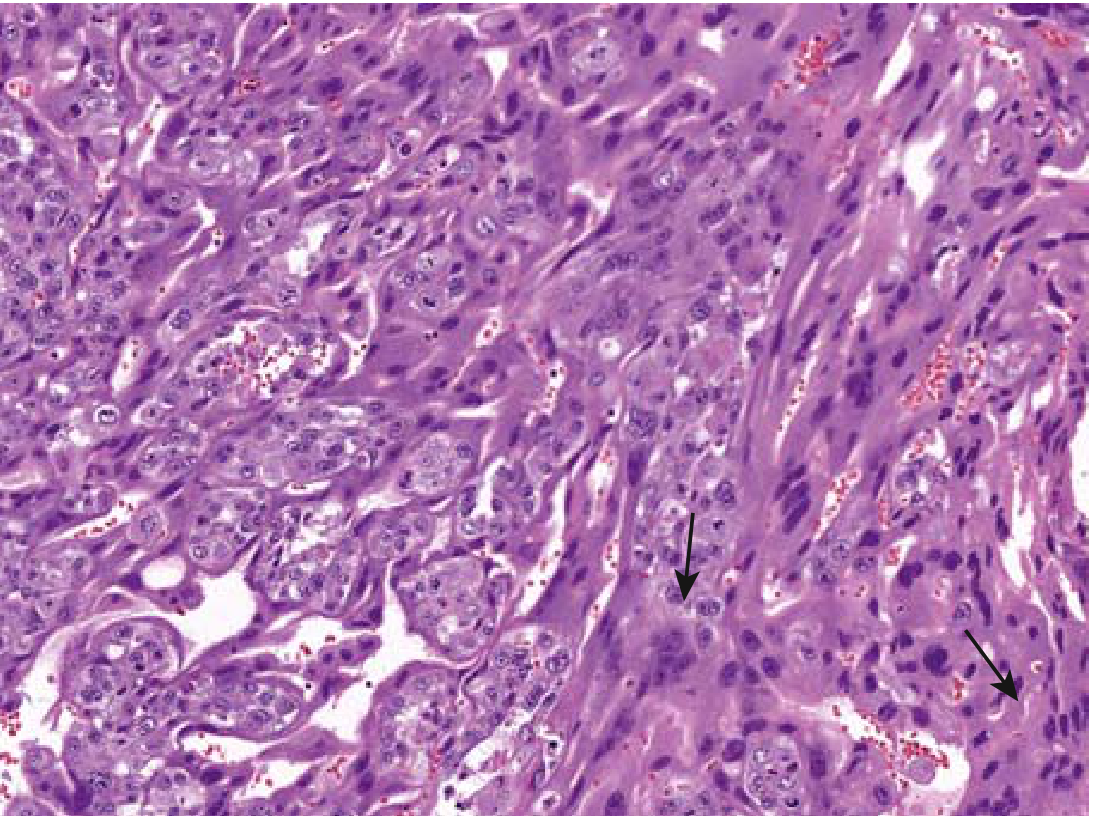
Clinical Features
- Classic presentation: irregular bloody/brownish vaginal discharge with a persistently rising hCG titer, often without significant uterine enlargement.
- By the time of diagnosis, hematogenous metastases are usually already present:
- Lungs ~50%
- Vagina ~30-40%
- Also brain, liver, kidneys
- Lymphatic spread is uncommon.
Investigations
- Serial serum β-hCG (markedly elevated, rises faster than in normal/multiple pregnancy)
- Imaging (CT chest/brain, pelvic ultrasound) to stage metastatic disease
- Histology confirms diagnosis when tissue is available
Treatment and Prognosis
- Gestational choriocarcinoma is exquisitely chemosensitive (methotrexate-based regimens, EMA-CO for high-risk disease) - nearly 100% cure rate, even with distant metastases.
- In sharp contrast, choriocarcinoma arising in the gonads (testis/ovary, non-gestational) responds poorly to chemotherapy - an important exam distinction.
- Patients are followed with serial hCG for 6-12 months post-treatment to detect persistence/recurrence.
Key exam differentiators
| Feature | Hydatidiform mole | Invasive mole | Choriocarcinoma |
|---|---|---|---|
| Villi | Present (hydropic) | Present, invade myometrium | Absent |
| Invasion | No | Myometrial | Myometrial + vascular, widely metastatic |
| Chemosensitivity | N/A | Good | Excellent (gestational) |
Recent evidence (surfaced per literature check)
A few recent systematic reviews add context beyond the core textbook material - useful if you want current data rather than contradicting the pathology above:
- A 2025 meta-analysis on the burden and histopathological patterns of gestational trophoblastic disease in Africa (PMID: 41120163)
- A 2024 systematic review on contraceptive use after gestational trophoblastic disease, relevant to post-treatment hCG surveillance and pregnancy timing (PMID: 38763274)
- A 2024 meta-analysis on how lung metastasis affects treatment and prognosis in gestational trophoblastic neoplasia, refining the "lungs ~50%" figure above with outcome data (PMID: 38282348)
Sources: Robbins, Cotran & Kumar Pathologic Basis of Disease, p. 957; Robbins & Kumar Basic Pathology, p. 704.
This is a shared conversation. Sign in to Orris to start your own chat.