
50 years old male known diabetic came with complaints of pricking type of pain over left thigh left calf region more during flexing left leg for past 1 month
Reading File
This is a clinical case: 50-year-old diabetic male with pricking pain over left thigh and left calf, worse on flexion, for 1 month. The key differentials include peripheral arterial disease (claudication), diabetic peripheral neuropathy, lumbar radiculopathy (L2-L4), or deep vein thrombosis. Let me search the medical library for all relevant topics in parallel.
Searching sources...
Finding Sources
Finding Sources
Finding Sources
Good results. Now let me pull deeper content on PAD claudication, diabetic neuropathy features, and radiculopathy differentials - with ABI and workup details.
Reading File
Reading File
Finding Sources
Excellent content gathered. Let me now get the pseudoclaudication vs claudication differential and DVT/neuropathy workup details.
Reading File
Finding Sources
Searching Images
peripheral arterial disease ABI ankle brachial index measurement
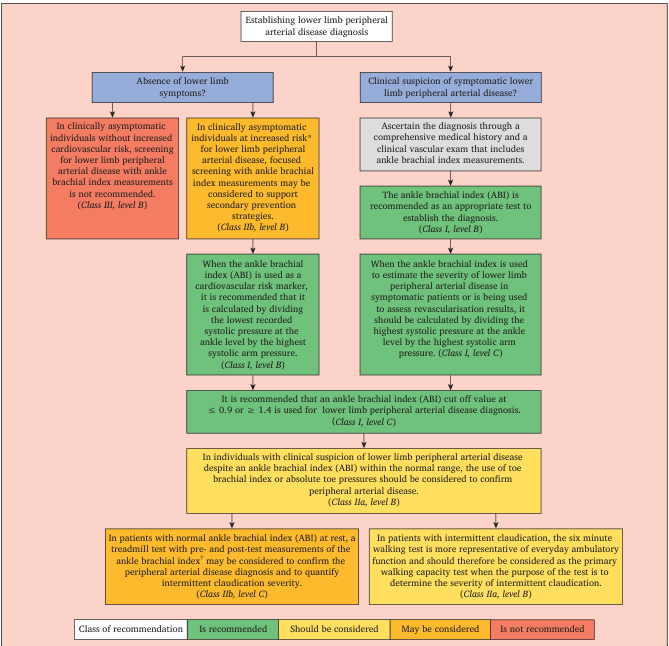
Summary : This flowchart presents the recommended diagnostic pathway for establishing lower limb peripheral arterial disease (PAD) using ankle brachial index (ABI) measurements, based on patient symptoms and cardiovascular risk, with colour-coded recommendations for clinical practice.
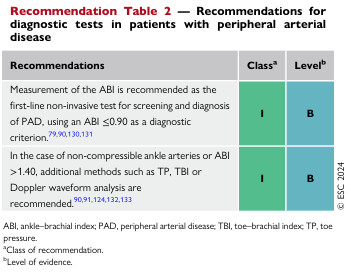
Recommendation Table 2 — Recommendations for diagnostic tests in patients with peripheral arterial disease
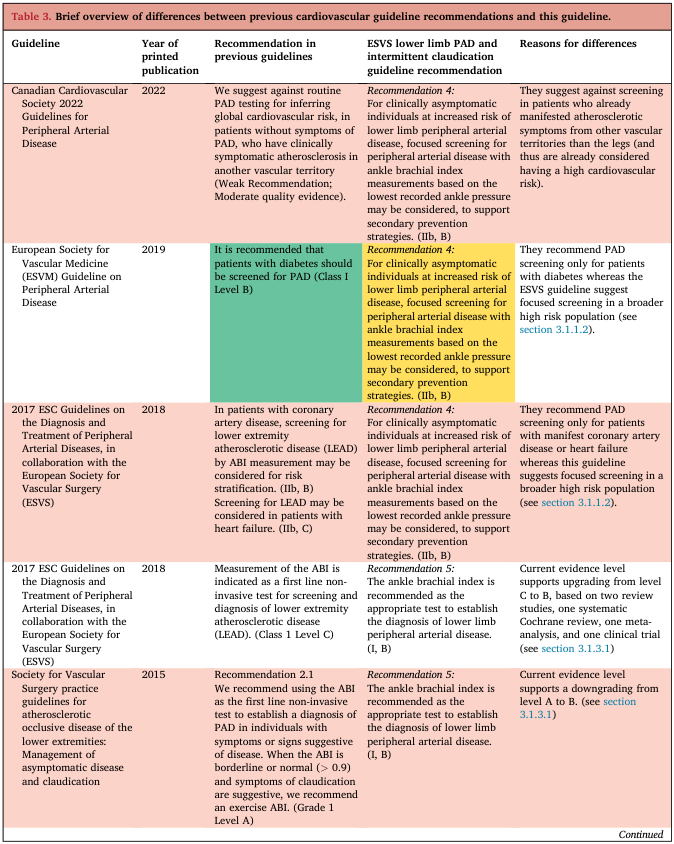
Table 3. Brief overview of differences between previous cardiovascular guideline recommendations and this guideline.
I now have excellent material. Let me also grab info on the key distinguishing feature in this case (pain on flexing the leg) and the workup/management approach for PAD in diabetics.
Reading File
Finding Sources
I have all the information needed for a comprehensive response. Let me now compile a thorough clinical analysis.
Clinical Analysis: 50-Year-Old Diabetic Male with Left Thigh and Calf Pain on Flexion (1 month)
Key Clinical Features to Analyze
| Feature | Significance |
|---|---|
| Age 50, male, known diabetic | High cardiovascular and neuropathic risk |
| Pricking/stabbing pain quality | Neuropathic character |
| Left thigh + left calf distribution | Unilateral - vascular vs. radicular vs. neuropathic |
| Worse on flexing the left leg | Critical localizing clue |
| Duration 1 month | Subacute onset |
Differential Diagnosis (Most Likely to Less Likely)
1. NEUROGENIC CLAUDICATION (Spinal Stenosis / Lumbar Radiculopathy) - HIGH PROBABILITY
The key feature here is pain worsening on leg flexion, which is the classic behavior of neurogenic/pseudoclaudication. According to Furst & Hurst's The Heart (15e):
"Neurogenic claudication usually presents with an abnormal sensation or sense of touch that is elicited with ambulation that usually requires a specific posture for relief (hips flexed)... These symptoms may also develop with prolonged standing."
- Lumbar radiculopathy (L2-L3-L4 nerve roots) produces pain radiating from the thigh to the calf
- Hip extension worsens upper lumbar radiculopathy; straight leg raising aggravates lumbosacral roots
- Pain worsening with flexion of the leg may indicate sciatic nerve stretch or piriformis syndrome (flexion + adduction of hip worsens piriformis-related pain)
- Bradley & Daroff's Neurology in Clinical Practice notes: "Pain confined to the leg is usually caused by a leg disorder, although neuropathic pain from lumbar spine disease can radiate down the leg without back pain in a minority of patients"
Differentiating features from vascular claudication:
| Vascular Claudication | Neurogenic/Pseudoclaudication | |
|---|---|---|
| Character | Cramping, tightness | Tingling, pricking, weakness |
| Relief | Rapid with stopping | Requires sitting/position change |
| Standing alone causes pain | No | Yes |
| Walking distance | Reproducible | Variable |
| Pulses | Absent/reduced | Normal |
(Goldman-Cecil Medicine, Table 65-4)
2. PERIPHERAL ARTERIAL DISEASE (PAD) with Intermittent Claudication - MODERATE PROBABILITY
In a 50-year-old diabetic, PAD is a serious consideration. Per Goldman-Cecil Medicine:
"Claudication is defined as exertional discomfort, relieved with rest, in specific muscle groups at risk for ischemia during exercise. Symptoms usually begin one segment below the level of arterial narrowing. Femoral and popliteal artery obstructions typically cause symptoms in the calf and foot muscles."
- Thigh + calf involvement together suggests iliac vessel level disease (aortoiliac disease classically causes buttock-hip-thigh-calf pain)
- Diabetes markedly accelerates PAD and makes it more distal
- However, vascular claudication is NOT typically worsened by leg flexion - it is worsened by walking/exercise and rapidly relieved by rest (within 1-2 minutes)
- Only 10% of PAD patients have classic claudication; 50% are asymptomatic
Physical exam pointers for PAD:
- Reduced or absent peripheral pulses
- Pallor on elevation, rubor on dependency
- Diminished hair growth, shiny skin, nail changes
- ABI < 0.9 is diagnostic (note: may be falsely elevated in diabetics due to arterial calcification)
3. DIABETIC PERIPHERAL NEUROPATHY - MODERATE PROBABILITY
From Tintinalli's Emergency Medicine:
"Diabetic neuropathy: Symmetric numbness and burning or stabbing pain in lower extremities; allodynia may occur."
- Diabetic neuropathy is typically symmetric and bilateral (stocking distribution)
- A unilateral presentation is atypical for symmetric polyneuropathy
- However, diabetic amyotrophy (Bruns-Garland syndrome / diabetic lumbosacral radiculoplexus neuropathy) can be unilateral - presents with severe pain and weakness in one thigh
- Schwartz's Surgery notes the three components of diabetic lower limb disease: peripheral neuropathy (motor, sensory, autonomic), peripheral vascular disease, and immunodeficiency
4. DEEP VEIN THROMBOSIS (DVT) - LOWER PROBABILITY
- Can cause left thigh and calf pain
- Typically described as heaviness, fullness, or aching - not "pricking"
- Venous claudication: tightness/bursting pain in groin-thigh, slow relief with leg elevation
- DVT risk is elevated in diabetics
5. MERALGIA PARESTHETICA (Lateral Femoral Cutaneous Nerve Entrapment)
- Pricking/burning over the lateral thigh
- Unilateral - diabetes and obesity are risk factors
- Worsened by hip extension, standing
- No calf involvement (only thigh)
Recommended Workup
History to Elicit
- Is the pain at rest or only on exertion/walking?
- Does rest relieve it? How quickly?
- Is there associated back pain, weakness?
- Does standing alone reproduce the pain?
- Any numbness, tingling in a dermatomal pattern?
- History of DVT, varicose veins?
- Duration and control of diabetes (HbA1c)
Physical Examination
- Vascular exam: Peripheral pulses (femoral, popliteal, dorsalis pedis, posterior tibial), capillary refill, skin changes
- Neurological exam: Power in L2-S1 myotomes, sensation in dermatomes, knee and ankle reflexes
- Provocative tests:
- Straight leg raise (SLR) - positive in lumbosacral radiculopathy
- Femoral stretch test - L2-L3-L4 radiculopathy
- FABER/FADIR for hip joint pathology
- Tinel's at the inguinal ligament (meralgia paresthetica)
Investigations
| Investigation | Rationale |
|---|---|
| ABI (Ankle-Brachial Index) | Screen for PAD; <0.9 = PAD; >1.3 in diabetics = arterial calcification (unreliable) |
| Duplex Doppler USG of lower limb arteries | Map arterial occlusion/stenosis |
| Duplex USG for DVT | Exclude deep vein thrombosis |
| MRI Lumbosacral Spine | Disc herniation, spinal stenosis, nerve root compression |
| Nerve Conduction Study (NCS) / EMG | Quantify neuropathy, locate lesion |
| FBS, HbA1c, Lipid profile | Assess diabetic control and cardiovascular risk |
| CBC, ESR, CRP | Exclude inflammatory/infective causes |
Management Principles (Once Diagnosis Confirmed)
If PAD:
- Risk factor control: Tight glycemic control (HbA1c < 7%), BP < 130/80, LDL < 70 mg/dL
- Antiplatelet: Aspirin 75-100 mg/day or Clopidogrel 75 mg/day
- Statin therapy: High-intensity (Atorvastatin 40-80 mg)
- Supervised exercise therapy: First-line for claudication
- Cilostazol (phosphodiesterase inhibitor): Improves walking distance in claudication
- Revascularization: Endovascular or surgical if lifestyle-limiting claudication
If Lumbar Radiculopathy/Spinal Stenosis:
- Physiotherapy and posture correction
- NSAIDs / Gabapentin / Pregabalin for neuropathic pain
- Epidural steroid injections if conservative management fails
- Surgical decompression if severe neurological deficit
If Diabetic Neuropathy:
- Optimize glycemic control - most important
- Pregabalin 75-300 mg BD (first-line for diabetic neuropathic pain)
- Duloxetine 60 mg/day (SNR inhibitor, also first-line)
- Amitriptyline / Gabapentin as alternatives
- Topical capsaicin or lidocaine patches
Clinical Bottom Line
This presentation has features pointing most strongly toward lumbar radiculopathy or neurogenic claudication, given:
- Pricking (neuropathic) pain quality
- Worsening with leg flexion - not typical of vascular claudication
- Unilateral distribution - atypical for symmetric diabetic polyneuropathy
- Both thigh AND calf involved - suggests L4-L5 or femoral nerve territory
PAD must be actively excluded given his diabetes and age by doing an ABI and vascular exam. DVT should be ruled out urgently with Doppler ultrasound. An MRI of the lumbosacral spine and nerve conduction study would help confirm the neurogenic etiology.
Urgent red flags to exclude: rest pain, pallor, pulselessness, paralysis, paresthesia (acute limb ischemia), saddle anesthesia, bladder/bowel dysfunction (cauda equina).
Sources: Goldman-Cecil Medicine (9780323930345), Fuster & Hurst's The Heart 15e, Bradley & Daroff's Neurology in Clinical Practice, Schwartz's Principles of Surgery, Tintinalli's Emergency Medicine
This is a shared conversation. Sign in to Orris to start your own chat.