
Chronic heart disease
chronic heart disease etiology pathophysiology classification diagnosis management
Catheter Ablation of Ventricular Arrhythmias
Page 117
chronic heart disease cardiac imaging echocardiography
Hugging Face pmc clinical VQA raw
Page 0
Chronic Heart Disease
Classification
| Category | Examples |
|---|---|
| Coronary Artery Disease (CAD) | Stable angina, prior MI, ischemic cardiomyopathy |
| Heart Failure | HFrEF (EF <40%), HFmrEF (EF 40–49%), HFpEF (EF ≥50%) |
| Cardiomyopathies | Dilated, hypertrophic, restrictive, arrhythmogenic |
| Valvular Heart Disease | Aortic stenosis/regurgitation, mitral stenosis/regurgitation |
| Congenital Heart Disease | Corrected or uncorrected structural defects persisting into adulthood |
| Hypertensive Heart Disease | Concentric LV hypertrophy, diastolic dysfunction |
Etiology & Risk Factors
- Hypertension (most common cause of HFpEF)
- Dyslipidemia, diabetes mellitus, obesity
- Smoking, sedentary lifestyle
- Alcohol use (dilated cardiomyopathy)
- Age, male sex, family history
- Prior MI or cardiac surgery
- Chagas disease (endemic cause in Latin America — a parasitic cardiomyopathy)
- Autoimmune disorders (lupus, sarcoidosis, amyloidosis)
- Chemotherapy-related cardiotoxicity (anthracyclines, trastuzumab)
Pathophysiology
- Cardiac injury (ischemia, pressure/volume overload, toxin)
- Neurohormonal activation: RAAS and sympathetic nervous system upregulation
- Ventricular remodeling: hypertrophy, dilation, fibrosis
- Reduced cardiac output → systemic and pulmonary congestion
- End-organ damage: renal impairment, hepatic congestion, skeletal muscle wasting
Clinical Presentation
| NYHA Class | Description |
|---|---|
| I | No symptoms with ordinary activity |
| II | Mild symptoms, slight limitation with ordinary activity |
| III | Marked limitation; comfortable only at rest |
| IV | Symptoms at rest; unable to perform any activity without discomfort |
- Dyspnea on exertion, orthopnea, PND
- Peripheral edema, elevated JVP
- S3 gallop (volume overload), S4 (stiff ventricle)
- Displaced apical impulse (dilated cardiomyopathy)
- Murmurs (valvular disease)
- Pulmonary crackles
Diagnosis
Initial Workup
- ECG: LVH, prior MI (Q waves), arrhythmias, LBBB
- Chest X-ray: Cardiomegaly, pulmonary vascular congestion, pleural effusions, Kerley B lines
- BNP / NT-proBNP: Elevated in HF (BNP >100 pg/mL suggestive; NT-proBNP >300 pg/mL)
- Labs: CBC, BMP (eGFR, electrolytes), LFTs, TSH, fasting lipids, HbA1c, iron studies
Imaging Modalities
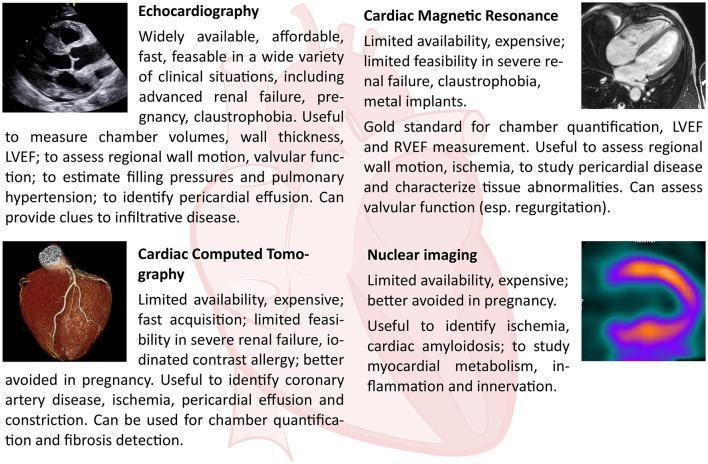
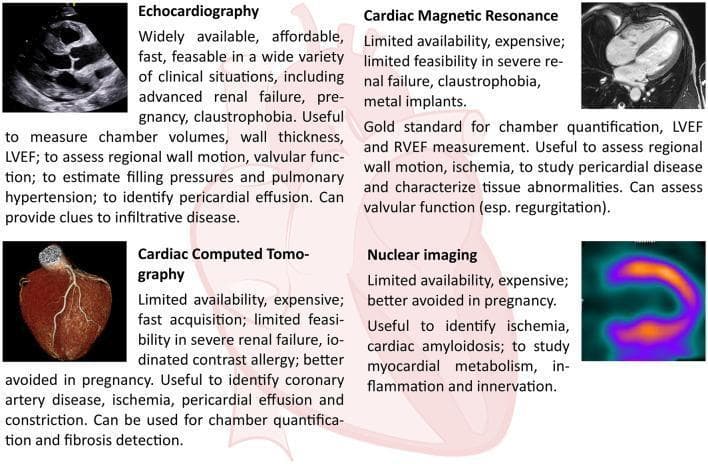
| Modality | Key Role |
|---|---|
| Echocardiography | First-line: EF, wall motion, valvular function, diastolic parameters |
| Cardiac MRI (CMR) | Gold standard for chamber quantification, tissue characterization (fibrosis, edema, amyloid) |
| Cardiac CT (CCT) | Coronary anatomy, rule out CAD, pericardial disease |
| Nuclear (SPECT/PET) | Myocardial perfusion/ischemia, viability, amyloidosis (PYP scan) |
| Coronary angiography | Definitive assessment of CAD; pre-revascularization |
Management
Non-Pharmacological
- Salt restriction (<2 g/day in HF), fluid restriction if severe
- Daily weight monitoring
- Cardiac rehabilitation (Class I for stable CAD and HFrEF)
- Exercise training, smoking cessation, alcohol abstinence
Pharmacological — HFrEF (EF <40%)
| Drug Class | Examples | Benefit |
|---|---|---|
| ACEi/ARB/ARNi | Ramipril, Losartan, Sacubitril-Valsartan | Reduce mortality ~20%; ARNi preferred over ACEi |
| Beta-blockers | Carvedilol, Metoprolol succinate, Bisoprolol | Reduce mortality ~35% |
| MRA (mineralocorticoid antagonist) | Spironolactone, Eplerenone | Reduce mortality in NYHA II–IV |
| SGLT2 inhibitors | Dapagliflozin, Empagliflozin | Reduce HF hospitalization and CV death regardless of diabetes status |
- Diuretics (furosemide, torsemide): Symptom relief, not mortality benefit
- Ivabradine: For HR ≥70 bpm on max beta-blocker; reduces hospitalization
- Hydralazine + nitrates: In ACEi/ARB-intolerant patients (especially African Americans — A-HeFT trial)
- Digoxin: Reduces hospitalization; no mortality benefit
Pharmacological — HFpEF (EF ≥50%)
- SGLT2 inhibitors (Empagliflozin — EMPEROR-Preserved; Dapagliflozin — DELIVER): Reduce HF hospitalization
- Control of comorbidities: BP, AF, obesity, diabetes
- Diuretics for congestion
- MRAs (Spironolactone — TOPCAT trial: modest benefit in Americas subgroup)
Device Therapy
| Device | Indication |
|---|---|
| ICD | Primary/secondary prevention; EF ≤35%, NYHA II–III, on GDMT ≥3 months |
| CRT (biventricular pacing) | EF ≤35%, LBBB, QRS ≥150 ms, NYHA II–IV |
| CRT-D | Combination of CRT + ICD |
| Wearable cardioverter-defibrillator | Newly diagnosed cardiomyopathy awaiting GDMT response |
| LVAD | Bridge to transplant or destination therapy in advanced HF |
Revascularization
- PCI or CABG indicated for ischemic cardiomyopathy with viable myocardium and suitable anatomy
- CABG preferred over PCI for multivessel CAD with diabetes (FREEDOM trial)
Complications
- Arrhythmias: AF (most common), ventricular tachycardia/fibrillation — major cause of sudden cardiac death
- Thromboembolic events: LV thrombus, stroke (especially with AF)
- Cardiorenal syndrome: Worsening renal function secondary to low output or venous congestion
- Cardiac cachexia: Muscle wasting in advanced HF
- Sudden cardiac death (SCD): Risk highest in HFrEF with EF ≤35%
- Pulmonary hypertension: Secondary to chronic left-sided failure
Prognosis
- 1-year mortality after hospitalization for HF: ~20–30%
- 5-year mortality: ~50% overall (worse than many cancers)
- Predictors of poor prognosis: Low EF, elevated BNP, renal dysfunction, hyponatremia, NYHA IV, frequent hospitalizations
- MAGGIC risk score and SHFM (Seattle Heart Failure Model) are validated tools for estimating prognosis
Monitoring
- BNP/NT-proBNP: Serial measurement guides therapy titration
- Echocardiography: Repeat at 3–6 months after initiating GDMT, then annually
- Remote hemodynamic monitoring (CardioMEMS PA pressure sensor): Reduces HF hospitalizations in NYHA III patients (CHAMPION trial)
- Renal function and electrolytes: Monitor closely on ACEi/ARB, MRA, SGLT2i
Create a poster
A detailed medical educational poster about Chronic Heart Disease. Include sections on: types (CAD, Heart Failure HFrEF/HFpEF, Cardiomyopathy, Valvular Disease), risk factors (hypertension, diabetes, smoking, obesity), key symptoms (dyspnea, edema, fatigue, chest pain), NYHA classification table, diagnosis (ECG, Echo, BNP, Chest X-ray), treatment pillars (ACEi/ARNi, Beta-blockers, MRA, SGLT2 inhibitors, devices like ICD/CRT), and complications (arrhythmias, sudden cardiac death, cardiorenal syndrome). Include a central anatomical illustration of the human heart with labeled affected structures. Professional clinical style with a clean layout, medical blue and red color scheme, suitable for a hospital or cardiology department.
Medical educational poster about Chronic Heart Disease for a cardiology department. Features a central human heart illustration with labeled parts. Organized sections covering: risk factors, symptoms, NYHA classification, diagnosis methods, treatment options including medications and devices, and complications. Clean professional medical design with blue and red color scheme.
- Use an AI image generator such as Adobe Firefly, Canva AI, or DALL·E via ChatGPT with this prompt:
"A professional medical educational poster about Chronic Heart Disease for a cardiology department. Central human heart illustration with labeled structures. Organized sections covering: types (CAD, HFrEF, HFpEF, Cardiomyopathy, Valvular Disease), risk factors (hypertension, diabetes, smoking, obesity), key symptoms (dyspnea, edema, fatigue), NYHA classification (Class I–IV), diagnosis methods (ECG, Echo, BNP, Chest X-ray), treatment (ACEi/ARNi, Beta-blockers, MRA, SGLT2 inhibitors, ICD/CRT devices), and complications (arrhythmias, SCD, cardiorenal syndrome). Clean clinical layout, blue and red color scheme, suitable for a hospital setting."
- Use Canva (canva.com) with their medical poster templates and fill in the content from the comprehensive overview I provided above.