
Parotid gland under the following heading
I need to clarify what you mean by "under the following heading" — it seems the headings or structure you want weren't included in your message.
Asking for Preferences
What headings/structure would you like the parotid gland content organized under?
I'll proceed with the standard anatomical headings for the parotid gland. Let me first read the medical library skill, then search for parotid gland content in parallel.
Reading File
Finding Sources
Searching the Web
parotid gland anatomy location relations duct nerve supply
Excellent sources found. Now let me read the comprehensive sections from Gray's Anatomy for Students and K.J. Lee's Essential Otolaryngology in parallel:
Reading File
Reading File
Reading File
Now let me read more from Gray's (innervation, lymphatics, histology sections) and get the rest of K.J. Lee's content:
Reading File
Reading File
Now let me fetch the key anatomical image from Gray's and also get the Gray's block 5 parotid content (second entry):
Loading Image
Reading File
I now have comprehensive information from multiple textbooks. Let me compile a thorough, well-structured answer.
Parotid Gland
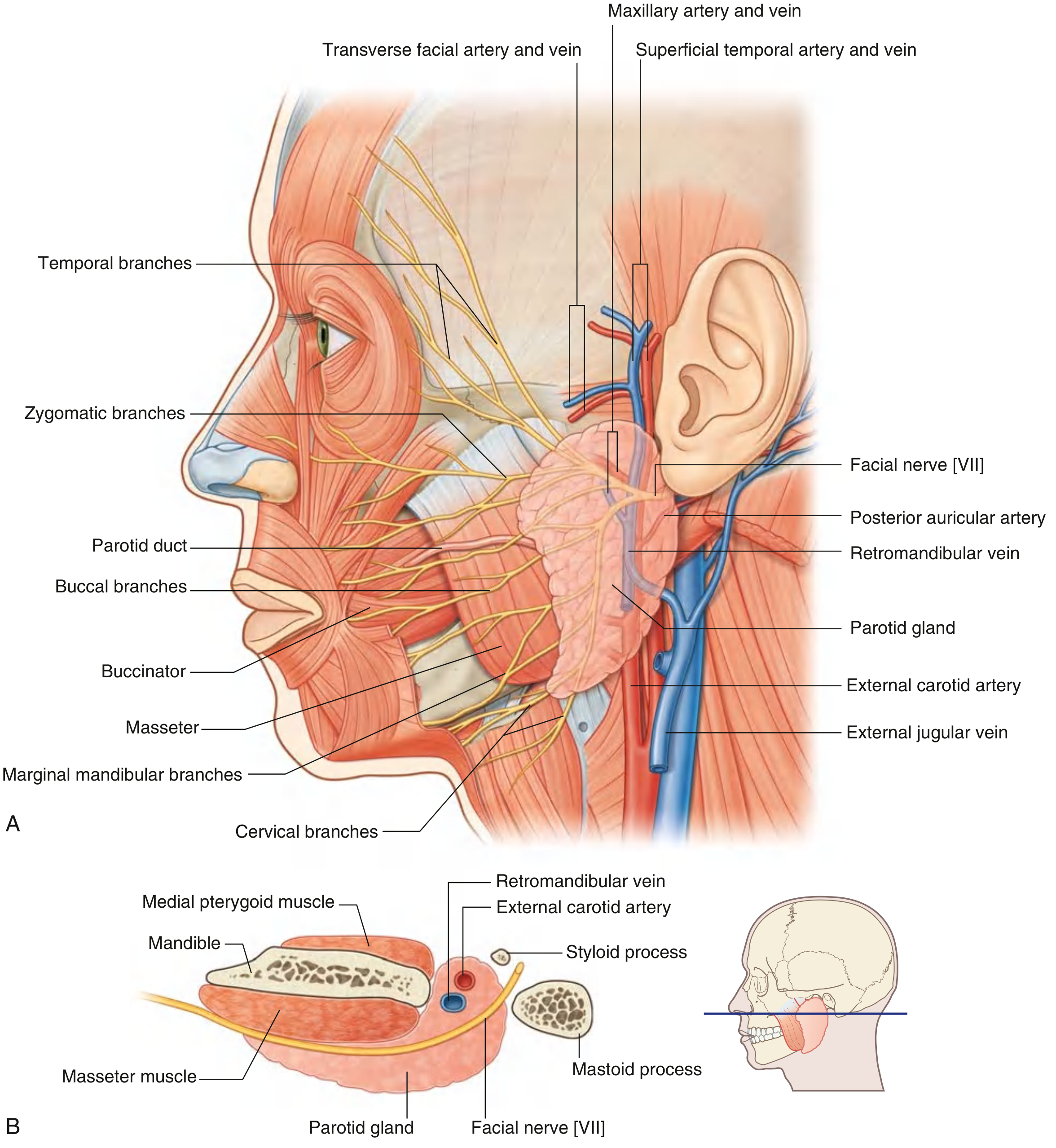
1. Overview
The parotid gland is the largest of the three pairs of major salivary glands (parotid, submandibular, sublingual). It produces serous (watery) saliva rich in salivary amylase, which lubricates food, initiates oral digestion, and facilitates swallowing. The gland is enclosed within the split investing layer of the deep cervical fascia (parotidomasseteric fascia), which attaches to the root of the zygoma superiorly and to the mastoid process posteriorly; the thick inferior portion separates the parotid from the submandibular gland.
2. Location & Borders
The parotid gland occupies a shallow, triangular-shaped trench on the lateral face, situated entirely outside the oral cavity:
| Border | Structure |
|---|---|
| Anterior | Masseter muscle and ramus of the mandible |
| Posterior | Tragal cartilage and sternocleidomastoid muscle |
| Superior | Zygomatic arch |
| Inferior | Tail of parotid (between ramus of mandible and SCM, overlying the digastric muscle) |
| Deep | Pretyloid compartment of the parapharyngeal space |
The gland extends anteriorly over the masseter muscle and inferiorly over the posterior belly of the digastric muscle. It is palpable anterior and inferior to the lower half of the ear on the lateral cheek.
3. Lobes
The gland is divided into a superficial lobe (80% of the parenchyma) and a deep lobe by the facial nerve [CN VII] and the posterior facial (retromandibular) vein:
- The superficial lobe lies lateral to the facial nerve, overlying the lateral surface of the masseter.
- The deep lobe lies medial to the facial nerve, situated between the mastoid process and the mandibular ramus; it can extend into the pretyloid compartment of the parapharyngeal space.
4. Parotid (Stensen's) Duct
- Leaves the anterior edge of the gland midway between the zygomatic arch and the corner of the mouth.
- Traverses across the external surface of the masseter muscle in a transverse direction.
- At the anterior border of the masseter, turns medially into the buccal fat pad.
- Pierces the buccinator muscle and opens into the oral cavity opposite the crown of the second upper molar tooth.
An accessory parotid gland may be present superiorly related to the duct.
5. Structures Passing Through the Gland
Three major neurovascular structures traverse the substance of the parotid — from superficial to deep:
- Facial nerve [CN VII] — most superficial
- Retromandibular vein — intermediate
- External carotid artery — deepest
6. Facial Nerve Relations
The facial nerve exits the skull through the stylomastoid foramen (posterolateral to the styloid process, anteromedial to the mastoid process) and enters the parotid, where it branches into the pes anserinus:
- Upper divisions: temporofacial branches
- Lower divisions: cervicofacial branches
Five terminal groups emerge from the gland's borders:
| Branch | Exit border |
|---|---|
| Temporal | Upper border |
| Zygomatic | Upper border |
| Buccal | Anterior border |
| Marginal mandibular | Lower border |
| Cervical | Lower border |
Surgical landmark identification of the facial nerve:
- Tympanomastoid suture line
- Posterior belly of digastric muscle (marks depth of nerve)
- Tragal pointer (nerve lies ~1 cm deep and inferior to the tip of the tragal cartilage)
- Retrograde identification from a peripheral branch
The facial nerve is more superficial in children under 2 years of age.
7. Blood Supply
Arterial
The parotid receives arterial supply from branches traversing its substance:
- The external carotid artery courses medially within the gland, dividing into:
- Maxillary artery (passes horizontally, deep to the mandible)
- Superficial temporal artery (exits the upper border, gives off the transverse facial artery)
- Posterior auricular artery — given off before the terminal division
Venous
- The superficial temporal vein and maxillary vein join within the gland to form the retromandibular vein.
- The retromandibular vein divides below the gland into:
- Posterior branch → joins external jugular vein
- Anterior branch → joins facial vein → drains to internal jugular vein (lies just deep to the marginal mandibular branch of CN VII)
8. Nerve Supply (Innervation)
Secretomotor (Parasympathetic) Pathway
The pathway follows the lesser petrosal nerve route:
- Glossopharyngeal nerve [CN IX] — provides preganglionic parasympathetic fibers via the tympanic branch (Jacobson's nerve) → tympanic plexus → lesser petrosal nerve
- Preganglionic fibers synapse in the otic ganglion (just inferior to foramen ovale)
- Postganglionic fibers travel with the auriculotemporal nerve (branch of V3) → parotid gland
Sympathetic
- Superior cervical ganglion supplies postganglionic sympathetic fibers (vasoconstrictor to the gland)
Sensory
- Auriculotemporal nerve (branch of mandibular nerve [V3], exits skull via foramen ovale) provides sensory innervation to the gland and the external ear; it also carries the secretomotor fibers described above.
Skin overlying the gland
- The great auricular nerve (C2, C3) — divides into anterior and posterior branches — provides cutaneous innervation. The posterior branch can sometimes be preserved during parotidectomy to reduce auricular numbness.
9. Lymphatic Drainage
The parotid gland has an intraparotid group of lymph nodes and drains to the superficial and deep cervical lymph nodes. Intraparotid nodes may be involved in metastases from skin cancers of the scalp and face.
10. Histology
The parotid is a pure serous gland — its acini contain serous cells producing protein-rich (amylase-containing), watery secretions. This is in contrast to the submandibular (mixed) and sublingual (predominantly mucous) glands. Because the secretion is watery, calculi (stones) are rare in the parotid duct (compared to the submandibular duct).
11. Clinical Correlations
Frey's Syndrome (Auriculotemporal Syndrome)
Following injury to the auriculotemporal nerve (e.g., during incision for suppurative parotitis or parotidectomy), aberrant regeneration of parasympathetic secretomotor fibers into cutaneous sweat gland sympathetics results in gustatory sweating — the parotid region becomes red, hot, and sweaty during meals.
Parotid Stones (Sialolithiasis)
Less common than in the submandibular gland due to the watery nature of parotid secretion. Stones typically form at the main duct confluence or in the main duct. Patients experience intense pain on salivation. Treatment depends on stone location: anterior duct stones → sphincterotomy via buccal mucosa; posterior stones → total gland excision may be required.
Parotid Tumors
- ~90% of all salivary gland neoplasms occur in the parotid.
- ~75% are benign; ~25% are malignant or of variable aggressiveness.
- Most common benign tumor: Pleomorphic adenoma (mixed tumor)
- Common benign tumor: Adenolymphoma (Warthin's tumor)
- Malignant tumors (in descending frequency): mucoepidermoid carcinoma, adenoid cystic carcinoma, adenocarcinoma, epidermoid carcinoma, undifferentiated carcinoma, carcinoma ex pleomorphic adenoma.
- Deep lobe tumors can extend into the pretyloid compartment of the parapharyngeal space, presenting as a parapharyngeal mass.
- Facial nerve sacrifice risk must be considered in all parotid surgery; damage to upper branches prevents voluntary eyelid closure (risk of corneal injury); lower branch damage causes facial asymmetry.
Acute Suppurative Parotitis
Infection ascends from the oral cavity. Presents as brawny, oedematous swelling over the parotid region with signs of inflammation. Fluctuation is a late sign due to the strong overlying fascia.
Mumps Parotitis
Nonsuppurative viral (paramyxovirus) inflammation. May begin unilaterally but becomes bilateral within days, associated with constitutional symptoms and other manifestations (orchitis, pancreatitis).
Parotidectomy
- The facial nerve divides the gland into superficial and deep lobes and is the critical surgical landmark.
- Superficial parotidectomy (preserving CN VII) is the procedure of choice for most benign tumors.
- Total parotidectomy may involve the external carotid artery medially.
Sources: Gray's Anatomy for Students (9780323934237); K.J. Lee's Essential Otolaryngology (9781260122237); S. Das Manual on Clinical Surgery, 13th Ed. (9788190568104); Bailey & Love's Short Practice of Surgery, 28th Ed. (9780367548117)

IMG-20260515-WA0002.jpg
Answer 1st question which asking about parotid with full details and of 20 marks content
The question asks: Parotid gland under following headings (20 marks):
- (a) Presenting parts — 5
- (b) Capsule — 2
- (c) Structures passing through gland — 5
- (d) Nerve supply — 5
- (e) Applied — 3
Let me pull comprehensive textbook content for all these headings in parallel.
Finding Sources
Finding Sources
Finding Sources
Reading File
Reading File
Reading File
Reading File
Reading File
Reading File
Now let me get the S. Das clinical surgery parotid section and fetch the key diagram:
Reading File
Loading Image
I now have all the material needed for a complete 20-mark answer. Here it is:
Q1. Parotid Gland — 20 Marks
(a) Presenting Parts — [5 Marks]
The parotid gland is the largest of the three paired major salivary glands. It is a pure serous gland of ectodermal origin, secreting watery saliva rich in salivary amylase.
Location & Shape
The gland is irregular in shape and is situated below, behind, and slightly in front of the lobule of the ear. It is wedged in a recess between:
- the ramus of the mandible anteriorly
- the base of the skull superiorly
- the mastoid process posteriorly
It occupies the parotid region (retromandibular fossa). It extends:
- Superiorly up to the zygomatic arch
- Inferiorly down to the lower border of the mandible
- Anteriorly halfway across the masseter muscle (and over the sternocleidomastoid posteriorly)
Lobes
The facial nerve and retromandibular vein divide the gland into:
- Superficial lobe — 80% of the parenchyma; lies lateral to the facial nerve, overlying the masseter
- Deep (retromandibular) lobe — lies medial to the facial nerve, between the mastoid process and mandibular ramus; can extend into the pretyloid compartment of the parapharyngeal space
Parotid (Stensen's) Duct
- Leaves the anterior border of the gland midway between the zygomatic arch and the corner of the mouth
- Runs horizontally over the masseter muscle
- At the anterior border of masseter, turns medially through the buccal fat pad
- Pierces the buccinator muscle
- Opens into the oral cavity at the level of the crown of the 2nd upper molar tooth
Accessory parotid gland: Present in 21–61% of individuals; lies on the masseter anterior to Stensen's duct, with a secondary duct joining the main duct.
Lymphatics
The parotid has a unique feature — lymph nodes are embedded within its substance (both intra- and periparotid nodes), because the lymphatic system developed after the gland was partially encapsulated. Most nodes lie in the superficial lobe.
(b) Capsule — [2 Marks]
Formation
The parotid unlike other salivary glands, undergoes delayed encapsulation. This is the key embryological fact. The gland is ectodermal in origin (develops from the 6th week of gestation) but acquires its capsule after the facial nerve, vessels, and lymph nodes have been embedded within it. Because of this late encapsulation:
- Vessels, nerves (facial nerve), and lymph nodes are all trapped within the capsule/substance of the gland
- The capsule merges with the investing (deep cervical) fascia — from the zygoma and temporomandibular joint above, over the masseter anteriorly, to the styloid base, posterior belly of digastric, and sternocleidomastoid posteroinferiorly
Structure
- The capsule is formed from the split investing layer of the deep cervical fascia (parotidomasseteric fascia)
- Superficial part is thin and closely related to the tragal and conchal cartilage
- Deep part is thick and attaches to the mastoid process
- The thick inferior portion separates the parotid from the submandibular gland
- The superficial musculoaponeurotic system (SMAS) is closely approximated to this capsule
Clinical Importance of Capsule
Because the fascial capsule is strong and unyielding, fluctuation is a late sign in parotid abscess. Pus tracks along fascial planes (deep, or through thin superficial part) rather than pointing early.
(c) Structures Passing Through the Gland — [5 Marks]
Three major neurovascular structures traverse the substance of the parotid gland, arranged from superficial to deep (mnemonic: "Some Researchers Earn" — Superficial to deep: facial nerve [Seventh], Retromandibular vein, External carotid artery):
1. Facial Nerve [CN VII] — Most Superficial
- Exits the skull through the stylomastoid foramen (posterolateral to styloid process, anteromedial to mastoid process)
- Enters the posteromedial surface of the parotid and forms the pes anserinus (goose's foot)
- Divides into upper (temporofacial) and lower (cervicofacial) divisions within the gland
- Five terminal branch groups emerge from the gland's borders:
| Branch | Exit Border |
|---|---|
| Temporal | Upper border |
| Zygomatic | Upper/anterior border |
| Buccal | Anterior border |
| Marginal mandibular | Lower border |
| Cervical | Lower border |
The facial nerve divides the parotid into superficial (80%) and deep (20%) lobes — Patey's faciovenous plane.
2. Retromandibular Vein — Intermediate
- Formed within the gland by the union of the superficial temporal vein and maxillary vein
- Passes inferiorly through the gland
- Divides just below the inferior border into:
- Posterior branch → joins the posterior auricular vein → external jugular vein
- Anterior branch → joins the facial vein → internal jugular vein (lies just deep to the marginal mandibular branch of CN VII — surgical landmark)
3. External Carotid Artery — Deepest
- Enters via the inferior border of the gland
- Gives off the posterior auricular artery within the gland
- Divides into its two terminal branches near the lower border of the ear:
- Maxillary artery — passes horizontally, deep to the mandible
- Superficial temporal artery — exits the superior border after giving off the transverse facial artery
Other Structures (Embedded or Related)
- Intraparotid lymph nodes — embedded within the substance (particularly in superficial lobe)
- Great auricular nerve (C2, C3) — runs on the surface of the gland
- Auriculotemporal nerve — enters and carries secretomotor fibers to the gland
(d) Nerve Supply — [5 Marks]
The parotid gland receives secretomotor (parasympathetic), sympathetic, and sensory innervation.
1. Secretomotor (Parasympathetic) — The Main Pathway
Inferior salivatory nucleus (medulla)
↓
Glossopharyngeal nerve [CN IX]
↓
Jacobson's nerve (tympanic branch of CN IX)
→ enters via inferior tympanic canaliculus
↓
Tympanic plexus (in middle ear)
↓
Lesser petrosal nerve (preganglionic parasympathetic)
→ exits skull via foramen ovale (or a small canal near it)
↓
Otic ganglion (just below foramen ovale, medial to mandibular nerve V3)
→ SYNAPSE here
↓
Postganglionic secretomotor fibers
→ join the AURICULOTEMPORAL NERVE (branch of V3)
↓
Parotid gland
Effect: Acetylcholine (ACh) stimulates acinar secretion, ductal transport, vasodilation, and contraction of myoepithelial cells → profuse watery saliva
Pharmacology: Atropine blocks ACh at muscarinic receptors → reduces salivation
2. Sympathetic
- Postganglionic fibers from the superior cervical ganglion travel along the external carotid artery plexus → parotid gland
- Effect: vasoconstriction; produces small amounts of thick, mucoid saliva
3. Sensory
- Auriculotemporal nerve (branch of V3, mandibular division of trigeminal [CN V])
- Exits skull through foramen ovale
- Provides sensory innervation to the parotid gland and the skin overlying it, the external acoustic meatus, and the auricle
4. Skin Overlying the Gland
- Great auricular nerve (C2, C3) — anterior and posterior branches; provides cutaneous sensation over the parotid region and lower part of the auricle
(e) Applied Anatomy — [3 Marks]
1. Frey's Syndrome (Auriculotemporal/Gustatory Sweating Syndrome)
- Cause: Injury to the auriculotemporal nerve (during parotidectomy, incision for parotid abscess, or trauma)
- Mechanism: Aberrant regeneration — the cut parasympathetic secretomotor fibers regrow and reinnervate the cutaneous sweat glands (which are normally supplied by sympathetic fibers but also respond to ACh)
- Features: At mealtimes, the skin over the parotid region becomes red, hot, and sweaty (gustatory sweating and flushing); cutaneous hyperaesthesia may also be present
- Treatment: Botulinum toxin injection into the affected skin (blocks ACh release)
2. Parotid Tumors
- ~90% of salivary gland neoplasms occur in the parotid gland
- ~75% benign, ~25% malignant or intermediate
- Most common benign: Pleomorphic adenoma (mixed tumor) — slow-growing, painless, at the angle of the jaw; sudden rapid growth + pain = malignant transformation
- Adenolymphoma (Warthin's tumor) — arises in the lower pole of the parotid at the level of the lower border of mandible, slightly lower than pleomorphic adenoma; bilateral in 10%
- Malignant tumors (decreasing order): Mucoepidermoid carcinoma > Adenoid cystic carcinoma > Adenocarcinoma > Epidermoid carcinoma > Undifferentiated carcinoma
- Facial nerve involvement: Any parotid tumor must be assessed for its relation to CN VII branches. Damage to upper branches → inability to close eye (risk of corneal ulceration); damage to lower branches → facial asymmetry
3. Parotidectomy & Facial Nerve Landmarks
Landmarks to identify the facial nerve trunk surgically:
- Tragal pointer — facial nerve lies ~1 cm deep and inferior to the tip of the tragal cartilage
- Tympanomastoid suture line — nerve exits just anterior to this
- Posterior belly of digastric — marks the depth of the nerve
- Retrograde identification — tracing peripheral branches back to the trunk
Late encapsulation means the capsule fuses widely with the investing fascia from temporalis (above) to digastric (below) and from buccinator (anteriorly) to mastoid (posteriorly) — making parotidectomy a challenging dissection.
4. Acute Parotitis & Abscess
- Infection ascends from the oral cavity (poor oral hygiene, dehydration)
- Features: brawny, oedematous swelling with signs of inflammation
- Fluctuation is a late sign due to the thick, unyielding fascial capsule
- Parotid calculi (stones): less common than submandibular stones (parotid secretion is watery); cause pain on salivation — lemon juice test reproduces symptoms
Sources: Gray's Anatomy for Students (9780323934237) | Bailey & Love's Short Practice of Surgery, 28th Ed. (9780367548117) | K.J. Lee's Essential Otolaryngology (9781260122237) | S. Das Manual on Clinical Surgery, 13th Ed. (9788190568104)
IMG-20260515-WA0002.jpg
I want answers of all of these questions with detail and proper content with gray anatomy and bdc content plzz make it marks oriented
Searching all three topics in parallel now.
Finding Sources
Finding Sources
Finding Sources
Finding Sources
Finding Sources
Reading File
Finding Sources
Finding Sources
Reading File
Reading File
Reading File
Finding Sources
Reading File
Reading File
Loading Image
Reading File
Loading Image
Loading Image
Reading File
I now have all the material. Here are all four complete, marks-oriented answers:
QUESTION PAPER — COMPLETE ANSWERS
Q1. Parotid Gland under Following Headings — (20 Marks)
(Already answered in the previous session — reproduced in full below for completeness)
(a) Presenting Parts — [5 Marks]
The parotid gland is the largest of the three paired major salivary glands. It is a pure serous gland of ectodermal origin, secreting watery saliva rich in salivary amylase.
Location
It lies below, behind, and slightly in front of the lobule of the ear, wedged in a recess between:
- Ramus of mandible — anteriorly
- Mastoid process + base of skull — posteriorly/superiorly
- Sternocleidomastoid muscle — posteroinferiorly
It extends:
- Superiorly → up to the zygomatic arch
- Inferiorly → down to lower border of mandible (tail of the parotid)
- Anteriorly → halfway across the masseter muscle
Lobes
The facial nerve + retromandibular vein divide the gland into:
| Lobe | Proportion | Position |
|---|---|---|
| Superficial | 80% | Lateral to facial nerve, over masseter |
| Deep (retromandibular) | 20% | Medial to facial nerve, between mastoid and mandibular ramus |
Parotid (Stensen's) Duct
- Leaves the anterior border of gland midway between zygomatic arch and corner of mouth
- Runs horizontally across the masseter
- At anterior border of masseter turns medially through buccal fat pad
- Pierces buccinator muscle
- Opens in oral cavity opposite crown of 2nd upper molar tooth
Accessory parotid gland: Present in 21–61% of individuals; found on the masseter anterior to Stensen's duct, with its own accessory duct joining Stensen's duct.
Lymphatics
Unique feature — lymph nodes are embedded within the gland substance (intraparotid and periparotid nodes), because lymphatic system developed after partial encapsulation. Lymph drains to deep cervical nodes.
(b) Capsule — [2 Marks]
Formation (Key Point: Delayed Encapsulation)
Unlike other glands, the parotid undergoes delayed encapsulation. It develops from the 6th week of gestation (ectodermal origin) but acquires its capsule after the facial nerve, vessels, and lymph nodes are already embedded within it.
Structure
- The capsule is formed from the split investing layer of deep cervical fascia (parotidomasseteric fascia)
- Superficial layer — thin, closely related to tragal and conchal cartilage
- Deep layer — thick, attaches to the mastoid process
- The capsule merges with the investing fascia from:
- Zygoma + TMJ → above
- Masseter → anteriorly
- Styloid base + posterior belly of digastric + SCM → posteroinferiorly
- The thick inferior portion separates the parotid from the submandibular gland
- SMAS (superficial musculoaponeurotic system) is closely applied to this capsule
Clinical Importance
- Because of late encapsulation, vessels, nerves, and lymph nodes are trapped inside the gland
- The thick unyielding capsule means fluctuation is a late sign in parotid abscess
- Fascia fuses widely (temporalis above → digastric below; buccinator anteriorly → mastoid posteriorly) — making parotidectomy a difficult dissection
(c) Structures Passing Through the Gland — [5 Marks]
Three major neurovascular structures traverse the gland from superficial to deep (mnemonic: "Some Reason Exists" → facial nerve [Seventh], Retromandibular vein, External carotid artery):
1. Facial Nerve [CN VII] — Most Superficial
- Exits skull through the stylomastoid foramen (posterolateral to styloid process, anteromedial to mastoid process)
- Enters the posteromedial aspect of the parotid, forming the pes anserinus (goose's foot)
- Divides into upper (temporofacial) and lower (cervicofacial) trunks
- Five terminal branch groups emerge from the gland's borders:
| Branch | Exit Border | Supplies |
|---|---|---|
| Temporal | Upper | Frontalis, orbicularis oculi (upper) |
| Zygomatic | Upper/Anterior | Orbicularis oculi (lower), zygomaticus |
| Buccal | Anterior | Buccinator, orbicularis oris |
| Marginal mandibular | Lower | Depressors of lower lip |
| Cervical | Lower | Platysma |
The facial nerve divides the gland into superficial (80%) and deep (20%) lobes — clinically known as Patey's faciovenous plane
2. Retromandibular Vein — Intermediate Depth
- Formed within the gland by union of superficial temporal vein + maxillary vein
- Passes inferiorly through the gland
- Divides below the inferior border into:
- Posterior branch → joins posterior auricular vein → external jugular vein
- Anterior branch → joins facial vein → internal jugular vein (lies just deep to marginal mandibular branch of CN VII — surgical landmark)
3. External Carotid Artery — Deepest
- Enters via the inferior border of the gland
- Gives off posterior auricular artery within the gland
- Divides into two terminal branches near the lower border of the ear:
- Maxillary artery → passes horizontally, deep to the mandible
- Superficial temporal artery → exits the upper border, giving off the transverse facial artery
Other Structures Embedded/Related
- Intraparotid lymph nodes — embedded (mostly in superficial lobe)
- Great auricular nerve (C2, C3) — on surface of gland
- Auriculotemporal nerve — enters the gland, carrying secretomotor fibers
(d) Nerve Supply — [5 Marks]
The parotid receives secretomotor (parasympathetic), sympathetic, and sensory innervation.
1. Secretomotor (Parasympathetic) — The Main and Most Important Pathway
Inferior salivatory nucleus (medulla oblongata)
↓
Glossopharyngeal nerve [CN IX]
↓
Jacobson's nerve (tympanic branch of CN IX)
→ enters via inferior tympanic canaliculus
↓
Tympanic plexus (in middle ear, on promontory)
↓
Lesser petrosal nerve (preganglionic parasympathetic fibers)
→ exits skull via foramen ovale (or small canaliculus nearby)
↓
OTIC GANGLION (just below foramen ovale, medial to V3)
→ SYNAPSE here
↓
Postganglionic secretomotor fibers
→ join the AURICULOTEMPORAL NERVE (branch of V3)
↓
PAROTID GLAND
Effect: Acetylcholine (ACh) stimulates:
- Acinar secretion and ductal transport
- Vasodilation of the gland
- Contraction of myoepithelial cells → Profuse watery saliva
Pharmacology: Atropine blocks muscarinic ACh receptors → reduces salivation (used preoperatively)
2. Sympathetic Innervation
- Postganglionic fibers from the superior cervical ganglion
- Travel along the external carotid artery plexus → parotid gland
- Effect: Vasoconstriction; produces small amounts of thick mucoid saliva
3. Sensory Innervation
- Auriculotemporal nerve (branch of V3 — mandibular nerve)
- Exits skull via foramen ovale
- Provides sensory innervation to:
- The parotid gland itself
- Skin overlying the gland
- External acoustic meatus and auricle
4. Cutaneous (Skin over Gland)
- Great auricular nerve (C2, C3) — anterior and posterior branches
(e) Applied Anatomy — [3 Marks]
1. Frey's Syndrome (Auriculotemporal / Gustatory Sweating Syndrome)
- Cause: Injury to the auriculotemporal nerve during parotidectomy or incision for parotid abscess
- Mechanism: Aberrant regeneration — cut parasympathetic secretomotor fibers regrow and mistakenly reinnervate sweat glands of overlying skin (which are also cholinergic)
- Features: During meals — skin over parotid region becomes red, hot, and sweaty (gustatory sweating and flushing); cutaneous hyperaesthesia may be present
- Treatment: Botulinum toxin injection into affected skin
2. Parotid Tumors
- ~90% of salivary gland neoplasms occur in the parotid gland
- ~75% benign, ~25% malignant/intermediate
- Most common benign: Pleomorphic adenoma — slow-growing, painless, at angle of jaw; sudden rapid growth + pain = malignant transformation
- Adenolymphoma (Warthin's tumor) — arises at lower pole of parotid near lower border of mandible; bilateral in 10%; occurs in older male smokers
- Malignant tumors (decreasing order): Mucoepidermoid carcinoma > Adenoid cystic carcinoma > Adenocarcinoma > Epidermoid carcinoma > Undifferentiated carcinoma
- Facial nerve involvement → upper branch damage → inability to close eye (corneal ulceration); lower branch damage → facial asymmetry
3. Parotidectomy — Facial Nerve Landmarks
Surgical landmarks to identify the facial nerve trunk:
- Tragal pointer — nerve lies ~1 cm deep and inferior to tip of tragal cartilage
- Tympanomastoid suture line — nerve exits just anterior to this
- Posterior belly of digastric — marks depth of nerve
- Retrograde dissection — tracing peripheral branches back to main trunk
Q2. Venous Drainage of the Face — Short Note (5 Marks)
Introduction
The face is drained primarily by the facial vein, supplemented by the transverse facial vein and deep connections to intracranial venous sinuses.
Facial Vein — Main Drainage
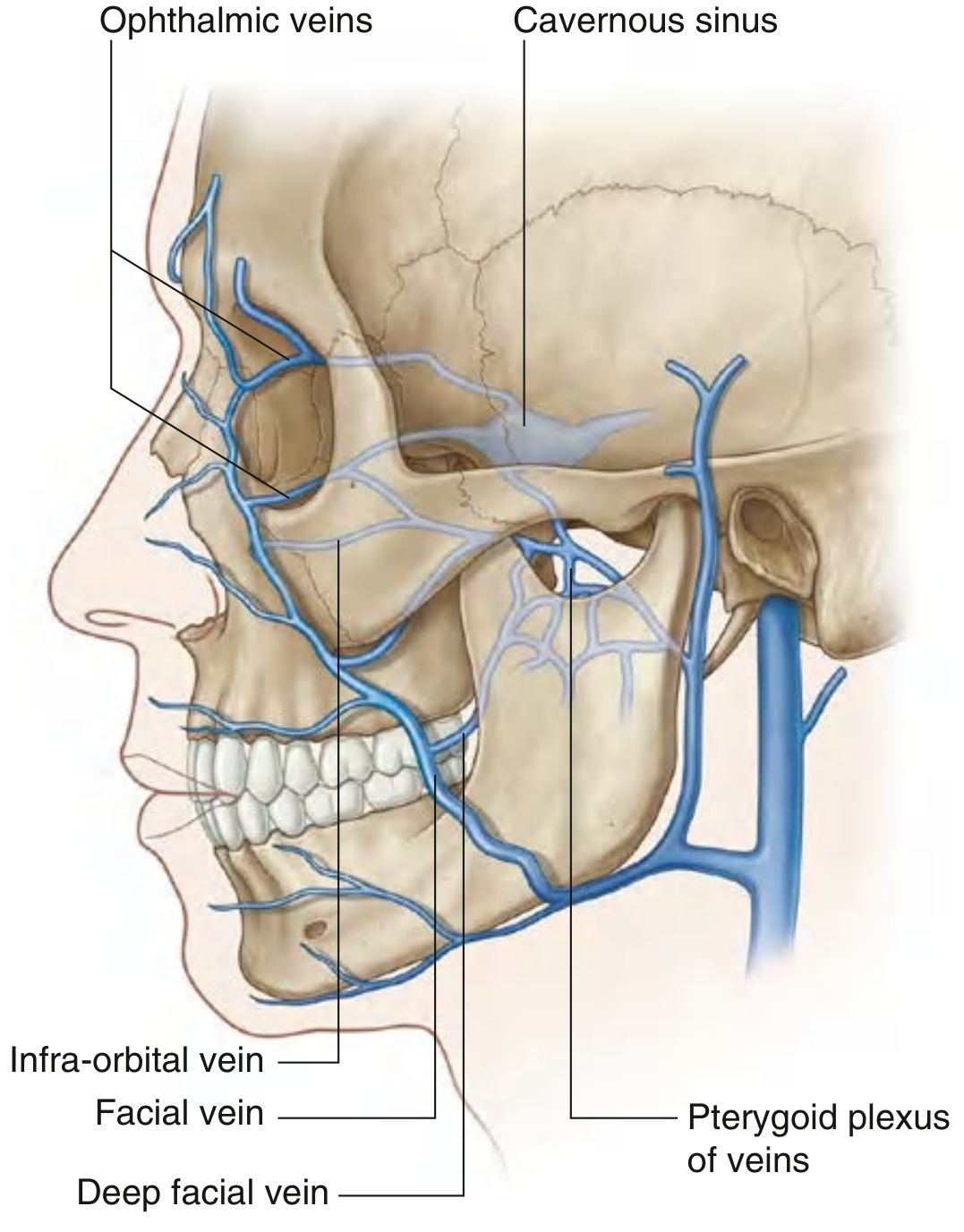
Formation
- Formed near the medial corner of the orbit by union of the supratrochlear vein and supra-orbital vein → forming the angular vein, which becomes the facial vein as it descends inferiorly
Course
- Descends across the face just posterior to the facial artery
- Runs obliquely (lateral to medial) downward across the cheek
- At the inferior border of the mandible, it parts from the facial artery
- Passes superficial to the submandibular gland
- Drains into the internal jugular vein
Tributaries
Throughout its course, the facial vein receives tributaries from:
- Superior and inferior palpebral veins (eyelids)
- External nasal vein (dorsum of nose)
- Superior and inferior labial veins (lips)
- Deep facial vein (from pterygoid plexus)
- Buccal vein (cheek)
- Mental vein (chin)
- Infraorbital vein
Transverse Facial Vein
- Accompanies the transverse facial artery across the face
- Drains into the superficial temporal vein within the substance of the parotid gland
Deep (Intracranial) Venous Connections — Clinically Important
The facial vein communicates with deeper venous channels at multiple levels:
| Level | Connection | Route to Cavernous Sinus |
|---|---|---|
| Medial corner of orbit | Ophthalmic veins (superior + inferior) | → Superior ophthalmic vein → Cavernous sinus |
| Cheek | Infraorbital vein | → Pterygoid plexus → Cavernous sinus |
| Deep face | Deep facial vein | → Pterygoid plexus → Cavernous sinus (via emissary veins) |
Critical Feature: No Valves The facial vein and all venous channels in the head have NO valves — blood can move in any direction.
Danger Area / Danger Triangle of the Face
- The area bounded by the upper lip and nose (angles of the mouth to the root of the nose)
- Infections in this area (boils, furuncles) can spread intracranially via:
- Facial vein → Angular vein → Ophthalmic veins → Cavernous sinus
- Can lead to cavernous sinus thrombosis — a life-threatening complication with features of: proptosis, chemosis, ophthalmoplegia, headache, fever
- Clinical rule: Never squeeze a boil in the "danger area" of the face
Applied
- Cavernous sinus thrombosis: Spread of infection from the face (especially nasolabial region) via the valveless facial/ophthalmic veins
- Facial vein used in surgery: The facial vein serves as a landmark for identifying the marginal mandibular branch of the facial nerve (nerve lies superficial to the vessels at the mandibular border)
Q3. Carotid Triangle — Short Note (5 Marks)
Definition
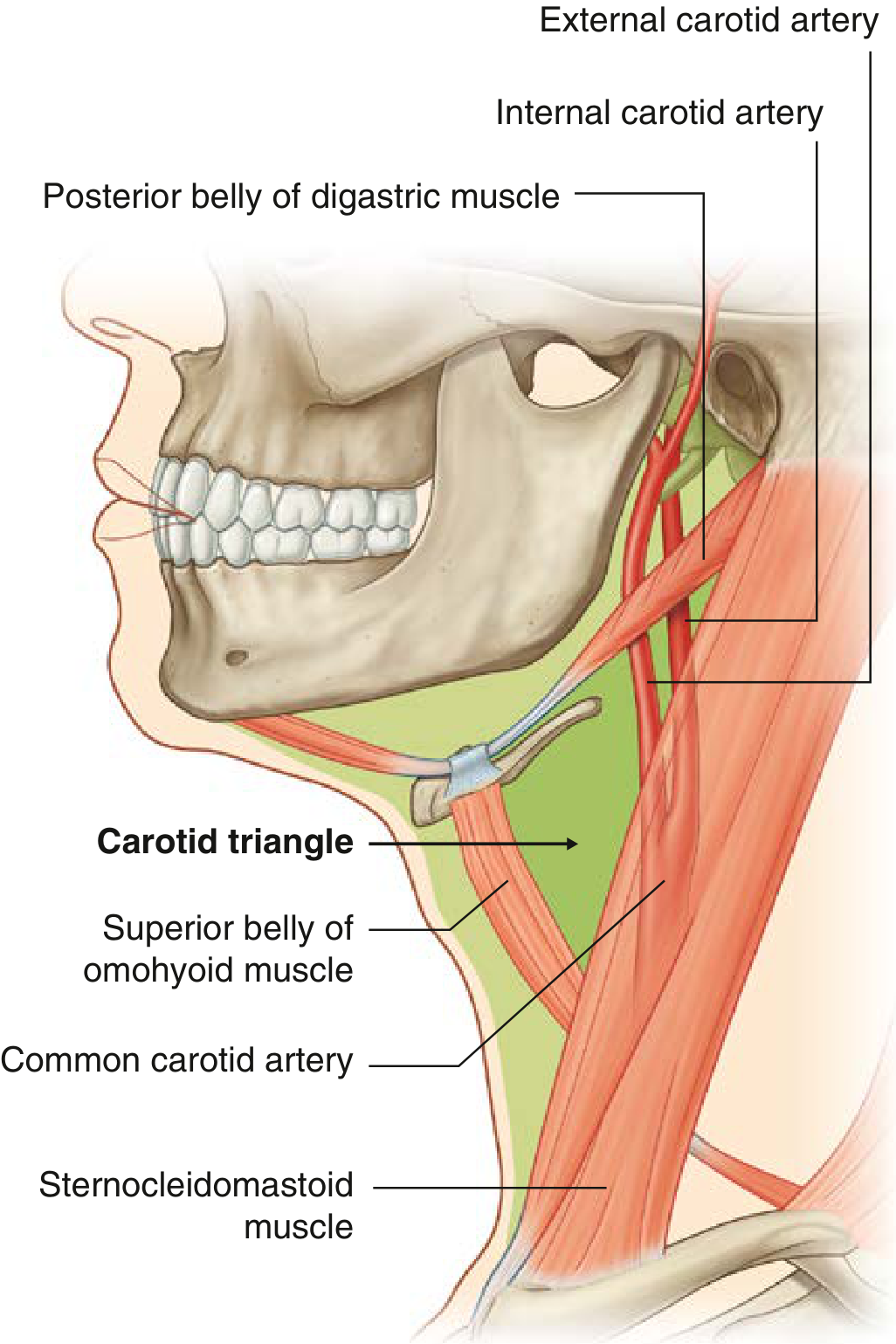
The carotid triangle is a paired, clinically important subdivision of the anterior triangle of the neck. It contains the bifurcation of the common carotid artery and is important in vascular surgery, clinical examination, and ENT/head-neck surgery.
Boundaries
| Border | Structure |
|---|---|
| Superior (superoposterior) | Posterior belly of digastric muscle |
| Inferior (anteroinferior) | Superior belly of omohyoid muscle |
| Lateral (posterior) | Anterior border of sternocleidomastoid muscle |
| Floor | Hyoglossus, thyrohyoid, inferior and middle pharyngeal constrictor muscles |
| Roof | Skin, superficial fascia, platysma, investing layer of deep cervical fascia |
Contents
Arteries
- Common carotid artery — ascends through the triangle
- External carotid artery — branches immediately after bifurcation; gives off multiple branches in the triangle:
- Superior thyroid artery
- Ascending pharyngeal artery
- Lingual artery
- Facial artery
- Occipital artery
- Internal carotid artery — ascends with no branches in the neck
- Carotid sinus — dilation at the bifurcation (at the level of superior border of thyroid cartilage, C3/C4 level); contains baroreceptors (pressure receptors) innervated by the glossopharyngeal nerve [IX]
- Carotid body — at the bifurcation; contains chemoreceptors (detects O₂, CO₂, pH) innervated by branches of CN IX and CN X (vagus)
Veins
- Internal jugular vein — descends within the carotid sheath, lateral to the carotid arteries
- Tributaries to the common facial vein
Nerves
| Nerve | Course/Branch |
|---|---|
| Vagus nerve [X] | Descends in carotid sheath; gives off superior laryngeal nerve (external + internal laryngeal branches) and pharyngeal branches |
| Glossopharyngeal nerve [IX] | Passes between internal and external carotid arteries; innervates carotid sinus and stylopharyngeus |
| Accessory nerve [XI] | Crosses lateral to internal jugular vein, passes deep/posterior to SCM |
| Hypoglossal nerve [XII] | Loops forward across both carotid arteries, deep to posterior belly of digastric; gives off superior root of ansa cervicalis |
| Ansa cervicalis (superior + inferior roots) | Loop lying on or in the carotid sheath, anterior to common carotid artery; innervates infrahyoid muscles |
| Cervical branch of facial nerve [VII] | Runs in the triangle, innervates platysma |
| Transverse cervical nerve (C2, C3) | Crosses the triangle to supply skin of the neck |
Applied Anatomy
-
Carotid pulse palpation: The common carotid artery can be palpated in the carotid triangle by pressing posteriorly at the level of the thyroid cartilage — used in cardiac arrest assessment and monitoring
-
Carotid sinus hypersensitivity: Pressure on the carotid sinus (e.g., tight collar, during examination) stimulates baroreceptors → reflex bradycardia + hypotension (vasovagal syncope / carotid sinus syndrome)
-
Carotid endarterectomy: Surgical procedure performed via the carotid triangle for symptomatic carotid stenosis to prevent stroke
-
Carotid body tumors (paragangliomas/chemodectomas): Arise from chemoreceptors at the bifurcation; present as a pulsatile, slowly enlarging mass in the anterior triangle — splays the internal and external carotid arteries (lyre sign on angiography); mobile side-to-side but not vertically
-
Ligation of common carotid artery: Endangers blood supply to ipsilateral brain and eye
Q4. Lacrimal Apparatus — Short Note (5 Marks)
Definition
The lacrimal apparatus consists of structures involved in the production, distribution, and drainage of tears (lacrimal fluid) from the surface of the eyeball.
Components
- Lacrimal gland + its ducts
- Lacrimal canaliculi (superior and inferior)
- Lacrimal sac
- Nasolacrimal duct
Lacrimal Gland
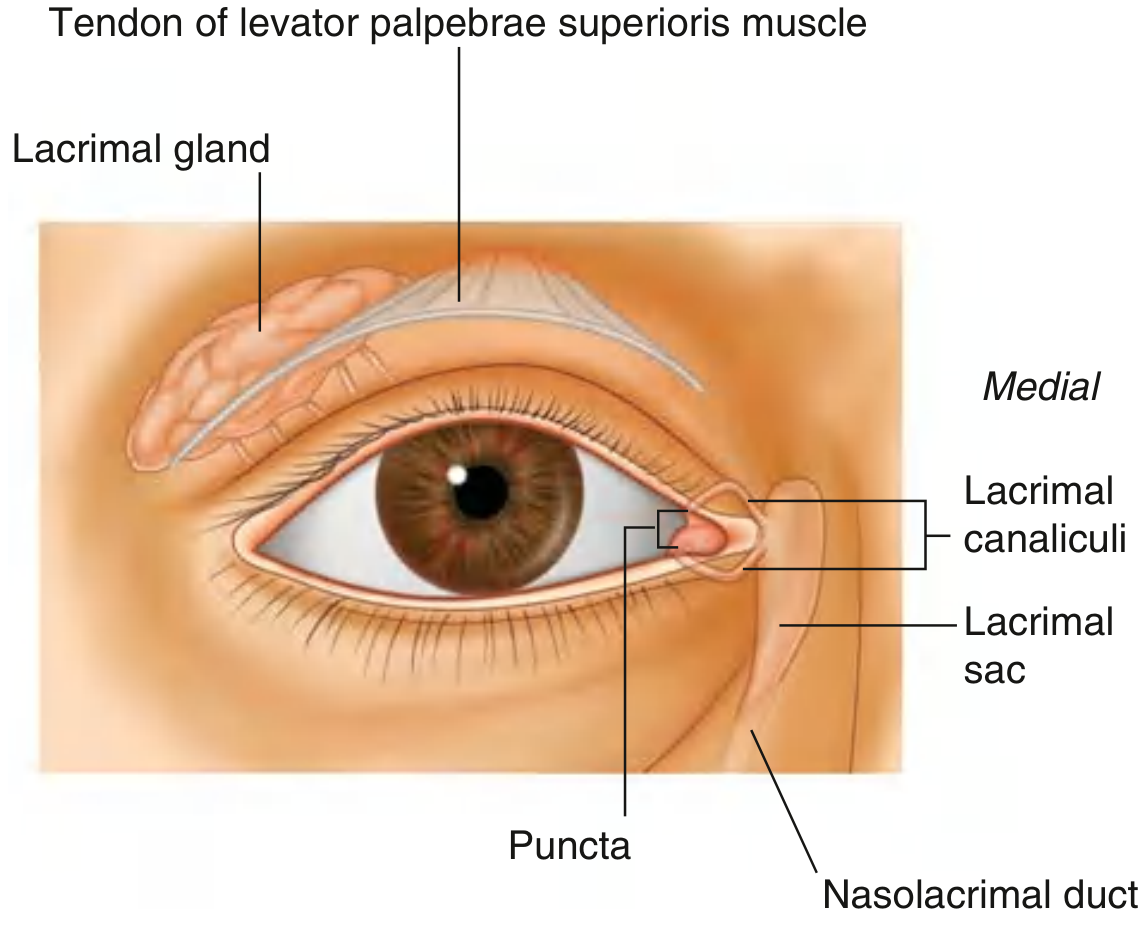
Position
- Located in the superolateral region of the orbit (anteriorly), in a bony depression called the lacrimal fossa in the frontal bone
Division
The levator palpebrae superioris tendon divides the gland into two parts:
| Part | Location |
|---|---|
| Orbital part (larger) | In the lacrimal fossa of the frontal bone — above the levator |
| Palpebral part (smaller) | In the superolateral part of the upper eyelid — below the levator |
Ducts
- Numerous ducts from both parts empty into the lateral part of the superior fornix of the conjunctiva
Flow of Tears (Lacrimal Pathway)
Lacrimal gland (secretion)
↓
Lateral part of superior conjunctival fornix
↓
Across eyeball surface (lateral → medial, aided by blinking)
↓
Lacrimal lake (accumulates medially at medial canthus)
↓
Lacrimal puncta (superior + inferior) — openings on the medial margins of each eyelid
↓
Lacrimal canaliculi (superior + inferior) — pass medially
↓
Lacrimal sac (between anterior and posterior lacrimal crests; lies posterior to medial palpebral ligament; anterior to lacrimal part of orbicularis oculi)
↓
Nasolacrimal duct (descends through bony nasolacrimal canal)
↓
Inferior meatus of the nasal cavity (opens under the inferior nasal concha)
Blinking mechanism: The lacrimal part of orbicularis oculi (Horner's muscle) contracts during blinking — dilates the lacrimal sac and draws tears in through the canaliculi (lacrimal pump mechanism)
Nerve Supply of the Lacrimal Gland
1. Secretomotor (Parasympathetic)
Facial nerve [CN VII]
↓
Greater petrosal nerve (preganglionic parasympathetic)
↓
Nerve of pterygoid canal (joins with deep petrosal nerve)
↓
Pterygopalatine ganglion (SYNAPSE)
↓
Postganglionic fibers → join maxillary nerve [V2] → zygomatic nerve
→ zygomaticotemporal nerve → small communicating branch
↓
Lacrimal nerve (branch of V1) → Lacrimal gland
Effect: Stimulates tear production (lacrimation)
2. Sympathetic
- Postganglionic fibers from superior cervical ganglion
- Travel along internal carotid artery plexus → deep petrosal nerve
- Join the nerve of pterygoid canal → follow same route as parasympathetic fibers → lacrimal gland
3. Sensory
- Lacrimal nerve — branch of ophthalmic nerve [V1] — provides sensory innervation to the lacrimal gland
Blood Supply
- Arterial: Lacrimal artery (branch of ophthalmic artery, itself a branch of the internal carotid artery)
- Venous: Drains via the ophthalmic veins
Applied Anatomy
1. Dacryocystitis
- Infection/inflammation of the lacrimal sac
- Usually due to obstruction of the nasolacrimal duct
- Presents as painful swelling at the medial canthus, below the medial palpebral ligament, with epiphora (watering eyes) and mucopurulent discharge
- Treatment: Warm compresses, antibiotics; surgical — dacryocystorhinostomy (DCR) to create a new drainage passage
2. Dacryocystorhinostomy (DCR)
- Surgical bypass of the blocked nasolacrimal duct, creating a new connection between the lacrimal sac and nasal cavity
3. Epiphora (Watering Eye)
- Overflow of tears onto the cheek
- Causes: Ectropion (everted punctum), blocked nasolacrimal duct, excessive tear production
4. Crocodile Tear Syndrome
- Aberrant regeneration following facial nerve (CN VII) palsy — parasympathetic fibers to salivary glands regrow and reinnervate the lacrimal gland
- Patient produces tears while eating (gustatory lacrimation)
5. Lacrimal Gland Tumors
- Most common are pleomorphic adenomas (benign mixed tumors)
- Present as painless swelling in the superolateral orbit, causing proptosis and downward displacement of the globe
Sources: Gray's Anatomy for Students, 4th Ed. (9780323934237) | Bailey & Love's Short Practice of Surgery, 28th Ed. (9780367548117) | K.J. Lee's Essential Otolaryngology (9781260122237) | S. Das Manual on Clinical Surgery, 13th Ed. (9788190568104)Your credits are exhausted. Your daily credits reset tomorrow, or you can purchase a top-up for more.
This is a shared conversation. Sign in to Orris to start your own chat.