
Cipap and bipap
I'll start with a quick overview while I pull detailed content from the medical library.
CPAP (Continuous Positive Airway Pressure) delivers a single, constant pressure throughout the breathing cycle. BiPAP (Bilevel Positive Airway Pressure) delivers two pressures - a higher one during inhalation (IPAP) and a lower one during exhalation (EPAP). Both are forms of non-invasive positive pressure ventilation (NIPPV) used for respiratory support.
Searching sources...
Reading File
Finding Sources
Finding Sources
Good hits. Now let me read the most comprehensive sections in parallel.
Reading File
Reading File
Reading File
Good content retrieved. Let me fetch more detail on indications, settings, and the comparison figure.
Reading File
Reading File
Reading File
I now have solid content from multiple authoritative textbooks. Let me also fetch the comparison figure and check for Tintinalli and Harrison's content.
Loading Image
Reading File
Excellent - I now have comprehensive data from five major textbooks. Let me compile the full answer.
CPAP vs BiPAP - Non-Invasive Positive Pressure Ventilation
Both CPAP and BiPAP are forms of Non-Invasive Positive Pressure Ventilation (NIPPV/NPPV) - meaning they deliver respiratory support via a mask rather than an endotracheal tube.
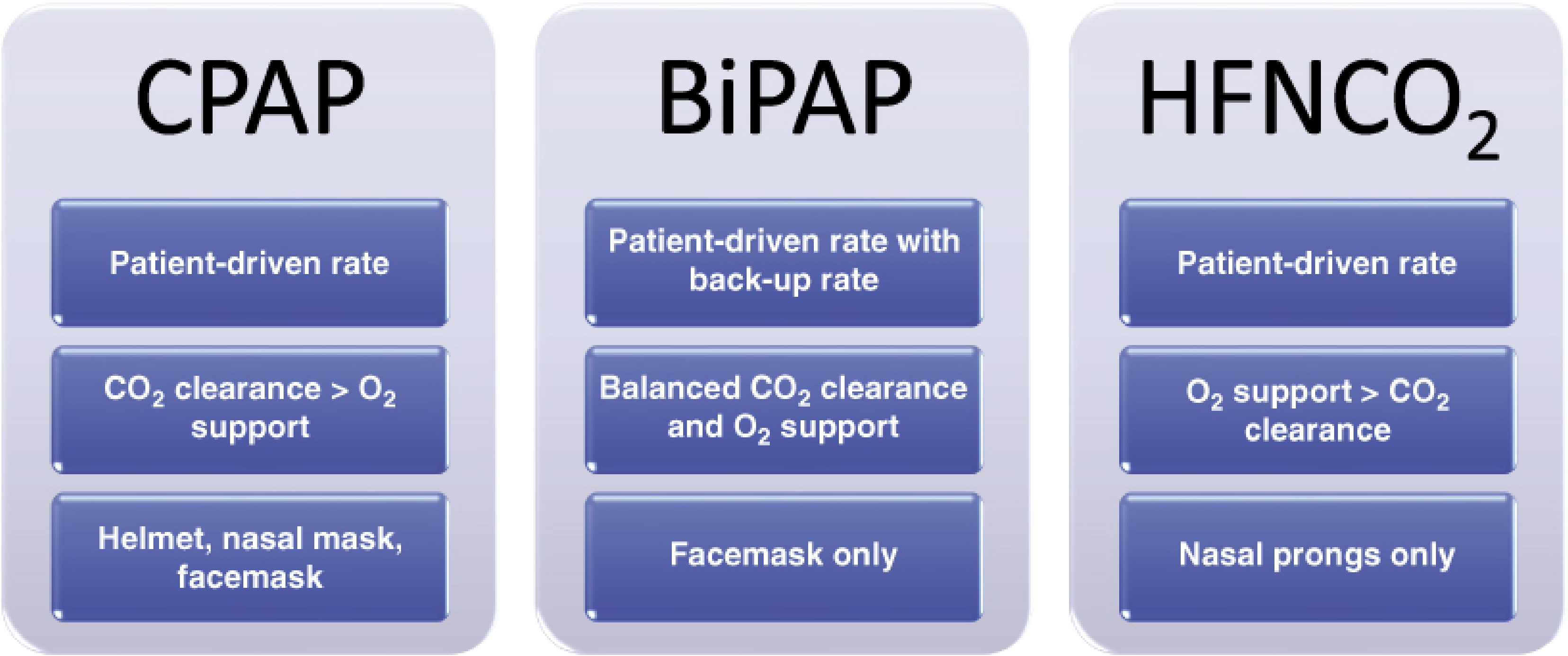
Definitions
CPAP - Continuous Positive Airway Pressure
- Delivers a single, constant pressure throughout the entire respiratory cycle (both inspiration and expiration)
- The pressure level is equivalent to PEEP (Positive End-Expiratory Pressure)
- Patient-driven rate - completely relies on the patient's own respiratory effort and drive
- No extra pressure boost during inhalation
- Delivered via: helmet, nasal mask, or full facemask
BiPAP - Bilevel Positive Airway Pressure
- Delivers two different pressure levels:
- IPAP (Inspiratory Positive Airway Pressure) - higher pressure during inhalation
- EPAP (Expiratory Positive Airway Pressure) - lower pressure during exhalation (equivalent to PEEP)
- The IPAP-EPAP difference = pressure support (analogous to PS in invasive ventilation)
- Patient-driven rate with a backup rate - newer devices can be set to cycle between pressures at a minimum rate even if the patient fails to initiate a breath
- Delivered via: facemask only
Key Physiological Effects
| Effect | Mechanism |
|---|---|
| Alveolar recruitment | Increased pressure keeps alveoli open at end-expiration (PEEP effect) |
| Improved V/Q matching | Opens atelectatic areas, improves gas exchange surface area |
| Reduced work of breathing | IPAP (BiPAP) and PEEP (both) reduce inspiratory effort by 60% |
| Decreased preload | Increased intrathoracic pressure reduces venous return |
| Decreased afterload | Reduced transmural pressure aids LV emptying - especially beneficial in pulmonary edema |
| PEEP negation in auto-PEEP | Externally applied PEEP reduces inspiratory threshold load in COPD/asthma |
BiPAP provides both CO2 clearance AND oxygenation support (balanced). CPAP favors CO2 clearance over oxygenation.
Indications
CPAP Indications
- Obstructive Sleep Apnea (OSA) - primary chronic use
- Acute cardiogenic pulmonary edema - well-evidenced reduction in intubation rate
- Mild-moderate hypoxemic respiratory failure
- Post-operative atelectasis
- Bridge therapy in selected hypoxic patients
BiPAP Indications
- Acute exacerbation of COPD - strongest evidence; reduces intubation, length of stay, and in-hospital mortality (should be started early, not after medical therapy failure)
- Acute cardiogenic pulmonary edema
- Neuromuscular disease with respiratory failure (e.g., ALS, myasthenia gravis)
- Obesity Hypoventilation Syndrome (OHS) - preferred when patient cannot tolerate high CPAP levels
- Hypercapnic respiratory failure of any cause
- Patients who fail CPAP
- Bridge to intubation in impending respiratory failure
- DNR/DNI patients - as ceiling-of-care respiratory support
(Roberts and Hedges' Clinical Procedures in Emergency Medicine, Box 8.2; Tintinalli's Emergency Medicine)
Starting Settings
| Parameter | CPAP | BiPAP |
|---|---|---|
| Starting pressure | 5-15 cm H2O | IPAP 8-12 cm H2O / EPAP 4-5 cm H2O |
| Titration goal | Relieve obstruction, improve SpO2 | Reduce RR, reduce dyspnea, improve SpO2, lower PaCO2 |
| Backup rate | Not available | Set on BiPAP S/T (Spontaneous/Timed) mode |
(Tintinalli's Emergency Medicine)
Contraindications (Both)
- Altered mental status / inability to protect airway - risk of aspiration if vomiting occurs
- Apnea (CPAP specifically, as it has no backup rate)
- Neuromuscular blockade - both modes require an open glottis and intact respiratory drive
- Copious secretions (patient must be able to cough and clear)
- Facial fractures or trauma preventing mask seal
- Recent esophageal, gastric, or duodenal anastomoses (positive pressure can insufflate the GI tract and stress anastomoses)
- Hemodynamic instability
- Inability to cooperate (delirium)
- Bacterial pneumonia is a relative contraindication for BiPAP - the high mask pressures make it very difficult to expectorate sputum and reduce bacterial bioburden
Advantages Over Invasive Mechanical Ventilation
- Avoids ETT-related complications (VAP, airway/lung injury)
- Preserves upper airway defense mechanisms
- Patient can speak, eat, clear secretions when mask removed
- Less sedation required
- Shorter hospital stay
- Reduced mortality in appropriate populations (especially COPD exacerbation)
(Roberts and Hedges; Sabiston Textbook of Surgery)
Important Practical Notes
- Tightness of mask seal is critical for effectiveness - leaks reduce delivered pressure
- Do NOT use physical restraints on patients wearing NIV masks - they must be able to remove the mask if they vomit
- Standard ventilators set to NIPPV mode have additive IPAP + EPAP (total delivered = sum). Standalone BiPAP units have independent IPAP/EPAP (set IPAP = delivered IPAP)
- CPAP is appropriate in the right patient for COVID-19 (including helmet CPAP)
- Early initiation in COPD exacerbation is key - late initiation after failed medical therapy eliminates the mortality benefit
Summary Comparison
| Feature | CPAP | BiPAP |
|---|---|---|
| Pressure levels | 1 (continuous) | 2 (IPAP + EPAP) |
| Respiratory rate | Patient-driven | Patient-driven + backup rate option |
| Primary effect | Oxygenation / recruitment | Both O2 + CO2 clearance |
| CO2 clearance | Limited | Good |
| Best for | OSA, cardiogenic pulmonary edema | COPD exacerbation, hypercapnic failure, neuromuscular disease |
| Interface | Nasal mask, facemask, helmet | Facemask only |
| Sedation/NMB | Contraindicated | Contraindicated |
Sources: Roberts and Hedges' Clinical Procedures in Emergency Medicine; Fischer's Mastery of Surgery 8th ed; Sabiston Textbook of Surgery; Tintinalli's Emergency Medicine; Miller's Anesthesia 10th ed
This is a shared conversation. Sign in to Orris to start your own chat.