
Pressure of pancreatic and biliary duct
Reading File
The normal pressure of the pancreatic duct (duct of Wirsung) is approximately 8-15 mmHg, while the bile duct (common bile duct) pressure is around 10-15 cmH2O at rest. The sphincter of Oddi creates a pressure gradient that prevents reflux between these ducts and the duodenum.
Searching sources...
Finding Sources
Finding Sources
Good - I found some key data. Let me read the most relevant passages for precise pressure values.
Reading File
Reading File
Reading File
Excellent data gathered. Let me also fetch the diagram of the sphincter anatomy.
Finding Sources
I now have comprehensive data from multiple authoritative textbooks. Let me also get Yamada's physiology section on Sphincter of Oddi and fetch the anatomy diagram.
Reading File
Loading Image
I now have all the information needed for a thorough, well-cited answer. Here is the full response:
Pressures of the Pancreatic and Biliary Ducts
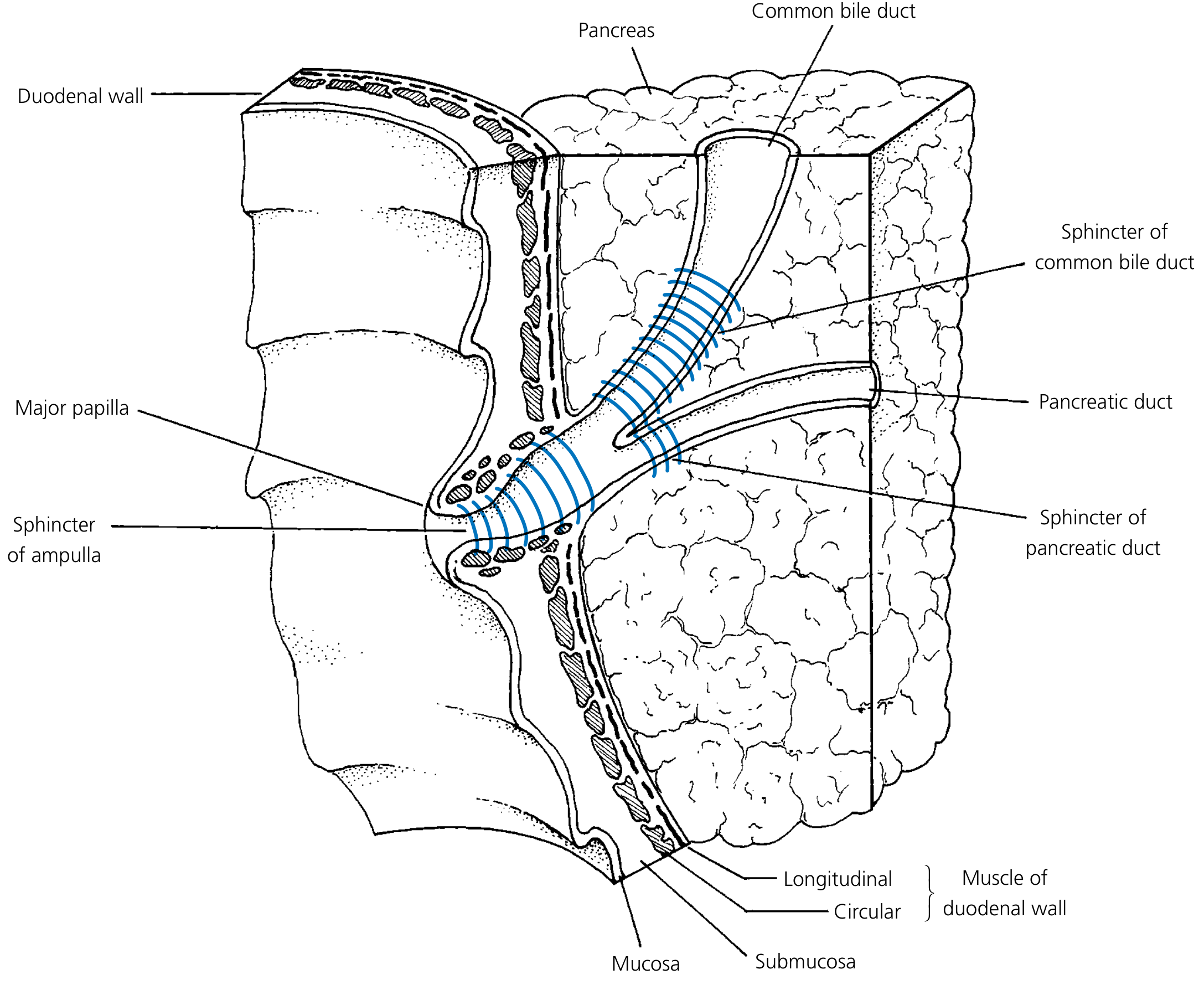
The muscular apparatus at the terminal end of the common bile duct. Each duct has its own sphincter; the sphincter pancreaticus is poorly developed compared to the sphincter choledochus. - Yamada's Textbook of Gastroenterology
1. Pancreatic Duct Pressure
Pressure inside the pancreatic duct is approximately twice that of the common bile duct. This pressure gradient is physiologically important - it prevents reflux of bile into the pancreatic duct.
- Schwartz's Principles of Surgery states directly: "Pressure inside the pancreatic duct is about twice that in the common bile duct, which is thought to prevent reflux of bile into the pancreatic duct."
In obstruction (stones, strictures), intraductal pressure rises - this increased pressure initiates pancreatitis through calcineurin signaling-dependent mechanisms, as demonstrated in animal models (Sabiston Textbook of Surgery).
2. Common Bile Duct Pressure
The resting pressure of the common bile duct (CBD) is lower than the pancreatic duct. The sphincter of Oddi sits at the terminus of both ducts and governs outflow.
3. Sphincter of Oddi - The Key Pressure Regulator
The sphincter of Oddi (SO) is the primary regulator of both biliary and pancreatic secretion into the duodenum. It acts as a regulated resistor and prevents duodenal reflux.
| Parameter | Value |
|---|---|
| SO resistance at duct openings | ~5 mmHg |
| SO basal (tonic) pressure above CBD pressure | 5-15 mmHg |
| SO basal pressure above duodenal pressure | 10-33 mmHg |
| SO resting pressure above duodenal pressure (Yamada) | ~13 mmHg |
| Phasic contraction amplitude | 100-150 mmHg |
| Phasic contraction frequency | 2-6 per minute (every 8-15 s) |
| Phasic contraction duration | 4-5 seconds |
| Abnormal basal SO pressure (Sphincter of Oddi Dysfunction) | >40 mmHg |
Source: Fischer's Mastery of Surgery, 8th ed., p. 4639; Yamada's Textbook of Gastroenterology, 7th ed.
4. Pressure Gradient Summary (Low to High)
Duodenum < Common Bile Duct < Pancreatic Duct < Sphincter of Oddi (basal) < Sphincter of Oddi (phasic peaks)
This gradient ensures:
- Bile flows into the duodenum (CBD pressure > duodenal pressure when SO relaxes)
- No bile reflux into pancreatic duct (pancreatic duct pressure > CBD pressure)
- No duodenal reflux into ducts (SO basal tone > duodenal pressure at all times)
5. Regulation of SO Pressure
Relaxation (decreased pressure) - facilitates flow:
- Cholecystokinin (CCK) - major hormonal signal after meals
- Parasympathetic (cholinergic) stimulation
- Glucagon, secretin, nitric oxide, nifedipine, nitroglycerin
Contraction (increased pressure) - inhibits flow:
- Sympathetic stimulation
- Morphine, fentanyl (clinically important - opioids increase SO tone and can cause biliary pain/pancreatitis)
- Gastrin, motilin, substance P
Fasted vs. Fed state: During fasting, SO contractions increase (particularly during phase III of the migrating motor complex). After feeding, contraction amplitude decreases and tone is reduced to facilitate passive bile flow.
6. Clinical Significance
| Condition | Pressure Change | Consequence |
|---|---|---|
| Choledocholithiasis / pancreatic stone | Increased intraductal pressure upstream | Pain, pancreatitis, jaundice |
| Sphincter of Oddi Dysfunction (SOD) | Basal SO pressure >40 mmHg | Biliary-type pain, elevated LFTs |
| Pancreatitis (chronic) | Elevated pancreatic duct pressure | Pain via ischemia mechanism |
| Morphine administration | Increased SO tone | Worsens biliary/pancreatic pain |
| ERCP sphincterotomy / stenting | Reduces intraductal pressure | Symptom relief |
Sources:
- Schwartz's Principles of Surgery, 11th ed. - "Pressure inside the pancreatic duct is about twice that in the common bile duct"
- Fischer's Mastery of Surgery, 8th ed. - SO physiology and manometric values
- Yamada's Textbook of Gastroenterology, 7th ed. - SO physiology and pressure values
- Sleisenger & Fordtran's GI and Liver Disease - pancreatic duct pressure in pain and chronic pancreatitis
This is a shared conversation. Sign in to Orris to start your own chat.