
Describe the attachment,nerve supply and action of the muscles of mastication
I'll read the medical library skill first, then search for detailed information on the muscles of mastication.
Reading File
Now I'll search the library for muscles of mastication content:
Finding Sources
Finding Sources
Excellent results. Now I'll read the most detailed anatomy sources in parallel:
Reading File
Reading File
Now let me read the Gray's Anatomy section for detailed attachments of each muscle:
Reading File
Finding Sources
I found a detailed table. Let me read that section from Cummings Otolaryngology and the detailed Gray's anatomy muscle sections:
Reading File
Finding Sources
I can see the table is starting. Let me read more of it and also find the detailed Gray's Anatomy muscle descriptions:
Reading File
Finding Sources
Excellent! I found the Gray's Anatomy table too. Let me read it in detail:
Reading File
Reading File
I now have comprehensive information from multiple authoritative textbooks. Let me also fetch the key anatomical images:
Loading Image
Reading File
Let me now read the temporalis, medial pterygoid, and lateral pterygoid sections from Gray's Anatomy:
Reading File
Reading File
Reading File
Reading File
I now have all the information needed for a thorough, well-sourced answer. Let me compose it.
Muscles of Mastication
There are four primary muscles of mastication: masseter, temporalis, medial pterygoid, and lateral pterygoid. All are innervated by branches of the mandibular nerve (V3) - the only division of the trigeminal nerve that carries both motor and sensory fibers. The motor root passes through the foramen ovale to join V3 in the infratemporal fossa, from which all motor branches arise.
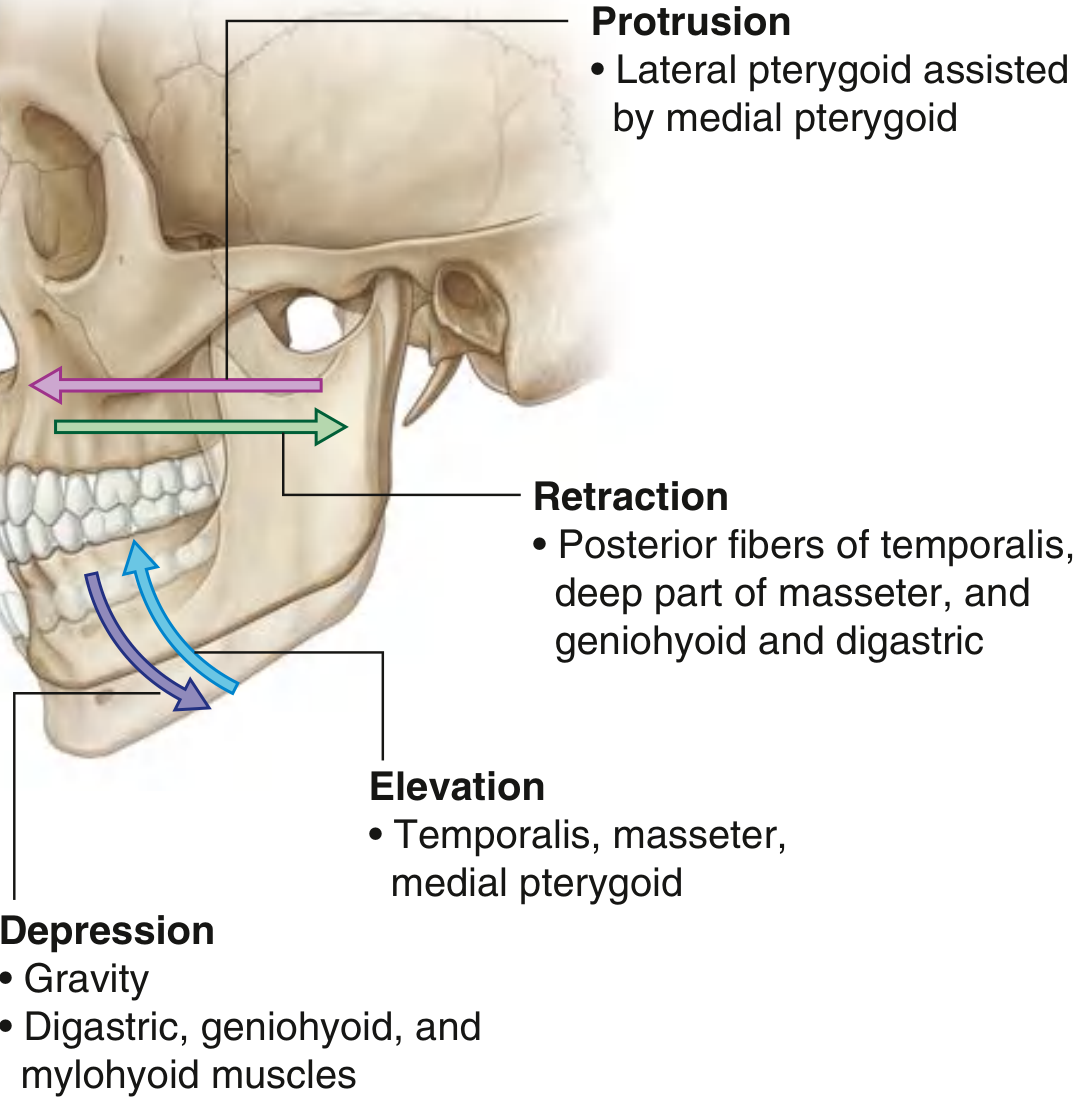
1. Masseter
Shape: Quadrangular; overlies the lateral surface of the ramus of the mandible.
Attachment (Origin and Insertion)
The masseter has two parts:
| Part | Origin | Insertion |
|---|---|---|
| Superficial part | Maxillary process of the zygomatic bone and the anterior two-thirds of the lower border of the zygomatic arch | Angle of the mandible and the posterior part of the lateral surface of the ramus |
| Deep part | Medial aspect of the zygomatic arch and the posterior part of its inferior margin | Central and upper part of the ramus of the mandible, as high as the coronoid process |
Nerve Supply
Masseteric nerve - from the anterior trunk of the mandibular nerve [V3]. It originates in the infratemporal fossa, passes laterally over the margin of the mandibular notch, and enters the deep surface of the masseter.
Action
- Primary: Elevation of the mandible (closes the mouth) - the most powerful jaw-closing movement
- Secondary: Protrusion of the mandible (superficial fibers)
- Retraction (deep fibers)
The masseter and medial pterygoid together form the masseteric-pterygoid sling, gripping the angle of the mandible on its lateral and medial surfaces respectively.
2. Temporalis
Shape: Large, fan-shaped muscle that fills the temporal fossa. Anterior fibers are oriented vertically; posterior fibers are oriented horizontally.
Attachment
| Detail | |
|---|---|
| Origin | Bony surface of the temporal fossa superiorly to the inferior temporal line (floor of the fossa - contributions from temporal, parietal, frontal, and greater wing of sphenoid bones) + deep surface of the temporal fascia |
| Insertion | Coronoid process of the mandible and along the anterior margin of the ramus, almost as far inferiorly as the last molar tooth |
The fibers converge to form a tendon that passes between the zygomatic arch and the infratemporal crest before inserting.
Nerve Supply
Deep temporal nerves - usually two (anterior and posterior) - from the anterior trunk of the mandibular nerve [V3]. They curve around the infratemporal crest of the sphenoid to enter the deep surface of the temporalis.
Action
- Primary: Elevation of the mandible (all fibers)
- Retraction of the mandible (posterior horizontal fibers specifically - the only muscle with a pure retracting component)
- During jaw closure, the temporalis coordinates with the masseter; the temporalis fires slightly after the masseter during the closing phase of mastication
3. Medial Pterygoid
Shape: Quadrangular; has deep and superficial heads. Acts as the medial counterpart of the masseter in the pterygoid-masseteric sling.
Attachment
| Head | Origin | Insertion |
|---|---|---|
| Deep head (larger) | Medial surface of the lateral plate of the pterygoid process + pyramidal process of the palatine bone | |
| Superficial head | Tuberosity of the maxilla + adjacent pyramidal process of the palatine bone | |
| Both heads | - | Roughened medial surface of the ramus and angle of the mandible (posterior and inferior part) |
The muscle descends obliquely downward and backward, passing medial to the sphenomandibular ligament.
Nerve Supply
Nerve to medial pterygoid - arises directly from the main trunk of the mandibular nerve [V3] (before it divides into anterior and posterior trunks), making it one of the first branches given off.
Action
- Primary: Elevation of the mandible (closes the mouth)
- Protrusion - because of its oblique, backward-directed insertion
- Lateral movements (side-to-side grinding) - when acting with the contralateral lateral pterygoid
4. Lateral Pterygoid
Shape: Thick, triangular; has upper (superior) and lower (inferior) heads. Unique among the muscles of mastication in that it is oriented almost horizontally, while the others are more vertically oriented.
Attachment
| Head | Origin | Insertion |
|---|---|---|
| Upper head | Roof of the infratemporal fossa (inferior surface of the greater wing of the sphenoid + infratemporal crest), lateral to foramen ovale and foramen spinosum | Capsule of the temporomandibular joint and articular disc |
| Lower head (larger) | Lateral surface of the lateral plate of the pterygoid process | Pterygoid fovea on the neck (condylar neck) of the mandible |
Nerve Supply
Nerve to lateral pterygoid - from the anterior trunk of the mandibular nerve [V3], either directly or via the buccal branch.
Action
- Primary: Protrusion of the mandible (both heads pull the condyle and disc forward onto the articular tubercle)
- Depression of the mandible (inferior head - also involved in mouth opening, along with gravity, digastric, geniohyoid, and mylohyoid)
- Lateral displacement (side-to-side) - unilateral contraction shifts the chin to the opposite side
- The superior head acts differently from the inferior head: the superior head contracts during jaw closing (stabilizing the disc during elevation), whereas the inferior head contracts during jaw opening
Summary Table
| Muscle | Origin | Insertion | Nerve (all V3) | Main Action |
|---|---|---|---|---|
| Masseter | Zygomatic arch and maxillary process of zygoma | Lateral surface of ramus and angle of mandible | Masseteric nerve (V3 anterior trunk) | Elevation; protrusion (superficial), retraction (deep) |
| Temporalis | Temporal fossa (bone + temporal fascia) | Coronoid process + anterior margin of ramus | Deep temporal nerves (V3 anterior trunk) | Elevation; retraction (posterior fibers) |
| Medial pterygoid | Medial surface of lateral pterygoid plate + pyramidal process of palatine + maxillary tuberosity | Medial surface of ramus and angle of mandible | Nerve to medial pterygoid (V3 main trunk) | Elevation; protrusion; lateral movements |
| Lateral pterygoid | Upper head: infratemporal fossa; Lower head: lateral surface of lateral pterygoid plate | Upper head: articular disc/capsule; Lower head: pterygoid fovea of condylar neck | Nerve to lateral pterygoid (V3 anterior trunk) | Protrusion; depression; lateral movements |
Key Clinical Notes
- All four muscles are innervated by V3 - damage to V3 (e.g., at the foramen ovale) causes deviation of the jaw to the ipsilateral (same) side on opening, due to unopposed action of the contralateral lateral pterygoid.
- Bilateral contraction of the lateral pterygoids = protrusion; unilateral = deviation to opposite side.
- The jaw jerk reflex (masseter reflex) tests the integrity of the V3 arc and is a stretch reflex of the jaw-closing muscles.
- Trismus (inability to open the mouth) typically results from spasm or scarring of the masseter, temporalis, or medial pterygoid.
Sources: Gray's Anatomy for Students (Table 8.11, pp. 1116-1122); Cummings Otolaryngology Head and Neck Surgery (Table 92.1, pp. 1681-1682; Table 86.2, p. 1560); Scott-Brown's Otorhinolaryngology Head & Neck Surgery Vol. 2, pp. 1994-2006
This is a shared conversation. Sign in to Orris to start your own chat.