
Adapalen
Reading File
Adapalene is a third-generation synthetic retinoid used primarily in acne treatment. It works by binding to specific nuclear retinoic acid receptors (RAR-beta and RAR-gamma) to normalize follicular keratinization and reduce comedone formation. It also has anti-inflammatory properties. It is generally better tolerated than tretinoin with less irritation.
Searching sources...
Finding Sources
Searching PubMed
adapalene acne treatment
Reading File
Reading File
Reading File
Reading File
Loading Image
Searching Images
adapalene acne comedone mechanism retinoid
Here is a complete overview of Adapalene, drawn from dermatology and pharmacology textbooks:
Adapalene
Classification
Adapalene is a third-generation synthetic retinoid - specifically an aromatic naphthoic acid derivative. It structurally resembles retinoic acid but has a rigid, highly lipophilic structure that gives it distinct receptor selectivity.
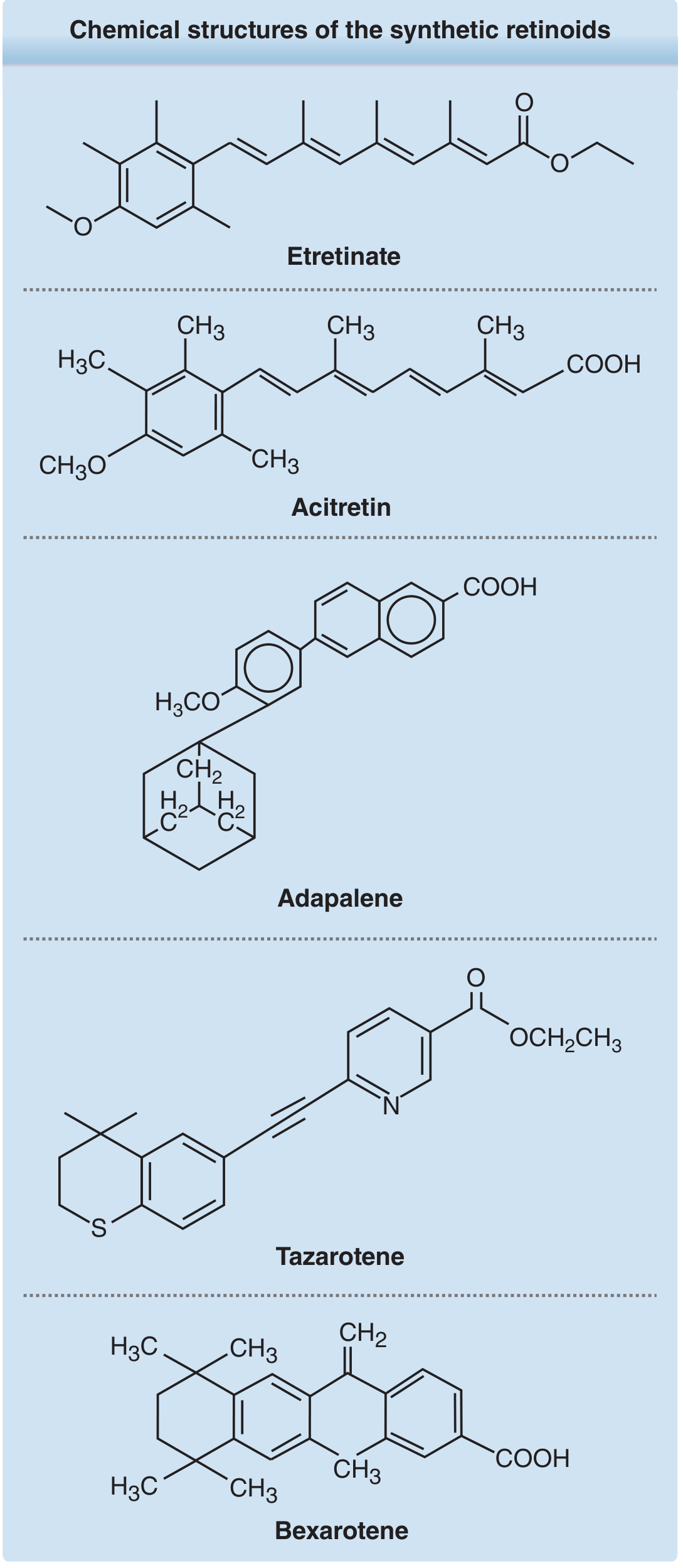
Mechanism of Action
- Binds selectively to RAR-β and RAR-γ (retinoic acid receptors beta and gamma), with higher affinity for RAR-γ
- Since RAR-β is not expressed in keratinocytes, RAR-γ is the primary target in the epidermis
- Does not bind to cellular retinoic acid-binding proteins (CRABPs), but induces expression of CRABP-II
- Modulates cellular differentiation, keratinization, and inflammatory processes that are dysregulated in acne
- Decreases cohesion between epidermal cells and increases epidermal cell turnover → expulsion of open comedones and conversion of closed comedones to open ones
- Has anti-inflammatory properties in addition to its comedolytic effects
- In vitro studies show it inhibits triacylglycerol biosynthesis and lipid droplet accumulation in sebocytes, though not proven sebostatic in vivo
- Its lipophilic properties enhance pilosebaceous uptake
(Dermatology 2-Volume Set 5e; Katzung Basic & Clinical Pharmacology 16e)
Key Pharmacological Properties
| Property | Adapalene | Tretinoin |
|---|---|---|
| Receptor binding | RAR-β/γ (selective) | RAR-α and RAR-γ |
| Photostability | Stable (photostable) | Photolabile (degrades in light) |
| Benzoyl peroxide compatibility | Compatible (resistant to oxidation) | Inactivated by BPO |
| Skin irritation | Less irritating | More irritating |
| Onset vs. tretinoin | Faster onset of clinical effect | Slower onset |
| Application timing | Anytime (photostable) | Nighttime recommended |
Formulations
- 0.1% gel, cream, or lotion - standard strength
- 0.3% gel - higher strength
- 0.1% gel (OTC) - FDA-approved for over-the-counter sale
- Combination products:
- Epiduo: 0.1% adapalene + 2.5% benzoyl peroxide
- Epiduo Forte: 0.3% adapalene + 2.5% benzoyl peroxide
(Harriet Lane Handbook 23e; Katzung 16e)
Indications
- Primary: Mild to moderate acne vulgaris (comedonal and inflammatory)
- Used as part of stepped acne therapy:
- Comedonal acne: topical retinoid or adapalene alone
- Mild inflammatory acne: topical antibiotic + benzoyl peroxide ± adapalene
- Moderate-severe non-cystic acne: systemic antibiotic + topical retinoid
- Nodular cystic acne: isotretinoin
(Symptom to Diagnosis 4e)
Dosing & Administration
- Apply a thin film once daily to cleansed, dry skin of affected areas
- Age: approved for ≥12 years (adapalene alone); Epiduo approved ≥9 years
- Limited data in children 7 to <12 years
- Onset of benefit: 8-12 weeks (4-8 weeks for the adapalene + BPO combination)
- An acne flare may occur in the first month (comedones becoming apparent) - this resolves spontaneously
Adverse Effects
- Local irritation (most common): erythema, dryness, scaling, peeling - peaks at 2-4 weeks, improves with continued use
- Mild transitory warm or stinging sensation in first 4 weeks
- Not a true photosensitizer, but skin peeling/irritation can increase susceptibility to sunburn - advise sunscreen use
- Avoid contact with eyes, mucous membranes, abraded skin, and open wounds
Safety in Pregnancy
- Systemic absorption after topical application is negligible
- Teratogenic risks from topical adapalene appear minimal
- However, as a retinoid class drug, caution is still advised in pregnancy
- Contrast with tazarotene, which is FDA contraindicated in pregnancy
Comparison with Other Topical Retinoids
| Drug | Generation | Selectivity | Key Feature |
|---|---|---|---|
| Tretinoin | 1st (natural) | RAR-α and RAR-γ | Gold standard; photolabile |
| Adapalene | 3rd synthetic | RAR-β/γ | Photostable, less irritating, OTC available |
| Tazarotene | Synthetic acetylenic | RAR-β/γ | Most potent; contraindicated in pregnancy |
| Trifarotene | 4th generation | RAR-γ only | Approved for face + back acne (≥9 yr) |
Recent Evidence (2024-2025)
- A 2025 systematic review and meta-analysis compared clindamycin/BPO vs. clindamycin/adapalene, providing updated comparative data on combination regimens in acne vulgaris (PMID: 40594517)
- A 2025 systematic review investigated adapalene's emerging role as an anticancer agent, with in vitro and in vivo studies showing effects on cell proliferation, apoptosis, and cell survival in tumor cell lines - a novel area of interest beyond acne (PMID: 41093226)
- A 2024 meta-analysis confirmed the comparative efficacy and safety of adapalene/BPO vs. clindamycin/BPO combinations (PMID: 39225838)
This is a shared conversation. Sign in to Orris to start your own chat.