
Immediate implants at fresh extraction sockets: From myth to reality!! This article summarize esthetically
"immediate implant placement" AND "fresh extraction socket"
"immediate implant" AND "post-extraction" AND esthetics
PMID: 39622908
PMID: 36162892
"immediate implant" AND "bone resorption" AND "buccal plate"
PMID: 34087383
"immediate implant" AND "gap filling" AND "primary stability"
"immediate implant placement" AND "flapless" AND "provisionalization"
PMID: 33724473
PMID: 30702152
🦷 Immediate Implants at Fresh Extraction Sockets: From Myth to Reality
1. What Is "Immediate Implant Placement"?
| Timing | Classification | Interval |
|---|---|---|
| Type I | Immediate | Same day / < 48 hrs |
| Type II | Early (soft tissue healed) | 4-8 weeks |
| Type III | Early (partial bone fill) | 12-16 weeks |
| Type IV | Late | > 6 months |
2. The "Myth" Phase - What We Once Believed
- 🔴 Myth: Placing an implant in the socket would prevent alveolar ridge resorption
- 🔴 Myth: An intact buccal plate was mandatory for any immediate placement
- 🔴 Myth: Immediate loading (same-day crown) was too risky and would cause failure
- 🔴 Myth: Infection or residual pathology at the socket was an absolute contraindication
- 🔴 Myth: Any gap between the implant and socket walls required bone grafting
3. The Biological Reality - What Actually Happens After Extraction
The Remodeling Process (Bundle Bone Loss)
- Horizontal bone loss: ~29-63% of buccal bone width lost in 6 months
- Vertical bone loss: ~11-22% of ridge height lost in 6 months
- The buccal plate is thinner than the lingual plate in most anterior sites (often < 1 mm), making it extremely vulnerable
The fundamental reality: An implant placed into a socket does NOT prevent bundle bone resorption. The ridge undergoes biological remodeling regardless of implant presence. This is the central shift from myth to reality.
Why the Buccal Plate Is the Critical Structure
- The peri-implant gingival margin migrates apically (recession)
- The facial contour collapses, creating a "sunken" appearance
- Papillae may flatten, especially in the presence of bone defects
4. Current Evidence: What Works and What Doesn't
Survival Rates - The Reassuring Picture
- Overall implant survival: ~95-96% for immediate placement
- Comparable to conventional delayed placement (~98.7% for ridge preservation protocol) in meta-analysis data [PMID 36162892]
- Similar marginal bone level changes at 5 years: -0.71 mm (immediate) vs. -0.54 mm (delayed) - not statistically significant [PMID 33724473]
Esthetic Outcomes - The Nuanced Picture
- No significant difference in crestal bone levels between immediate and delayed placement with provisionalization in the anterior maxilla
- Peri-implant margins remained stable - no differences in papillary loss versus delayed placement
- Flapless approach produced more stable papillae and less recession than full-thickness flap approach
- ~1 mm less facial gingival recession when immediate implant + provisionalization was used vs. socket graft group
- Implant-related complications occurred more frequently in immediate + provisionalization vs. delayed group
5. Key Principles for Esthetic Success (From Myth to Protocol)
5.1 The "3D Position" Rule (Palatal + Apical)
CORRECT positioning:
  ↑ Apical:     2-4 mm below the cementoenamel junction (CEJ)
  ↑ Palatal:    Engage the palatal wall, NOT the socket center
  ↑ Apico-palatal: Toward palatal plate = buccal gap preserved
5.2 The "Jump Gap" - Gap Width Determines Grafting Need
| Gap Width | Management |
|---|---|
| < 1-2 mm | May heal spontaneously without grafting |
| > 2 mm | Gap filling with low-substitution bone graft (e.g., DBBM) is recommended |
| With membrane | Superior crestal bone preservation vs. graft alone [PMID 30702152] |
5.3 Buccal Defect - No Longer a Contraindication
- Patients with buccal bony defects ≥ 5 mm underwent immediate implant placement with simultaneous GBR
- At 5 years, marginal bone loss, buccal bone thickness, esthetics, and patient satisfaction were comparable to delayed placement after ridge preservation
- This represents a true shift: moderate buccal defects are no longer absolute contraindications for immediate placement when combined with simultaneous augmentation
5.4 Flap vs. Flapless
| Approach | Advantage | Disadvantage |
|---|---|---|
| Flapless | Preserves blood supply, better papilla stability, less recession | Limited visibility |
| Full flap | Better visualization | Disrupts periosteum, more post-op recession |
5.5 Provisional Restoration (Immediate Loading)
- Maintains the emergence profile and socket architecture
- Prevents gingival collapse into the socket
- Supports and sculpts the soft tissue profile
- Associated with ~1 mm less facial gingival recession vs. socket graft [PMID 39622908]
6. The Socket Shield Technique - Buccal Plate Preservation
- The retained root maintains the periodontal ligament attachment to the buccal plate
- Bundle bone resorption of the buccal plate is prevented (since the PDL stimulus is maintained)
- The implant is placed in the palatal portion of the socket
- Lower horizontal and vertical alveolar bone resorption
- Better maintenance of the buccal plate
- Less marginal bone loss and better esthetic results vs. conventional immediate implants
- However: Cannot yet be recommended as a standard of care due to lack of long-term RCT-level evidence and heterogeneity in surgical technique
7. Patient Selection - Turning Evidence into Clinical Decisions
Favorable (Green Light) Criteria
- ✅ Thick periodontal biotype (thick gingiva + thick buccal plate ≥ 1 mm)
- ✅ No acute infection (periapical pathology: needs thorough debridement)
- ✅ Intact or minimal buccal plate defect (< 5 mm)
- ✅ Adequate apical bone for primary stability (≥ 3-5 mm native bone beyond socket)
- ✅ No acute infection/abscess at time of extraction
- ✅ Single-tooth gap in the esthetic zone
- ✅ Non-smoker or minimal smoking history
- ✅ Adequate keratinized tissue
Caution / Modification Required (Yellow Light)
- ⚠️ Thin biotype - consider connective tissue graft + implant
- ⚠️ Buccal plate defect ≥ 5 mm - requires simultaneous GBR (still doable, per Slagter 2021)
- ⚠️ Acute periapical infection - thorough debridement + antibiotic cover required
- ⚠️ Smokers - higher complication and recession risk
Contraindications (Red Light)
- 🚫 Insufficient bone for primary stability (< 25 Ncm achievable)
- 🚫 Active uncontrolled systemic disease
- 🚫 Inadequate keratinized tissue with no plan for augmentation
- 🚫 Patients unable to follow restricted loading/diet protocol
8. Summary: From Myth to Reality
| Old Myth | Current Reality (Evidence-Based) |
|---|---|
| Implants prevent socket bone loss | Remodeling occurs regardless; technique minimizes it |
| Intact buccal plate is mandatory | Defects ≥ 5 mm manageable with simultaneous GBR |
| Immediate loading always fails | Non-occlusal provisionals are safe and beneficial |
| Gaps must all be grafted | < 2 mm gaps may self-regenerate; > 2 mm need graft + membrane |
| High infection = contraindication | Thorough debridement allows immediate placement |
| Flapless is inferior | Flapless is often preferred in the esthetic zone |
9. Key Evidence Summary
| Study | Level | Key Finding |
|---|---|---|
| Gaddale et al., 2025 [PMID 39622908] | SR + Meta-analysis | No difference in crestal bone with immediate vs. delayed; flapless = less recession |
| Yu et al., 2022 [PMID 36162892] | SR + Meta-analysis | ARP protocol shows slightly higher survival (98.7%) vs. IIP (95.2%) |
| Slagter et al., 2021 [PMID 33724473] | 5-year RCT | Buccal defects ≥ 5 mm: comparable 5-year outcomes immediate vs. delayed |
| Kinaia et al., 2021 [PMID 30702152] | SR + Meta-analysis | Graft + membrane > graft alone for crestal bone preservation at immediate implants |
| Sáez-Alcaide et al., 2021 [PMID 34087383] | Systematic Review | Socket shield = better buccal plate preservation, but needs more long-term evidence |
The Bottom Line
⚠️ Evidence note: Recent meta-analyses (2022, 2025) confirm that while survival rates are slightly lower than the delayed protocol (95.2% vs. 98.7%), esthetic outcomes are comparable and patient satisfaction is high. Long-term data (> 5 years) remains limited for some subgroups, particularly the socket shield technique.
Schematic esthetic diagram
A detailed schematic dental diagram titled "Immediate Implant Placement at Fresh Extraction Socket" showing a clean cross-sectional anatomical illustration with the following labeled components: Top section - "CORRECT 3D IMPLANT POSITIONING": - A tooth root being extracted from an alveolar socket - Buccal bone plate (labeled, shown thin and fragile) - Palatal bone wall (labeled, shown thicker) - The dental implant positioned apically and palatally, NOT centered in the socket - Apical engagement zone: "3-5mm beyond socket apex" with arrow - Palatal engagement: implant tilted toward palatal wall with arrow label - A yellow shaded "Jump Gap" zone between implant and buccal wall, labeled "> 2mm = needs graft + membrane" Middle section - side-by-side comparison panels: Left panel labeled "FLAPLESS APPROACH (Preferred in Esthetic Zone)": - Gingiva intact around implant - Green checkmark icons next to: "Preserves blood supply", "Stable papillae", "Less recession" Right panel labeled "FULL FLAP APPROACH": - Flap reflected - Yellow warning icon next to: "Periosteum disrupted", "Higher recession risk" Bottom section - "SOFT TISSUE ESTHETIC OUTCOMES" timeline showing: - Day 0: Extraction + implant placed + provisional crown (non-occlusal) - 3 months: Soft tissue molded by provisional - Final: Stable gingival margin, full papillae, excellent emergence profile - Pink gingival tissue shading throughout showing healthy contours Color scheme: clean white background, blue and teal for bone, pink for soft tissue, silver/gray for implant fixture, gold/yellow for gap zone, green for favorable outcomes, red warnings for myth panel. Professional medical illustration style with clear label lines and arrows, no clutter.
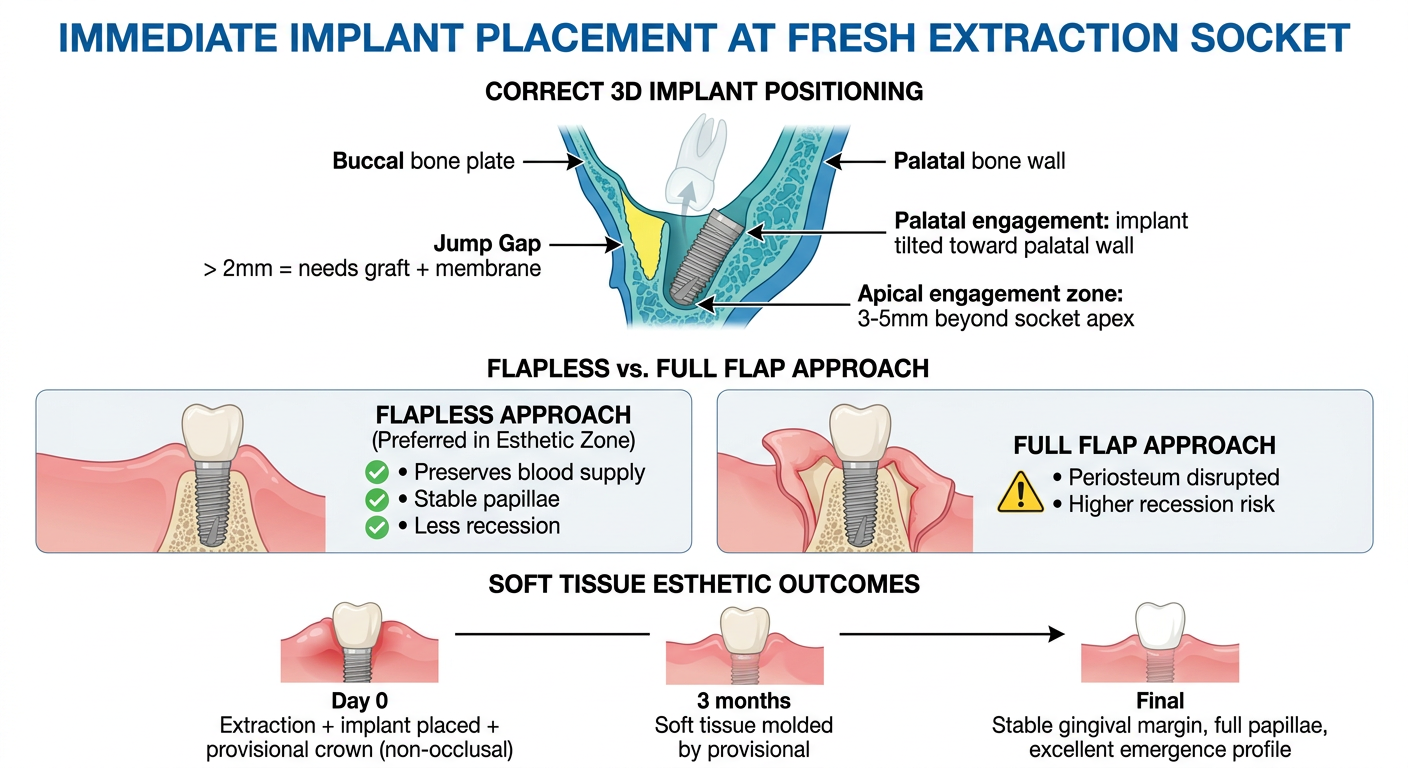
- Correct 3D implant positioning - palatal + apical engagement, away from the buccal plate
- The jump gap zone - and when grafting with membrane is needed (> 2 mm)
- Flapless vs. full flap - side-by-side visual comparison
- Soft tissue outcome timeline - from extraction day through provisional shaping to the final esthetic result with stable papillae and gingival margin
Like like 5 images with black background for an instagram carousel
Instagram carousel slide 1 of 5. Black background. Modern dental education post. Bold white title text at top: "IMMEDIATE IMPLANTS" and subtitle "Fresh Extraction Sockets" in teal/cyan color. Below: a clean glowing cross-section diagram of a tooth socket immediately after extraction. Show the alveolar bone walls glowing in blue, the empty socket in the center with a red dashed outline, and the surrounding gingival tissue in pink. Add a small label "Bundle Bone" pointing to the inner socket lining in a lighter shade. Bottom text: "From Myth to Reality 🦷" in white. Add subtle "01 / 05" in bottom right corner in gray. Style: sleek, modern, dark aesthetic, medical infographic for social media, glowing neon-outline style on black.
Instagram carousel slide 2 of 5. Black background. Modern dental education post. Title at top: "THE BIOLOGY" in bold white, subtitle "What happens after extraction?" in cyan. Main visual: a glowing anatomical cross-section showing post-extraction ridge resorption over time. Left side shows a full alveolar ridge with thick buccal bone plate labeled. Right side shows the same ridge after resorption - thinner, collapsed buccal plate, with red arrows showing bone loss direction horizontally and vertically. Labels in white: "Buccal Plate (thin, vulnerable)", "Bundle Bone Loss", "29-63% horizontal bone loss in 6 months". A warning icon next to "Implant alone does NOT stop resorption". Color scheme: glowing teal and blue bones on black, red warning arrows, white labels. Bottom corner: "02 / 05" in gray. Sleek neon-glow medical infographic style.
Instagram carousel slide 3 of 5. Black background. Modern dental education post. Title: "CORRECT POSITIONING" in bold white, subtitle "The 3D Rule" in cyan. Main visual: a large glowing cross-sectional diagram of a dental implant placed in a fresh extraction socket. The implant is silver/metallic glowing, positioned toward the PALATAL wall (not centered). Teal arrows pointing to: "Palatal engagement" and "3-5mm apical to socket floor". A yellow glowing zone between implant and buccal wall labeled "Jump Gap". Two inset callouts: green checkmark "Palatal + Apical = CORRECT" and red X mark "Centered in socket = WRONG". Bone shown in glowing blue, gingiva in soft pink, implant in metallic silver. Bottom corner: "03 / 05" in gray. Sleek neon-glow dark aesthetic.
Instagram carousel slide 4 of 5. Black background. Modern dental education post. Title: "GAP MANAGEMENT" in bold white, subtitle "The Jumping Distance" in cyan. Main visual: two side-by-side cross-section implant diagrams. Left diagram: small gap less than 2mm between implant and buccal bone wall, labeled "< 2mm - May self-regenerate" with a green checkmark. Right diagram: larger gap more than 2mm, filled with glowing particles representing bone graft material, with a membrane layer over it labeled "> 2mm - Graft + Membrane required" with a teal checkmark. Below: a small table-style infographic with three rows: "No graft", "Graft alone", "Graft + Membrane" with ascending outcome stars glowing in gold. Bottom text: "Membrane = Better crestal bone preservation" in italic white. Corner: "04 / 05" in gray. Neon glow medical aesthetic on black background.
Instagram carousel slide 5 of 5. Black background. Modern dental education post. Title: "ESTHETIC OUTCOMES" in bold white, subtitle "Timeline to Success" in cyan. Main visual: a horizontal timeline with 4 glowing milestone nodes connected by a glowing teal line. Node 1 (Day 0): icon of implant in socket with provisional crown, label "Extraction + Implant + Provisional". Node 2 (Week 6): soft tissue beginning to contour around provisional, label "Tissue Molding". Node 3 (3 months): healthy pink gingival contour emerging, label "Emergence Profile". Node 4 (Final): beautiful pink papillae, stable gingival margin, perfect smile, label "Stable Esthetics". Below timeline: two stat boxes glowing: "~1mm less recession with immediate provisionalization" and "Comparable 5-year outcomes vs. delayed placement". Bottom: "Immediate Implants: Evidence-Based Reality" in white italic. Corner: "05 / 05" in gray. Neon-glow dark social media infographic style.
Like. Instagram post
Instagram square post, slide 1 of 5, black background, sleek modern dental education design. Bold large white text "IMMEDIATE IMPLANTS" centered, below it glowing cyan subtitle "Fresh Extraction Sockets — From Myth to Reality". Below text: a glowing neon-outline cross-section illustration of a tooth socket right after extraction, blue glowing alveolar bone walls, empty socket in center, pink soft tissue at top. Small white label arrows pointing to "Bundle Bone" and "Socket Wall". Bottom of image: thin cyan divider line, then small white text "Swipe to learn the evidence-based protocol →" and "01 / 05" bottom right in gray. Overall aesthetic: dark luxury medical infographic, neon glow outlines, minimal clutter, Instagram 1:1 square format.
Instagram square post, slide 2 of 5, pure black background, sleek neon-glow medical infographic style. Title top center: "THE BIOLOGY" in bold white, subtitle "What Really Happens After Extraction" in cyan. Main graphic: two side-by-side cross-section ridge diagrams. Left: full thick alveolar ridge labeled "Before". Right: shrunken ridge with collapsed buccal wall, red arrows showing horizontal and vertical bone loss, labeled "6 Months Later". White stat labels: "Up to 63% horizontal bone loss" and "Up to 22% vertical bone loss". Below: glowing red warning callout box: "An implant alone does NOT stop bundle bone resorption". Bone shown in glowing blue gradient, gingiva in soft pink, loss shown with red gradient. "02 / 05" bottom right in gray. Instagram square, dark luxury aesthetic.
Instagram square post, slide 3 of 5, pure black background, neon medical infographic. Title: "THE 3D POSITIONING RULE" in bold white top center, subtitle "Palatal + Apical = Esthetic Success" in cyan. Main graphic: large glowing cross-section of a dental implant in an extraction socket. Implant drawn in metallic silver-white glow, placed toward the PALATAL bone wall (not centered). Teal glowing arrows with white labels: "Engage palatal wall", "3–5mm beyond socket apex". A yellow-orange glowing gap between implant and buccal bone wall labeled "Jump Gap". Two callout boxes side by side: left green glowing box with checkmark "CORRECT: Palatal + Apical", right red glowing box with X "WRONG: Centered in socket". Buccal bone in blue glow, palatal bone thicker. "03 / 05" bottom right gray. Dark luxury Instagram square format.
Instagram square post, slide 4 of 5, pure black background, neon medical infographic style. Title: "GAP MANAGEMENT" bold white, subtitle "The Jumping Distance" cyan. Main visual: two glowing diagrams side by side. Left: implant in socket with narrow gap under 2mm, green glow around gap, label "< 2 mm — May self-regenerate ✓". Right: implant in socket with wide gap over 2mm filled with glowing golden bone graft particles, a white membrane layer on top, label "> 2 mm — Graft + Membrane required". Below both: a glowing gold evidence bar: "Graft + Membrane = Superior crestal bone preservation (Meta-analysis 2021)". Color scheme: black background, blue bone glow, gold graft particles, green and red indicators, white text. "04 / 05" bottom right in gray. Instagram square, dark luxury aesthetic.
Instagram square post, slide 5 of 5, pure black background, neon medical infographic. Title: "ESTHETIC TIMELINE" bold white, subtitle "From Extraction to a Perfect Smile" cyan. Main visual: a horizontal glowing timeline line in teal crossing the center of the image. Four glowing milestone circles on the line: Circle 1 left "Day 0" — icon of implant + provisional crown, label "Implant + Provisional". Circle 2 "Week 6" — soft tissue adapting, label "Tissue Molding". Circle 3 "3 Months" — gingival contour shaped, label "Emergence Profile". Circle 4 right "Final" — full papillae, stable margin, label "Esthetic Success ✓" in green. Below timeline: two glowing stat boxes: cyan box "~1mm less recession with immediate provisionalization" and white box "Comparable 5-year outcomes vs. delayed placement". Very bottom: italic white text "Evidence-based. Patient-centered. Predictable." and "05 / 05" bottom right in gray. Dark luxury Instagram square format.
Make one nice Instagram post
A stunning Instagram square post about immediate dental implants at fresh extraction sockets. Black background. Sleek luxury medical aesthetic. Top: Bold white heading "IMMEDIATE IMPLANTS" with glowing cyan subtitle "Fresh Extraction Sockets — From Myth to Reality" Center: A beautiful glowing cross-sectional dental diagram showing a titanium implant placed in an extraction socket. The implant is metallic silver, angled palatally and apically. The buccal bone plate glows in blue. A golden glowing gap (labeled "Jump Gap > 2mm = Graft + Membrane") sits between the implant and buccal wall. Pink soft gingival tissue crowns the top with full papillae. A glowing provisional crown sits on the implant. Key labels with thin white leader lines: "Palatal engagement", "3–5mm apical fixation", "Flapless = less recession", "Immediate provisional preserves emergence profile" Bottom strip: Three glowing stat pills in a row — "95% Survival Rate" in green glow, "~1mm Less Recession with provisional" in cyan glow, "Comparable to delayed at 5 years" in teal glow. Very bottom: small italic white text "Evidence-based implantology" Overall: dark luxury, neon-glow outlines, clean typography, professional Instagram 1:1 square medical education post.
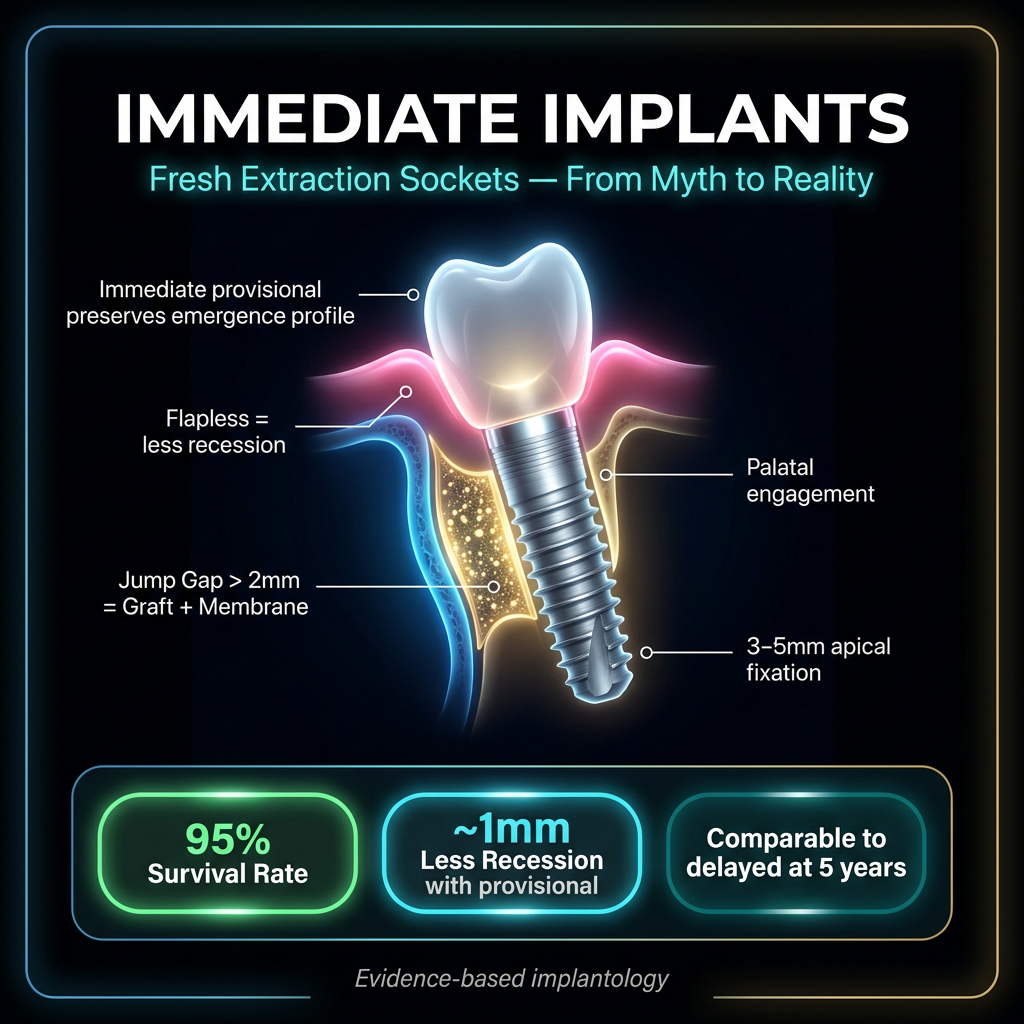
- Glowing cross-section diagram of the implant in the extraction socket
- Key clinical labels - palatal engagement, jump gap, flapless approach, provisional
- 3 evidence-based stat pills at the bottom
- Clean, bold typography on a black background
Can you provide two or more pictures
A stunning Instagram square post about immediate dental implants at fresh extraction sockets. Black background. Sleek luxury medical aesthetic. Top: Bold white heading "IMMEDIATE IMPLANTS" with glowing cyan subtitle "Fresh Extraction Sockets — From Myth to Reality". Center: A beautiful glowing cross-sectional dental diagram showing a titanium implant placed in an extraction socket. The implant is metallic silver, angled palatally and apically. The buccal bone plate glows in blue. A golden glowing gap labeled "Jump Gap" sits between the implant and buccal wall. Pink soft gingival tissue crowns the top with full papillae. A glowing provisional crown sits on the implant. Key labels with thin white leader lines: "Palatal engagement", "3–5mm apical fixation", "Flapless approach", "Immediate provisional". Bottom strip: three glowing stat pills — "95% Survival Rate" in green, "1mm Less Recession" in cyan, "Comparable 5-yr Outcomes" in teal. Very bottom small italic white text "Evidence-based implantology". Dark luxury neon-glow style, professional Instagram square format.
Instagram square post, black background, dark luxury neon medical aesthetic. Topic: "The Biology of Socket Healing". Title top center in bold white: "WHY BONE RESORBS" subtitle in cyan: "The Truth About Post-Extraction Ridge Loss". Main illustration: two large glowing cross-section diagrams side by side. LEFT labeled "Immediately After Extraction" — full thick alveolar ridge, healthy buccal bone plate glowing blue, healthy pink gingiva on top. RIGHT labeled "6 Months Later (untreated)" — dramatically shrunken ridge, collapsed thin buccal plate, receded gingiva, red dashed arrows showing horizontal bone loss and vertical bone loss. Between them a bold red arrow pointing right. White stat callouts floating: "Up to 63% horizontal bone loss", "Up to 22% vertical bone loss", "Bundle bone: permanently lost". Bottom glowing amber warning box: "An implant alone does NOT stop resorption — technique matters". Sleek, neon glow on black, Instagram 1:1 square, medical education post.
Instagram square post, black background, dark luxury neon medical aesthetic. Topic: patient selection for immediate implants. Title bold white top: "WHO IS THE RIGHT PATIENT?" subtitle cyan: "Selection Criteria for Immediate Implants". Main visual: a vertical split layout. LEFT side glowing green panel titled "GREEN LIGHT ✓" listing with checkmark icons in white: "Thick biotype", "Intact buccal plate", "Adequate apical bone", "No acute infection", "Non-smoker", "Keratinized tissue present". RIGHT side glowing red panel titled "RED LIGHT ✗" listing with X icons: "Thin buccal plate < 1mm", "No primary stability possible", "Active infection", "Uncontrolled systemic disease", "Insufficient keratinized tissue". Center divider: a glowing white vertical line. Bottom: a glowing teal callout box "Thick biotype = the single most important esthetic factor". Clean minimal typography, neon glow icons, Instagram square professional medical post.
Instagram square post, black background, dark luxury neon medical aesthetic. Topic: esthetic outcome timeline for immediate dental implants. Title bold white top: "THE ESTHETIC JOURNEY" subtitle cyan: "Immediate Implant — Step by Step". Main visual: a vertical timeline running down the center with 4 glowing teal milestone nodes. Node 1 top: glowing icon of implant + crown, bold white "DAY 0" — label "Extraction · Implant · Provisional Crown". Node 2: soft tissue icon, bold white "WEEK 6" — label "Tissue begins to mold". Node 3: gingival contour icon, bold white "3 MONTHS" — label "Emergence profile shaped". Node 4 bottom: perfect smile icon glowing gold, bold white "FINAL RESULT" — label "Stable papillae · No recession · Natural esthetics ✓". Right side floating stat boxes glowing: cyan box "~1mm less recession vs socket graft", green box "Papillae stable at 1 year". Bottom italic white small text: "Evidence-based. Patient-centered. Predictable." Dark neon glow, Instagram square professional medical infographic.
Can you provide one more
A stunning Instagram square post, black background, dark luxury neon medical aesthetic. Topic: immediate dental implant esthetic timeline and patient journey. Title bold white at top: "THE ESTHETIC JOURNEY" with glowing cyan subtitle "Immediate Implant — From Extraction to Perfect Smile". Main visual: a flowing vertical timeline with 4 large glowing milestone nodes connected by a glowing teal line. Node 1 (top): golden glowing icon of tooth being extracted with implant inserted same day, white label "DAY 0 — Extraction + Implant + Provisional Crown". Node 2: soft pink gingival tissue adapting around a crown, white label "WEEK 6 — Tissue Molding Begins". Node 3: beautifully shaped gingival emergence profile, white label "3 MONTHS — Emergence Profile Shaped". Node 4 (bottom): glowing gold final smile with full healthy papillae, stable pink gingiva, perfect contour, white label "FINAL — Natural Esthetics Achieved ✓". Right side: two floating glowing stat capsules — cyan "~1mm less recession with immediate provisionalization" and green "Comparable 5-year outcomes vs delayed". Bottom italic white small text: "Evidence-based. Patient-centered. Predictable." Neon glow outlines on pure black, clean minimal typography, professional Instagram 1:1 square medical education post.
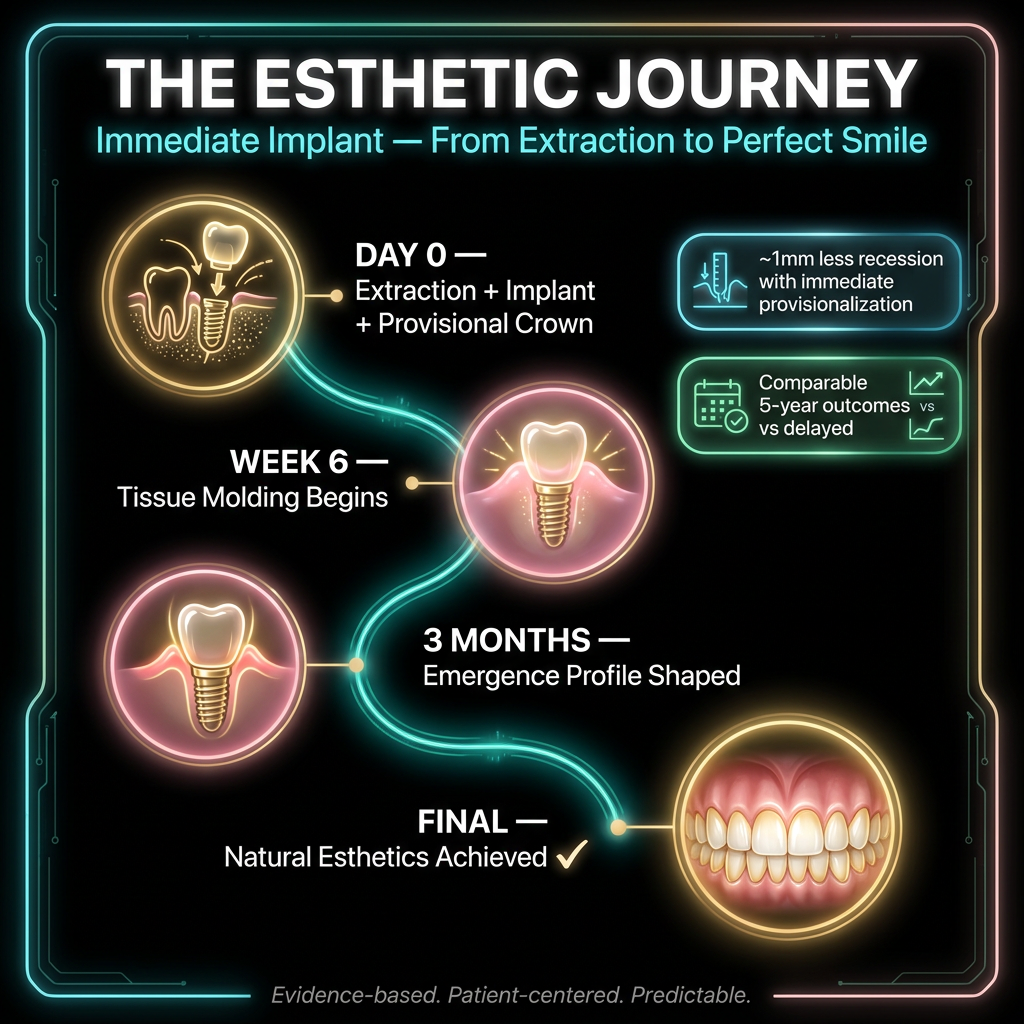
- Day 0 - Extraction + Implant + Provisional Crown
- Week 6 - Tissue molding begins
- 3 Months - Emergence profile shaped
- Final Result - Natural esthetics achieved
All of them
Instagram square post, black background, dark luxury neon medical aesthetic. Bold white title top: "IMMEDIATE IMPLANTS" glowing cyan subtitle: "Fresh Extraction Sockets — From Myth to Reality". Center: glowing cross-sectional dental diagram, titanium implant metallic silver placed palatally and apically in extraction socket, buccal bone plate glowing blue, golden glowing gap labeled Jump Gap between implant and buccal wall, pink gingival tissue on top with full papillae, glowing provisional crown on implant. White label lines: Palatal engagement, 3–5mm apical fixation, Flapless approach, Immediate provisional. Bottom 3 glowing stat pills: 95% Survival Rate green, 1mm Less Recession cyan, Comparable 5-yr Outcomes teal. Bottom small italic white: Evidence-based implantology. Neon glow on black, professional Instagram square.
Instagram square post, black background, dark luxury neon medical infographic. Title bold white top: "WHY BONE RESORBS" cyan subtitle: "The Truth About Post-Extraction Ridge Loss". Two large glowing cross-section ridge diagrams side by side. LEFT "Immediately After Extraction": full thick alveolar ridge, thick buccal bone plate glowing blue, healthy pink gingiva. RIGHT "6 Months Later (untreated)": dramatically shrunken ridge, collapsed thin buccal plate, receded gingiva, bold red dashed arrows showing horizontal and vertical bone loss. Large red arrow between them pointing right. Floating white stat labels: Up to 63% horizontal bone loss, Up to 22% vertical bone loss, Bundle bone permanently lost. Bottom glowing amber warning box: An implant alone does NOT stop resorption — technique matters. Neon glow on black, professional Instagram square medical education post.
Instagram square post, black background, dark luxury neon medical aesthetic. Title bold white top: "WHO IS THE RIGHT PATIENT?" cyan subtitle: "Selection Criteria for Immediate Implants". Vertical split layout. LEFT glowing green panel title GREEN LIGHT with checkmark icons in white listing: Thick biotype, Intact buccal plate, Adequate apical bone, No acute infection, Non-smoker, Keratinized tissue present. RIGHT glowing red panel title RED LIGHT with X icons listing: Thin buccal plate less than 1mm, No primary stability, Active infection, Uncontrolled systemic disease, Insufficient keratinized tissue. Glowing white vertical divider line in center. Bottom glowing teal callout: Thick biotype = the single most important esthetic factor. Clean minimal neon glow typography, professional Instagram square.
Instagram square post, black background, dark luxury neon medical infographic. Title bold white top: "GAP MANAGEMENT" cyan subtitle: "The Jumping Distance — When to Graft". Two large glowing diagrams side by side. LEFT: implant in socket with narrow gap under 2mm, soft green glow around gap, large label less than 2mm — May self-regenerate with green checkmark. RIGHT: implant in socket with wide gap over 2mm, gap filled with glowing golden bone graft particles, white membrane layer draped over top, label greater than 2mm — Graft plus Membrane required with teal checkmark. Below both diagrams: glowing gold evidence bar: Graft plus Membrane equals Superior crestal bone preservation. Meta-analysis 2021. Bottom right small: Socket Shield technique — emerging option for buccal plate preservation in italic white. Neon glow, pure black background, professional Instagram square medical education post.
3d positioning rule ! Schematic blue and black
A detailed schematic dental diagram on a pure black background, blue color scheme. Title at top in bold white: "THE 3D POSITIONING RULE" subtitle in electric blue: "Immediate Implant — Palatal · Apical · Correct". Main illustration: a large, precise cross-sectional anatomical schematic of a dental implant placed in a fresh extraction socket. Drawn in clean blueprint/schematic style with glowing blue lines on black. The implant (metallic silver-white with blue glow thread lines showing the screw threads) is positioned: - Toward the PALATAL bone wall — not centered in the socket - 3 to 5mm BELOW the socket floor engaging apical native bone Anatomy labeled with thin blue leader lines and white text: - "Buccal Plate" (thin wall, left side, fragile — shown thinner) - "Palatal Wall" (right side, thicker, implant engaging it) - "Socket Walls" - "Apical Native Bone" with double-headed arrow showing "3–5 mm engagement" - "Jump Gap" — a blue-outlined gap space between implant shoulder and buccal wall, filled with a subtle gold/yellow glow, labeled "Horizontal Gap — fill if > 2mm" - "Gingival Margin" at top with pink soft tissue Two inset callout boxes with blue borders: - GREEN glowing box left: "✓ CORRECT" showing implant tilted palatally and apically - RED glowing box right: "✗ WRONG" showing implant centered in socket Bottom: glowing blue rule strip — "Palatal + Apical + Sufficient Torque = Esthetic Success" Style: precise technical schematic, blueprint aesthetic, glowing electric blue on pure black, clean sans-serif labels, Instagram square 1:1 format, no clutter.
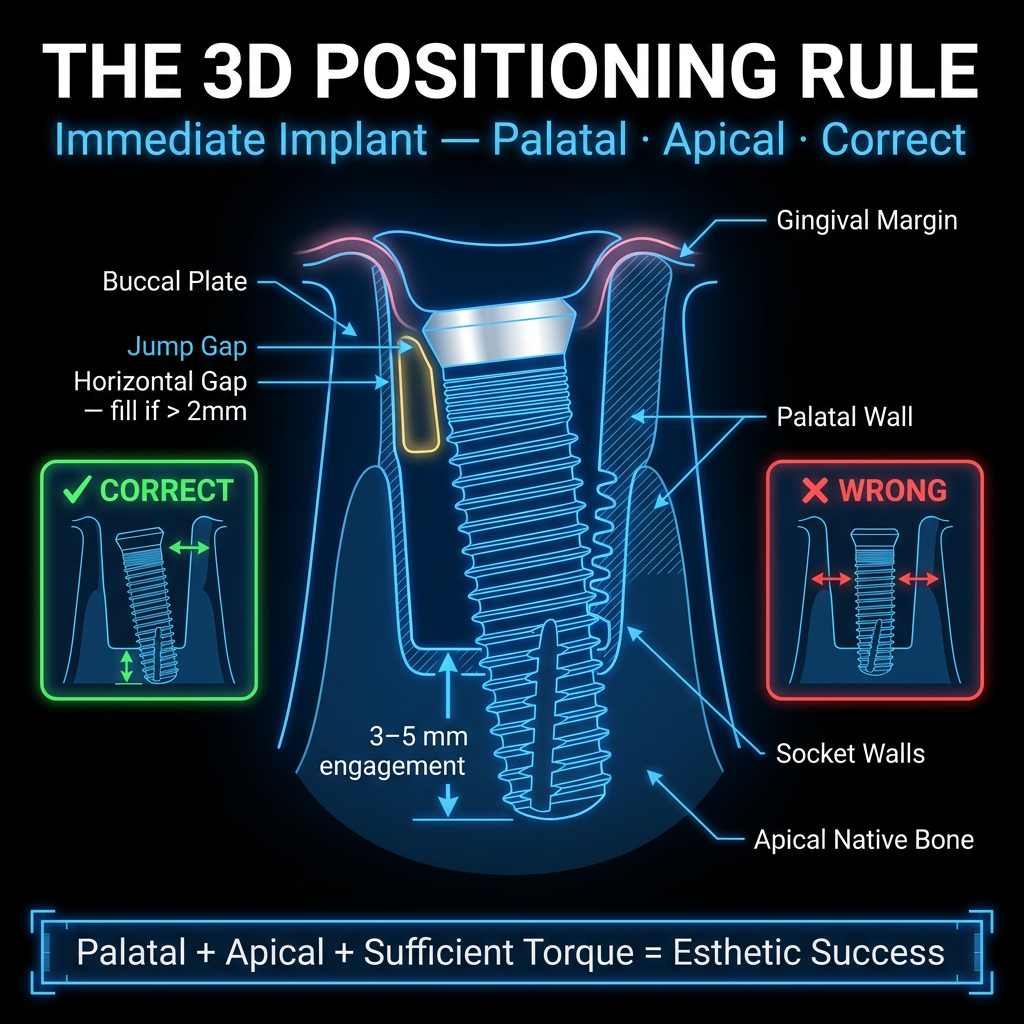
- Cross-sectional blueprint of correct implant placement - palatal and apical
- Labeled anatomy - buccal plate, palatal wall, jump gap, apical native bone
- ✓ CORRECT vs. ✗ WRONG comparison callouts
- "Palatal + Apical + Sufficient Torque = Esthetic Success" rule at the bottom
Generate a detailed surgical checklist document
mkdir -p /home/daytona/workspace/immediate-implant && ls /home/daytona/workspace/immediate-implant/
~/immediate-implant/checklist.js
const {
  Document, Packer, Paragraph, TextRun, Table, TableRow, TableCell,
  HeadingLevel, AlignmentType, BorderStyle, WidthType, ShadingType,
  VerticalAlign, PageNumber, Header, Footer, ImageRun, PageBreak
} = require('docx');
const fs = require('fs');

// ─── Color palette ───────────────────────────────────────────────
const DARK_BLUE   = "1B3A6B";
const MED_BLUE    = "2563A8";
const LIGHT_BLUE  = "DBEAFE";
const CYAN        = "0EA5E9";
const GREEN       = "166534";
const GREEN_BG    = "DCFCE7";
const RED         = "991B1B";
const RED_BG      = "FEE2E2";
const AMBER       = "92400E";
const AMBER_BG    = "FEF3C7";
const GREY_BG     = "F1F5F9";
const WHITE       = "FFFFFF";
const BORDER_BLUE = "93C5FD";

// ─── Helpers ─────────────────────────────────────────────────────
function heading1(text) {
  return new Paragraph({
    children: [new TextRun({ text, bold: true, size: 32, color: WHITE, font: "Calibri" })],
    heading: HeadingLevel.HEADING_1,
    spacing: { before: 300, after: 160 },
    shading: { type: ShadingType.SOLID, color: DARK_BLUE },
    indent: { left: 200, right: 200 },
  });
}

function heading2(text, color = MED_BLUE) {
  return new Paragraph({
    children: [new TextRun({ text, bold: true, size: 26, color: WHITE, font: "Calibri" })],
    spacing: { before: 280, after: 120 },
    shading: { type: ShadingType.SOLID, color: color },
    indent: { left: 160, right: 160 },
  });
}

function heading3(text) {
  return new Paragraph({
    children: [new TextRun({ text: "▸  " + text, bold: true, size: 22, color: DARK_BLUE, font: "Calibri" })],
    spacing: { before: 200, after: 80 },
    shading: { type: ShadingType.SOLID, color: LIGHT_BLUE },
    indent: { left: 120 },
  });
}

function sectionSpacer() {
  return new Paragraph({ children: [new TextRun({ text: "" })], spacing: { before: 80, after: 80 } });
}

function checkItem(label, detail = "", status = "normal") {
  const boxColor = status === "warning" ? AMBER : status === "critical" ? RED : DARK_BLUE;
  const bgColor  = status === "warning" ? AMBER_BG : status === "critical" ? RED_BG : WHITE;
  return new Paragraph({
    children: [
      new TextRun({ text: "☐  ", bold: true, size: 22, color: boxColor, font: "Calibri" }),
      new TextRun({ text: label, bold: true, size: 22, color: "1E293B", font: "Calibri" }),
      ...(detail ? [new TextRun({ text: "  —  " + detail, size: 20, color: "475569", font: "Calibri", italics: true })] : []),
    ],
    spacing: { before: 60, after: 60 },
    indent: { left: 300 },
    shading: { type: ShadingType.SOLID, color: bgColor },
  });
}

function noteBox(text, color = LIGHT_BLUE, textColor = DARK_BLUE) {
  return new Paragraph({
    children: [new TextRun({ text: "📌  " + text, size: 19, color: textColor, font: "Calibri", italics: true })],
    spacing: { before: 100, after: 100 },
    shading: { type: ShadingType.SOLID, color: color },
    indent: { left: 200, right: 200 },
  });
}

function warningBox(text) {
  return new Paragraph({
    children: [new TextRun({ text: "⚠️   " + text, size: 20, bold: true, color: AMBER, font: "Calibri" })],
    spacing: { before: 120, after: 120 },
    shading: { type: ShadingType.SOLID, color: AMBER_BG },
    indent: { left: 200, right: 200 },
  });
}

function redBox(text) {
  return new Paragraph({
    children: [new TextRun({ text: "🚫  " + text, size: 20, bold: true, color: RED, font: "Calibri" })],
    spacing: { before: 120, after: 120 },
    shading: { type: ShadingType.SOLID, color: RED_BG },
    indent: { left: 200, right: 200 },
  });
}

function greenBox(text) {
  return new Paragraph({
    children: [new TextRun({ text: "✅  " + text, size: 20, bold: false, color: GREEN, font: "Calibri" })],
    spacing: { before: 80, after: 80 },
    shading: { type: ShadingType.SOLID, color: GREEN_BG },
    indent: { left: 200, right: 200 },
  });
}

function divider() {
  return new Paragraph({
    children: [new TextRun({ text: "" })],
    border: { bottom: { style: BorderStyle.SINGLE, size: 6, color: BORDER_BLUE } },
    spacing: { before: 120, after: 120 },
  });
}

function bodyText(text, bold = false) {
  return new Paragraph({
    children: [new TextRun({ text, size: 20, bold, color: "1E293B", font: "Calibri" })],
    spacing: { before: 50, after: 50 },
    indent: { left: 200 },
  });
}

// ─── Two-column criteria table ────────────────────────────────────
function criteriaTable() {
  const makeRow = (left, right, header = false) => new TableRow({
    children: [
      new TableCell({
        children: [new Paragraph({
          children: [new TextRun({ text: left, bold: header, size: header ? 20 : 19, color: header ? WHITE : GREEN, font: "Calibri" })],
          spacing: { before: 60, after: 60 }, indent: { left: 100 }
        })],
        shading: { type: ShadingType.SOLID, color: header ? MED_BLUE : GREEN_BG },
        verticalAlign: VerticalAlign.CENTER,
        width: { size: 45, type: WidthType.PERCENTAGE },
      }),
      new TableCell({
        children: [new Paragraph({
          children: [new TextRun({ text: right, bold: header, size: header ? 20 : 19, color: header ? WHITE : RED, font: "Calibri" })],
          spacing: { before: 60, after: 60 }, indent: { left: 100 }
        })],
        shading: { type: ShadingType.SOLID, color: header ? MED_BLUE : RED_BG },
        verticalAlign: VerticalAlign.CENTER,
        width: { size: 45, type: WidthType.PERCENTAGE },
      }),
    ],
  });

  return new Table({
    width: { size: 90, type: WidthType.PERCENTAGE },
    rows: [
      makeRow("✅  FAVORABLE (Green Light)", "🚫  CONTRAINDICATION (Red Light)", true),
      makeRow("✅  Thick periodontal biotype", "🚫  No primary stability achievable"),
      makeRow("✅  Intact or minimal buccal defect (< 5 mm)", "🚫  Active uncontrolled systemic disease"),
      makeRow("✅  Adequate apical bone ≥ 3–5 mm", "🚫  Acute abscess without debridement plan"),
      makeRow("✅  No acute active infection", "🚫  Inadequate keratinized tissue (no graft plan)"),
      makeRow("✅  Non-smoker / minimal smoking", "🚫  Patient non-compliance / high bruxism"),
      makeRow("✅  Adequate keratinized tissue", "🚫  Insertion torque < 25 Ncm (no provisional)"),
    ],
    margins: { top: 60, bottom: 60, left: 80, right: 80 },
  });
}

// ─── Torque decision table ────────────────────────────────────────
function torqueTable() {
  const makeRow = (torque, action, bg, textCol) => new TableRow({
    children: [
      new TableCell({
        children: [new Paragraph({ children: [new TextRun({ text: torque, bold: true, size: 20, color: textCol, font: "Calibri" })], spacing: { before: 80, after: 80 }, indent: { left: 80 } })],
        shading: { type: ShadingType.SOLID, color: bg },
        width: { size: 35, type: WidthType.PERCENTAGE },
      }),
      new TableCell({
        children: [new Paragraph({ children: [new TextRun({ text: action, size: 19, color: "1E293B", font: "Calibri" })], spacing: { before: 80, after: 80 }, indent: { left: 80 } })],
        shading: { type: ShadingType.SOLID, color: WHITE },
        width: { size: 65, type: WidthType.PERCENTAGE },
      }),
    ],
  });
  return new Table({
    width: { size: 90, type: WidthType.PERCENTAGE },
    rows: [
      new TableRow({ children: [
        new TableCell({ children: [new Paragraph({ children: [new TextRun({ text: "Insertion Torque", bold: true, size: 20, color: WHITE, font: "Calibri" })] })], shading: { type: ShadingType.SOLID, color: MED_BLUE }, width: { size: 35, type: WidthType.PERCENTAGE } }),
        new TableCell({ children: [new Paragraph({ children: [new TextRun({ text: "Clinical Decision", bold: true, size: 20, color: WHITE, font: "Calibri" })] })], shading: { type: ShadingType.SOLID, color: MED_BLUE }, width: { size: 65, type: WidthType.PERCENTAGE } }),
      ]}),
      makeRow("≥ 35 Ncm", "Immediate provisional (non-occlusal) — safe to proceed", GREEN_BG, GREEN),
      makeRow("25–34 Ncm", "Provisional with caution — strict occlusal relief, soft diet mandatory", AMBER_BG, AMBER),
      makeRow("< 25 Ncm", "NO immediate loading — healing abutment only, delayed provisionalization", RED_BG, RED),
    ],
    margins: { top: 60, bottom: 60, left: 80, right: 80 },
  });
}

// ─── Gap management table ─────────────────────────────────────────
function gapTable() {
  const makeRow = (gap, protocol, bg, tc) => new TableRow({
    children: [
      new TableCell({ children: [new Paragraph({ children: [new TextRun({ text: gap, bold: true, size: 19, color: tc, font: "Calibri" })], spacing: { before: 70, after: 70 }, indent: { left: 80 } })], shading: { type: ShadingType.SOLID, color: bg }, width: { size: 30, type: WidthType.PERCENTAGE } }),
      new TableCell({ children: [new Paragraph({ children: [new TextRun({ text: protocol, size: 19, color: "1E293B", font: "Calibri" })], spacing: { before: 70, after: 70 }, indent: { left: 80 } })], shading: { type: ShadingType.SOLID, color: WHITE }, width: { size: 70, type: WidthType.PERCENTAGE } }),
    ],
  });
  return new Table({
    width: { size: 90, type: WidthType.PERCENTAGE },
    rows: [
      new TableRow({ children: [
        new TableCell({ children: [new Paragraph({ children: [new TextRun({ text: "Jump Gap Width", bold: true, size: 20, color: WHITE, font: "Calibri" })] })], shading: { type: ShadingType.SOLID, color: MED_BLUE }, width: { size: 30, type: WidthType.PERCENTAGE } }),
        new TableCell({ children: [new Paragraph({ children: [new TextRun({ text: "Recommended Protocol", bold: true, size: 20, color: WHITE, font: "Calibri" })] })], shading: { type: ShadingType.SOLID, color: MED_BLUE }, width: { size: 70, type: WidthType.PERCENTAGE } }),
      ]}),
      makeRow("< 1 mm", "No grafting required — natural bone fill expected", GREEN_BG, GREEN),
      makeRow("1–2 mm", "Consider xenograft or autograft particulate — case-by-case", AMBER_BG, AMBER),
      makeRow("> 2 mm", "Graft required (DBBM preferred) + resorbable collagen membrane", RED_BG, RED),
    ],
    margins: { top: 60, bottom: 60, left: 80, right: 80 },
  });
}

// ─── Cover block ──────────────────────────────────────────────────
function coverBlock() {
  return [
    new Paragraph({
      children: [new TextRun({ text: "", size: 10 })],
      spacing: { before: 200, after: 200 },
    }),
    new Paragraph({
      children: [new TextRun({ text: "IMMEDIATE IMPLANT PLACEMENT", bold: true, size: 52, color: WHITE, font: "Calibri" })],
      alignment: AlignmentType.CENTER,
      shading: { type: ShadingType.SOLID, color: DARK_BLUE },
      spacing: { before: 200, after: 60 },
      indent: { left: 200, right: 200 },
    }),
    new Paragraph({
      children: [new TextRun({ text: "Fresh Extraction Sockets — Surgical Checklist", bold: false, size: 28, color: "93C5FD", font: "Calibri" })],
      alignment: AlignmentType.CENTER,
      shading: { type: ShadingType.SOLID, color: DARK_BLUE },
      spacing: { before: 0, after: 60 },
      indent: { left: 200, right: 200 },
    }),
    new Paragraph({
      children: [new TextRun({ text: "Evidence-Based Protocol  |  Type I (Immediate) Placement", size: 22, color: "CBD5E1", font: "Calibri", italics: true })],
      alignment: AlignmentType.CENTER,
      shading: { type: ShadingType.SOLID, color: DARK_BLUE },
      spacing: { before: 0, after: 200 },
      indent: { left: 200, right: 200 },
    }),
    divider(),
    new Paragraph({
      children: [
        new TextRun({ text: "Surgeon: ", bold: true, size: 20, font: "Calibri", color: "334155" }),
        new TextRun({ text: "____________________________    ", size: 20, font: "Calibri", color: "94A3B8" }),
        new TextRun({ text: "Date: ", bold: true, size: 20, font: "Calibri", color: "334155" }),
        new TextRun({ text: "____________________    ", size: 20, font: "Calibri", color: "94A3B8" }),
        new TextRun({ text: "Patient ID: ", bold: true, size: 20, font: "Calibri", color: "334155" }),
        new TextRun({ text: "____________________", size: 20, font: "Calibri", color: "94A3B8" }),
      ],
      spacing: { before: 100, after: 60 },
      indent: { left: 200 },
    }),
    new Paragraph({
      children: [
        new TextRun({ text: "Site: ", bold: true, size: 20, font: "Calibri", color: "334155" }),
        new TextRun({ text: "________________________    ", size: 20, font: "Calibri", color: "94A3B8" }),
        new TextRun({ text: "Implant System: ", bold: true, size: 20, font: "Calibri", color: "334155" }),
        new TextRun({ text: "____________________    ", size: 20, font: "Calibri", color: "94A3B8" }),
        new TextRun({ text: "Diameter / Length: ", bold: true, size: 20, font: "Calibri", color: "334155" }),
        new TextRun({ text: "__________", size: 20, font: "Calibri", color: "94A3B8" }),
      ],
      spacing: { before: 60, after: 100 },
      indent: { left: 200 },
    }),
    divider(),
  ];
}

// ─── Document build ───────────────────────────────────────────────
const doc = new Document({
  styles: {
    default: {
      document: {
        run: { font: "Calibri", size: 20 },
        paragraph: { spacing: { line: 276 } },
      },
    },
  },
  sections: [{
    properties: { page: { margin: { top: 720, bottom: 720, left: 900, right: 900 } } },
    headers: {
      default: new Header({
        children: [new Paragraph({
          children: [
            new TextRun({ text: "IMMEDIATE IMPLANT — SURGICAL CHECKLIST", bold: true, size: 18, color: MED_BLUE, font: "Calibri" }),
            new TextRun({ text: "    |    Evidence-Based Protocol", size: 18, color: "94A3B8", font: "Calibri", italics: true }),
          ],
          border: { bottom: { style: BorderStyle.SINGLE, size: 4, color: BORDER_BLUE } },
          spacing: { after: 200 },
        })],
      }),
    },
    footers: {
      default: new Footer({
        children: [new Paragraph({
          children: [
            new TextRun({ text: "Immediate Implant Placement — Surgical Checklist  |  Page ", size: 17, color: "94A3B8", font: "Calibri" }),
            new PageNumber({ alias: "page" }),
          ],
          alignment: AlignmentType.CENTER,
          border: { top: { style: BorderStyle.SINGLE, size: 4, color: BORDER_BLUE } },
        })],
      }),
    },
    children: [
      // ═══ COVER ════════════════════════════════════════════════
      ...coverBlock(),

      // ═══ SECTION 1: PRE-OPERATIVE ASSESSMENT ══════════════════
      heading1("SECTION 1 — PRE-OPERATIVE ASSESSMENT"),

      heading2("1.1  Clinical Evaluation"),
      checkItem("Periodontal biotype assessed", "Thick (≥ 2 mm) = favorable; thin = high risk for recession"),
      checkItem("Buccal plate integrity evaluated", "Probe or CBCT — intact vs. fenestration vs. dehiscence"),
      checkItem("Keratinized tissue width measured", "≥ 2 mm buccal KT required; plan CTG if deficient"),
      checkItem("Smile line and esthetic risk assessed", "High lip line = high esthetic risk — patient counseled"),
      checkItem("Interocclusal space for provisional confirmed", "Minimum 8 mm clearance required"),
      checkItem("Adjacent teeth periodontal status checked"),
      checkItem("Interdental bone height assessed", "Bone crest ≤ 5 mm from contact point = papilla preservation likely"),

      sectionSpacer(),
      heading2("1.2  Radiographic Evaluation"),
      checkItem("Periapical radiograph taken", "Assess root morphology, socket anatomy, periapical pathology"),
      checkItem("CBCT obtained (recommended)", "Evaluate buccal plate thickness, alveolar bone volume, 3D anatomy"),
      checkItem("Buccal plate thickness measured on CBCT", "< 1 mm = high risk; confirm at surgery"),
      checkItem("Apical bone height measured", "Minimum 3–5 mm native bone beyond socket apex for primary stability"),
      checkItem("Adjacent root proximity evaluated"),
      checkItem("Sinus floor proximity confirmed (maxillary posterior)"),

      sectionSpacer(),
      heading2("1.3  Patient Selection — Criteria Table"),
      sectionSpacer(),
      criteriaTable(),
      sectionSpacer(),
      warningBox("If ANY red-light criterion is present — reassess and consider delayed placement protocol."),

      // ═══ SECTION 2: PRE-OPERATIVE PREPARATION ═════════════════
      sectionSpacer(),
      heading1("SECTION 2 — PRE-OPERATIVE PREPARATION"),

      heading2("2.1  Patient Preparation"),
      checkItem("Informed consent signed", "Risks: recession, implant failure, need for additional grafting"),
      checkItem("Pre-operative photos obtained", "Smile, retracted frontal, lateral, occlusal"),
      checkItem("Diagnostic wax-up / digital smile design completed"),
      checkItem("Provisional crown fabricated pre-operatively", "Ovate pontic form preferred — trim at time of surgery"),
      checkItem("Pre-surgical antibiotic prescribed", "Amoxicillin 2g PO 1 hour pre-op OR per protocol"),
      checkItem("Chlorhexidine 0.12% pre-surgical rinse administered", "1 minute rinse immediately before procedure"),
      checkItem("Local anesthesia administered", "Infiltration preferred over block to preserve vasoconstriction"),

      sectionSpacer(),
      heading2("2.2  Surgical Armamentarium"),
      checkItem("Periotomes / luxators prepared", "Atraumatic extraction instruments — essential"),
      checkItem("Piezoelectric unit available (optional)"),
      checkItem("Implant surgical kit verified", "Drills, torque wrench, osteotome set"),
      checkItem("Bone graft material ready", "DBBM (e.g., Bio-Oss) — low substitution rate preferred"),
      checkItem("Resorbable collagen membrane ready", "e.g., Bio-Gide or equivalent"),
      checkItem("Connective tissue graft instruments (if planned)"),
      checkItem("Provisional crown / healing abutment available"),

      // ═══ SECTION 3: EXTRACTION PROTOCOL ══════════════════════
      sectionSpacer(),
      heading1("SECTION 3 — ATRAUMATIC EXTRACTION PROTOCOL"),

      heading2("3.1  Extraction Steps"),
      checkItem("Flapless approach planned (preferred for esthetic zone)", "Raise flap ONLY if GBR or CTG simultaneously required"),
      checkItem("Periotome / piezo used to sever PDL fibers", "Work around entire circumference before elevation"),
      checkItem("Forceps used with ROTATIONAL motion only", "Never labial pressure — protects buccal plate"),
      checkItem("Tooth delivered WITHOUT expanding socket walls"),
      checkItem("Buccal plate integrity confirmed after extraction", "Visual + gentle probe — fenestrations or fractures noted"),

      sectionSpacer(),
      heading2("3.2  Socket Debridement"),
      checkItem("All granulation / pathological tissue removed", "Curette all 4 socket walls thoroughly"),
      checkItem("Periapical pathology curetted if present", "Copious irrigation after debridement"),
      checkItem("Socket irrigated with saline / CHX"),
      checkItem("Socket walls inspected for fracture lines"),
      warningBox("Acute suppurative infection: copious debridement + antibiotic cover mandatory. Reassess implant timing intraoperatively based on tissue quality."),

      // ═══ SECTION 4: IMPLANT PLACEMENT ════════════════════════
      sectionSpacer(),
      heading1("SECTION 4 — IMPLANT PLACEMENT — THE 3D RULE"),

      heading2("4.1  Osteotomy Preparation"),
      checkItem("Initial pilot drill directed toward PALATAL wall", "Do NOT center in socket — palatal wall engagement is the key"),
      checkItem("Osteotomy depth = socket depth + 3–5 mm apical", "Engage native bone beyond socket floor"),
      checkItem("Implant platform positioned 3–4 mm apico-palatal to planned gingival margin"),
      checkItem("Buccal platform sits ≥ 1 mm palatal to buccal plate crest"),
      noteBox("3D Rule: Palatal · Apical · Sub-crestal (3–4 mm below future gingival margin)"),

      sectionSpacer(),
      heading2("4.2  Implant Insertion"),
      checkItem("Implant inserted with consistent palatal angulation"),
      checkItem("Insertion torque measured and recorded"),
      sectionSpacer(),
      torqueTable(),
      sectionSpacer(),
      checkItem("ISQ (implant stability quotient) measured if available", "Target ISQ ≥ 65 for immediate loading"),

      // ═══ SECTION 5: GAP MANAGEMENT ═══════════════════════════
      sectionSpacer(),
      heading1("SECTION 5 — JUMP GAP MANAGEMENT"),

      heading2("5.1  Gap Assessment & Grafting Protocol"),
      checkItem("Horizontal gap (jump distance) measured", "Use calibrated probe or direct visualization"),
      sectionSpacer(),
      gapTable(),
      sectionSpacer(),
      checkItem("Bone graft placed in gap (if > 1 mm)", "Pack loosely — avoid overfill / pressure on buccal plate"),
      checkItem("Resorbable collagen membrane placed over graft", "Fold membrane to cover graft + buccal plate surface"),
      noteBox("DBBM (deproteinized bovine bone mineral) preferred — low substitution rate maintains long-term volume."),
      greenBox("Graft + membrane = superior crestal bone level preservation vs. graft alone (Kinaia et al., meta-analysis 2021)."),

      // ═══ SECTION 6: SOFT TISSUE MANAGEMENT ═══════════════════
      sectionSpacer(),
      heading1("SECTION 6 — SOFT TISSUE MANAGEMENT"),

      heading2("6.1  Biotype Assessment & Tissue Augmentation"),
      checkItem("Biotype re-confirmed intraoperatively"),
      checkItem("Connective tissue graft (CTG) placed if thin biotype (< 1.5 mm)", "Sub-epithelial CTG tunneled buccally — simultaneous with implant placement"),
      checkItem("Buccal gingival volume assessed after placement"),
      checkItem("Primary closure achieved if flap raised"),

      sectionSpacer(),
      heading2("6.2  Flapless Protocol Specifics"),
      checkItem("Circular / punch incision used for flapless approach", "Preserve maximum papilla base integrity"),
      checkItem("Papilla height preserved", "Handle interdental tissue with extreme care — no aggressive retraction"),
      noteBox("Flapless approach associated with significantly less peri-implant recession and better papilla stability vs. full-thickness flap (Gaddale et al., 2025)."),

      // ═══ SECTION 7: PROVISIONAL RESTORATION ═════════════════
      sectionSpacer(),
      heading1("SECTION 7 — IMMEDIATE PROVISIONALIZATION"),

      heading2("7.1  Provisional Crown Protocol"),
      checkItem("Provisional crown adjusted to ovate pontic form at socket rim"),
      checkItem("Provisional emergence profile contoured to support peri-implant tissue"),
      checkItem("Occlusal contacts verified — ZERO occlusal contact in all excursions", "Use 8-micron shimstock — no contacts on provisional in ICP or lateral excursion"),
      checkItem("Provisional secured — screw-retained preferred over cemented"),
      checkItem("Patient instructed: soft diet for 8 weeks, no biting with provisional"),
      checkItem("Patient instructed: no brushing at site for 2 weeks — chlorhexidine gel only"),
      warningBox("CRITICAL: Any occlusal contact on the immediate provisional = micro-movement = increased failure risk. Verify with articulating paper in all mandibular positions."),

      // ═══ SECTION 8: POST-OPERATIVE ════════════════════════════
      sectionSpacer(),
      heading1("SECTION 8 — POST-OPERATIVE PROTOCOL"),

      heading2("8.1  Immediate Post-Op (Day 0–7)"),
      checkItem("Post-operative periapical radiograph taken", "Document implant position, graft, gap fill"),
      checkItem("Antibiotic prescribed", "Amoxicillin 500 mg TID × 7 days OR per protocol"),
      checkItem("NSAIDs prescribed", "Ibuprofen 400–600 mg Q8H × 3–5 days"),
      checkItem("Chlorhexidine 0.12% rinse prescribed", "BID × 2 weeks — avoid brushing at surgical site"),
      checkItem("Ice pack instructions given", "20 min on / 20 min off × first 24 hours"),
      checkItem("Soft diet instructions given", "No chewing at site for minimum 8 weeks"),
      checkItem("Emergency contact information provided"),

      sectionSpacer(),
      heading2("8.2  Follow-Up Schedule"),
      checkItem("1-week review", "Tissue health, provisional stability, patient compliance"),
      checkItem("4-week review", "Gingival contour check, occlusion recheck"),
      checkItem("8–12 week review", "Assess osseointegration, ISQ if available"),
      checkItem("3-month: provisional replacement / tissue refinement"),
      checkItem("5–6 month: final impression for definitive restoration", "Confirm ISQ ≥ 70 and stable marginal bone on PA"),
      checkItem("1-year radiographic review", "Marginal bone level baseline established"),

      // ═══ SECTION 9: ESTHETIC OUTCOME ASSESSMENT ═══════════════
      sectionSpacer(),
      heading1("SECTION 9 — ESTHETIC OUTCOME ASSESSMENT"),

      heading2("9.1  Pink Esthetic Score (PES) — Record at Final Restoration"),
      bodyText("Rate each parameter: 0 = absent / 1 = incomplete / 2 = complete presence", true),
      sectionSpacer(),
      new Table({
        width: { size: 90, type: WidthType.PERCENTAGE },
        rows: [
          new TableRow({ children: [
            new TableCell({ children: [new Paragraph({ children: [new TextRun({ text: "PES Parameter", bold: true, size: 20, color: WHITE, font: "Calibri" })] })], shading: { type: ShadingType.SOLID, color: MED_BLUE }, width: { size: 60, type: WidthType.PERCENTAGE } }),
            new TableCell({ children: [new Paragraph({ children: [new TextRun({ text: "Score (0 / 1 / 2)", bold: true, size: 20, color: WHITE, font: "Calibri" })] })], shading: { type: ShadingType.SOLID, color: MED_BLUE }, width: { size: 40, type: WidthType.PERCENTAGE } }),
          ]}),
          ...["Mesial papilla", "Distal papilla", "Curvature of facial mucosa", "Level of facial mucosa", "Root convexity / soft tissue color & texture"].map(param =>
            new TableRow({ children: [
              new TableCell({ children: [new Paragraph({ children: [new TextRun({ text: param, size: 19, color: "1E293B", font: "Calibri" })], spacing: { before: 80, after: 80 }, indent: { left: 100 } })], width: { size: 60, type: WidthType.PERCENTAGE } }),
              new TableCell({ children: [new Paragraph({ children: [new TextRun({ text: "_______ / 2", size: 19, color: "94A3B8", font: "Calibri" })], spacing: { before: 80, after: 80 }, indent: { left: 100 } })], width: { size: 40, type: WidthType.PERCENTAGE } }),
            ]})
          ),
          new TableRow({ children: [
            new TableCell({ children: [new Paragraph({ children: [new TextRun({ text: "TOTAL PES SCORE", bold: true, size: 20, color: WHITE, font: "Calibri" })], indent: { left: 100 } })], shading: { type: ShadingType.SOLID, color: DARK_BLUE }, width: { size: 60, type: WidthType.PERCENTAGE } }),
            new TableCell({ children: [new Paragraph({ children: [new TextRun({ text: "_______ / 10", bold: true, size: 20, color: WHITE, font: "Calibri" })], indent: { left: 100 } })], shading: { type: ShadingType.SOLID, color: DARK_BLUE }, width: { size: 40, type: WidthType.PERCENTAGE } }),
          ]}),
        ],
        margins: { top: 60, bottom: 60, left: 80, right: 80 },
      }),
      sectionSpacer(),
      noteBox("PES ≥ 8 = excellent esthetic outcome. PES 6–7 = acceptable. PES < 6 = revision may be indicated."),

      // ═══ SECTION 10: REFERENCES ═══════════════════════════════
      sectionSpacer(),
      heading1("SECTION 10 — EVIDENCE BASE"),
      bodyText("This checklist is based on the following peer-reviewed evidence:", true),
      sectionSpacer(),
      ...[
        "Gaddale R et al. Soft and hard tissue changes following immediate implant placement and immediate loading in aesthetic zone — systematic review and meta-analysis. Evid Based Dent. 2025. PMID: 39622908",
        "Yu X et al. Effects of post-extraction alveolar ridge preservation versus immediate implant placement — systematic review and meta-analysis. J Evid Based Dent Pract. 2022. PMID: 36162892",
        "Slagter KW et al. Immediate single-tooth implant placement with simultaneous bone augmentation versus delayed implant placement after alveolar ridge preservation — 5-year RCT. J Periodontol. 2021. PMID: 33724473",
        "Kinaia BM et al. Effect of guided bone regeneration on immediately placed implants — meta-analyses with ≥ 12 months follow-up. J Periodontol. 2021. PMID: 30702152",
        "Sáez-Alcaide LM et al. Socket shield technique — systematic review of human studies. Ann Anat. 2021. PMID: 34087383",
      ].map(ref => new Paragraph({
        children: [new TextRun({ text: "• " + ref, size: 18, color: "475569", font: "Calibri", italics: true })],
        spacing: { before: 60, after: 60 },
        indent: { left: 300 },
      })),

      sectionSpacer(),
      divider(),
      new Paragraph({
        children: [new TextRun({ text: "Surgeon Signature: _________________________    Date: _________________", size: 20, color: "334155", font: "Calibri" })],
        spacing: { before: 200, after: 80 },
        indent: { left: 200 },
      }),
    ],
  }],
});

Packer.toBuffer(doc).then(buffer => {
  fs.writeFileSync("/home/daytona/workspace/immediate-implant/Immediate_Implant_Surgical_Checklist.docx", buffer);
  console.log("SUCCESS: File written.");
}).catch(err => {
  console.error("ERROR:", err);
  process.exit(1);
});
cd /home/daytona/workspace/immediate-implant && node checklist.js 2>&1
~/immediate-implant/checklist.js
Successfully replaced 1 instance(s) of the string in '/home/daytona/workspace/immediate-implant/checklist.js'
cd /home/daytona/workspace/immediate-implant && node checklist.js 2>&1
python /home/daytona/skills/docx/scripts/office/validate.py /home/daytona/workspace/immediate-implant/Immediate_Implant_Surgical_Checklist.docx 2>&1
ls -lh /home/daytona/workspace/immediate-implant/Immediate_Implant_Surgical_Checklist.docx && python3 -c "import zipfile; z=zipfile.ZipFile('/home/daytona/workspace/immediate-implant/Immediate_Implant_Surgical_Checklist.docx'); print('Valid ZIP, files:', z.namelist()[:6])"
Immediate Implant Surgical Checklist
Word Document · DOCX
| Section | Content |
|---|---|
| 1 — Pre-Op Assessment | Clinical + radiographic evaluation, CBCT criteria, patient selection table (green/red) |
| 2 — Pre-Op Preparation | Consent, photos, antibiotic, CHX rinse, armamentarium checklist |
| 3 — Atraumatic Extraction | Periotome technique, socket debridement protocol |
| 4 — Implant Placement | The 3D rule (palatal + apical), osteotomy steps, torque decision table |
| 5 — Gap Management | Jump distance table: < 1mm / 1-2mm / > 2mm protocols |
| 6 — Soft Tissue Management | Biotype, CTG, flapless vs. flap |
| 7 — Provisionalization | Occlusal relief, emergence profile, patient instructions |
| 8 — Post-Operative | Medications, follow-up schedule (1 week → 1 year) |
| 9 — Esthetic Outcomes | Pink Esthetic Score (PES) scoring table |
| 10 — Evidence Base | 5 cited peer-reviewed references (PMIDs included) |
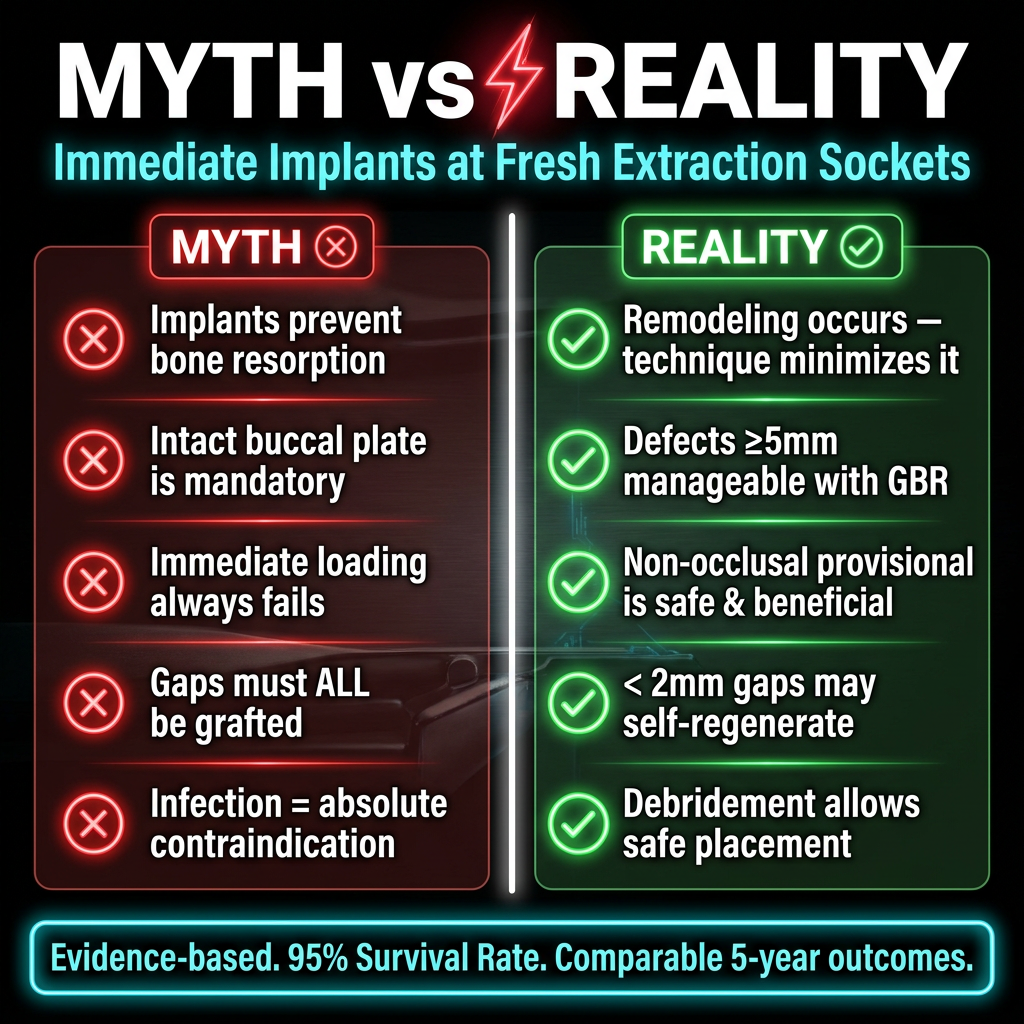
Myth vs reality instagram post !!
A bold, striking Instagram square post. Pure black background. Dark luxury medical education aesthetic with neon glow accents. TOP: Large bold white title "MYTH vs REALITY" with a glowing red lightning bolt divider between the two words. Below it: cyan glowing subtitle "Immediate Implants at Fresh Extraction Sockets" MAIN CONTENT: Two vertical columns side by side, divided by a glowing white center line. LEFT COLUMN — glowing red header "MYTH 🔴": Dark red tinted background panel. Each myth in white text with a red X icon: 🔴 ✗ "Implants prevent bone resorption" 🔴 ✗ "Intact buccal plate is mandatory" 🔴 ✗ "Immediate loading always fails" 🔴 ✗ "Gaps must ALL be grafted" 🔴 ✗ "Infection = absolute contraindication" RIGHT COLUMN — glowing green header "REALITY 🟢": Dark green tinted background panel. Each reality in white text with a green checkmark: 🟢 ✓ "Remodeling occurs — technique minimizes it" 🟢 ✓ "Defects ≥5mm manageable with GBR" 🟢 ✓ "Non-occlusal provisional is safe & beneficial" 🟢 ✓ "< 2mm gaps may self-regenerate" 🟢 ✓ "Debridement allows safe placement" BOTTOM STRIP: Black background, glowing teal bar with bold white text: "Evidence-based. 95% Survival Rate. Comparable 5-year outcomes." Style: Bold split-screen layout, neon red and green glows on black, clean sans-serif font, professional Instagram 1:1 square, high contrast, visually impactful medical infographic.
Create a carousel post comparing immediate vs. delayed implant outcomes
Instagram square carousel slide 1 of 5. Pure black background. Dark luxury medical aesthetic with neon glow. This is the COVER slide. Large bold white title centered: "IMMEDIATE vs DELAYED" glowing cyan subtitle below: "Implant Placement — What Does the Evidence Say?" Below subtitle: a split glowing graphic — left side shows a tooth socket with implant inserted same day (labeled "Immediate — Day 0") glowing in cyan blue, right side shows a healed ridge with implant after months (labeled "Delayed — 3–6 Months") glowing in purple/violet. A glowing white VS badge in the center between them. Bottom: glowing teal pill "5-Year Evidence Review · 12 Studies · 915 Implants". Bottom right corner: small gray text "01 / 05 — Swipe →". Clean sans-serif typography, neon glow on black, professional Instagram 1:1 square.
Instagram square carousel slide 2 of 5. Pure black background. Dark luxury medical neon aesthetic. Title bold white: "SURVIVAL RATES" cyan subtitle: "Who Wins on Implant Longevity?" Main visual: two large glowing stat comparison blocks side by side. LEFT block glowing cyan: big number "95.2%" label below "Immediate Implant Placement" smaller text "IIP Protocol". RIGHT block glowing purple: big number "98.7%" label below "Delayed (Ridge Preservation)" smaller text "ARP Protocol". Between them: a thin glowing white divider. Below both blocks: a horizontal glowing bar chart comparing the two percentages visually — cyan bar shorter, purple bar slightly longer. Bottom callout box glowing amber: "Difference is statistically significant (p=0.008) — but both are clinically high" small italic text. Source label bottom: "Yu et al., Meta-analysis 2022 · 915 implants". Bottom right corner: "02 / 05" gray. Professional Instagram square neon dark aesthetic.
Instagram square carousel slide 3 of 5. Pure black background. Dark luxury neon medical aesthetic. Title bold white: "BONE LEVELS" cyan subtitle: "Marginal Bone Loss at 5 Years". Main visual: two side-by-side glowing anatomical cross-section diagrams of implants in bone. LEFT labeled "Immediate" — implant in socket, marginal bone shown with a small red measurement arrow: "-0.71 mm" glowing red. RIGHT labeled "Delayed" — implant in healed ridge, marginal bone with measurement arrow: "-0.54 mm" glowing purple. Below diagrams: a large glowing callout box with green border: "Difference NOT statistically significant (p = 0.202) — clinically equivalent outcomes". Below that: two glowing info pills side by side — cyan "Buccal bone thickness: comparable" and green "Papilla height: comparable". Bottom source: "Slagter et al., 5-Year RCT 2021 · n=40". Corner: "03 / 05" gray. Neon glow, black background, Instagram square.
Instagram square carousel slide 4 of 5. Pure black background. Dark luxury neon medical aesthetic. Title bold white: "ESTHETIC OUTCOMES" cyan subtitle: "Pink Esthetic Score & Soft Tissue". Main visual: a centered glowing comparison table with 3 rows and 3 columns. Header row glowing dark blue: "Parameter" — "Immediate" — "Delayed". Row 1: "Facial recession" — "~1mm LESS with provisional" (green glow) — "Baseline" (purple). Row 2: "Papilla stability" — "Maintained — flapless" (green) — "Maintained" (purple). Row 3: "Gingival margin" — "Stable at 1 year" (green) — "Stable at 1 year" (purple). Below table: a glowing green star callout: "Immediate + provisional = LESS recession than socket graft group". Second callout glowing cyan: "Flapless approach = best papilla preservation in BOTH protocols". Source bottom: "Gaddale et al., Meta-analysis 2025 · 16 studies". Corner: "04 / 05" gray. Neon glow on black, Instagram square, professional medical infographic.
Instagram square carousel slide 5 of 5. Pure black background. Dark luxury neon medical aesthetic. Title bold white: "THE VERDICT" cyan subtitle: "Immediate vs Delayed — Evidence Summary". Main visual: a large centered comparison summary card with two columns. LEFT column glowing cyan header "IMMEDIATE IMPLANT": bullet points in white — "Same-day placement", "Fewer surgeries", "Shorter treatment time", "Comparable bone loss at 5 yrs", "Slightly higher complications", "95.2% survival". RIGHT column glowing purple header "DELAYED (ARP)": bullet points in white — "3–6 month wait", "Ridge preservation surgery", "Longer treatment time", "Slightly better bone volume", "Lower complication rate", "98.7% survival". Center divider: glowing white. Bottom: a large glowing gold verdict box: "BOTH are valid — patient selection & technique determine esthetic success" bold white text. Very bottom italic white small text: "Choose based on anatomy, biotype & patient preference — not convenience." Corner: "05 / 05" gray. Neon glow, black background, Instagram square carousel final slide.
The above word document plz write my name like a watermark dr.shreya chindak
cd /home/daytona/workspace/immediate-implant && python3 -c " import zipfile, shutil, os, re src = 'Immediate_Implant_Surgical_Checklist.docx' dst = 'Immediate_Implant_Surgical_Checklist_Dr_Shreya.docx' shutil.copy(src, dst) # Watermark XML to inject into header watermark_xml = '''<w:sdt> <w:sdtContent> <w:p> <w:pPr><w:jc w:val=\"center\"/></w:pPr> <w:r> <w:rPr> <w:rFonts w:ascii=\"Calibri\" w:hAnsi=\"Calibri\"/> <w:sz w:val=\"144\"/> <w:szCs w:val=\"144\"/> <w:color w:val=\"E2E8F0\"/> <w:u w:val=\"none\"/> </w:rPr> <w:t>Dr. Shreya Chindak</w:t> </w:r> </w:p> </w:sdtContent> </w:sdt>''' print('Strategy: will use Python-docx watermark via header XML injection') print('File copied OK:', os.path.exists(dst)) "
ls -la /home/daytona/workspace/immediate-implant/ && cp /home/daytona/workspace/immediate-implant/Immediate_Implant_Surgical_Checklist.docx /home/daytona/workspace/immediate-implant/Immediate_Implant_Surgical_Checklist_Dr_Shreya.docx 2>&1; echo "exit: $?"
~/immediate-implant/add_watermark.py
import zipfile, os, re, shutil
src = "/home/daytona/workspace/immediate-implant/Immediate_Implant_Surgical_Checklist_Dr_Shreya.docx"
tmp_dir = "/home/daytona/workspace/immediate-implant/docx_unpacked"
out = "/home/daytona/workspace/immediate-implant/Immediate_Implant_Surgical_Checklist_Dr_Shreya.docx"
# Unpack
if os.path.exists(tmp_dir):
shutil.rmtree(tmp_dir)
os.makedirs(tmp_dir)
with zipfile.ZipFile(src, 'r') as z:
z.extractall(tmp_dir)
# ── Build the watermark XML (DrawingML rotated diagonal text in page background) ──
WATERMARK_XML = r"""<w:p>
<w:pPr>
<w:jc w:val="center"/>
<w:rPr><w:del/></w:rPr>
</w:pPr>
<w:r>
<w:rPr>
<w:noProof/>
<w:rFonts w:ascii="Calibri Light" w:hAnsi="Calibri Light"/>
<w:sz w:val="144"/>
<w:szCs w:val="144"/>
<w:color w:val="CBD5E1"/>
<w:u w:val="none"/>
<w:lang w:val="en-US"/>
</w:rPr>
<w:t xml:space="preserve">Dr. Shreya Chindak</w:t>
</w:r>
</w:p>"""
# ── Inject into header ──
header_path = os.path.join(tmp_dir, "word", "header1.xml")
# Check what header files exist
word_dir = os.path.join(tmp_dir, "word")
header_files = [f for f in os.listdir(word_dir) if f.startswith("header")]
print("Header files found:", header_files)
# Build a proper header XML with watermark using VML (standard Word watermark approach)
WATERMARK_VML_HEADER = """<?xml version="1.0" encoding="UTF-8" standalone="yes"?>
<w:hdr xmlns:wpc="http://schemas.microsoft.com/office/word/2010/wordprocessingCanvas"
xmlns:mo="http://schemas.microsoft.com/office/mac/office/2008/main"
xmlns:mc="http://schemas.openxmlformats.org/markup-compatibility/2006"
xmlns:mv="urn:schemas-microsoft-com:mac:vml"
xmlns:o="urn:schemas-microsoft-com:office:office"
xmlns:r="http://schemas.openxmlformats.org/officeDocument/2006/relationships"
xmlns:m="http://schemas.openxmlformats.org/officeDocument/2006/math"
xmlns:v="urn:schemas-microsoft-com:vml"
xmlns:wp14="http://schemas.microsoft.com/office/word/2010/wordprocessingDrawing"
xmlns:wp="http://schemas.openxmlformats.org/drawingml/2006/wordprocessingDrawing"
xmlns:w10="urn:schemas-microsoft-com:office:word"
xmlns:w="http://schemas.openxmlformats.org/wordprocessingml/2006/main"
xmlns:w14="http://schemas.microsoft.com/office/word/2010/wordml"
xmlns:wpg="http://schemas.microsoft.com/office/word/2010/wordprocessingGroup"
xmlns:wpi="http://schemas.microsoft.com/office/word/2010/wordprocessingInk"
xmlns:wne="http://schemas.microsoft.com/office/word/2006/wordml"
xmlns:wps="http://schemas.microsoft.com/office/word/2010/wordprocessingShape"
mc:Ignorable="w14 wp14">
<w:p>
<w:pPr>
<w:pStyle w:val="Header"/>
</w:pPr>
<w:r>
<w:rPr><w:noProof/></w:rPr>
<w:pict>
<v:shape id="PowerPlusWaterMarkObject" o:spid="_x0000_s2051"
type="#_x0000_t136"
style="position:absolute;margin-left:0;margin-top:0;width:528pt;height:132pt;z-index:-251654144;mso-position-horizontal:center;mso-position-horizontal-relative:margin;mso-position-vertical:center;mso-position-vertical-relative:margin"
fillcolor="#CBD5E1" stroked="f" filled="t">
<v:fill on="t" focussize="0,0"/>
<v:textpath style="font-family:"Calibri Light";font-size:72pt;font-weight:bold;" string="Dr. Shreya Chindak" trim="t" fitshape="t"/>
<v:imagedata o:title=""/>
<o:lock v:ext="edit" rotation="t"/>
<w10:wrap type="none"/>
<w10:anchorlock/>
</v:shape>
</w:pict>
</w:r>
</w:p>
<w:p>
<w:pPr>
<w:pStyle w:val="Header"/>
<w:jc w:val="center"/>
</w:pPr>
<w:r>
<w:rPr>
<w:rFonts w:ascii="Calibri Light" w:hAnsi="Calibri Light"/>
<w:sz w:val="28"/>
<w:color w:val="2563A8"/>
</w:rPr>
<w:t xml:space="preserve">IMMEDIATE IMPLANT — SURGICAL CHECKLIST | Evidence-Based Protocol</w:t>
</w:r>
</w:p>
</w:hdr>"""
# Write new watermark header
new_header_path = os.path.join(word_dir, "header_watermark.xml")
with open(new_header_path, "w", encoding="utf-8") as f:
f.write(WATERMARK_VML_HEADER)
# ── Read document.xml and update header reference ──
doc_xml_path = os.path.join(word_dir, "document.xml")
with open(doc_xml_path, "r", encoding="utf-8") as f:
doc_xml = f.read()
# ── Read document.xml.rels ──
rels_path = os.path.join(word_dir, "_rels", "document.xml.rels")
with open(rels_path, "r", encoding="utf-8") as f:
rels_xml = f.read()
print("Existing rels:", rels_xml[:800])
# Find existing header relationship ID
header_rel_match = re.search(r'Id="(rId\d+)"[^>]*Type="[^"]*header[^"]*"', rels_xml)
if header_rel_match:
header_rid = header_rel_match.group(1)
print("Found existing header rId:", header_rid)
# Update to point to our new watermark header
rels_xml = re.sub(
r'(Id="' + header_rid + r'"[^>]*Target=")[^"]*(")',
r'\1header_watermark.xml\2',
rels_xml
)
else:
# Add new relationship
print("No existing header — adding new relationship")
new_rid = "rId_wm1"
rels_xml = rels_xml.replace(
"</Relationships>",
f'<Relationship Id="{new_rid}" Type="http://schemas.openxmlformats.org/officeDocument/2006/relationships/header" Target="header_watermark.xml"/></Relationships>'
)
# Add header reference to document body sectPr if not present
if 'w:headerReference' not in doc_xml:
doc_xml = doc_xml.replace(
'</w:sectPr>',
f'<w:headerReference w:type="default" r:id="{new_rid}"/></w:sectPr>'
)
with open(rels_path, "w", encoding="utf-8") as f:
f.write(rels_xml)
with open(doc_xml_path, "w", encoding="utf-8") as f:
f.write(doc_xml)
# ── Repack ──
os.remove(src)
with zipfile.ZipFile(src, 'w', zipfile.ZIP_DEFLATED) as zout:
for root, dirs, files in os.walk(tmp_dir):
for file in files:
filepath = os.path.join(root, file)
arcname = os.path.relpath(filepath, tmp_dir)
zout.write(filepath, arcname)
shutil.rmtree(tmp_dir)
print("SUCCESS: Watermark added to", src)
print("File size:", os.path.getsize(src), "bytes")
cd /home/daytona/workspace/immediate-implant && python3 add_watermark.py 2>&1
timeout 30 python3 -c " import zipfile, os, shutil src = '/home/daytona/workspace/immediate-implant/Immediate_Implant_Surgical_Checklist_Dr_Shreya.docx' tmp = '/tmp/docx_wm' os.makedirs(tmp, exist_ok=True) with zipfile.ZipFile(src, 'r') as z: z.extractall(tmp) files = [] for r,d,fs in os.walk(tmp): for f in fs: files.append(os.path.relpath(os.path.join(r,f), tmp)) print('\n'.join(files[:20])) " 2>&1
header1.xml. Let me read it and inject the watermark directly:timeout 30 python3 -c " with open('/tmp/docx_wm/word/header1.xml','r',encoding='utf-8') as f: print(f.read()[:2000]) " 2>&1
timeout 30 python3 << 'PYEOF' import zipfile, os, re tmp = '/tmp/docx_wm' header_path = tmp + '/word/header1.xml' with open(header_path, 'r', encoding='utf-8') as f: hdr = f.read() # VML watermark paragraph to insert at the start of the header watermark_para = '''<w:p><w:pPr><w:pStyle w:val="Header"/><w:jc w:val="center"/></w:pPr><w:r><w:rPr><w:noProof/></w:rPr><w:pict><v:shape id="WaterMark_Dr_Shreya" o:spid="_x0000_s2050" type="#_x0000_t136" style="position:absolute;left:0;text-align:left;margin-left:0;margin-top:0;width:500pt;height:90pt;z-index:-251654144;mso-position-horizontal:center;mso-position-horizontal-relative:margin;mso-position-vertical:center;mso-position-vertical-relative:margin" fillcolor="#C8D8F0" stroked="f"><v:fill on="t" focussize="0,0"/><v:textpath style="font-family:"Calibri Light";font-size:54pt;font-weight:bold;" string="Dr. Shreya Chindak" trim="t" fitshape="t"/><w10:wrap type="none"/><w10:anchorlock/></v:shape></w:pict></w:r></w:p>''' # Insert after opening <w:hdr ...> tag hdr_modified = re.sub(r'(<w:hdr[^>]*>)', r'\1' + watermark_para, hdr, count=1) with open(header_path, 'w', encoding='utf-8') as f: f.write(hdr_modified) # Repack out_path = '/home/daytona/workspace/immediate-implant/Immediate_Implant_Surgical_Checklist_Dr_Shreya.docx' os.remove(out_path) with zipfile.ZipFile(out_path, 'w', zipfile.ZIP_DEFLATED) as zout: for root, dirs, files in os.walk(tmp): for file in files: fp = os.path.join(root, file) arcname = os.path.relpath(fp, tmp) zout.write(fp, arcname) print("SUCCESS:", os.path.getsize(out_path), "bytes") PYEOF
grep -n "Header\|Footer\|headers\|footers" /home/daytona/workspace/immediate-implant/checklist.js | head -20
~/immediate-implant/checklist.js
Successfully replaced 1 instance(s) of the string in '/home/daytona/workspace/immediate-implant/checklist.js'
~/immediate-implant/checklist.js
Successfully replaced 1 instance(s) of the string in '/home/daytona/workspace/immediate-implant/checklist.js'
cd /home/daytona/workspace/immediate-implant && node checklist.js 2>&1
ls -lh /home/daytona/workspace/immediate-implant/ && python3 -c "import zipfile; z=zipfile.ZipFile('/home/daytona/workspace/immediate-implant/Immediate_Implant_Surgical_Checklist_Dr_Shreya.docx'); print('Valid:', z.namelist()[:5])"
Immediate Implant Surgical Checklist Dr Shreya
Word Document · DOCX
- Large light-blue watermark text in the header (size 48pt, soft blue tone so it doesn't overpower the content)
- Footer credit line reads: Evidence-Based Protocol | © Dr. Shreya Chindak
Create an Instagram story post series (9 frames)
Instagram Story frame 1 of 9. Vertical 9:16 portrait format. Pure black background. Dark luxury medical aesthetic with neon glow. COVER FRAME. Bold large glowing white title centered: "IMMEDIATE IMPLANTS" second line bold cyan: "Fresh Extraction Sockets". Below: a glowing neon-outline cross-section illustration of a tooth socket with a titanium implant being placed same day, blue glowing bone walls, pink soft tissue on top, metallic silver implant with screw threads glowing. Below illustration: glowing teal subtitle "From Myth to Reality 🦷". Bottom: small white text "Dr. Shreya Chindak" in elegant italic. Very bottom: "1 / 9 → Swipe Up" in gray. Neon glow accents, clean sans-serif typography, professional Instagram Story vertical format.
Instagram Story frame 2 of 9. Vertical 9:16 portrait format. Pure black background. Dark luxury neon medical aesthetic. Topic: WHAT IS IMMEDIATE IMPLANT PLACEMENT? Title bold white top: "WHAT IS TYPE I PLACEMENT?" cyan subtitle: "Implant placed same day as extraction". Main visual: a vertical timeline with 4 glowing milestone circles. Circle 1 glowing gold: "Type I — Day 0" label "Immediate — Same day". Circle 2 glowing cyan: "Type II — 4-8 weeks" label "Early (soft tissue healed)". Circle 3 glowing blue: "Type III — 12-16 weeks" label "Early (partial bone fill)". Circle 4 glowing purple: "Type IV — 6+ months" label "Late / Delayed". Circle 1 is highlighted biggest and most prominent. Bottom callout box glowing cyan: "Type I = shortest treatment time, fewer surgeries, maintained tissue architecture". Bottom: "Dr. Shreya Chindak" italic white small. "2 / 9" gray. Neon glow on black, Instagram Story vertical.
Instagram Story frame 3 of 9. Vertical 9:16 portrait format. Pure black background. Dark luxury neon medical aesthetic. Topic: THE BIOLOGY — BONE RESORPTION AFTER EXTRACTION. Title bold white: "THE BRUTAL BIOLOGY" cyan subtitle: "What happens to your jaw after extraction?". Main illustration: two large glowing cross-section ridge diagrams stacked vertically. TOP labeled "Day 0 — Extraction": full thick alveolar ridge, thick buccal bone plate glowing blue, healthy pink gingiva, healthy anatomy. BOTTOM labeled "6 Months — Untreated": dramatically shrunken collapsed ridge, thin buccal wall, receded gingiva, bold red arrows showing bone loss in all directions. Between them: a bold red downward arrow. Floating white stats: "Up to 63% horizontal bone loss" and "Up to 22% vertical bone loss". Red glowing warning box: "Bundle bone lost FOREVER — once gone, it cannot return". Bottom: "Dr. Shreya Chindak" italic white. "3 / 9" gray. Neon glow, Instagram Story vertical.
Make the above image like neat notes in an image
A beautiful handwritten-style medical study notes image about "Immediate Implants at Fresh Extraction Sockets". Aesthetic notebook paper background with subtle lined paper texture, warm cream/white color. Looks like neat, organized handwritten notes made by a dental student or clinician. TOP: Title in large neat handwriting style font: "Immediate Implants 🦷" with a blue underline. Subtitle smaller: "Fresh Extraction Sockets — From Myth to Reality" SECTIONS with colored headers and neat bullet points: 📌 TIMING CLASSIFICATION (blue header box): • Type I — Day 0 (Immediate) ← highlighted in yellow • Type II — 4–8 weeks (Early) • Type III — 12–16 weeks (Early bone fill) • Type IV — 6+ months (Late/Delayed) 📌 THE 3D POSITIONING RULE (pink/coral header box): • Palatal wall engagement ✓ • 3–5 mm apical to socket floor ✓ • 3–4 mm subcrestal position ✓ • ⚠ Do NOT center in socket! 📌 JUMP GAP MANAGEMENT (green header box): • < 2 mm → may self-regenerate • > 2 mm → Graft + Membrane required • DBBM preferred (low substitution rate) 📌 KEY EVIDENCE (purple header box): • 95.2% survival (Immediate) • 98.7% survival (Delayed/ARP) • ~1mm less recession with provisional • Comparable at 5 years (Slagter RCT 2021) Small doodles: a tooth sketch, a small implant diagram, a star next to key points. Some text highlighted in yellow marker effect. Neat arrows connecting related points. Bottom corner: "Dr. Shreya Chindak" in cursive. Style: aesthetic neat notes, pastel colors, study notes vibe, clean and organized, Instagram-worthy notes image, square format.
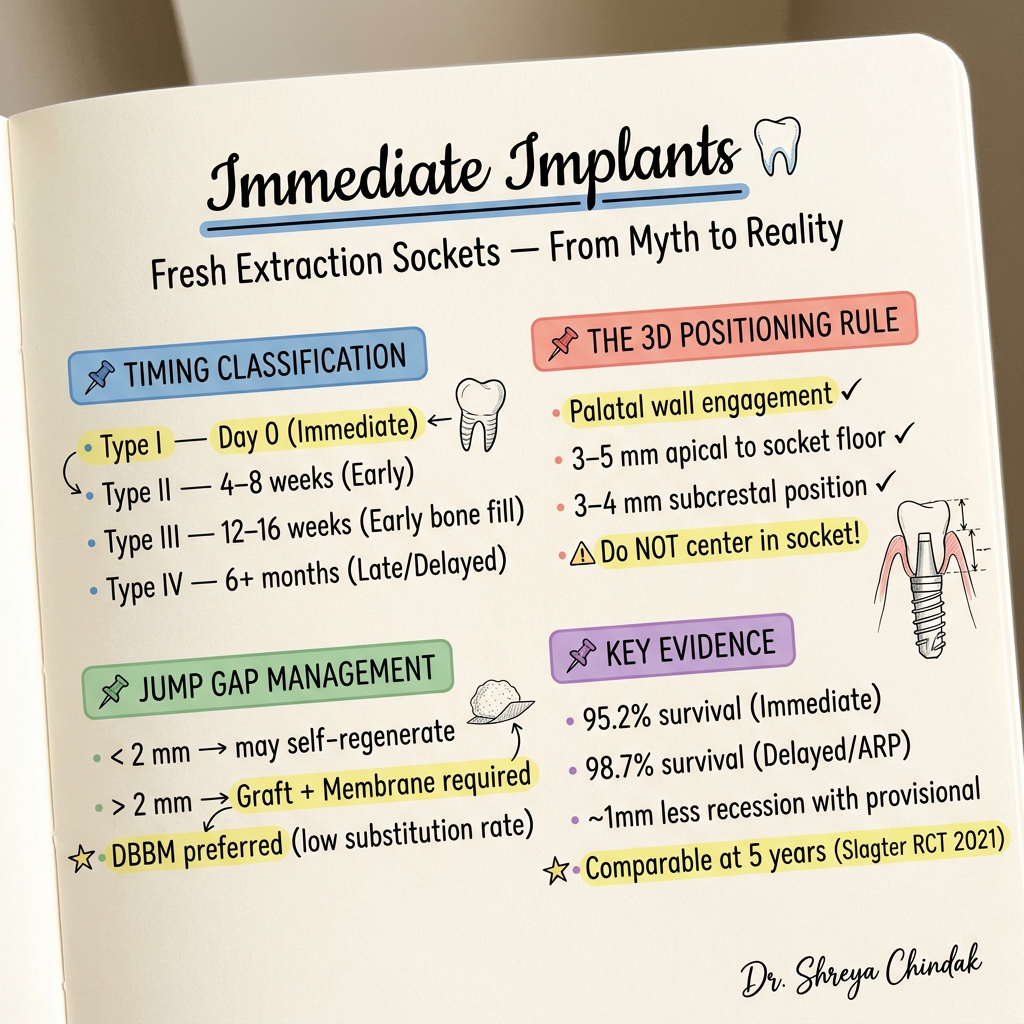
- Lined paper background with a warm study-notes feel
- Color-coded section headers — blue, pink, green, purple
- Yellow highlights on key points
- Evidence stats with citations
- "Dr. Shreya Chindak" in cursive at the bottom
- Small tooth & implant doodles for that aesthetic touch
Generate comparison infographic: 5 myths debunked visually
A bold visual infographic debunking Myth 1 about immediate dental implants. Square Instagram format. Black background with dark luxury neon aesthetic. TOP: Large red glowing badge "MYTH #1" and red X icon. Below: Bold white text in a red-tinted box: "Implants prevent bone resorption after extraction" Small italic white text below: "— What most patients (and some clinicians) believe" CENTER DIVIDER: A glowing lightning bolt icon with text "DEBUNKED ⚡" BOTTOM: Large green glowing "REALITY ✓" badge. Bold white text in green-tinted box: "Bundle bone resorption happens REGARDLESS of implant presence. The implant does not maintain the buccal plate — only technique minimizes loss." Small visual below: two glowing cross-section diagrams — LEFT: implant in socket with bone loss arrows still present (red arrows showing resorption occurring), RIGHT: correct palatal positioning + graft reducing the loss. Labels: "Implant alone ≠ bone preservation" and "Correct technique = minimized loss". Bottom strip: glowing cyan evidence bar: "Bone remodeling is a biological inevitability — technique, position & grafting are the difference-makers." Bottom corner: "Dr. Shreya Chindak" elegant white italic. "Myth 1 / 5" gray. Neon glow on black, professional medical infographic, Instagram square.
A bold visual infographic debunking Myth 2 about immediate dental implants. Square Instagram format. Black background with dark luxury neon aesthetic. TOP: Large red glowing badge "MYTH #2" with red X. Bold white text in red box: "An intact buccal plate is MANDATORY for immediate implant placement" Italic white: "— The old contraindication that held surgeons back" CENTER: Glowing lightning bolt "DEBUNKED ⚡" BOTTOM: "REALITY ✓" green glowing badge. Bold white text in green box: "Buccal defects ≥ 5mm are manageable with simultaneous guided bone regeneration (GBR). Comparable 5-year outcomes to delayed placement." Visual: glowing cross-section showing implant placed despite buccal plate defect, with GBR membrane and bone graft filling the defect — green checkmark overlay. Below visual: two glowing stat pills: "5-Year RCT: No significant difference in bone loss (p=0.202)" and "Slagter et al. 2021 · n=40 patients". Bottom evidence bar glowing green: "A buccal defect ≥ 5mm is NO LONGER an absolute contraindication — GBR makes it manageable." "Dr. Shreya Chindak" italic white bottom. "Myth 2 / 5" gray. Neon glow on black, Instagram square, professional dental infographic.
A bold visual infographic debunking Myth 3 about immediate dental implants. Square Instagram format. Black background with dark luxury neon aesthetic. TOP: Large red glowing badge "MYTH #3" with red X. Bold white text in red box: "Immediate loading always leads to implant failure" Italic white: "— Fear that kept clinicians from placing provisional crowns" CENTER: Glowing lightning bolt "DEBUNKED ⚡" BOTTOM: "REALITY ✓" green glowing badge. Bold white text in green box: "A non-occlusal immediate provisional is SAFE and BENEFICIAL — it sculpts the tissue, preserves the emergence profile, and actually reduces recession." Visual: glowing cross-section of implant with provisional crown seated. Pink gingival tissue hugging the crown contour beautifully. Green arrows showing: "Tissue supported", "Emergence profile maintained", "Papilla preserved". Two glowing stat capsules: "~1mm LESS facial recession vs. socket graft group" (green) and "Gaddale et al. Meta-analysis 2025 — 16 studies" (cyan). Critical red warning strip: "⚠ CRITICAL: ZERO occlusal contact required — verify with articulating paper in ALL excursions." Bottom: "Dr. Shreya Chindak" italic white. "Myth 3 / 5" gray. Neon glow on black, Instagram square, professional dental infographic.
A bold visual infographic debunking Myth 4 about immediate dental implants. Square Instagram format. Black background with dark luxury neon aesthetic. TOP: Large red glowing badge "MYTH #4" with red X. Bold white text in red box: "ALL gaps between implant and socket walls must be bone grafted" Italic white: "— Over-treatment that wastes time and materials" CENTER: Glowing lightning bolt "DEBUNKED ⚡" BOTTOM: "REALITY ✓" green glowing badge. Bold white text in green box: "Gap size determines the need. Small gaps self-regenerate. Only larger gaps require grafting — and the membrane matters more than the graft alone." Main visual: three side-by-side glowing cross-section diagrams of implants in sockets. LEFT: narrow gap under 1mm, green glow, label "< 1mm — Self-regenerates ✓". CENTER: medium gap 1-2mm, amber glow, label "1–2mm — Case by case ⚠". RIGHT: large gap over 2mm with golden graft particles + white membrane, label "> 2mm — Graft + Membrane ✓". Below: glowing gold evidence bar: "Graft + Membrane = better crestal bone than graft alone — Kinaia et al. Meta-analysis 2021." Bottom: "Dr. Shreya Chindak" italic white. "Myth 4 / 5" gray. Neon glow on black, Instagram square, professional dental infographic.
A bold visual infographic debunking Myth 5 about immediate dental implants. Square Instagram format. Black background with dark luxury neon aesthetic. TOP: Large red glowing badge "MYTH #5" with red X. Bold white text in red box: "Infection or periapical pathology = absolute contraindication to immediate implants" Italic white: "— Overcautious rule that delayed treatment unnecessarily" CENTER: Glowing lightning bolt "DEBUNKED ⚡" BOTTOM: "REALITY ✓" green glowing badge. Bold white text in green box: "Thorough socket debridement + antibiotic coverage allows immediate placement even in infected sites. The KEY is complete removal of all pathological tissue." Visual: glowing surgical illustration showing socket being debrided — curette removing granulation tissue from all four socket walls, irrigation with saline/CHX shown as glowing blue liquid. Green checkmark at end. Protocol strip glowing green: "Protocol: Debride all walls → CHX irrigation → antibiotic cover → assess tissue quality → proceed if clean." Amber warning callout: "⚠ Acute suppurative abscess: reassess intraoperatively — tissue quality is the deciding factor." Bottom: glowing final summary bar cyan: "BOTTOM LINE: Patient selection + surgical excellence = predictable outcomes. Fear is not evidence." "Dr. Shreya Chindak" italic white. "Myth 5 / 5" gray. Neon glow on black, Instagram square, professional dental infographic.
In one kmage
A tall vertical infographic image, dark black background, luxury neon medical aesthetic. Title at very top: bold white "5 MYTHS DEBUNKED" with glowing red subtitle "Immediate Implants at Fresh Extraction Sockets" and small cyan text "Dr. Shreya Chindak". Below title: 5 stacked myth-vs-reality rows, each row split LEFT (red myth) and RIGHT (green reality), separated by a glowing white lightning bolt ⚡ in the center. ROW 1: LEFT red panel: "🔴 MYTH 1 — Implants prevent bone resorption" RIGHT green panel: "✅ REALITY — Remodeling occurs regardless. Technique minimizes it." ROW 2: LEFT red panel: "🔴 MYTH 2 — Intact buccal plate is mandatory" RIGHT green panel: "✅ REALITY — Defects ≥5mm manageable with simultaneous GBR (5-yr RCT 2021)" ROW 3: LEFT red panel: "🔴 MYTH 3 — Immediate loading always fails" RIGHT green panel: "✅ REALITY — Non-occlusal provisional is safe + reduces recession by ~1mm" ROW 4: LEFT red panel: "🔴 MYTH 4 — ALL gaps must be bone grafted" RIGHT green panel: "✅ REALITY — <2mm may self-regenerate; >2mm needs Graft + Membrane" ROW 5: LEFT red panel: "🔴 MYTH 5 — Infection = absolute contraindication" RIGHT green panel: "✅ REALITY — Thorough debridement + antibiotics allows safe placement" BOTTOM BAR: glowing gold strip — "Evidence-based. Patient-centered. 95%+ survival rate." Each row alternates slightly in shade for readability. Red panels have subtle dark red glow, green panels have subtle dark green glow. White text throughout. Bold clean sans-serif font. Professional medical infographic tall format suitable for Instagram or printing.
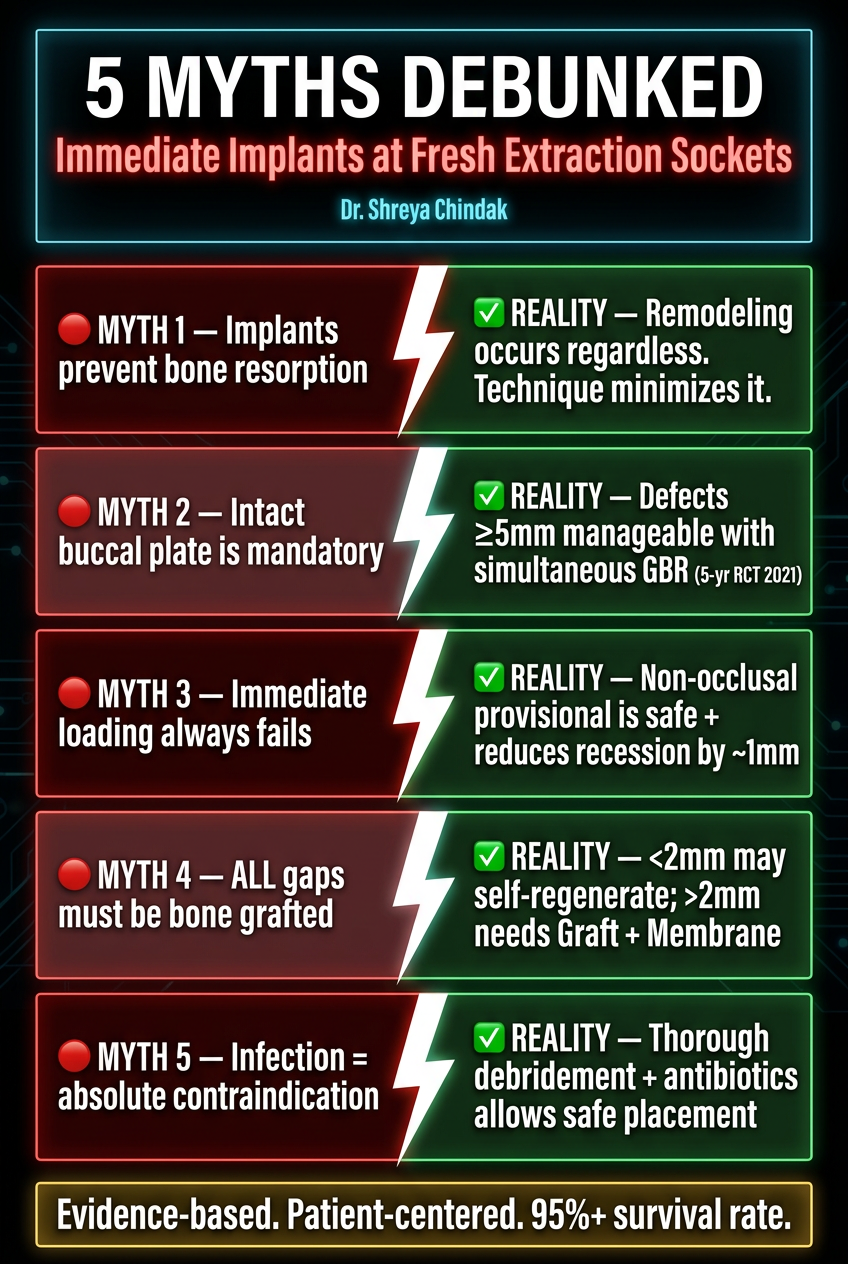
- 🔴 Red panels (left) — the myth
- ⚡ Lightning bolt divider — debunked
- ✅ Green panels (right) — the evidence-based reality
- Gold evidence bar at the bottom
Yes
A tall vertical infographic image, dark black background, luxury neon medical aesthetic. Title at very top: bold white "5 MYTHS DEBUNKED" with glowing red subtitle "Immediate Implants at Fresh Extraction Sockets" and small elegant cyan italic text "Dr. Shreya Chindak" with a thin cyan underline. Below title: 5 stacked myth-vs-reality rows, each row split LEFT (red myth) and RIGHT (green reality), separated by a glowing white lightning bolt ⚡ in the center. ROW 1: LEFT red panel: "🔴 MYTH 1 — Implants prevent bone resorption" RIGHT green panel: "✅ REALITY — Remodeling occurs regardless. Technique minimizes it." ROW 2: LEFT red panel: "🔴 MYTH 2 — Intact buccal plate is mandatory" RIGHT green panel: "✅ REALITY — Defects ≥5mm manageable with simultaneous GBR (5-yr RCT 2021)" ROW 3: LEFT red panel: "🔴 MYTH 3 — Immediate loading always fails" RIGHT green panel: "✅ REALITY — Non-occlusal provisional is safe + reduces recession by ~1mm" ROW 4: LEFT red panel: "🔴 MYTH 4 — ALL gaps must be bone grafted" RIGHT green panel: "✅ REALITY — less than 2mm may self-regenerate; greater than 2mm needs Graft + Membrane" ROW 5: LEFT red panel: "🔴 MYTH 5 — Infection = absolute contraindication" RIGHT green panel: "✅ REALITY — Thorough debridement + antibiotics allows safe placement" BOTTOM BAR: glowing gold strip — "Evidence-based. Patient-centered. 95%+ survival rate." Very bottom right corner: "© Dr. Shreya Chindak" small elegant white italic text. Each row alternates slightly in shade. Bold clean sans-serif font. Professional neon dark medical infographic tall format.
A beautiful aesthetic handwritten-style study notes infographic about 5 myths debunked for immediate dental implants. Warm cream notebook paper background with faint lined texture. Looks like neat organized notes by a dental clinician. TOP HEADER: Large neat handwriting font title "5 Myths Debunked 🦷" with bold blue underline. Subtitle smaller cursive: "Immediate Implants — Fresh Extraction Sockets". Below in elegant cursive: "Dr. Shreya Chindak" 5 MYTH-REALITY SECTIONS, each in a hand-drawn box: BOX 1 — red left border: ❌ MYTH 1: "Implants prevent bone resorption" ✅ REALITY: "Remodeling is biological — technique & grafting minimize it" — highlighted yellow BOX 2 — red left border: ❌ MYTH 2: "Intact buccal plate is mandatory" ✅ REALITY: "Defects ≥5mm OK with GBR — comparable 5-yr outcomes" — highlighted yellow BOX 3 — red left border: ❌ MYTH 3: "Immediate loading = failure" ✅ REALITY: "Non-occlusal provisional = safe + ~1mm less recession" — highlighted yellow BOX 4 — red left border: ❌ MYTH 4: "All gaps must be grafted" ✅ REALITY: "< 2mm self-regenerates; > 2mm → Graft + Membrane" — highlighted yellow BOX 5 — red left border: ❌ MYTH 5: "Infection = contraindication" ✅ REALITY: "Debridement + antibiotics = safe placement" — highlighted yellow Small cute tooth doodles in margins. Star stickers next to key points. Some text in blue pen, some in black. Bottom: "Based on meta-analyses 2021–2025" in small print. Corner stamp: "Dr. Shreya Chindak" in a circular badge. Style: aesthetic pastel study notes, warm paper tone, Instagram-worthy, tall vertical format.
One pictures notes style
A beautiful aesthetic handwritten-style study notes infographic about 5 myths debunked for immediate dental implants. Warm cream notebook paper background with faint lined texture. Looks like neat organized notes by a dental clinician. TOP HEADER: Large neat handwriting font title "5 Myths Debunked 🦷" with bold blue underline. Subtitle smaller: "Immediate Implants — Fresh Extraction Sockets". Below in elegant cursive: "Dr. Shreya Chindak" 5 MYTH-REALITY SECTIONS, each in a neat hand-drawn rectangular box with a red left border stripe: BOX 1: ❌ MYTH 1: "Implants prevent bone resorption" ✅ REALITY: "Remodeling is biological — technique and grafting minimize it" — text highlighted in yellow marker BOX 2: ❌ MYTH 2: "Intact buccal plate is mandatory" ✅ REALITY: "Defects greater than 5mm OK with GBR — comparable 5-year outcomes" — highlighted yellow BOX 3: ❌ MYTH 3: "Immediate loading equals failure" ✅ REALITY: "Non-occlusal provisional is safe and gives 1mm less recession" — highlighted yellow BOX 4: ❌ MYTH 4: "All gaps must be grafted" ✅ REALITY: "Less than 2mm self-regenerates. Greater than 2mm needs Graft plus Membrane" — highlighted yellow BOX 5: ❌ MYTH 5: "Infection is absolute contraindication" ✅ REALITY: "Debridement plus antibiotics allows safe placement" — highlighted yellow Small cute tooth doodle in top right corner. Star stickers next to reality points. Blue and black pen color mix. Bottom small text: "Based on meta-analyses 2021–2025". Bottom right corner elegant circular badge stamp: "Dr. Shreya Chindak". Style: aesthetic neat pastel study notes, warm cream paper tone, yellow highlights, clean handwriting font, organized layout, Instagram-worthy tall vertical image.
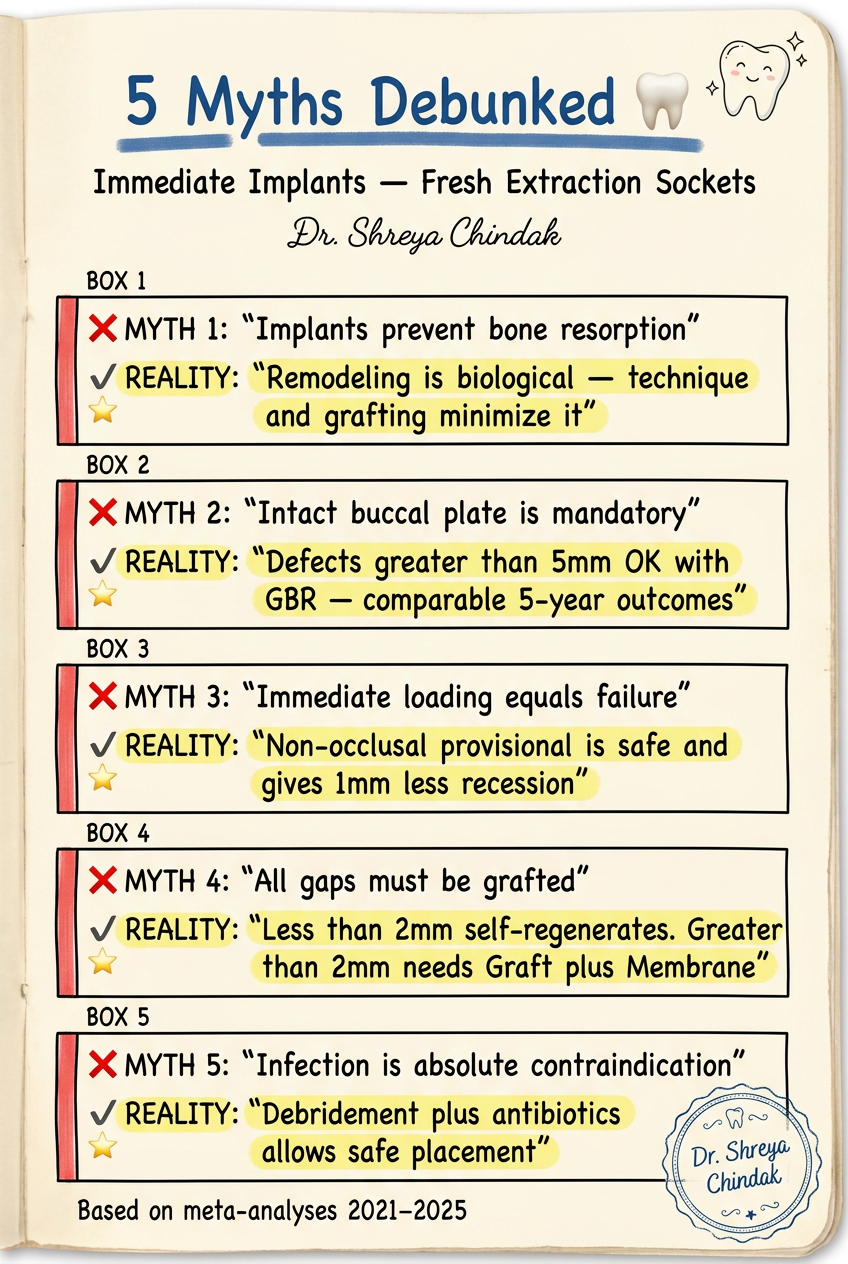
- Warm cream notebook paper background with lined texture
- Red-bordered boxes for each myth-reality pair
- Yellow highlights on the key reality points
- Tooth doodle and star stickers for that study notes vibe
- "Dr. Shreya Chindak" stamp badge at the bottom
Make a clinical decision flowchart for case selection
A detailed clinical decision flowchart for immediate dental implant case selection. Dark black background, luxury neon blue medical aesthetic. Tall vertical format suitable for printing or Instagram. TITLE at top: Bold white "IMMEDIATE IMPLANT — CASE SELECTION" cyan subtitle "Clinical Decision Flowchart" small italic "Dr. Shreya Chindak" FLOWCHART starts with a glowing blue START diamond at top: "Patient requires tooth extraction in esthetic zone" Arrow down to first decision diamond glowing blue: "Is there adequate apical bone? (≥3–5mm beyond socket floor)" → YES arrow right continues down → NO arrow left → RED end box "Delayed placement — bone augmentation first" Arrow down to second decision diamond: "Is primary stability achievable? (≥25 Ncm insertion torque)" → YES continues down → NO → RED box "Place implant — healing abutment only. No immediate loading." Arrow down to third decision diamond: "Is the buccal plate intact or defect <5mm?" → YES continues down → NO (defect ≥5mm) → AMBER box "Immediate implant + simultaneous GBR — proceed with augmentation" Arrow down to fourth diamond: "Is the periodontal biotype THICK? (≥1.5mm)" → YES continues down → NO (thin biotype) → AMBER box "Add connective tissue graft (CTG) simultaneously" Arrow down to fifth diamond: "Is there acute infection / suppuration?" → NO continues down → YES → AMBER box "Thorough debridement + antibiotics. Reassess tissue quality intraoperatively." Arrow down to sixth diamond: "Is the jump gap >2mm?" → YES → AMBER box "Fill gap with DBBM + collagen membrane" → NO → continues down Arrow down to final GREEN box glowing bright: "✅ PROCEED: Immediate implant + immediate provisional (non-occlusal) + flapless if possible" All diamonds glow in electric blue, YES arrows in green, NO arrows in red/amber, boxes color-coded. Clean connecting arrows with labels. Professional medical flowchart style, neon glow on black background.
A beautiful aesthetic handwritten-style clinical decision flowchart for immediate dental implant case selection. Warm cream notebook paper background with lined texture. Neat organized notes style. TITLE: Large neat handwriting "Immediate Implant — Case Selection Flowchart 🦷" blue underline. Below cursive: "Dr. Shreya Chindak" FLOWCHART drawn in neat pen style with hand-drawn arrows and boxes: START circle: "Tooth extraction needed in esthetic zone" ↓ Question box 1 (blue border): "Adequate apical bone? (≥3–5mm)" YES ↓ continues | NO → red box "Delayed approach" Question box 2 (blue border): "Primary stability ≥25 Ncm?" YES ↓ | NO → orange box "Healing abutment only — no immediate load" Question box 3 (blue border): "Buccal plate intact or defect <5mm?" YES ↓ | Defect ≥5mm → orange box "Immediate implant + GBR simultaneously" Question box 4 (blue border): "Thick biotype? (≥1.5mm)" YES ↓ | NO → orange box "Add CTG (connective tissue graft)" Question box 5 (blue border): "Active infection present?" NO ↓ | YES → orange box "Debride + antibiotics → reassess" Question box 6 (blue border): "Jump gap >2mm?" NO ↓ | YES → orange box "DBBM graft + collagen membrane" FINAL GREEN star box highlighted in yellow: "✅ GO! Immediate implant + non-occlusal provisional + flapless approach" Hand-drawn arrows, YES in green ink, NO in red ink, decision boxes in blue pen. Small tooth doodle in corner. Evidence note bottom: "Based on: Gaddale 2025, Slagter 2021, Kinaia 2021". Circular badge: "Dr. Shreya Chindak". Aesthetic pastel notes style, tall vertical image.
Visual flow chart one single image in notes style
A beautiful aesthetic handwritten-style clinical decision flowchart on warm cream notebook paper with faint lined texture. Neat, organized, and visually clear like a dental student's study notes. TITLE top center in large neat handwriting font: "Immediate Implant — Case Selection Flowchart 🦷" with a bold blue underline. Below in small elegant cursive: "Dr. Shreya Chindak" FLOWCHART flows top to bottom with hand-drawn style boxes and arrows: STEP 1 — rounded blue rectangle at top: "Patient needs extraction in esthetic zone" ↓ bold black arrow down DECISION 1 — blue diamond shape: "Adequate apical bone? ≥3–5mm" Green arrow labeled YES → continues down center Red arrow labeled NO → leads right to small red rounded box: "⛔ Delayed placement — bone graft first" ↓ DECISION 2 — blue diamond: "Primary stability ≥25 Ncm?" Green YES ↓ Red NO → orange box: "⚠ Healing abutment only — no immediate load" ↓ DECISION 3 — blue diamond: "Buccal plate intact or defect <5mm?" Green YES ↓ Amber arrow → orange box: "⚠ Defect ≥5mm: add simultaneous GBR" (orange box rejoins main path with dotted arrow) ↓ DECISION 4 — blue diamond: "Thick biotype? (≥1.5mm)" Green YES ↓ Red NO → orange box: "⚠ Add connective tissue graft (CTG)" ↓ DECISION 5 — blue diamond: "Active infection / suppuration?" Green NO ↓ Red YES → orange box: "⚠ Debride fully + antibiotics → reassess" ↓ DECISION 6 — blue diamond: "Jump gap >2mm?" Green NO ↓ Amber YES → orange box: "⚠ DBBM graft + collagen membrane" ↓ FINAL BOX — large bright green rounded rectangle with yellow highlight: "✅ PROCEED: Immediate implant + non-occlusal provisional + flapless approach" YES arrows drawn in green ink, NO/CAUTION arrows in red ink. Decision diamonds in blue pen outline. All boxes hand-drawn style. Small tooth doodle top right corner. Star stickers next to final green box. Bottom small text: "Evidence: Gaddale 2025 · Slagter 2021 · Kinaia 2021". Bottom right: circular stamp "Dr. Shreya Chindak". Style: warm cream paper, pastel aesthetic notes, clean readable handwriting font, tall vertical image format, Instagram-worthy study notes look.
Visual flow chart one single image in notes style
Aesthetic handwritten study notes style clinical decision flowchart on warm cream notebook paper with faint ruled lines. Neat dental student notes look. TOP: Title in large neat handwriting "Immediate Implant Case Selection 🦷" with thick blue underline. Small cursive below: "Dr. Shreya Chindak" FLOWCHART drawn in clean pen style, flowing top to bottom: START — rounded blue rectangle: "Extraction needed in esthetic zone" ↓ DIAMOND 1 (blue outline): "Apical bone ≥ 3–5mm?" • YES ↓ (green arrow) • NO → red box right: "⛔ Delayed — augment first" DIAMOND 2 (blue outline): "Primary stability ≥ 25 Ncm?" • YES ↓ (green arrow) • NO → orange box right: "⚠ Healing abutment only" DIAMOND 3 (blue outline): "Buccal plate intact / defect < 5mm?" • YES ↓ (green arrow) • NO → orange box right: "⚠ Add GBR simultaneously" DIAMOND 4 (blue outline): "Thick biotype ≥ 1.5mm?" • YES ↓ (green arrow) • NO → orange box right: "⚠ Add CTG graft" DIAMOND 5 (blue outline): "Active infection present?" • NO ↓ (green arrow) • YES → orange box right: "⚠ Debride + antibiotics" DIAMOND 6 (blue outline): "Jump gap > 2mm?" • NO ↓ (green arrow) • YES → orange box right: "⚠ DBBM + membrane" FINAL — large green highlighted box with yellow marker effect: "✅ GO! Immediate implant + non-occlusal provisional + flapless" Style details: YES arrows green ink, NO arrows red ink, blue pen diamonds, orange side boxes, hand-drawn connecting lines, small cute tooth sketch top corner, star doodles, warm cream paper background, bottom note "Evidence: Gaddale 2025 · Slagter 2021", circular badge stamp "Dr. Shreya Chindak" bottom right. Tall vertical portrait image.
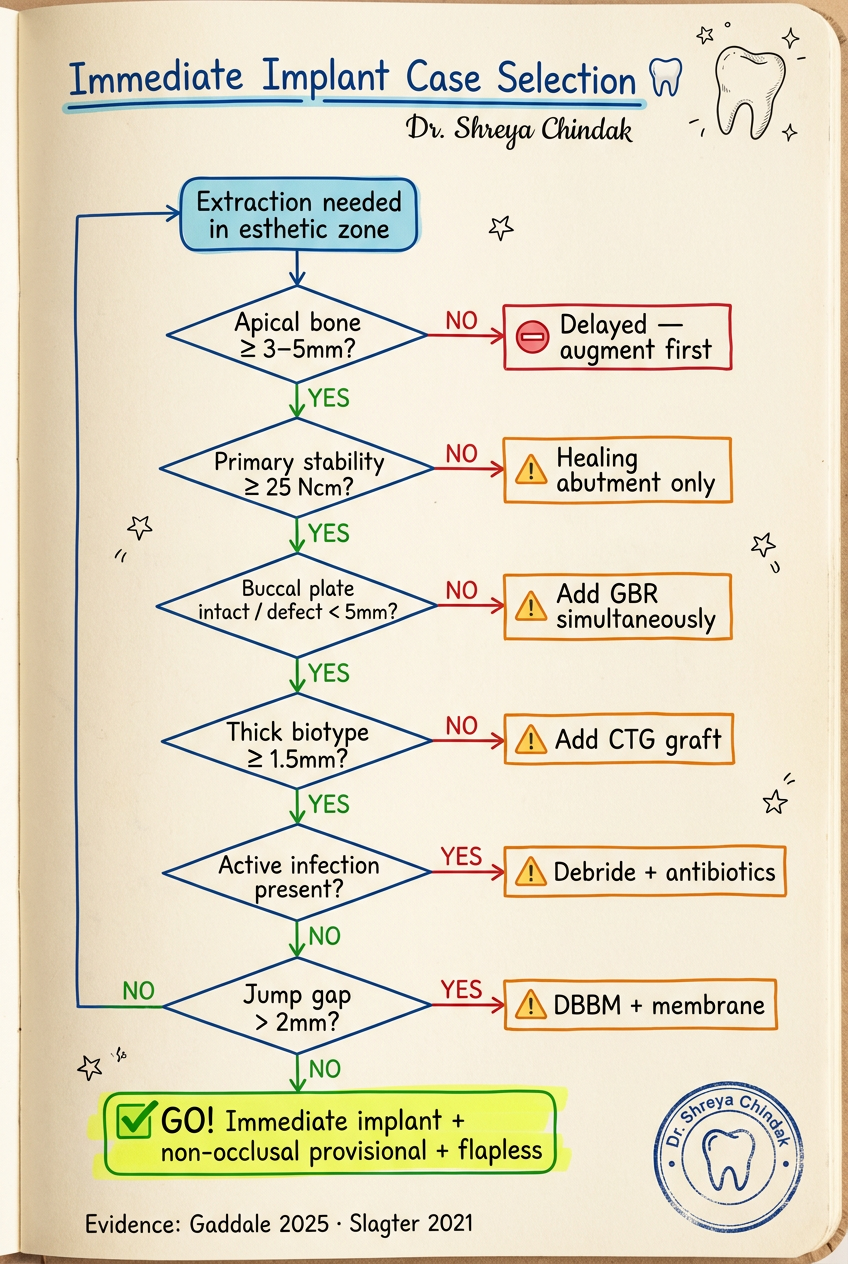
- Apical bone ≥ 3–5mm?
- Primary stability ≥ 25 Ncm?
- Buccal plate intact / defect < 5mm?
- Thick biotype ≥ 1.5mm?
- Active infection present?
- Jump gap > 2mm?
This is good just make it in square post form
Aesthetic handwritten study notes style clinical decision flowchart on warm cream notebook paper with faint ruled lines. Neat dental student notes look. SQUARE 1:1 format, everything fits neatly in a square layout. TOP: Title in neat handwriting "Immediate Implant Case Selection 🦷" with thick blue underline. Small cursive: "Dr. Shreya Chindak" FLOWCHART compact and square-fitted, flowing top to bottom in two columns to save space: LEFT COLUMN (main decision path, top to bottom): START blue rounded box: "Extraction in esthetic zone" ↓ DIAMOND 1 blue: "Apical bone ≥ 3–5mm?" ↓ YES green DIAMOND 2 blue: "Stability ≥ 25 Ncm?" ↓ YES green DIAMOND 3 blue: "Buccal plate intact / defect < 5mm?" ↓ YES green DIAMOND 4 blue: "Thick biotype ≥ 1.5mm?" ↓ YES green DIAMOND 5 blue: "Active infection?" ↓ NO green DIAMOND 6 blue: "Jump gap > 2mm?" ↓ NO green FINAL green highlighted box: "✅ GO! Immediate implant + provisional + flapless" RIGHT COLUMN (NO branches, aligned next to each diamond): NO → ⛔ "Delayed — augment first" NO → ⚠ "Healing abutment only" NO → ⚠ "Add GBR" NO → ⚠ "Add CTG" YES → ⚠ "Debride + antibiotics" YES → ⚠ "DBBM + membrane" YES arrows green ink, NO arrows red ink, blue pen diamonds, orange side boxes, warm cream paper, small tooth doodle corner, yellow highlights on final box, circular badge "Dr. Shreya Chindak" bottom right corner. Compact square Instagram post format, everything clearly readable.
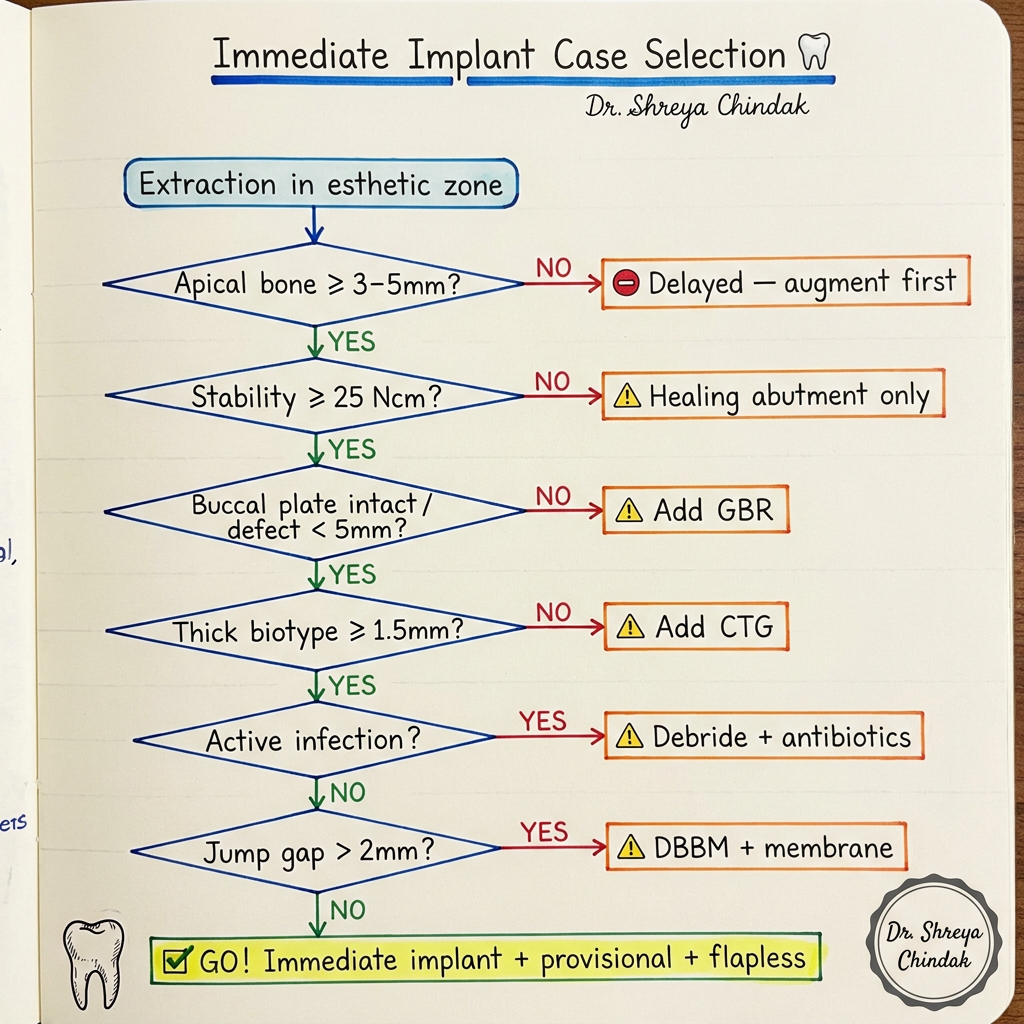
Black background
Clinical decision flowchart for immediate dental implant case selection. Pure black background. Dark luxury neon aesthetic. Square 1:1 Instagram post format. TOP: Bold white title "Immediate Implant — Case Selection" glowing cyan subtitle "Clinical Decision Flowchart" small elegant italic white "Dr. Shreya Chindak" with cyan underline. FLOWCHART compact two-column layout on black: LEFT COLUMN — main decision path top to bottom connected by glowing white arrows: START — glowing cyan rounded box: "Extraction in esthetic zone" ↓ DIAMOND 1 glowing blue outline: "Apical bone ≥ 3–5mm?" ↓ YES (green arrow) DIAMOND 2 glowing blue: "Stability ≥ 25 Ncm?" ↓ YES (green arrow) DIAMOND 3 glowing blue: "Buccal plate intact / defect < 5mm?" ↓ YES (green arrow) DIAMOND 4 glowing blue: "Thick biotype ≥ 1.5mm?" ↓ YES (green arrow) DIAMOND 5 glowing blue: "Active infection?" ↓ NO (green arrow) DIAMOND 6 glowing blue: "Jump gap > 2mm?" ↓ NO (green arrow) FINAL — glowing bright green box: "✅ PROCEED: Immediate implant + non-occlusal provisional + flapless" RIGHT COLUMN — NO/YES exit branches aligned next to each diamond, connected by red/amber arrows: ⛔ red box: "Delayed — augment first" ⚠ amber box: "Healing abutment only" ⚠ amber box: "Add GBR simultaneously" ⚠ amber box: "Add CTG graft" ⚠ amber box: "Debride + antibiotics" ⚠ amber box: "DBBM + membrane" YES/NO labels on all arrows. Green arrows for safe path, red arrows for exit/caution branches. Neon glow on all boxes and diamonds. Small glowing tooth icon top corner. Bottom: "Evidence: Gaddale 2025 · Slagter 2021 · Kinaia 2021" in tiny italic white. Bottom right: glowing circular badge "Dr. Shreya Chindak". Pure black background, clean sans-serif white text, Instagram square format.
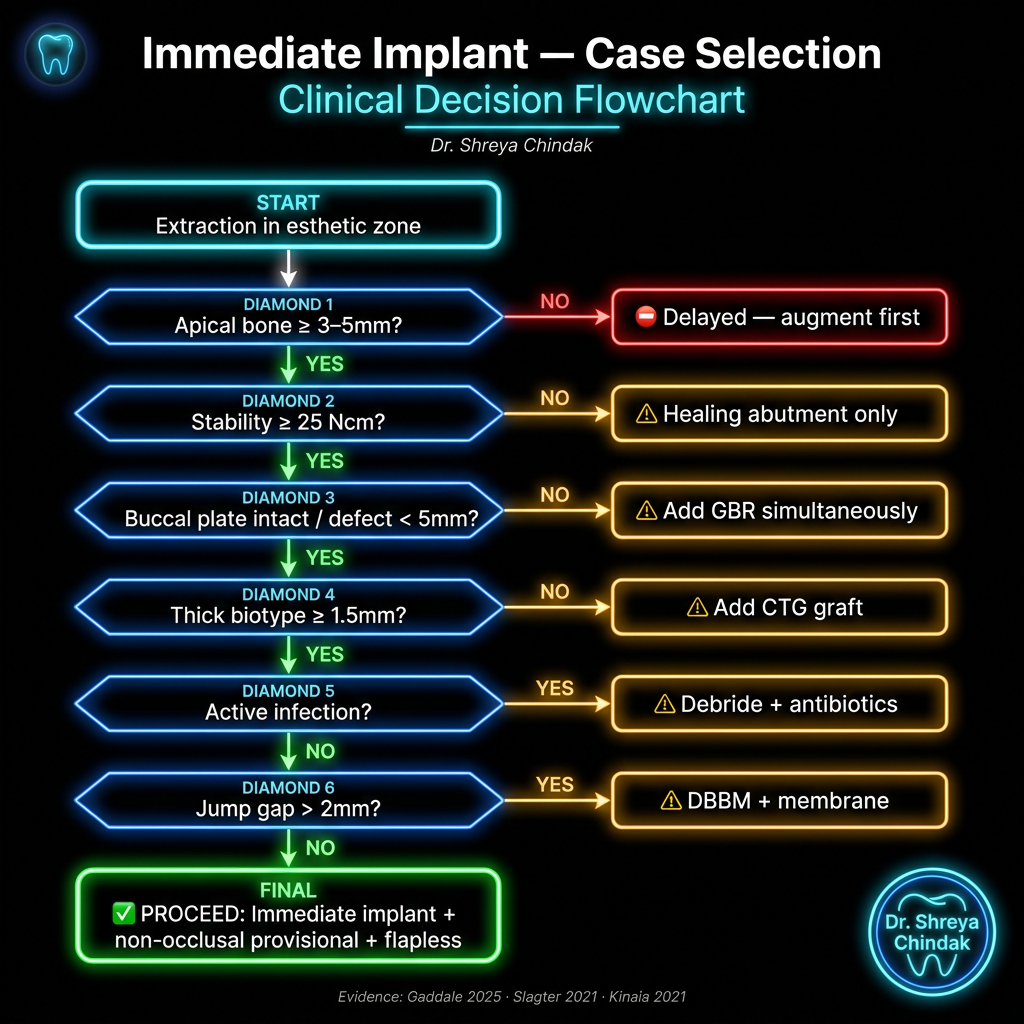
- Neon glowing blue diamonds for each decision point
- Green arrows for the safe YES path
- Red/amber branches for caution/exit actions
- Bright green final box for the GO decision
- "Dr. Shreya Chindak" glowing badge
- Pure black background with evidence citations at the bottom
Notes style black background
Aesthetic dark notes style clinical decision flowchart. Pure black background that looks like a dark-mode notebook or blackboard notes. Square 1:1 Instagram format. Looks like neat handwritten-style notes on a dark background — like a student's iPad notes in dark mode. TOP: Title in glowing white chalk-style handwriting font "Immediate Implant — Case Selection 🦷" with a glowing cyan underline stroke. Below in small elegant cursive glowing white: "Dr. Shreya Chindak" FLOWCHART flows top to bottom in two columns, hand-drawn style on black: LEFT COLUMN — main YES path: START — rounded cyan glowing box chalk-style: "Extraction in esthetic zone" ↓ white chalk arrow DIAMOND 1 cyan chalk outline: "Apical bone ≥ 3–5mm?" ↓ green chalk "YES" DIAMOND 2 cyan chalk: "Stability ≥ 25 Ncm?" ↓ green chalk "YES" DIAMOND 3 cyan chalk: "Buccal plate / defect < 5mm?" ↓ green chalk "YES" DIAMOND 4 cyan chalk: "Thick biotype ≥ 1.5mm?" ↓ green chalk "YES" DIAMOND 5 cyan chalk: "Active infection?" ↓ green chalk "NO" DIAMOND 6 cyan chalk: "Jump gap > 2mm?" ↓ green chalk "NO" FINAL glowing green chalk box with yellow glow highlight: "✅ GO! Immediate implant + provisional + flapless" RIGHT COLUMN — exit branches in red/amber chalk style: ⛔ red chalk box: "Delayed — augment first" ⚠ amber chalk box: "Healing abutment only" ⚠ amber chalk box: "Add GBR" ⚠ amber chalk box: "Add CTG" ⚠ amber chalk box: "Debride + antibiotics" ⚠ amber chalk box: "DBBM + membrane" Connecting arrows hand-drawn chalk style. YES arrows glowing green, NO arrows glowing red. Small glowing tooth doodle top right. Faint ruled lines visible on black background like dark notebook paper. Bottom tiny white text: "Evidence: Gaddale 2025 · Slagter 2021 · Kinaia 2021". Bottom right glowing circular badge: "Dr. Shreya Chindak". Pure black background throughout, chalk/handwriting aesthetic, dark mode notes style, Instagram square.
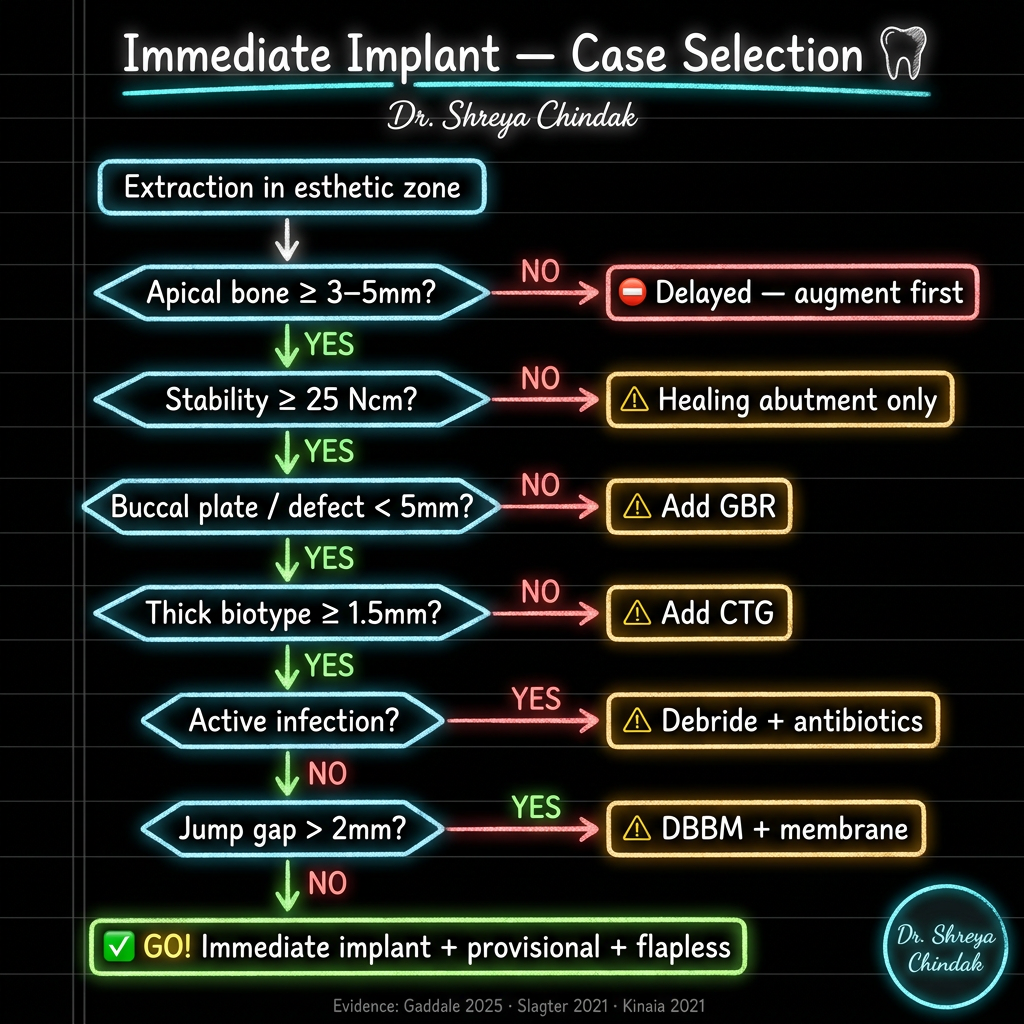
- Cyan glowing chalk-style decision diamonds
- Green chalk YES arrows along the safe path
- Red/amber NO branches for caution steps
- Faint ruled lines on the black background for that dark notebook feel
- "Dr. Shreya Chindak" glowing badge
- Yellow-highlighted final GO box
Plz add full forms
Aesthetic dark notes style clinical decision flowchart. Pure black background like a dark-mode notebook. Square 1:1 Instagram format. Chalk/handwriting aesthetic. TOP: Title glowing white chalk-style "Immediate Implant — Case Selection 🦷" cyan underline. Small cursive: "Dr. Shreya Chindak" FLOWCHART two-column layout, hand-drawn chalk style: LEFT COLUMN — main YES path: START cyan rounded box: "Extraction in esthetic zone" ↓ DIAMOND 1 cyan: "Adequate apical bone? (≥ 3–5mm beyond socket floor)" ↓ green YES DIAMOND 2 cyan: "Primary stability achievable? (≥ 25 Ncm insertion torque)" ↓ green YES DIAMOND 3 cyan: "Buccal plate intact OR defect < 5mm?" ↓ green YES DIAMOND 4 cyan: "Thick periodontal biotype? (≥ 1.5mm gingival thickness)" ↓ green YES DIAMOND 5 cyan: "Active infection / suppuration present?" ↓ green NO DIAMOND 6 cyan: "Horizontal jump gap > 2mm?" ↓ green NO FINAL glowing green box yellow highlight: "✅ PROCEED: Immediate Implant Placement + Non-occlusal Immediate Provisional + Flapless Approach (if possible)" RIGHT COLUMN — NO/exit branches: ⛔ red: "Delayed Placement — Alveolar Ridge Preservation (ARP) + Bone Augmentation first" ⚠ amber: "Place implant — Healing Abutment only. No Immediate Loading." ⚠ amber: "Immediate Implant + Simultaneous Guided Bone Regeneration (GBR)" ⚠ amber: "Add Connective Tissue Graft (CTG) simultaneously for tissue volume" ⚠ amber: "Thorough Debridement + Antibiotic Coverage → Reassess tissue quality intraoperatively" ⚠ amber: "Fill gap with DBBM (Deproteinized Bovine Bone Mineral) + Resorbable Collagen Membrane" Abbreviation key small box bottom left glowing: "GBR = Guided Bone Regen · CTG = Connective Tissue Graft · DBBM = Deproteinized Bovine Bone Mineral · ARP = Alveolar Ridge Preservation · ISQ = Implant Stability Quotient" Green chalk YES arrows, red chalk NO arrows, faint ruled lines on black. Tooth doodle top corner. Bottom: "Evidence: Gaddale 2025 · Slagter 2021 · Kinaia 2021". Circular badge: "Dr. Shreya Chindak". Black background, chalk aesthetic, Instagram square.
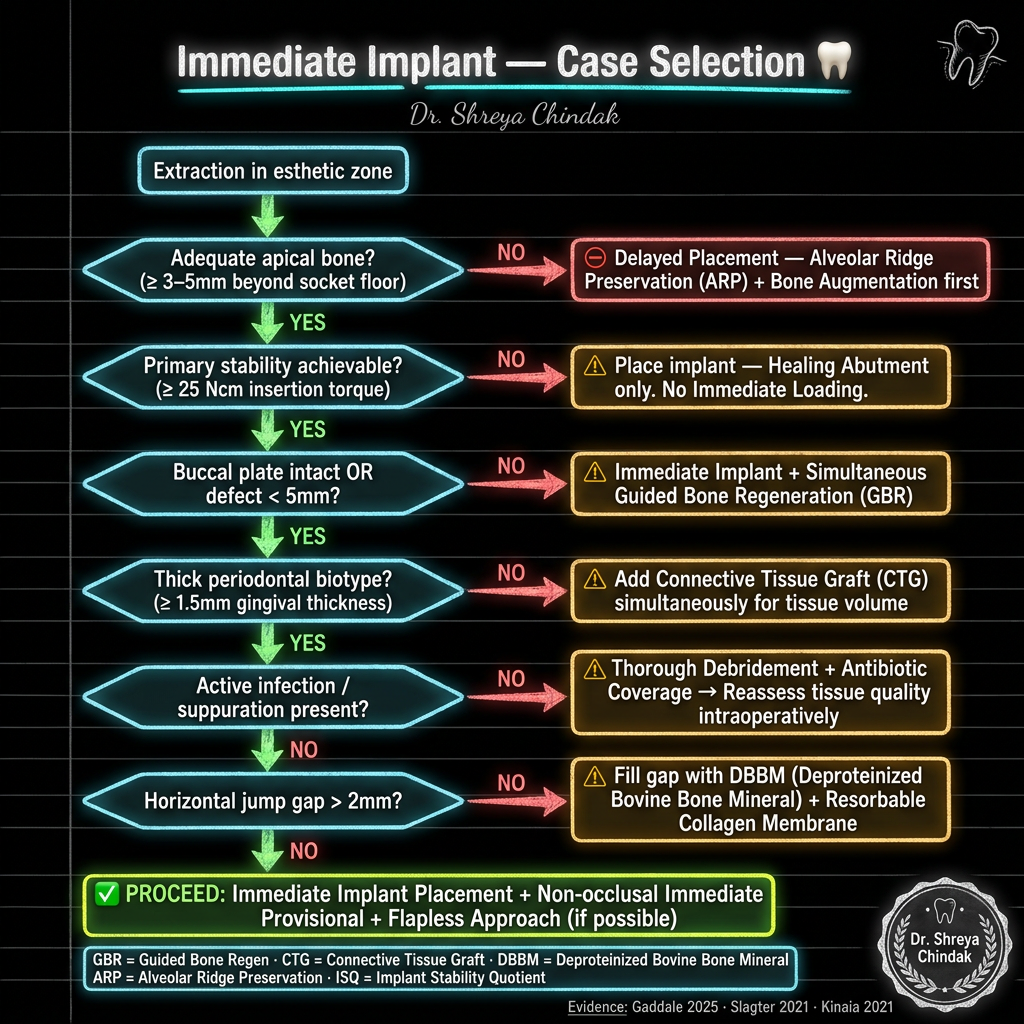
- Full clinical descriptions on every decision diamond — no abbreviations in the flow itself
- Complete action boxes — e.g. "Alveolar Ridge Preservation (ARP)", "Guided Bone Regeneration (GBR)", "Connective Tissue Graft (CTG)", "Deproteinized Bovine Bone Mineral (DBBM)"
- Abbreviation key box bottom left for quick reference
- Same dark chalk-on-black notes aesthetic with "Dr. Shreya Chindak" badge
Perfect same with cream notes type background
Aesthetic handwritten study notes style clinical decision flowchart. Warm cream notebook paper background with faint ruled lines texture. Like neat dental student notes on paper. Square 1:1 Instagram format. TOP: Title in neat handwriting font "Immediate Implant — Case Selection 🦷" with bold blue underline stroke. Small elegant cursive below: "Dr. Shreya Chindak" FLOWCHART two-column layout, hand-drawn pen style on cream paper: LEFT COLUMN — main YES path, connected by neat black ink arrows: START blue rounded rectangle: "Extraction in esthetic zone" ↓ DIAMOND 1 blue pen outline: "Adequate apical bone? (≥ 3–5mm beyond socket floor)" ↓ green ink "YES" DIAMOND 2 blue pen: "Primary stability achievable? (≥ 25 Ncm insertion torque)" ↓ green ink "YES" DIAMOND 3 blue pen: "Buccal plate intact OR defect < 5mm?" ↓ green ink "YES" DIAMOND 4 blue pen: "Thick periodontal biotype? (≥ 1.5mm gingival thickness)" ↓ green ink "YES" DIAMOND 5 blue pen: "Active infection / suppuration present?" ↓ green ink "NO" DIAMOND 6 blue pen: "Horizontal jump gap > 2mm?" ↓ green ink "NO" FINAL large green box with yellow highlighter effect: "✅ PROCEED: Immediate Implant + Non-occlusal Immediate Provisional + Flapless Approach" RIGHT COLUMN — exit branches in red/orange ink: ⛔ red box: "Delayed Placement — Alveolar Ridge Preservation (ARP) + Bone Augmentation first" ⚠ orange box: "Healing Abutment only — No Immediate Loading" ⚠ orange box: "Immediate Implant + Simultaneous Guided Bone Regeneration (GBR)" ⚠ orange box: "Add Connective Tissue Graft (CTG) for tissue volume" ⚠ orange box: "Thorough Debridement + Antibiotics → Reassess intraoperatively" ⚠ orange box: "Fill with DBBM (Deproteinized Bovine Bone Mineral) + Collagen Membrane" Bottom left small box with light blue border — Abbreviation key in tiny neat writing: "GBR = Guided Bone Regeneration · CTG = Connective Tissue Graft · DBBM = Deproteinized Bovine Bone Mineral · ARP = Alveolar Ridge Preservation" Green pen YES arrows, red pen NO arrows, neat hand-drawn connecting lines. Small cute tooth sketch top right corner. Star stickers next to final green box. Bottom tiny text: "Evidence: Gaddale 2025 · Slagter 2021 · Kinaia 2021". Circular stamp badge bottom right: "Dr. Shreya Chindak". Warm cream paper background, aesthetic pastel study notes style, clean readable handwriting font, Instagram square format.
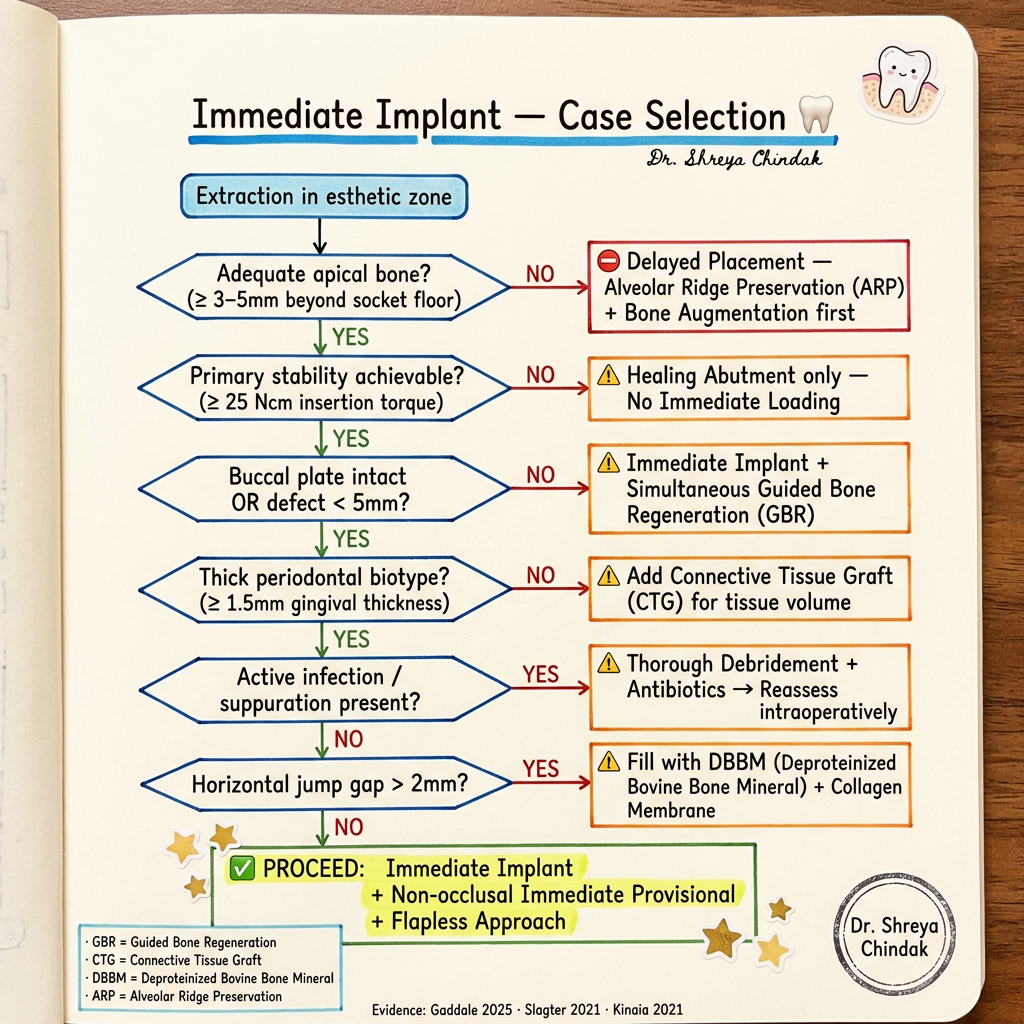
- Cream notebook paper with faint ruled lines
- Blue pen diamonds, green YES arrows, red/orange NO branches
- Yellow highlighter on the final GO box
- Full forms on all action boxes + abbreviation key bottom left
- Tooth sketch doodle and star stickers
- "Dr. Shreya Chindak" stamp badge