
What are the sources of vitamin A
Vitamin A comes from two main dietary sources: preformed vitamin A (retinol) found in animal products, and provitamin A carotenoids (mainly beta-carotene) found in plants. Animal sources include liver, fish liver oils, dairy products (milk, butter, cheese), eggs, and fatty fish. Plant sources include orange/yellow vegetables (carrots, sweet potatoes, pumpkin), dark leafy greens (spinach, kale), and orange fruits (mangoes, papayas, apricots).
Searching sources...
Reading File
Searching the Web
vitamin A dietary sources preformed provitamin A foods
Finding Sources
Finding Sources
Reading File
Reading File
Here is a thorough breakdown of vitamin A sources, drawn from multiple medical textbooks and current references:
Sources of Vitamin A
Vitamin A exists in the diet in two main forms: preformed vitamin A (retinoids) from animal sources, and provitamin A carotenoids from plant sources.
1. Preformed Vitamin A (Retinol / Retinyl Esters)
These are found exclusively in animal-derived foods and are directly usable by the body. Absorption efficiency is high at 70-90%.
| Food | Notes |
|---|---|
| Liver (beef, chicken, cod) | The richest source - 100g beef liver provides ~7,740 mcg (860% DV) |
| Fish liver oils (cod liver oil) | 1 tbsp provides ~4,080 mcg (453% DV) |
| Oily / fatty fish (salmon, mackerel, tuna) | Good natural source |
| Eggs | Particularly egg yolk |
| Full-cream milk and dairy products | Milk, butter, cheese |
| Offal / organ meats | Kidney, heart |
| Fortified foods | Margarine, breakfast cereals (in many countries) |
Breast milk is also a source for infants, provided the nursing mother has adequate vitamin A status.
2. Provitamin A Carotenoids (Plant Sources)
These are pigments in plants that the body converts to vitamin A. The most important is beta-carotene (β-carotene), which is efficiently cleaved to retinal by the enzyme β-carotene-15,15'-dioxygenase in intestinal cells. Absorption is much lower than preformed vitamin A (only 9-22%) and is improved by:
- Moderate cooking (enhances carotenoid release)
- Eating with some fat in the meal
Carotenoids contribute approximately 30% of vitamin A in human diets, while preformed retinol provides ~75% (based on NHANES II data).
Orange/yellow vegetables and fruits:
- Carrots
- Sweet potatoes
- Pumpkin and winter squash
- Tomatoes
- Apricots
- Mangoes
- Grapefruit
Dark green leafy vegetables:
- Spinach
- Kale
- Lettuce
- Most green vegetables (the green chlorophyll masks the orange pigment but carotenoids are still present)
Measuring Vitamin A: Retinol Activity Equivalents (RAE)
The modern unit for expressing vitamin A in food is the Retinol Activity Equivalent (RAE):
- 1 RAE = 1 μg of retinol
- 1 RAE = 12 μg of β-carotene
- 1 RAE = 24 μg of other provitamin A carotenoids
This reflects the lower conversion efficiency of plant carotenoids compared to preformed retinol. (Older literature used International Units: 1 μg retinol = 3.33 IU.)
Important Notes on Absorption and Bioavailability
- Fat-soluble nature means vitamin A requires dietary fat for absorption
- Concurrent zinc deficiency can interfere with mobilization of vitamin A from liver stores
- Alcohol competes with retinol dehydrogenase, impairing conversion in the eye
- Mineral oil, neomycin, and bile acid sequestrants (e.g., cholestyramine) reduce vitamin A absorption
Sources: Tietz Textbook of Laboratory Medicine, 7th Ed.; Harrison's Principles of Internal Medicine, 22nd Ed. (2025); Robbins & Kumar Basic Pathology; MedlinePlus; Harvard Nutrition Source
What are the signs and symptoms of vitamin A deficiency?
Vitamin A deficiency primarily affects the eyes (night blindness, xerophthalmia, Bitot's spots, corneal ulceration), skin (follicular hyperkeratosis), and immune function (increased susceptibility to infections). It is a leading cause of preventable blindness in children worldwide, especially in developing countries.
Searching sources...
Finding Sources
Searching the Web
vitamin A deficiency signs symptoms clinical features
Finding Sources
Reading File
Reading File
Reading File
Reading File
Reading File
Loading Image
Loading Image
Loading Image
Loading Image
Here is a comprehensive breakdown of the signs and symptoms of vitamin A deficiency, organized by system:
Signs and Symptoms of Vitamin A Deficiency
1. Ocular Manifestations (Xerophthalmia)
Eye involvement is the hallmark of vitamin A deficiency and follows a well-defined progressive sequence classified by the WHO:
| WHO Grade | Finding |
|---|---|
| XN | Night blindness (nyctalopia) |
| X1A | Conjunctival xerosis (dryness) |
| X1B | Bitot spots |
| X2 | Corneal xerosis |
| X3A | Corneal ulceration / keratomalacia < 1/3 corneal involvement |
| X3B | Corneal ulceration / keratomalacia ≥ 1/3 corneal involvement |
| XS | Corneal scar |
| XF | Xerophthalmic fundus (peripheral retinal dots from focal RPE defects) |
In order of progression:
- Night blindness (nyctalopia) - the earliest and most common manifestation. Vitamin A is a component of rhodopsin (visual pigment), so its loss impairs vision in dim/reduced light. Delayed dark adaptation is the earliest detectable finding.
- Dry eyes - inability to produce sufficient tears; one of the first clinical signs
- Conjunctival xerosis (X1A) - the lacrimal and mucus-secreting conjunctival epithelium is replaced by keratinized epithelium, causing dryness
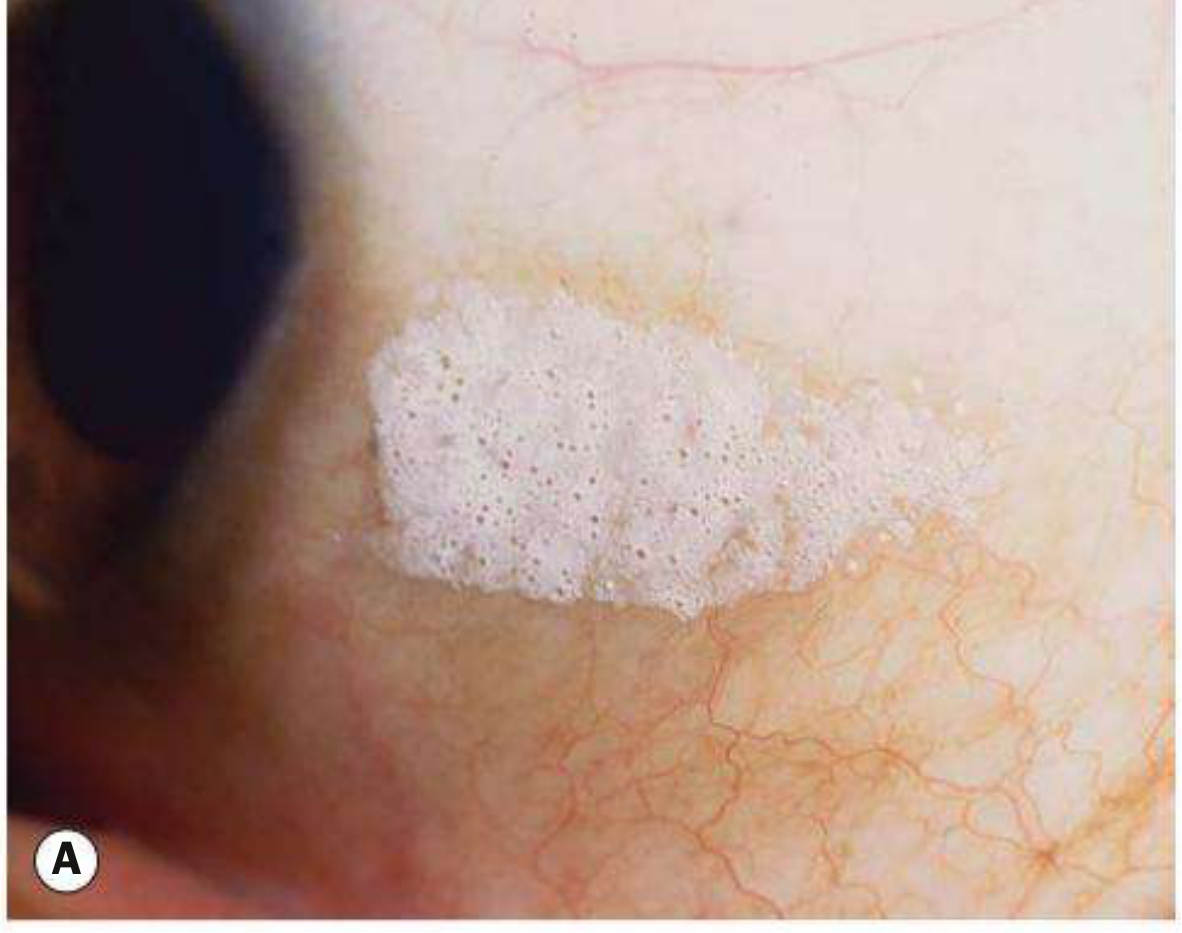
- Bitot spots (X1B) - triangular, perilimbal, gray, foamy plaques of keratinized conjunctival debris on the sclera. These are reversible with vitamin A treatment.
Bitot spot (from Kanski's Clinical Ophthalmology):
- Corneal xerosis (X2) - dryness of the corneal surface with epithelial defects
- Keratomalacia (X3A/X3B) - softening, ulceration, and necrosis of the cornea; may progress to corneal perforation, prolapse, endophthalmitis, and irreversible blindness. Often preceded by a GI, respiratory, or measles infection. This is a medical emergency, especially in infants.
- Corneal scarring (XS) - permanent scarring from healed ulceration; leading cause of preventable childhood blindness (~250,000 children/year)
- Inability to see bright light - also reported in severe deficiency
2. Skin Manifestations
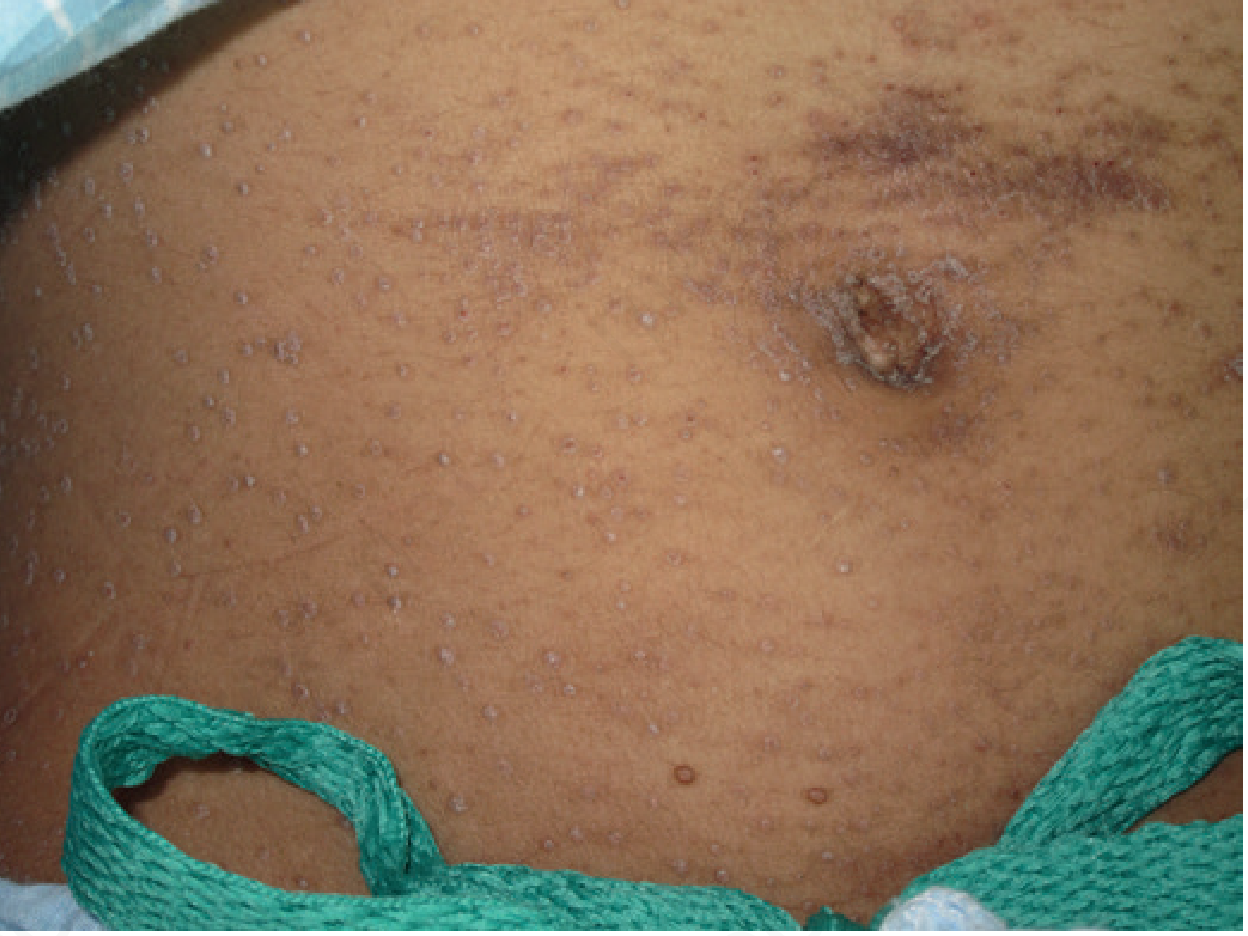
- Follicular hyperkeratosis / Phrynoderma ("toadskin") - the most characteristic skin sign. Presents as keratotic papules symmetrically distributed over the extremities and shoulders, arising from pilosebaceous follicles. Two lesion sizes occur:
- Small 1-2 mm papules resembling keratosis pilaris
- Larger 2-6 mm crateriform papules with a central keratotic plug (more diagnostic)
- Generalized skin dryness and fine scaling
- Roughness and papular eruptions of the skin
- Hyperpigmentation
- Lesions begin on the anterolateral thighs / posterolateral upper arms and spread to extensor surfaces, shoulders, abdomen, back, and buttocks. Hands and feet are spared.
Phrynoderma (follicular hyperkeratosis) in a patient with inflammatory bowel disease:
3. Epithelial / Mucosal Manifestations
Vitamin A is required for normal differentiation of epithelial cells. Deficiency causes squamous metaplasia and keratinization of multiple epithelial surfaces:
- Respiratory tract - squamous metaplasia of the mucociliary epithelium of the airways, predisposing to secondary pulmonary infections (pneumonia). Vitamin A deficiency worsens measles mortality.
- Urinary tract - squamous metaplasia leads to desquamation of keratin debris, which can form renal and urinary bladder stones
- Gastrointestinal tract - abnormal keratinization increases risk of inflammatory gut disease and diarrhea
4. Immune Dysfunction
- Increased susceptibility to infections, particularly respiratory (pneumonia) and GI (diarrhea)
- Vitamin A supplementation in deficient children reduces overall mortality by 20-30% by restoring immune function
- Children with measles benefit from vitamin A supplementation (200,000 IU/day for 2 days) to reduce the risk of blindness and death
5. Growth and Development
- Growth retardation in children - vitamin A deficiency is a significant cause of stunted growth
- Anemia - vitamin A deficiency can lead to anemia, though the precise mechanism is not fully established
Populations Most at Risk
- Preschool-age children in developing countries (southern Asia, sub-Saharan Africa, parts of Latin America, western Pacific)
- ~190 million preschool children worldwide have deficient serum retinol (<0.70 μmol/L)
-
5 million have clinical xerophthalmia
- Patients with fat malabsorption syndromes (celiac disease, Crohn disease, cystic fibrosis, chronic pancreatitis, bariatric surgery)
- Chronic alcoholism (alcohol competes with retinol dehydrogenase)
- Patients with liver disease (reduced retinol-binding protein synthesis)
Sources: Robbins & Kumar Basic Pathology; Kanski's Clinical Ophthalmology, 10th Ed.; The Wills Eye Manual; Andrews' Diseases of the Skin; Tietz Textbook of Laboratory Medicine, 7th Ed.; WHO on Vitamin A Deficiency
This is a shared conversation. Sign in to Orris to start your own chat.