
what are monoclonal antibodies?, differences bw monoclonal and polyclonal ab, briefly about principle and production of mAB, and what are its applications
Reading File
Now let me search the medical library for monoclonal antibodies content in parallel.
Finding Sources
Finding Sources
The best source is "Cellular and Molecular Immunology" - let me read that block plus the Katzung pharmacology block and search for polyclonal vs monoclonal content in parallel.
Reading File
Finding Sources
Finding Sources
Excellent sources found. Let me now read the most relevant blocks in parallel - Janeway's for the hybridoma technique, Henry's for mAb overview, and search for applications.
Reading File
Reading File
Finding Sources
Let me read more of the Janeway's hybridoma section and get the applications content.
Reading File
Finding Sources
I have the hybridoma diagram URL. Let me fetch it and get the applications content from Goodman & Gilman's.
Loading Image
Reading File
Finding Sources
I now have comprehensive content. Let me compile the full answer.
Monoclonal Antibodies (mAbs) - A Complete Overview
1. What Are Monoclonal Antibodies?
Monoclonal antibodies (mAbs) are homogeneous, identical antibody molecules all derived from a single B-cell clone, recognizing one specific epitope on an antigen. The term "monoclonal" means they originate from one ("mono") cell line ("clone").
They were first produced in 1975 by Georges Köhler and César Milstein, who fused immune spleen cells with immortal myeloma cells to produce hybrid cell lines (hybridomas) that could proliferate indefinitely and secrete antibody of a predefined specificity. This work earned them the 1984 Nobel Prize in Physiology/Medicine.
Key characteristics:
-
Recognize a single epitope (one specific binding site)
-
All molecules are structurally identical - same isotype, same antigen-binding site
-
Can be produced in unlimited quantities from a stable cell line
-
Highly consistent affinity and specificity between batches
-
Janeway's Immunobiology 10e, p. 828
-
Henry's Clinical Diagnosis and Management by Laboratory Methods, p. 3287
2. Monoclonal vs. Polyclonal Antibodies
| Feature | Monoclonal Antibody | Polyclonal Antibody |
|---|---|---|
| Origin | Single B-cell clone | Multiple B-cell clones |
| Epitope specificity | Single epitope | Multiple epitopes on the same antigen |
| Homogeneity | Completely uniform | Mixture of different antibody molecules |
| Affinity | Fixed, defined | Variable (mixture of high and low affinity) |
| Avidity | Lower (single epitope) | Higher (multi-epitope binding) |
| Cross-reactivity | May cross-react with same epitope on different antigens | Less likely to miss an antigen |
| Batch-to-batch consistency | Identical - unlimited supply | Each antiserum is different, even in genetically identical animals |
| Production | Hybridoma or recombinant technology | Simple immunization of an animal |
| Precipitation/agglutination | Weaker - single epitope creates weak lattice | Stronger - multi-epitope forms better immune complexes |
| Volume available | Unlimited | Limited |
Key insight from Janeway's: "Each antiserum is different from all other antisera, even if raised in a genetically identical animal using the identical preparation of antigen. Antisera can be produced in only limited volumes, and thus it is impossible to use the identical serological reagent in a long or complex series of experiments." mAbs were developed specifically to overcome these limitations.
A polyclonal antibody has stronger avidity to a complex antigen because it binds multiple epitopes simultaneously, while a single mAb recognizes only one epitope. However, mAbs have superior analytical precision - they can distinguish isoenzymes, protein subtypes, and conformational changes at the molecular level.
- Janeway's Immunobiology 10e, p. 827
- Henry's Clinical Diagnosis and Management, p. 3282
3. Principle and Production of mAbs
Principle
The core challenge: antibody-producing B cells (plasma cells) are mortal and die after a few days in culture. Myeloma (plasma cell tumor) cells are immortal but don't make the desired antibody. The solution - fuse them to combine both properties.
The resulting hybridoma cell has:
- From the B cell: ability to make specific antibody
- From the myeloma: ability to grow indefinitely in culture
Production Steps (Köhler-Milstein Method)
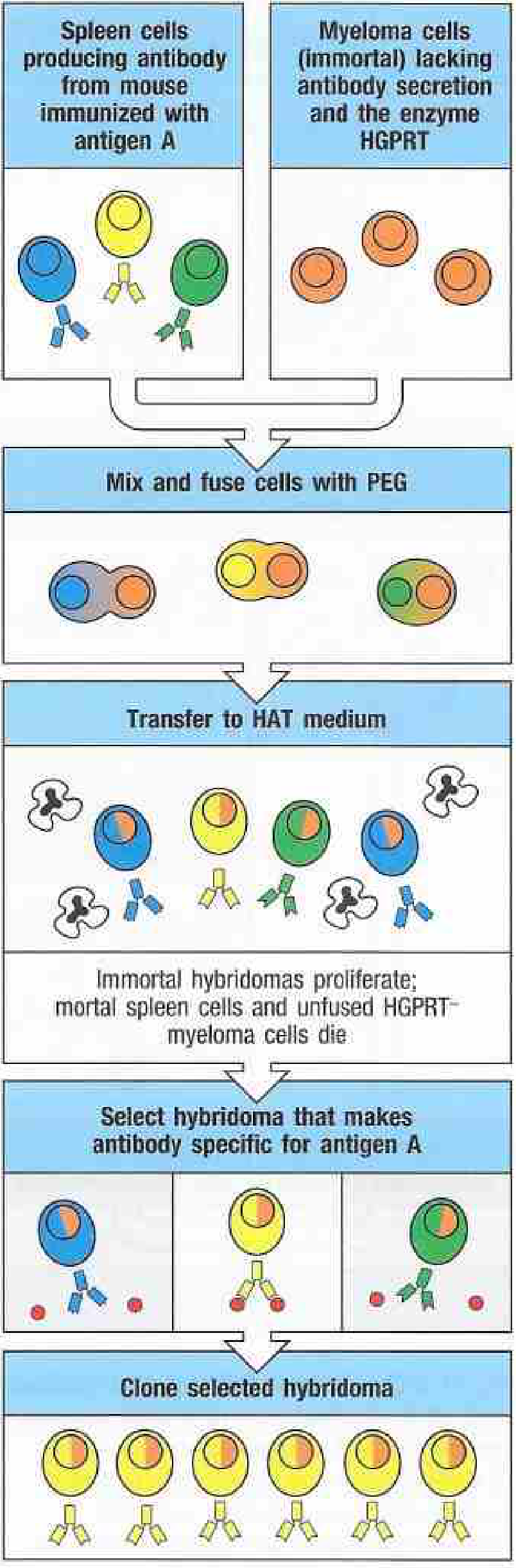
Step 1 - Immunization: A mouse is immunized with the target antigen. An intravenous booster is given 3 days before sacrifice to maximize the population of antigen-specific spleen cells secreting antibody.
Step 2 - Cell Fusion: Spleen cells are mixed with myeloma cells (specially selected to: a) produce no antibody themselves, b) lack the enzyme HGPRT - hypoxanthine-guanine phosphoribosyltransferase). Cell fusion is induced using polyethylene glycol (PEG), creating hybridoma cells.
Step 3 - HAT Selection: The mixture is transferred to HAT medium (hypoxanthine-aminopterin-thymidine):
- Unfused myeloma cells: die (lack HGPRT, can't use the salvage pathway in aminopterin-blocked medium)
- Unfused spleen cells: die naturally (finite lifespan)
- Only hybridoma cells survive (get HGPRT from spleen cell, immortality from myeloma cell)
Step 4 - Screening and Cloning: Hybridomas are diluted to single cells (limiting dilution). Individual clones are screened for production of antibody with the desired specificity.
Step 5 - Bulk Culture: The selected hybridoma clone is expanded in bulk culture to produce large quantities of the monoclonal antibody.
- Janeway's Immunobiology 10e, p. 828
Humanization of mAbs
Early mouse-derived mAbs caused HAMA (Human Anti-Mouse Antibody) reactions when used therapeutically. This led to progressive engineering:
- Chimeric mAbs (-ximab): Human Fc + mouse variable (Fv) domains (e.g., rituximab)
- Humanized mAbs (-zumab): Human IgG scaffold with only mouse CDRs inserted (e.g., trastuzumab)
- Fully human mAbs (-umab): Entirely human sequence - produced via phage display, transgenic mice, or recombinant cloning of human plasma cell genes (e.g., adalimumab)
The suffix "-mab" in drug names always signals a monoclonal antibody. The preceding morpheme indicates its origin/engineering.
- Goodman & Gilman's Pharmacological Basis of Therapeutics, p. 3853
Phage Display (Alternative to Hybridoma)
Antibody V-region genes are fused to bacteriophage coat protein genes. Phages expressing antigen-specific binding domains are isolated by affinity selection. This method eliminates the need for immunization and is now the main method for producing fully human mAbs. Greg Winter received the Nobel Prize (2018) for this concept.
4. Applications of Monoclonal Antibodies
A. Cancer Therapy
This is currently the largest application - over 40 mAb-based drugs are FDA-approved for cancer treatment. Mechanisms include:
- Blocking growth factor receptors - e.g., trastuzumab (Herceptin) blocks HER2/ErbB2, cetuximab blocks EGFR
- Recruiting immune cells - ADCC (antibody-dependent cellular cytotoxicity) via Fc receptor engagement on NK cells/macrophages
- Complement activation - CDC (complement-dependent cytotoxicity)
- Checkpoint inhibitors - Anti-PD-1/PD-L1 (pembrolizumab, nivolumab), anti-CTLA-4 (ipilimumab) - restore T cell anti-tumor activity
- Antibody-drug conjugates (ADCs) - mAb carries cytotoxic payload (toxin or radionuclide) directly to tumor cells
- Goodman & Gilman's, p. 3851
B. Autoimmune and Inflammatory Diseases
- Anti-TNF-α: infliximab, adalimumab (rheumatoid arthritis, Crohn's disease, psoriasis)
- Anti-IL-6: tocilizumab (rheumatoid arthritis)
- Anti-CD20: rituximab (depletes B cells in autoimmune disease and B-cell lymphoma)
- Anti-IgE: omalizumab (severe asthma)
- Anti-IL-17/23: secukinumab, ustekinumab (psoriasis, psoriatic arthritis)
C. Diagnostics and Laboratory Testing
- Immunoassays (ELISA, RIA, chemiluminescence): mAbs provide highly reproducible, specific assays for hormones, tumor markers, drugs, pathogens
- Flow cytometry: CD marker identification of cell types (CD4, CD8, etc.)
- Immunohistochemistry/immunofluorescence: Tissue diagnosis in pathology
- Tumor markers: e.g., CA 19-9 mAb detects carbohydrate epitopes shared across tumor-related molecules
- Pregnancy tests, cardiac troponin assays, infectious disease rapid tests - all rely on mAb technology
"Monoclonal antibody technology has allowed the development of extremely useful and nearly ideal immunoassay systems for clinical laboratory testing." - Henry's Clinical Diagnosis
D. Transplantation
- Anti-rejection therapy: Anti-CD25 (basiliximab) blocks IL-2 receptor on T cells
- T-cell depletion: Anti-thymocyte antibodies used in conditioning regimens
E. Infectious Diseases
- Palivizumab: Anti-RSV mAb for prophylaxis in high-risk infants
- SARS-CoV-2 neutralizing antibodies: Used during COVID-19 pandemic
- Passive immunotherapy against HIV, Ebola, and other pathogens
F. Ophthalmology
- Anti-VEGF mAbs: bevacizumab, ranibizumab - treat wet age-related macular degeneration and diabetic retinopathy by blocking neovascularization
G. Cardiovascular
- Abciximab: Anti-GPIIb/IIIa - prevents platelet aggregation during coronary intervention
- PCSK9 inhibitors: evolocumab, alirocumab - lower LDL cholesterol
H. Research Tools
- Western blotting, ELISA development, cell sorting, receptor characterization, drug target validation - mAbs are indispensable research reagents across all of biomedical science
Summary: Monoclonal antibodies represent one of the most significant biotechnological advances in medicine. Derived from a single B-cell clone via hybridoma technology (or modern recombinant methods), they offer unmatched specificity and consistency compared to polyclonal antisera. Their applications now span virtually every area of medicine - from highly sensitive lab diagnostics to life-saving cancer immunotherapies.
This is a shared conversation. Sign in to Orris to start your own chat.