
Sandflies and tsetseflies in spm
Reading File
Sandflies transmit Leishmania, sandfly fever, and Bartonella; tsetse flies transmit African trypanosomiasis. Let me pull the full SPM (Social and Preventive Medicine) content on both.
Searching sources...
Finding Sources
Finding Sources
Finding Sources
Reading File
Reading File
Reading File
Reading File
Finding Sources
Reading File
Reading File
I now have all the content needed. Let me fetch the figures as well for a complete answer.
Loading Image
Loading Image
Here is the complete SPM (Park's Textbook of Preventive and Social Medicine) coverage of Sandflies and Tsetse Flies:
SANDFLIES
(Park's Textbook of Preventive and Social Medicine, p. 878-879)
Sandflies belong to the genus Phlebotomus (family Psychodidae). They are smaller than mosquitoes, measuring 1.5 to 2.5 mm in length, with bodies and wings densely clothed with hair. About 30 species have been recorded in India. Important Indian species:
- Phlebotomus argentipes
- P. papatasi
- P. sergenti
- Sergentomyia punjabensis
General Characters
| Feature | Description |
|---|---|
| Head | Long, slender hairy antennae; palpi and a proboscis. Only females bite (males live on vegetable juices) |
| Thorax | One pair of wings + three pairs of legs. Wings are upright, lanceolate, and densely hairy |
| Wing vein | Second longitudinal vein branches twice, first branching in the middle of the wing - characteristic feature of Phlebotomus |
| Legs | Long and slender, out of proportion to body size |
| Abdomen | 10 segments, covered with hair. Female tip is rounded; male has conspicuous claspers |
Distinguishing sandflies from mosquitoes:
- Size - sandflies are smaller
- Wings - upright and lanceolate (mosquito wings are not)
- Legs - longer relative to body
- Hairs - sandfly is a hairy insect
- Hopping - sandflies hop about and do not fly by choice
Life History (Complete Metamorphosis: 4 stages)
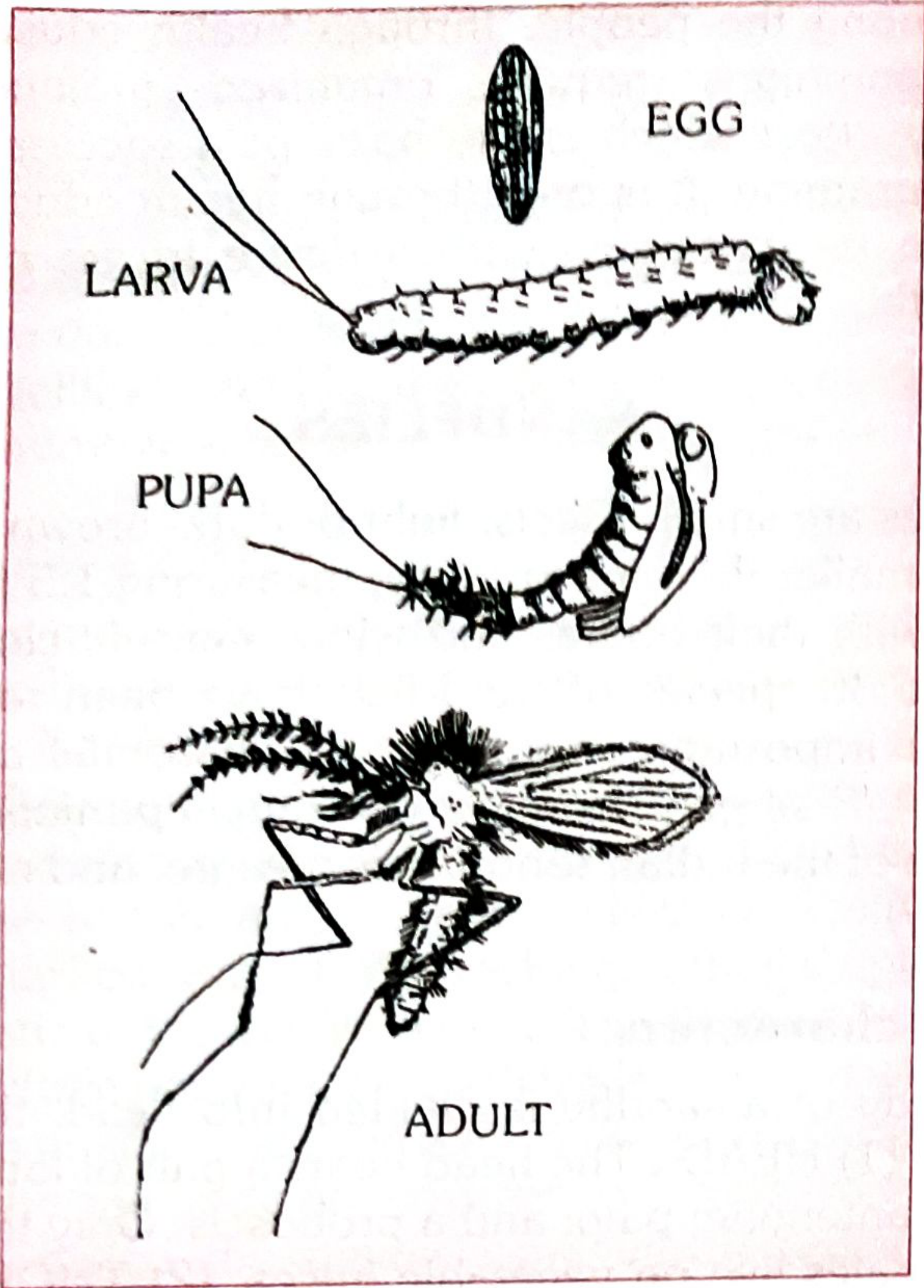
| Stage | Details |
|---|---|
| Egg | Laid in damp, dark places near cattle sheds and poultry. Large, torpedo-shaped with longitudinal wavy lines. Hatch in 7 days |
| Larva | Hairy maggots with distinct head, thorax, abdomen. Last abdominal segment has two pairs of long stout hairs (one pair remarkably long). Feeds on decaying organic matter. Becomes pupa in ~2 weeks |
| Pupa | Lasts ~1 week |
| Adult | Average life = about 2 weeks. Requires a blood meal every 3rd or 4th day for oviposition |
Habits
- Nocturnal pests - bite is irritating and painful
- Infest dwellings at night; shelter during day in wall crevices, holes in trees, dark rooms, stables
- Cannot fly long distances - confined to within 50 yards of their breeding places
- Females alone bite
Diseases Transmitted
| Species | Disease |
|---|---|
| Phlebotomus argentipes | Kala-azar (Visceral leishmaniasis) |
| Phlebotomus papatasi | Sandfly fever, Oriental sore |
| Phlebotomus sergenti | Oriental sore |
| Sergentomyia punjabensis | Sandfly fever |
Sandfly fever: Occurs in arid regions of West Pakistan and Middle East. In India, the virus was isolated in Aurangabad (Maharashtra) in 1967 from febrile cases, and also isolated from sandflies themselves. Control is based on control of the insect vector.
Control of Sandflies
(Easily controlled because they do not move long distances)
-
Insecticides: No resistance to DDT demonstrated. A single application of:
- DDT: 1 to 2 g/m² - effective for 1 to 2 years
- Lindane: 0.25 g/m² - effective for only 3 months
- Spraying in human dwellings, cattle sheds, and other places
-
Sanitation:
- Remove shrubs and vegetation within 50 yards of human dwellings
- Fill up cracks and crevices in walls and floors
- Locate cattle sheds and poultry houses at a fair distance from human habitations
TSETSE FLIES (Glossinae)
(Park's Textbook of Preventive and Social Medicine, p. 879)
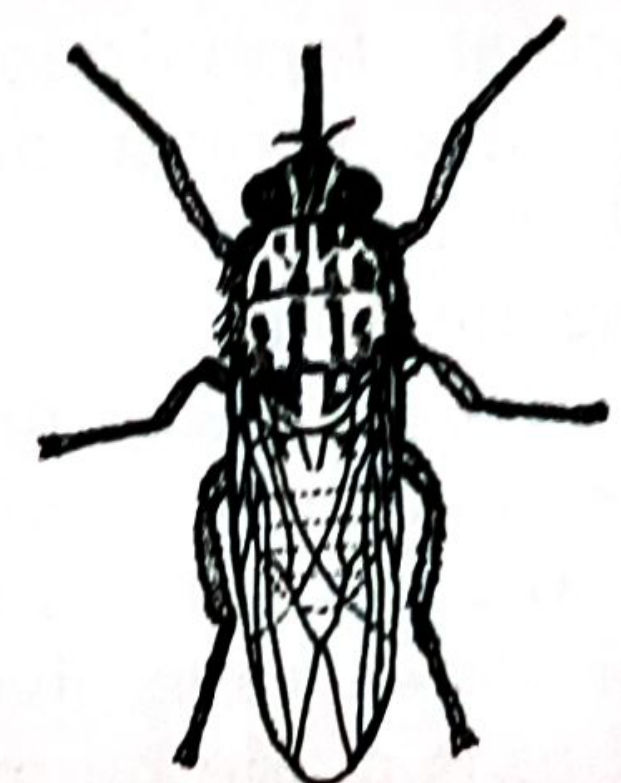
Tsetse flies (genus Glossina) are bloodsucking flies that resemble the common housefly. They are yellow or dark-brown in colour, about half an inch (12 mm) long.
Key identifying feature: Wings, when folded, overlap each other like the blades of scissors. They have a rigid, non-retractile proboscis adapted for piercing skin and sucking blood.
Geographic distribution: Found only on the African continent. Regions infested with tsetse flies are called "fly belts". They have ravaged vast areas of tropical Africa for centuries.
Life History (Abnormal/Viviparous)
- The female does not lay eggs - she gives birth to a living larva, one at a time, at 10-day intervals
- The female produces only a few offspring in its lifetime
- After birth, the larva crawls away and buries itself in the earth, usually 1 inch below the surface
- Pupation occurs within a few hours of birth
- Pupal stage lasts 20-40 days
- Adult emerges at end of pupal stage
- The tsetse lives less than 100 days
Species and Habits
More than 30 species of Glossinae recognised, but only 4 species are dangerous to man:
| Species | Group | Habitat |
|---|---|---|
| G. palpalis | Riverine | Near water courses, woodland vegetation |
| G. tachinoides | Riverine | Near water courses |
| G. morsitans | Savannah | Woodland vegetation in savannah country |
| G. pallidepes | Savannah | Savannah woodland |
- Riverine species (G. palpalis, G. tachinoides) have distinct attraction to man
- Savannah species prefer to feed on wild game rather than man
- Tsetse flies attack man, animals, wild game, birds, lizards, and snakes
- Both sexes bite, mainly during daytime
- Tsetse flies rarely enter houses but are known to follow travellers by road and rail for considerable distances to obtain a blood meal
Disease transmitted: Trypanosomiasis ("sleeping sickness") - affects man, domestic animals, and wild game. Particularly lethal to man and domestic stock.
Control of Tsetse Flies
Four main techniques:
-
Insecticides: No resistance reported in Glossina. DDT (25%) and dieldrin (18-20%) are the most commonly used pesticides. Applied from aircraft when large areas are to be covered quickly.
-
Clearing of Vegetation: Most widely adopted technique. Clears where tsetse flies live and breed. Used alone gives slow results, but combined with residual insecticides gives speedy reduction.
-
Game Destruction: Large tracts of Africa cleared of tsetse flies by destroying wild game. This method is now given up.
-
Genetic Control: Research centered on sterile male release technique.
Quick Comparison Table
| Feature | Sandfly | Tsetse Fly |
|---|---|---|
| Genus | Phlebotomus / Sergentomyia | Glossina |
| Size | 1.5-2.5 mm (smaller than mosquito) | ~12 mm (housefly-sized) |
| Who bites | Only females | Both sexes |
| Biting time | Night (nocturnal) | Day |
| Geography | India, Middle East, worldwide | Africa only ("fly belts") |
| Life cycle | Complete metamorphosis (egg, larva, pupa, adult) | Viviparous - gives birth to larva directly |
| Flight range | Very limited - stays within 50 yards | Long range - follows travellers |
| Disease | Kala-azar, sandfly fever, oriental sore | Trypanosomiasis (sleeping sickness) |
| DDT sensitivity | Sensitive (no resistance) | Sensitive (no resistance) |
| Key control | DDT/lindane + sanitation | Insecticides from aircraft + vegetation clearing |
- Park's Textbook of Preventive and Social Medicine, pp. 878-879 (Sandflies and Tsetse Flies chapter)
This is a shared conversation. Sign in to Orris to start your own chat.