
Thyroid strom
I'll read the medical library skill first, then search for thyroid storm content in parallel.
Reading File
Now I'll search the library and PubMed in parallel.
Finding Sources
Searching PubMed
"thyroid storm" management
Excellent results. Now I'll read the most comprehensive textbook sections in parallel - Rosen's Emergency Medicine and Tintinalli's (both emergency medicine focused), plus Braunwald's for cardiac aspects.
Reading File
Reading File
Reading File
Now let me get the treatment section from Rosen's and the Katzung pharmacology section, plus fetch the clinical features image.
Reading File
Reading File
Loading Image
Now let me get the treatment table and Burch-Wartofsky scoring details from Rosen's.
Reading File
I now have comprehensive information to write a detailed response. Let me compile everything.
Thyroid Storm (Thyrotoxic Crisis)
Definition
Thyroid storm is a rare, life-threatening form of severe thyrotoxicosis with multiorgan dysfunction. Untreated, mortality approaches 100%; with prompt treatment, it is still 10-30%. It most often occurs as an acute reaction to a precipitant in a patient with pre-existing, often unrecognized or undertreated hyperthyroidism.
Pathophysiology
The exact mechanism underlying the shift from simple thyrotoxicosis to thyroid storm is not fully understood, but it involves adrenergic hyperactivity - either by increased release of thyroid hormones or increased adrenergic receptor sensitivity. Patients in thyroid storm have relatively higher levels of free (unbound) thyroid hormones compared to uncomplicated hyperthyroidism.
- Excess T4/T3 enter cells, where T4 is converted to active T3
- T3 passes into the nucleus, binds thyroid hormone receptors, and drives gene transcription
- Precipitants (infection, trauma, MI) amplify this by freeing hormones from binding proteins or increasing receptor sensitivity
- TSH is suppressed via negative feedback on the pituitary
Precipitating Events
| Systemic | Cardiovascular | Obstetric | Drug/Hormone |
|---|---|---|---|
| Infection | Myocardial infarction | Labor and delivery | Withdrawal of antithyroid meds |
| Trauma | CVA/stroke | Eclampsia | Iodine load |
| Surgery | Pulmonary embolism | Hyperemesis gravidarum | Radioactive iodine therapy |
| DKA | Preeclampsia | Thyroid hormone ingestion | |
| Hyperosmolar coma | Thyroid gland palpation |
Unknown cause in up to 25% of cases.
Clinical Features
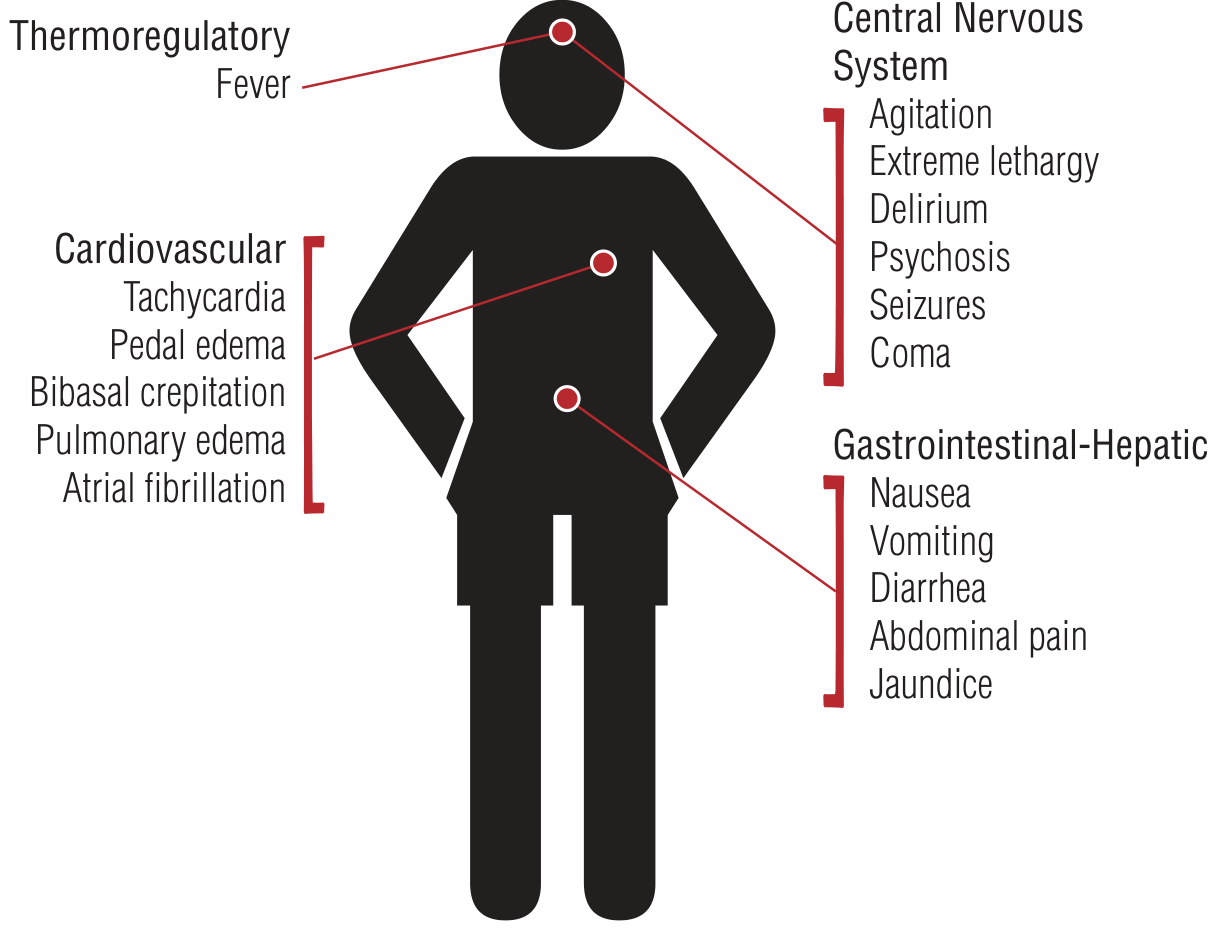
Figure: Clinical features of thyroid storm (Tintinalli's Emergency Medicine)
| System | Features |
|---|---|
| Thermoregulatory | Hyperpyrexia 104-106°F (40-41°C) |
| Cardiovascular | Extreme tachycardia (often disproportionate to fever), atrial fibrillation, heart failure, hypotension, cardiovascular collapse; Takotsubo cardiomyopathy can occur |
| CNS | Agitation, delirium, psychosis, extreme lethargy, seizures, coma |
| GI-Hepatic | Nausea, vomiting, diarrhea, abdominal pain; jaundice (hepatic failure - rare but poor prognosis) |
| Signs of hyperthyroidism | Goiter, exophthalmos, lid lag, tremor, warm/moist skin |
Diagnosis - Burch-Wartofsky Score
Thyroid storm is a clinical diagnosis - do not wait for labs. The Burch-Wartofsky scoring system (1993) helps distinguish thyrotoxicosis, impending storm, and frank storm:
| Category | Finding | Points |
|---|---|---|
| Fever (°F) | 99-99.9 | 5 |
| 100-100.9 | 10 | |
| 101-101.9 | 15 | |
| 102-102.9 | 20 | |
| 103-103.9 | 25 | |
| ≥104 | 30 | |
| Heart rate (bpm) | 90-109 | 5 |
| 110-119 | 10 | |
| 120-129 | 15 | |
| 130-139 | 20 | |
| ≥140 | 25 | |
| Mental status | Normal | 0 |
| Mild agitation | 10 | |
| Delirium/psychosis/extreme lethargy | 20 | |
| Coma/seizures | 30 | |
| CHF | Absent | 0 |
| Mild (edema) | 5 | |
| Moderate (rales) | 10 | |
| Pulmonary edema | 15 | |
| Atrial fibrillation | Present | 10 |
| GI-hepatic | None | 0 |
| N/V | 10 | |
| Diarrhea/abdominal pain | 20 | |
| Unexplained jaundice | 20 | |
| Precipitating event | Present | 10 |
- ≥45: Thyroid storm - treat immediately
- 25-44: Impending storm - treat aggressively
- <25: Unlikely to be thyroid storm
Labs
- TSH: depressed or undetectable (<0.01 μU/mL on 3rd-gen assay) - most sensitive test
- Free T4 and Free T3: elevated
- Note: Lab results should NOT delay treatment
Treatment
The order of medication is critical. Iodine given before thionamides can precipitate worsening storm - always give thionamides at least 1 hour before iodine.
Order of Treatment
Step 1 - Beta Blockade (immediate)
- Propranolol is first choice - it both blocks adrenergic effects AND inhibits peripheral conversion of T4 to T3
- Oral: 60-80 mg every 4-6 hours
- IV: 1-2 mg slowly every 5-10 min (max 10 mg), or infusion
- Esmolol (IV): 50-100 mcg/kg/min - preferred when rapid titration is needed, or in asthma/COPD
- Metoprolol can be used in asthma (beta-1 selective)
- If beta blockers are contraindicated (severe HF, asthma): use diltiazem 90-120 mg PO TID-QID, or IV 5-10 mg/h; or reserpine 2.5-5 mg IM q4h
- Avoid aspirin - it displaces T4/T3 from binding proteins, worsening thyrotoxicosis
Step 2 - Thionamides (block new hormone synthesis)
- PTU (Propylthiouracil) is preferred over methimazole in thyroid storm because it also blocks T4→T3 conversion
- Loading dose: 500-1000 mg PO, then 250 mg every 4-6 hours
- If unable to swallow: rectal preparation, 400 mg every 6 hours as retention enema
- Methimazole: 20-30 mg PO every 8 hours; rectal preparation 60-80 mg/day if needed
Step 3 - Iodine (>1 hour after thionamides - blocks hormone release via Wolff-Chaikoff effect)
- SSKI (Saturated Solution of Potassium Iodide): 5 drops PO every 6 hours
- Lugol's solution: 8-10 drops every 6 hours
- Lithium carbonate: alternative if iodine is contraindicated
Step 4 - Glucocorticoids (block T4→T3 conversion, prevent relative adrenal insufficiency)
- Hydrocortisone: 100-300 mg IV loading, then 100 mg IV every 8 hours
- Dexamethasone: 2-4 mg IV every 6 hours (also blocks peripheral conversion)
Step 5 - Supportive Care
- Cooling: blankets, fans, ice packs, gastric/bladder lavage
- Acetaminophen for fever (NOT aspirin - see above)
- IV fluids: D5/0.9%NS to replenish glycogen and volume losses
- Electrolyte replacement
- Benzodiazepines for agitation (also reduce central sympathetic outflow)
- Treat precipitating cause (empirical antibiotics if infection suspected)
- ICU monitoring
Refractory/Severe Cases
- Cholestyramine 1-4 g PO BID - blocks enterohepatic recirculation of thyroid hormones
- Plasmapheresis/plasma exchange - rapidly lowers circulating hormone levels
- Peritoneal dialysis (rarely used)
Causes of Death
- Congestive heart failure
- Cardiac arrhythmias
- Respiratory failure
- Multiorgan dysfunction
- DIC (disseminated intravascular coagulation)
- Hypoxic brain injury
- Sepsis
Differential Diagnoses
- Sympathomimetic intoxication
- Anticholinergic crisis
- Alcohol/sedative withdrawal
- Neuroleptic malignant syndrome
- Serotonin syndrome
- Heat stroke
- Meningitis / sepsis
- Manic episode / panic attack (especially if apathetic presentation in elderly)
Sources: Rosen's Emergency Medicine 9e, Tintinalli's Emergency Medicine, Katzung's Basic & Clinical Pharmacology 16e, Braunwald's Heart Disease, Goodman & Gilman's Pharmacological Basis of Therapeutics
This is a shared conversation. Sign in to Orris to start your own chat.